
Why people look for Anything alternatives
Anything (the AI builder formerly known as Create.xyz) has a genuinely useful idea at its core: a visual canvas where you can click a single component and prompt the AI to change just that element, which keeps edits targeted and saves credits. It ships with relational databases, pre-built login flows, Stripe and REST integrations, and code export. For a quick MVP or landing page, that is a fast start. The problems show up once the app needs to be stable, multi-user, or maintained over time.
The rebrand left paid users locked out of their own projects
The most serious complaint is structural. During the transition from Create.xyz to Anything, multiple paid-tier users reported that their existing active sites became read-only or broke entirely. One Trustpilot reviewer put it plainly: “One day I got the notification that the rebrand would make existing projects impossible to edit anymore.” For a tool meant to host production apps, having a platform change silently disable your ability to edit a live project is an existential risk, not a minor inconvenience. Several reviewers went as far as calling it a scam, frustrated that the rebrand seemed to distance the company from legacy product issues.
Credit burn during layout fixes
Anything’s paid tiers run on credit quotas consumed every time the AI agent generates pages, updates components, or resolves database queries. That is fine when generation goes smoothly. It becomes a problem in debug loops: when the visual editor introduces a layout bug, fixing it iteratively can quickly exhaust your monthly credit pool and force an upgrade. You end up spending credits to fix problems the tool created, which is the opposite of what you want from a builder.
Fiddly details require repeated prompt retries
Beyond layout bugs, users report that adding specific assets - images, custom forms, and other fine details - can be buggy and require multiple prompt retries to get right. Each retry is more credits and more time, and the friction lands exactly where polish matters: the last 20% of an app before it feels finished.
The permissions and data model are basic
Anything is designed to run on its own internal database, and its access control is thin compared to dedicated business-app platforms. To enforce who can see or edit what, you generally end up prompting the AI to write custom access logic in code, which is exactly the kind of thing that is easy to get subtly wrong and prone to security gaps. For a single-user MVP that is fine. For a multi-tenant app where each user should only see their own records, it is a real liability.
Built for simple MVPs, not production-scale apps
Anything’s sweet spot is founders, designers, and developers spinning up simple MVPs, landing pages, and interactive dashboards. That is a legitimate niche, but it is a ceiling. If your project is heading toward real users, structured data, and ongoing changes, you will likely outgrow the canvas and the credit model before long.

The best Anything alternatives, by use case
If you want AI to generate the app and you want to own the code
Code export is one of Anything’s real strengths, so if that is why you picked it, the right alternatives keep that benefit while giving you a more stable base and a clearer ownership story from day one.
Replit
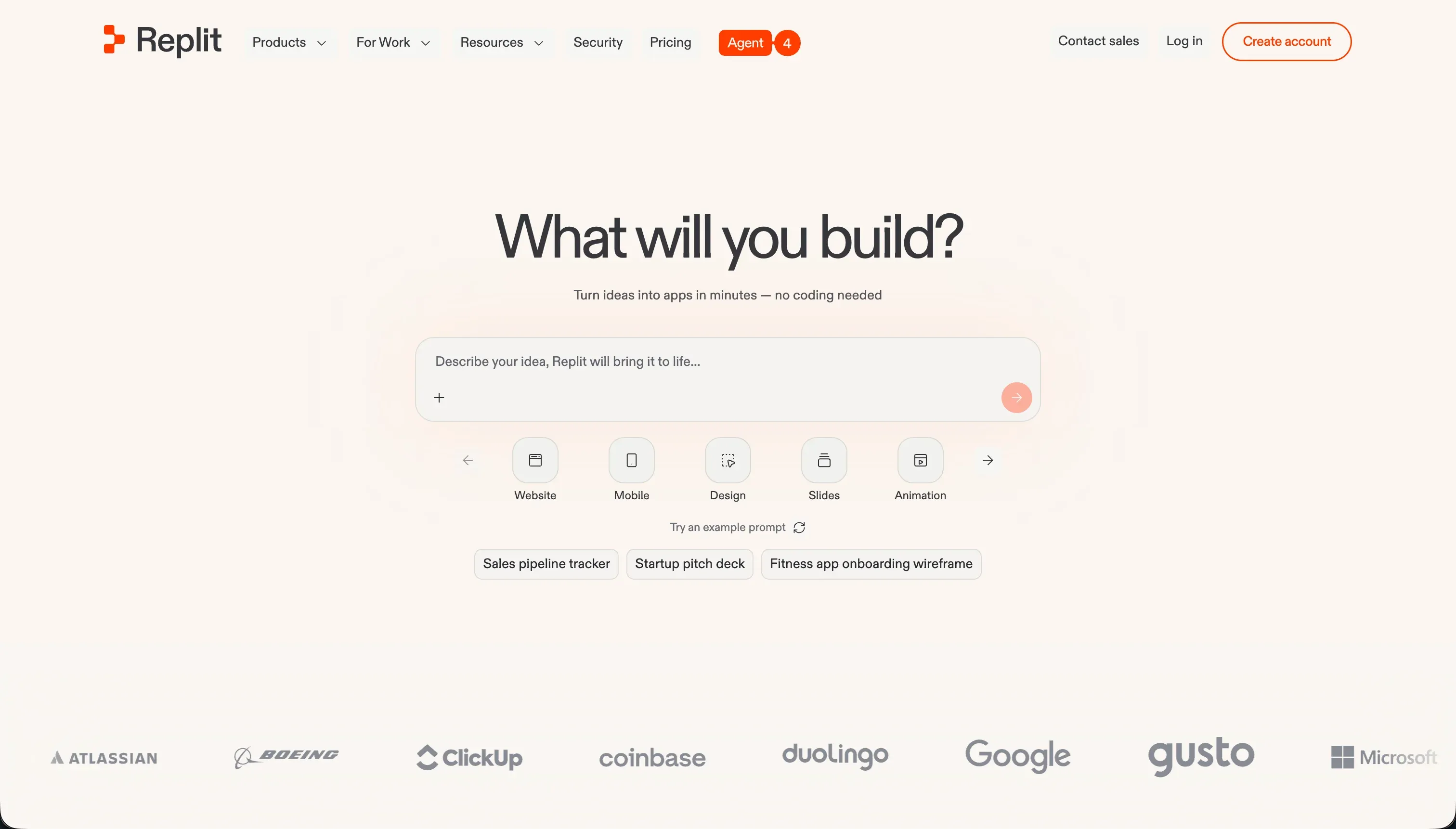
Replit pairs AI app generation with a complete cloud IDE, hosting, and a built-in database, so you go from a prompt to a running app without leaving the browser - and you keep real, editable code the whole way. Compared to Anything’s closed canvas, Replit gives you a terminal, package management, version control, and a deployment target, which means when the AI gets something wrong you can drop into the code and fix it directly instead of re-prompting and spending credits. It has a long operating track record, which matters after watching a rebrand break live projects elsewhere. The trade-off: Replit expects more comfort with code than Anything’s canvas does, so it rewards builders who want hands-on control.
Lovable
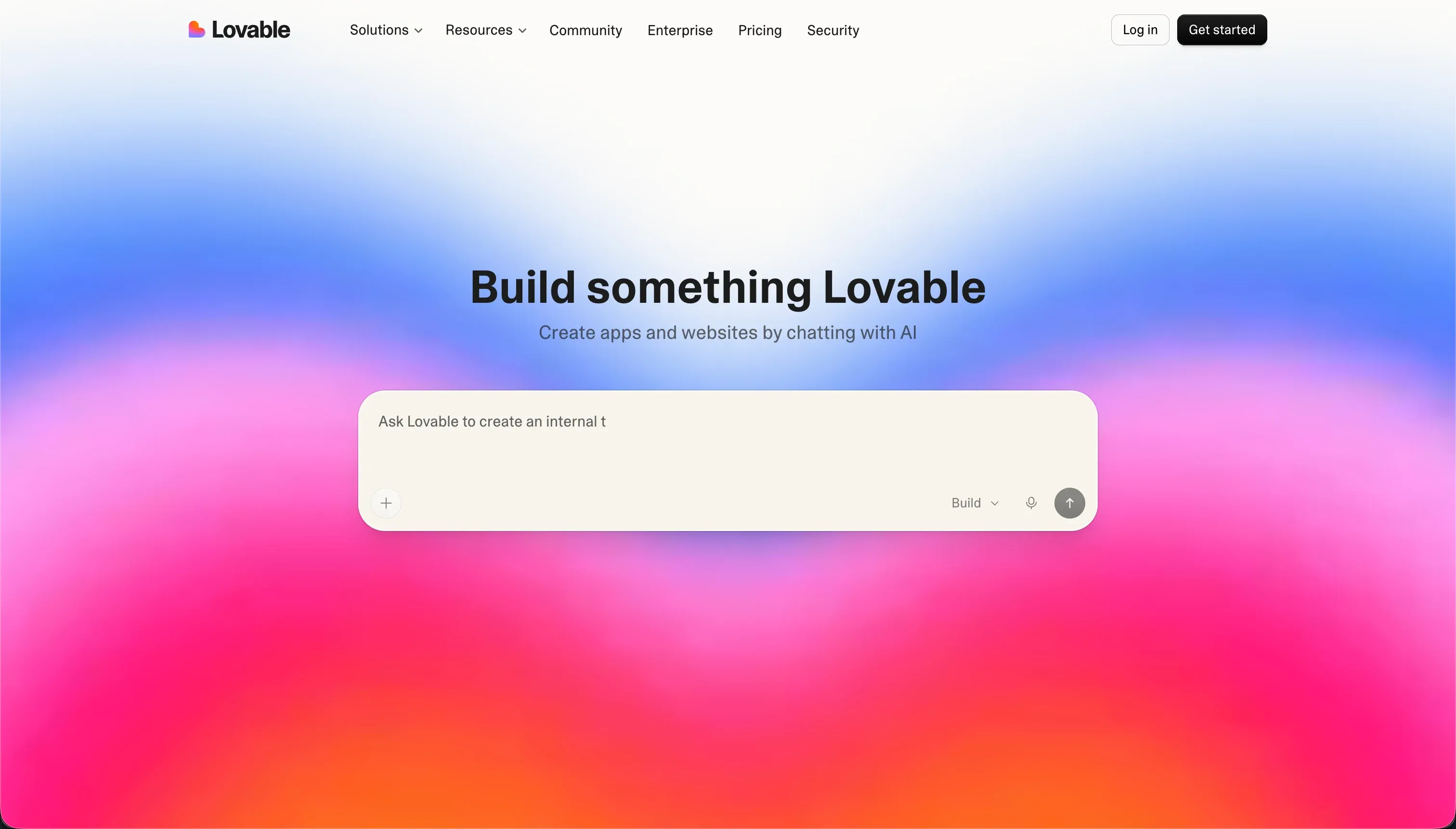
Lovable generates a full React frontend, backend, and Supabase database from a natural language prompt, and the output is real TypeScript that syncs to GitHub and can be continued in VS Code or Cursor. For web MVPs that are heading toward production, Lovable’s output is cleaner and more standard than a canvas-bound app, and the GitHub sync makes the exit path obvious. The honest caveats: Lovable runs on its own credit system that burns fast during debug loops (some users report 3 to 4 credits per prompt), and AI-generated Supabase Row Level Security is not always correct, so plan a developer review before going live with sensitive data. Pricing starts at EUR 25/month for 100 credits.
If you’re building internal tools your team needs to maintain
This is where Anything’s model strains hardest. Internal tools - trackers, approval workflows, team dashboards, CRMs, inventory systems - need to run reliably, get updated by non-developers, and stay within a predictable budget. Fixing a layout bug by spending credits, or prompting the AI to rewrite access logic, is the wrong shape for an app a whole team depends on.
Softr
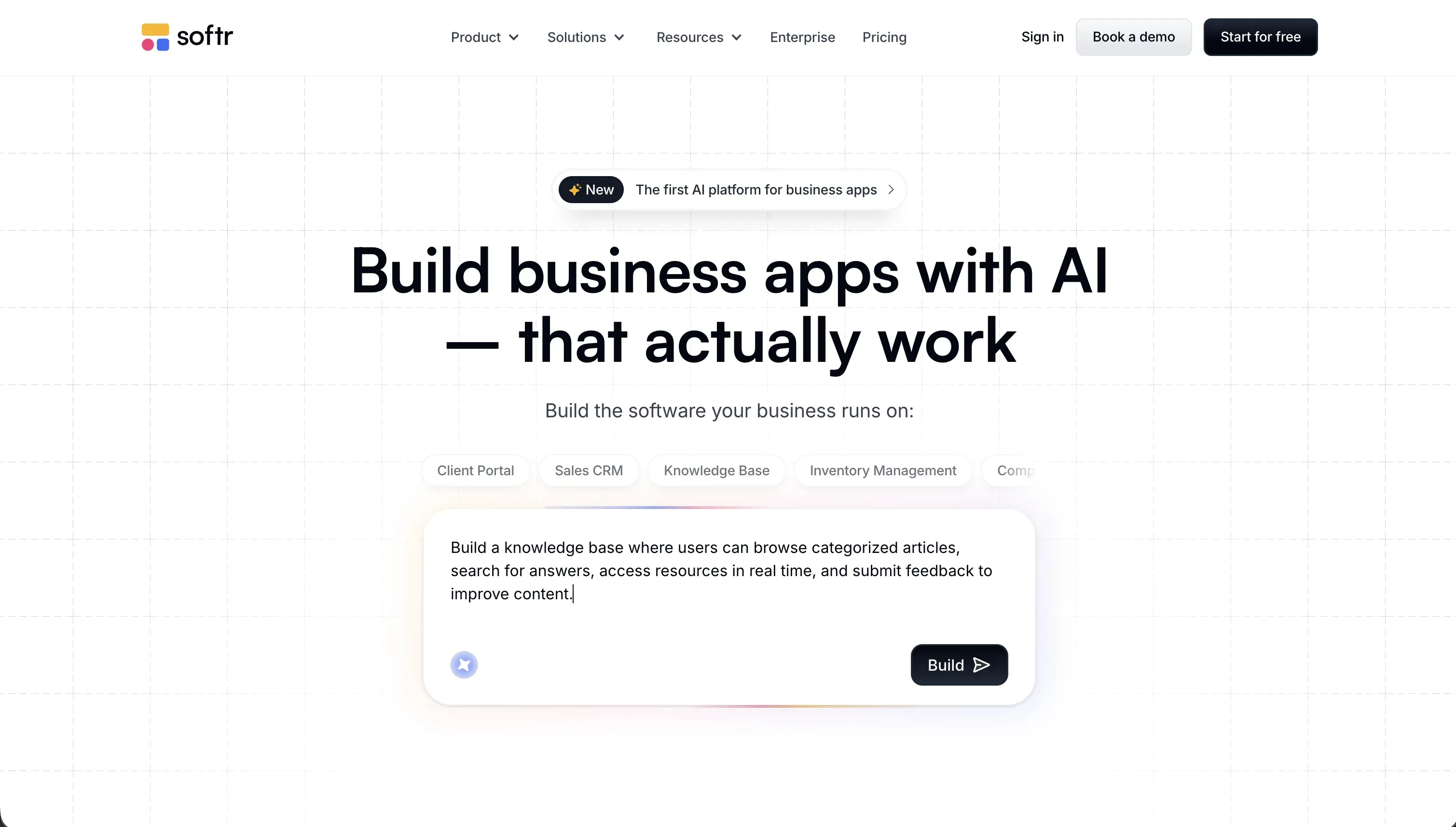
Softr is built specifically for internal business tools. Its AI Co-Builder generates a complete app from a plain-language description - database schema and relationships, pages, UI blocks, user roles, navigation, and permissions - in minutes. The difference that matters here is the hybrid model: the AI is one way to build, not the only way. Every layout, field, block, or permission the AI can configure, you can also adjust directly in the visual editor. So when a layout needs fixing, your operations manager opens the editor and changes it, rather than re-prompting and watching credits drain on a regression. Running low on AI credits never blocks you from maintaining or evolving the app.
The comparison against Anything on the things that matter most for this use case:
Stability: Softr apps run on a stable, hosted platform with native blocks that are tested in production, not generated fresh on each prompt. There is no scenario where editing your live app silently stops working because the platform shifted underneath you.
Data: Apps connect to Softr’s native relational database first - built for business data, with relational links, rollups, and CSV or Airtable import. Softr also connects to 17+ external sources (Postgres, HubSpot, Notion, BigQuery, Airtable, Google Sheets, and more), so you can build on top of systems your company already runs, rather than being confined to one internal database.
Permissions: Softr’s user permissions are visual and centralized. You define user groups and assign page-level, block-level, and row-level access by point and click - no prompting the AI to write access logic that might leak data.
Pricing: Flat-rate per plan. Basic at $19/month (5 team app users plus 5 client app users, 50,000 records), Pro at $99/month (10 team users expandable to 50 plus 50 client users expandable to 250, 500,000 records), Business at $329/month (30 team users expandable to 100 plus 100 client users expandable to 500, 1,000,000 records). Softr does include AI credits for the Co-Builder and AI features, but because every AI action has a manual equivalent, credit limits never block maintenance.
Real-world scale: MIT replaced a $100K custom-coded app with a Softr-built portal serving 2,800+ students, built by one person in a few months. EvenUp built a performance tracker for 340+ employees in 24 hours, saving over $6,000/month. Over 1 million builders use Softr, including teams at Netflix, Google, Stripe, and UPS.
The honest trade-off: Softr apps run on Softr’s hosted platform rather than exporting raw code you self-host. If owning the source to run anywhere is a hard requirement, Replit or Lovable fit better.
Retool

Retool is worth a look for teams that already have a database or API and need a UI layer on top. It connects directly to SQL databases, REST and GraphQL endpoints, and ships 100+ pre-built components (tables, charts, forms) built for data operations. For internal dashboards over existing infrastructure, that is faster than rebuilding the data layer in Anything. The trade-off: Retool is not true no-code - anything beyond a basic layout means writing SQL and JavaScript - and it is seat-based at $10/user/month (Team tier, billed monthly), which adds up for larger teams.
If you want to ship a polished MVP or landing page fast
This is Anything’s home turf, so the bar is high. The alternatives here win when you want output that is cleaner, more portable, or built on a more standard stack than a canvas-bound app.
Lovable
Lovable (covered above) fits squarely here. For a marketing site, a waitlist page, or an early product MVP, describing it in plain language and getting a real React and Supabase app is fast, and the standard stack means a developer can take over later without a rewrite. Watch the credit burn during iteration, and review any AI-generated security rules before launch.
Bolt
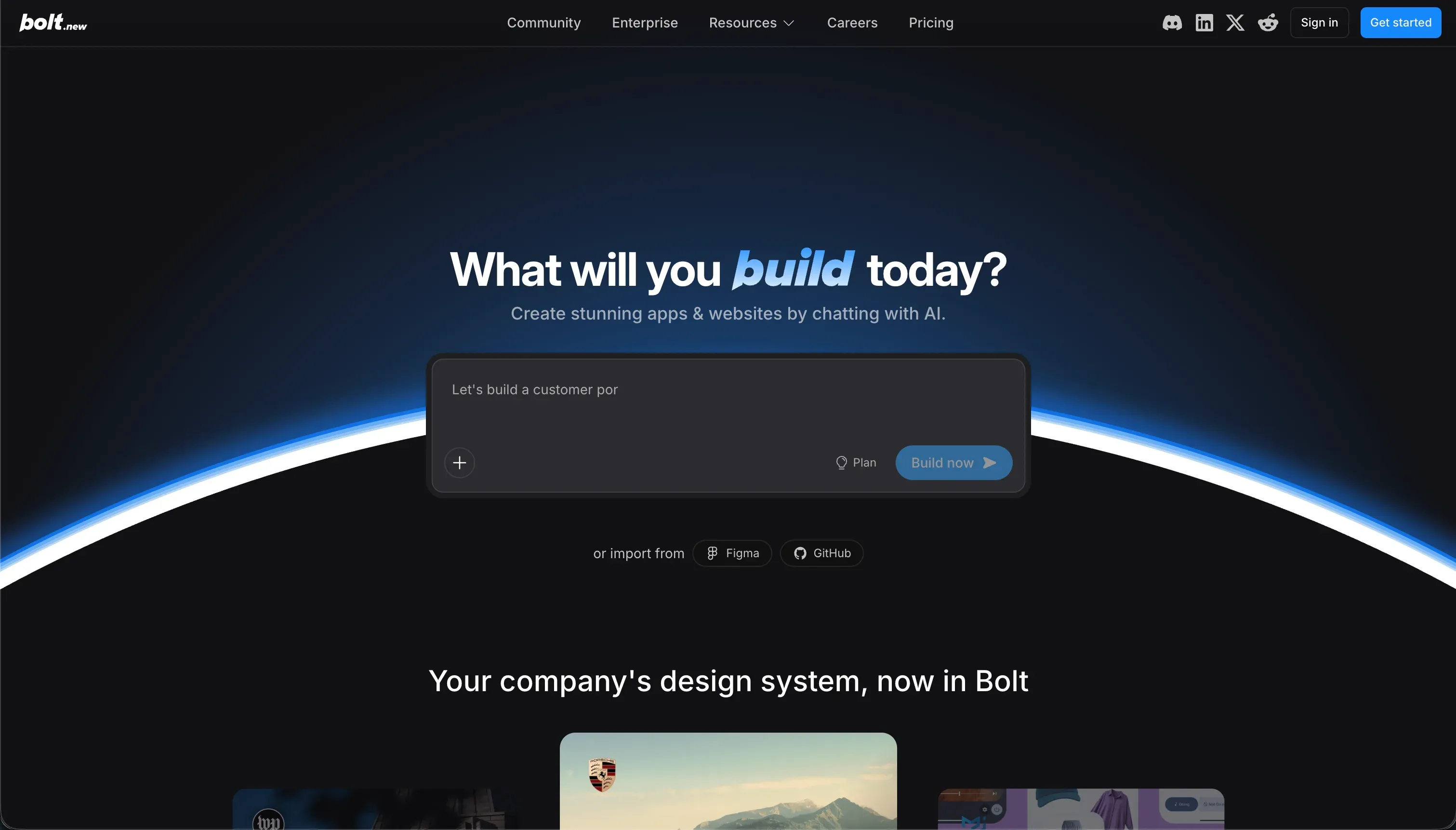
Bolt takes the AI generation approach but runs a full Node.js development environment in-browser via StackBlitz WebContainers. You get AI scaffolding plus a real IDE: install npm packages, run terminal commands, edit code, and see a live preview. For builders who want Anything’s speed but more hands-on control over the stack, Bolt’s environment is far more flexible. Pricing: Pro at $25/month for 10M tokens, which buys more iteration volume than a tight credit pool. The same caveat applies: it is a code-generating tool, so you own the maintenance.
If you need client portals or external-facing apps where users log in and see their own data
Anything can build authenticated apps, but enforcing that each external user sees only their own data leans on prompting the AI to write access logic. A subtly wrong rule does not throw an error - it silently returns data it should not, which you usually discover after launch. For external-facing apps, that is the risk you most want to remove.
Softr
Softr handles external-facing apps with a permissions model designed to be correct by default and auditable without developer expertise. You define user groups - clients, partners, members, admins - and assign what each group can access: which pages are visible, which records are returned, which blocks and buttons appear. Row-level filtering is visual: “this group sees only records where the Client field matches the logged-in user” is a point-and-click setting, not code you prompt the AI to write. White-label support means the portal carries your branding, and native auth pages (login, signup, password reset, SSO) are included. Pricing scales to external users without per-seat charges - 30 Team users (expandable to 100) and 100 Client users (expandable to 500) on the Business plan at $329/month. This covers client portals, partner dashboards, member directories, and vendor portals out of the box.
If you need rapid UI prototyping from a prompt or a screenshot
Sometimes the goal is not a full app - it is a clean front end, fast, that you will wire into your own backend. Anything’s canvas can do this, but the output is tied to its platform. A dedicated UI generator gives you portable code.
v0
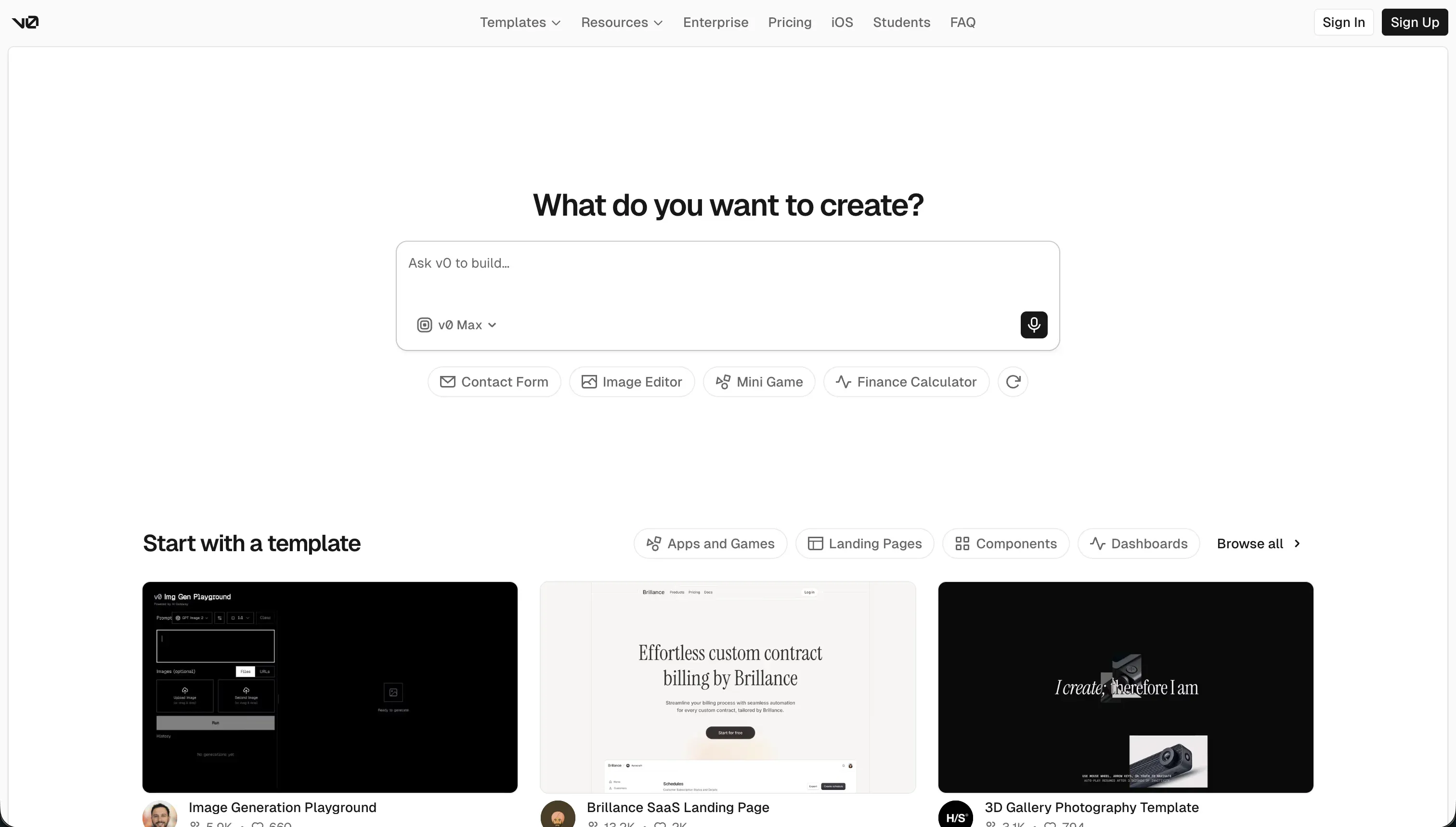
v0 (by Vercel) is the strongest option for generating React and Tailwind UI from a prompt or an uploaded screenshot. It produces clean, idiomatic components you can copy straight into a Next.js project, which is ideal when you have a backend already and just need a polished interface quickly. Compared to Anything, v0 is narrower - it is a UI tool, not a full app builder with a database and auth - but for the specific job of turning a design idea into production-ready front-end code, it is hard to beat. It is the better pick when you want the markup to live in your repo, not on someone else’s canvas.
Bolt
Bolt (covered above) also fits here for prototyping when you need a working app behind the UI, not just components. Its in-browser IDE lets you scaffold a front end and immediately run it against a real backend, which is more than v0’s component-focused output but heavier than Anything’s canvas.

Bottom line
Anything is a reasonable starting point for a quick MVP or landing page, and code export is a genuine plus. But the rebrand that locked paid users out of live projects, the credit burn during layout fixes, and the thin permissions model make it a risky base for anything you expect to maintain or grow. For internal tools and team apps that non-developers maintain without spending credits on regressions: Softr. For client portals and external-facing apps with real per-user data access: Softr. For AI-generated apps where you want to own the code: Replit or Lovable. For clean, portable UI from a prompt: v0.
→ Compare Vibecode vs Anything for a head-to-head on two AI builders. → Browse all reviewed tools for the full comparison across AI app builders.