What is Bubble?
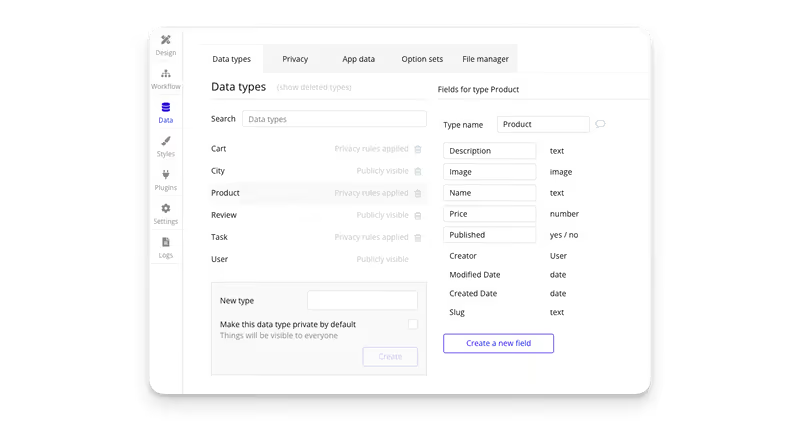
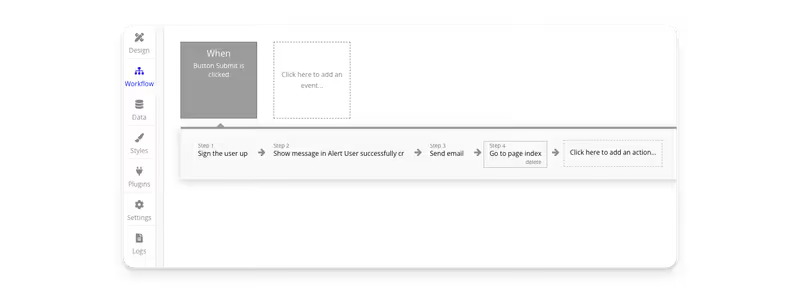
Bubble is a visual programming platform that allows builders to build, host, and scale full-stack web applications without writing code. Founded in 2012, it is one of the most mature platforms in the no-code ecosystem, featuring a drag-and-drop user interface designer, a visual workflow logic engine, and a managed relational database layer.
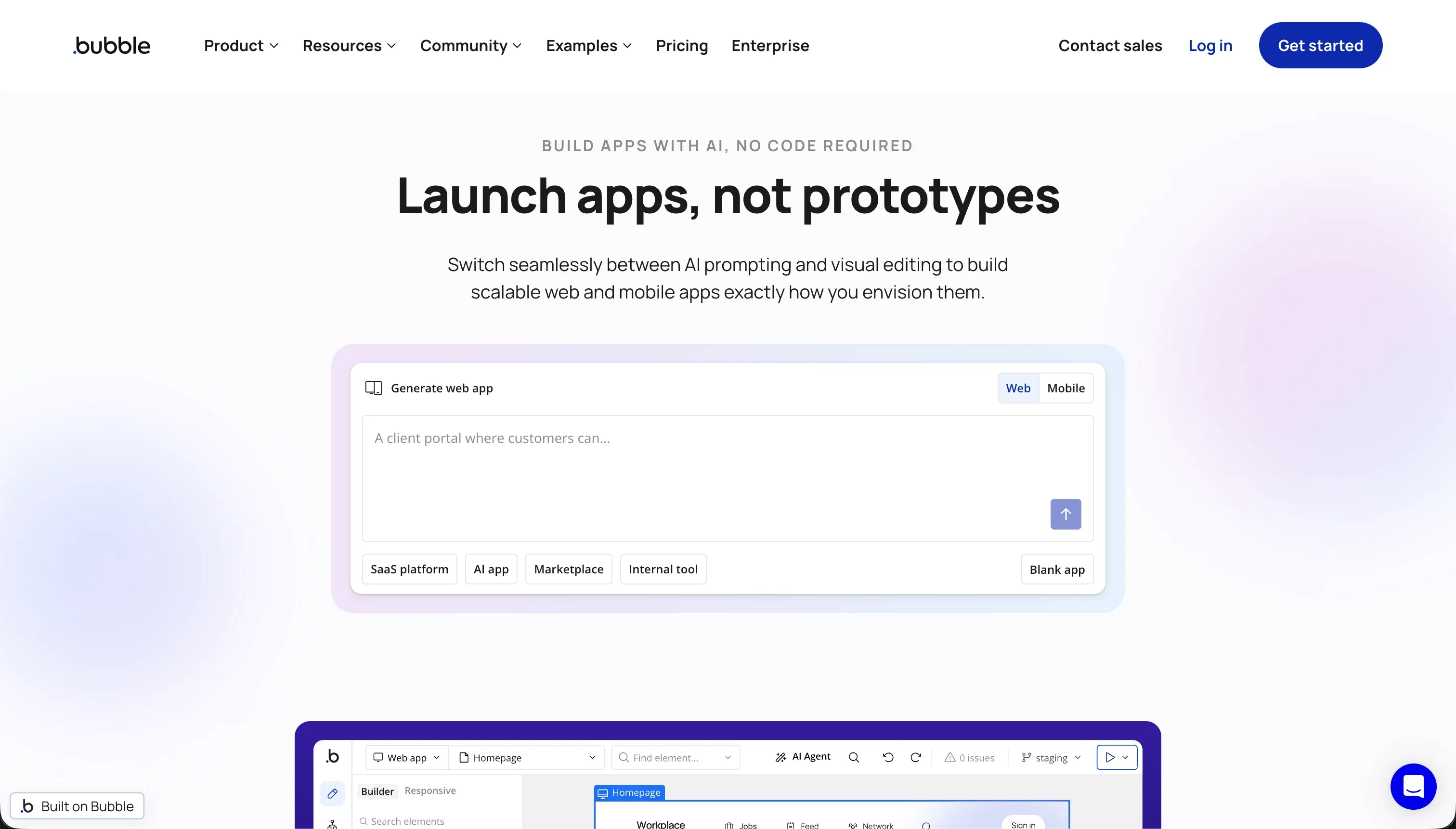 Bubble product snapshot
Unlike modern AI code generators that export clean code scripts, Bubble operates as a proprietary, closed system. You build your application directly within Bubble’s browser-based canvas, and Bubble hosts the final system on its own servers.

What types of applications can you build with Bubble?
Bubble is designed for complex, logic-heavy web applications. It is capable of building:
- Two-Sided Marketplaces: Build directories with complex booking flows, reviews, and messaging.
- SaaS Platforms: Create multi-tenant web systems with customizable dashboards and payment flows.
- Custom Social Networks: Build user feeds, groups, notifications, and real-time messaging.
However, because Bubble operates on its own server infrastructure and charges for compute operations, building business-oriented platforms (like internal operations databases, client-facing document hubs, or team portals) can quickly become expensive and complex to secure.
Where Bubble genuinely shines
For apps that require highly complex workflows-such as multi-step conditionals, scheduled backend triggers, and database-level calculations-Bubble is the most capable visual builder available. Its logic engine lets you configure sophisticated branching paths without writing code.
Its plugin marketplace, boasting over 8,000 integrations, makes adding Stripe checkouts, SendGrid mailers, maps, and analytics packages simple. Bubble’s database privacy rules also allow builders to configure secure row-level access control, ensuring that user roles are validated server-side.

The engineering overhead & setup complexity
Although Bubble is a “no-code” tool, building a production-ready application requires a developer’s mindset:
- The Mastering Cliff: Designing database tables, structuring one-to-many relationships, configuring API keys, and writing logic conditionals is essentially software engineering. Non-technical founders frequently spend months in video tutorials before they can build an app that runs efficiently.
- The Editor Performance Wall: Because the visual canvas is highly complex, running the Bubble editor on large applications is notorious for causing browser tab lag. Memory usage frequently exceeds 3-5 GB of RAM, causing lag and requiring frequent page refreshes on complex configurations.
- Maturing Mobile Capabilities: While native mobile application packaging is in public beta, it remains a maturing feature. Designing a performant, native-feeling iOS or Android app inside Bubble’s visual web editor is highly challenging compared to dedicated mobile builders.
The pricing gotchas & token/credit model
Bubble’s pricing structure has faced major pushback from the developer community since transitioning to a usage metric called Workload Units (WUs):
- The Workload Unit (WU) Metric: Rather than charging flat rates for page views or users, Bubble charges based on server compute operations (e.g. database searches, API requests, workflow runs).
- Volatile Billing Spikes: It is easy to write an inefficient database search query that runs every time a user loads a page. In production, a few hundred users running inefficient queries can deplete your monthly WU allowance in days, causing bills to spike from $69/month to over $1,500/month.
- Severe Free Tier Caps: The free plan limits projects to a tiny database cap of 200 records (things). If your app exceeds this, Bubble automatically blocks database inputs or shuts down the application layout, replacing your homepage with a subscription warning screen.
Public Sentiment & Community Consensus
Discussions on developer platforms and Reddit subreddits outline consistent risks of building on Bubble:
- Proprietary Vendor Lock-in: The largest risk of Bubble is the absolute lack of code export. If Bubble changes its pricing policies, suffers an outage, or goes out of business, you cannot host your project elsewhere. You must rebuild your entire app logic and visual layout from scratch.
- The “TMS” Scale Wall: Builders note that while Bubble is excellent for launching an initial MVP, attempting to scale complex platforms like Transport Management Systems (TMS) or real-time AI processing applications reveals latency bottlenecks.
- Integration Reliability: Relying on community plugins introduces stability risks. If a plugin developer abandons their integration, a browser update can break critical application workflows without warning.
For operations teams looking to build secure B2B portals, client dashboards, or internal databases, the overhead of Workload Units and visual lock-in is an unnecessary distraction. Softr is a practical alternative here. Its AI Co-Builder generates complete apps - database, pages, permissions, and navigation - from a single prompt, and the result is production-ready software with built-in auth and user groups, not a prototype you’ll need to debug. Softr’s native database handles your data by default, and it also connects to over 17 external sources (Airtable, Google Sheets, HubSpot, and others) if you’re already storing data elsewhere. There’s no proprietary canvas to maintain and no compute-based billing surprises.

Verdict: Who is it actually for?
Best for: Founders and experienced builders who need complex workflow logic, have the time to learn visual programming, and are comfortable with database hosting lock-in in exchange for platform power.
Not for: Teams in a hurry, non-technical operators building standard business systems, or anyone who wants full ownership of their application’s code and architecture.