

Deciding between Base44 and Bubble means choosing between two fundamentally distinct paradigms of web application creation. Base44 is an AI-powered conversational builder that scaffolds an entire full-stack application from a single prompt, while Bubble is a matured visual programming engine built for complex database architecture and precise front-end layout configurations. Both promise to eliminate manual custom coding, but they solve different problems on day two.
Technical teams, solo founders, and product managers are typically the ones weighing this decision when looking to deliver a functional MVP without a six-month development timeline. At stake is not just the upfront learning curve, but the long-term operational costs, proprietary vendor lock-in, and development flexibility. While one tool seeks to automate creation through conversational chat, the other requires you to think exactly like a database administrator and system architect to keep workload costs from breaking your budget.
Meet the Contenders
What is Base44?
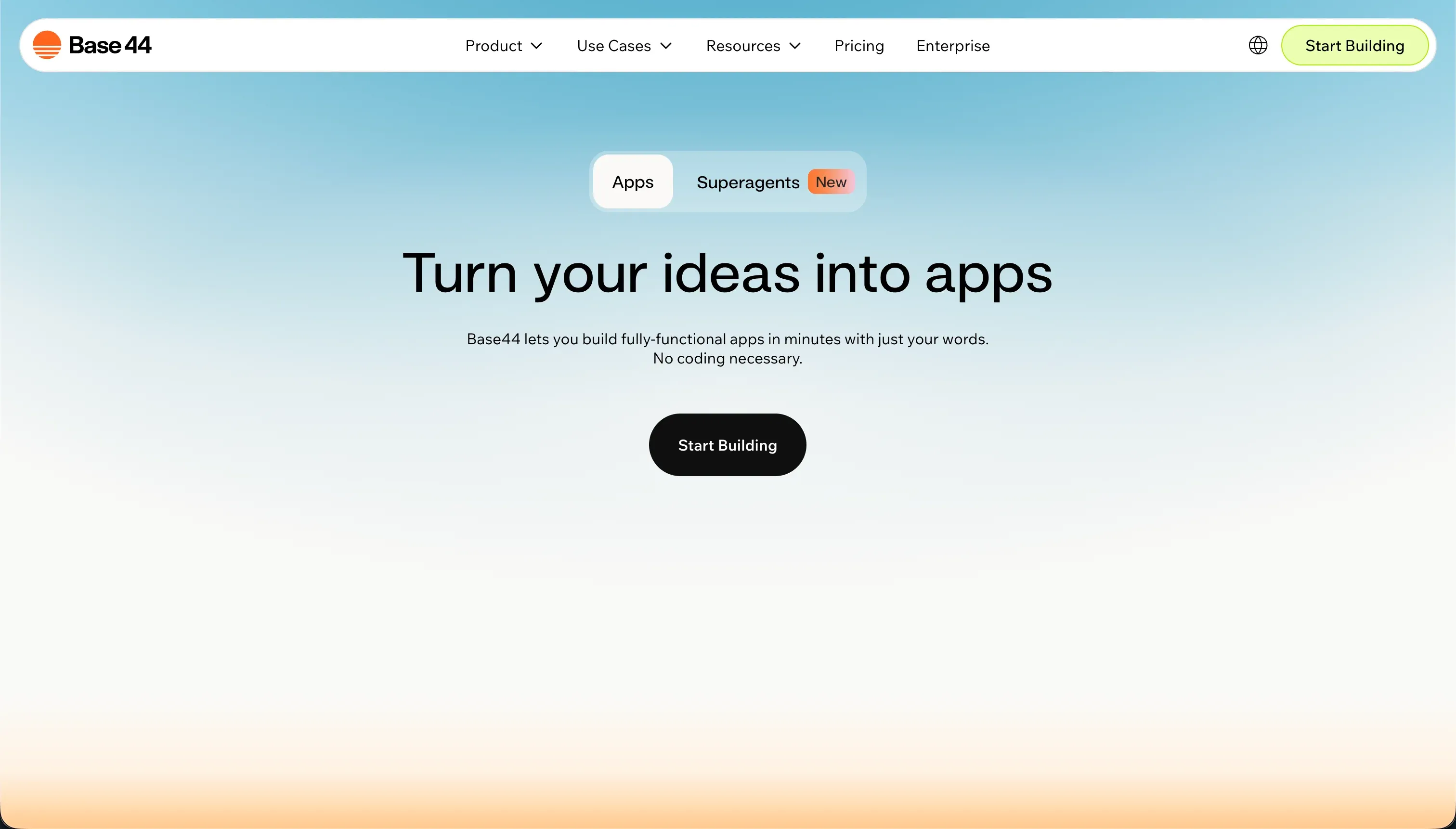
Base44 is an AI-powered all-in-one web builder designed to generate full-stack applications from simple natural language prompts. By combining UI drafting, managed PostgreSQL backend management, and user authentication into a single interface, it aims to eliminate the classic boilerplate configuration steps that traditionally stall early-stage projects.
In practice, the platform operates primarily through a conversational builder chat combined with a click-to-tweak post-generation editor. Builders can leverage Discuss Mode to collaborate with the AI on system layouts before burning message credits, and higher tiers like the Builder plan enable automatic GitHub sync to export the generated frontend react code for downstream customization.
It is built for prototype designers, non-technical founders, and software engineers who want a fast scaffolding tool for simple software. However, the platform frequently frustrates teams on day two, as complex operational tweaks require ongoing prompt loops that can introduce major regression loops, causing apps to break while quickly draining daily credit limits.
| Spec | Details |
|---|---|
| Primary Stack | AI-generated React frontend with managed PostgreSQL database backend |
| Interface | Conversational builder chat paired with click-to-tweak styling tool |
| Primary Deployment Target | Hosted Base44 cloud environment with optional frontend export to GitHub |
| Key Advantage | Instant deployment of complete database, auth, and frontend from one prompt |
What is Bubble?
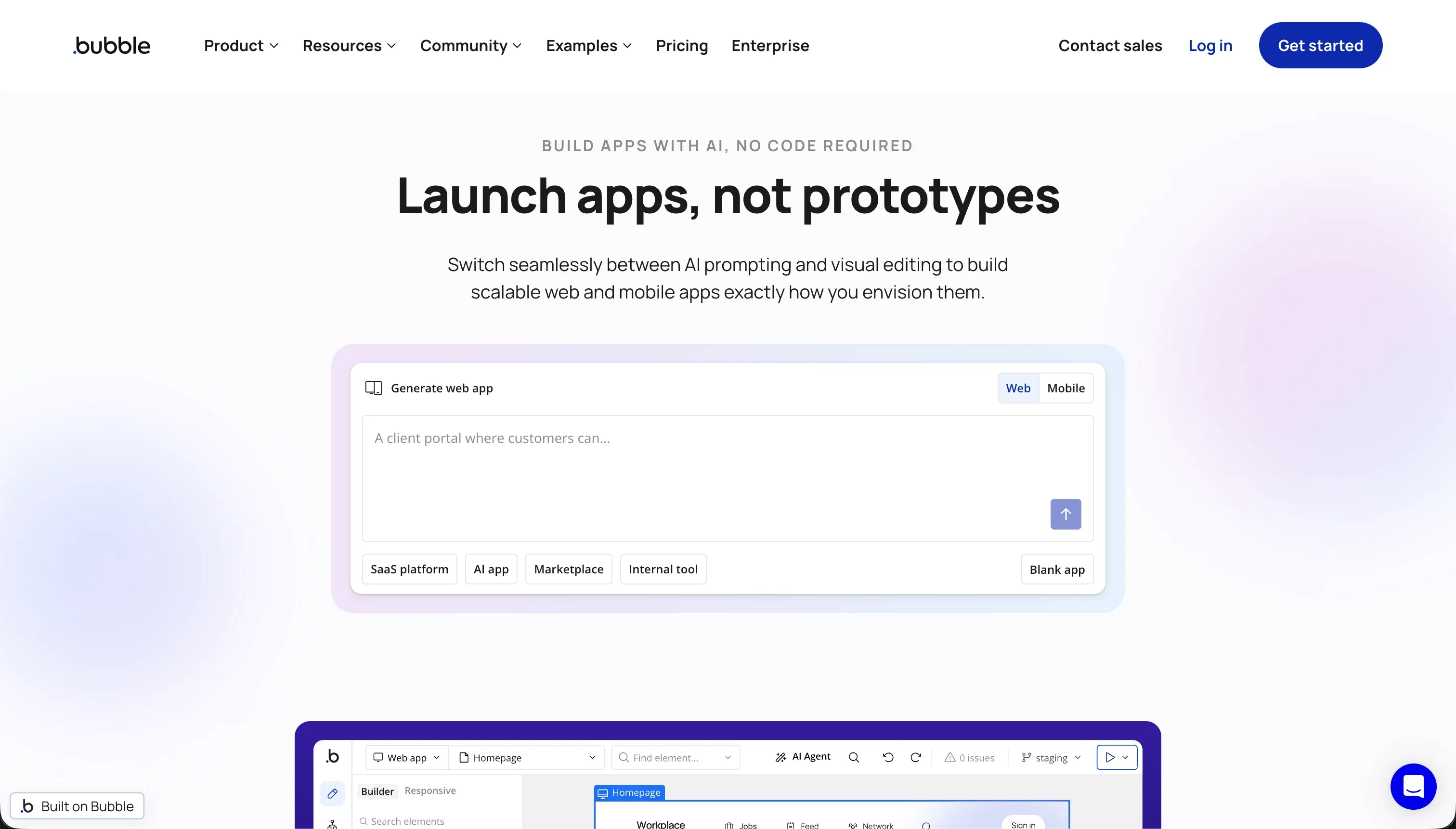
Bubble is a mature visual programming platform designed to construct, host, and scale full-stack web applications without writing code. Launched long before the modern generative AI wave, it provides a comprehensive visual designer, custom database manager, and workflow logic engine that gives creators granular layout and runtime structure controls.
In practice, visual development on Bubble revolves around its pixel-level drag-and-drop page editor, database privacy rules, and visual workflow logic that schedules complex server-side actions. Teams connect external databases and services via a native API Connector, and can choose from over eight thousand community plugins in its marketplace to add features like Stripe payments, analytics, or search optimizations.
Bubble is built for technical founders, systems operators, and product developers who need to implement complex multi-user workflows and relational databases without maintaining a traditional developer stack. However, it can significantly frustrate creators who are unprepared for its steep learning curve, painful visual editor performance issues, complete database export lock-in, and unpredictable Workload Unit pricing models that can spike bills dramatically.
| Spec | Details |
|---|---|
| Primary Stack | Proprietary full-stack visual programming engine with relational database |
| Interface | Pixel-level drag-and-drop canvas with visual conditional workflow builder |
| Primary Deployment Target | Bubble-hosted shared or dedicated cloud infrastructure |
| Key Advantage | Complete visual programming control over complex data logic and integrations |
The Core Difference
The fundamental divide between these platforms lies in how they trade visual manual logic against conversational AI speed.
- Base44 relies on conversational full-stack AI generation to deploy rapid, boilerplate MVPs that are limited by prompt stability and regression risks.
- Bubble relies on structured, visual drag-and-drop controls that require manual logic configuration but offer unparalleled scaling control over data logic.
Head-to-Head Comparison
We evaluated both platforms across four core categories.
1. Developer Experience & Iteration Speed
Base44 is exceptionally fast for generating an app from a baseline idea. Starting with a natural language description, you can get a functional layout with working user sign-ups and basic interactive cards in minutes. The built-in Discuss Mode allows you to review architectural choices with the AI before consuming any of your monthly message credits, making the early prototyping phase feel highly collaborative.
However, iteration speed drops off significantly when you need to make precise adjustments. Because you are reliant on prompt-driven edits, you are exposed to what community reviews call regression loop penalties. If you try to fix a layout bug on page three, the AI agent often introduces ten new bugs on the landing page, forcing you into a frustrating cycle that drains your daily credit limits.
Bubble offers a highly manual but exceptionally reliable builder interface. Its pixel-level drag-and-drop visual canvas gives you complete command over layouts, alignment, and responsiveness without letting AI hallucinate your visual styles. You define conditional formatting, multi-step backend scheduler loops, and dynamic state variables by clicking through structured logic blocks.
The major drawback is that the visual editor is known for major memory leaks and performance degradation. As documented on developer forums, even on high-spec machines with thirty-two gigabytes of RAM, the editor tabs regularly bloat to swallow five gigabytes of memory, forcing builders to reload pages constantly. There is zero conversational shortcut; every button state must be declared and configured by hand.
Edge: Bubble, because visual logic controls prevent the destructive regression loops inherent to prompt-driven edits.
2. Code Quality & Portability
Base44 provides partial frontend portability that outperforms typical visual visual programming environments. On the Builder plan, which starts at fifty dollars monthly, builders can configure a direct GitHub repository sync that automatically commits clean frontend React code. This provides a genuine exit pathway for visual UI assets if you ever decide to hand development over to a professional programming team.
The catch is that this portability is severely constrained at the database and backend layer. The PostgreSQL schemas, user access authentication, and custom backend functions stay hosted inside Base44’s proprietary wrapper. You can pull the frontend code, but you will still have to completely re-engineer the visual logic and backend infrastructure if you decide to fully migrate off the platform.
Bubble represents the extreme end of proprietary lock-in. Applications constructed on its engine are bound directly to its custom visual compiler, visual programming runtime, and hosted infrastructure. There is absolutely no code export or GitHub sync option; if you decide to leave Bubble, you must completely rewrite your entire application, visual layout, and backend workflows from scratch.
The only portability option you have is exporting your database datasets as CSV files. While this ensures you can recover user data, it does visual creators little good when attempting to preserve visual elements or complex API connector behaviors. You are completely committed to the Bubble platform ecosystem for the lifetime of your product.
Edge: Base44, which at least delivers partial frontend React code export and GitHub output compared to Bubble’s total proprietary lock-in.
3. Database & Backend Capabilities
Base44 automates database deployment by spinning up a managed PostgreSQL database immediately behind your application. For early-stage creators, this removes a huge administrative hurdle, enabling clean relational mapping and table creation without manual SQL configuration. The database handles user lists, records, and files automatically using default system tables.
The limitation is that the backend and security architecture are highly opaque and restricted. True role-based access control can be difficult to set up, and developers on Reddit note that Base44 lacks native SaaS multi-user patterns. If you need clean workspace-level data isolation, secure row-level visual permissions, or granular hide-and-show rules for individual UI components, the prompt-driven architecture often fails to implement them correctly or securely.
Bubble is one of the most powerful relational backend engines in the no-code ecosystem. It features structured visual tables, custom data types, relational linking, and a dedicated database administration dashboard. Crucially, its server-side privacy rules allow you to enforce granular database policies, defining precisely which user roles can search, view, create, or update specific record fields.
The critical challenge is scalability efficiency under the Workload Unit billing model. Because Bubble charges for the exact compute resource spent on searches and server runs, inefficient database queries or unoptimized loops can quickly consume your monthly allocation of visual units. Running bulk data scripts or heavy read-write operations will cause loading lag and can trigger massive, unexpected bill surprises.
Edge: Bubble, because its visual privacy rules and mature database layout engine provide enterprise-grade relational structure that Base44’s prompt builder cannot guarantee.
4. AI Quality & Reliability
Base44 leverages conversational LLMs to function as an autonomous full-stack software draft developer. From a single conceptual prompt, the AI produces backend tables, custom visual mockups, and deployment pipelines in one coordinated pass. Click-to-tweak options also allow you to prompt adjustments in real time as you preview the live app.
However, this reliance on AI exposes you to major technical fragility. As verified by technical evaluations on Reddit, the system uses LiteLLM to handle API models, which inherits significant loading latency and API throughput boundaries. If the AI encounters a minor dependency mismatch or packages update glitch, it can easily spin into loops, consuming your valuable message credits on failed code repairs.
Bubble has slowly integrated AI co-pilots, but it is fundamentally a visual manual programming tool. Its AI capabilities focus on help-docs search, visual design tips, and quick setup suggestions rather than automated code generation. If you want code built, you do not write prompts; you construct visual actions and configure workflows yourself.
This lack of automated coding makes Bubble’s outputs far more stable. Because an AI is not generating your database structures or writing custom backend code, your application will not break randomly or suffer from context window drift on day two. Your layouts and configurations remain exactly where you placed them, ensuring that you only deploy logic that you visually understand.
Edge: Bubble, because manual visual configurations completely eliminate AI hallucinations and dependency failures in production.
5. Learning Curve & Onboarding
Base44 has a remarkably low barrier to entry on day one. Beginners do not need to configure servers, set up databases, or learn visual layouts before building. By simply typing an app idea in conversational English, users can see a formatted web application on their screen in minutes, bypassing the visual builder paralysis of legacy tools.
But the learning curve spikes sharply once you try to solve bugs or add complex logic. Since you are not interacting with visual code directly, you must master the art of prompting a system to fix its own errors. The user experience can quickly become a guessing game, forcing beginners to browse online developer threads to find out why a specific backend function failed to update.
Bubble has one of the steepest learning curves in the entire no-code industry. Even though you are not writing syntax, mastering database normalizations, security privacy rules, nested states, responsive layout engines, and the API Connector takes weeks of dedicated study. It requires developers to think exactly like a traditional software programmer to build a successful app.
This investment yields high returns for professional builders. Once you grasp the conceptual architecture of visual relational systems, you can build very complex systems. Bubble provides an extensive template store, thousands of visual plugins, and robust community forums, but beginners should expect to invest dozens of hours before shipping their first production system.
Edge: Base44 for initial speed, but Bubble represents a more scalable learning path for professional creators who want deep visual control.

Pricing Comparison
Base44:
- Free: $0 per month with 25 message credits (max 5 per day) and 100 integration credits to test basic database and authentication configurations.
- Starter: $20 per month monthly ($16 per month billed annually) with 100 message credits and 2,000 integration credits plus in-app code editing capabilities.
- Builder: $50 per month monthly ($40 per month billed annually) with 250 message credits, 10,000 integration credits, backend function configurations, custom domains, and GitHub synchronization.
- Pro: $100 per month monthly ($80 per month billed annually) with 500 message credits, 20,000 integration credits, and access to premium AI models.
- Elite: $200 per month monthly ($160 per month billed annually) with 1,200 message credits and 50,000 integration credits for high-volume execution scenarios.
Bubble:
- Free: $0 per month with 50,000 Workload Units, basic visual development features, and a limit of 200 database items.
- Starter: $69 per month monthly with 175,000 Workload Units, custom domain capabilities, and foundational hosting tools.
- Growth: $249 per month monthly or equivalent billed annually with 250,000 Workload Units, multi-user development access, and backend API connector controls.
- Team: $649 per month monthly with 500,000 Workload Units, premium testing branches, and dedicated cloud hosting options.
Use Case Fit: When to use which?
When to choose Base44
- Choose Base44 when you need to quickly scaffold an early-stage prototype, SaaS landing project, or visual template demo from a plain text prompt.
- Choose Base44 when frontend portability is highly valuable and you want to push clean React source code directly to a GitHub repository on day one.
- Choose Base44 when you have simple relational database needs that do not require multi-tenant security layers or granular visual privacy settings.
When to choose Bubble
- Choose Bubble when you are building a highly customized, data-intensive web platform with complex multi-user workflows and nested conditional logic.
- Choose Bubble when secure, server-side data control and granular database privacy rules are required for managing sensitive record fields.
- Choose Bubble when you want access to a massive community ecosystem containing thousands of ready-made visual plugins and expert developers.
When neither Base44 nor Bubble is the right fit
For secure client portals and internal team software
Both Base44 and Bubble present significant operational bottlenecks when your goal is to deploy secure internal software like CRMs, client portals, or partner directories. Base44 forces non-technical operators to struggle with opaque prompt loops that introduce unstable design regressions and high database security risks. On the other side, Bubble introduces a steep learning curve alongside an unpredictable Workload Unit utility model, which can cause operating expenses to spike dramatically as your employees run normal database queries.
For these operational use cases, Softr represents the standard professional alternative. Softr couples visual drag-and-drop editor speed with robust visual permissions, ensuring different teams see personalized records, pages, and interactive buttons based on their user groups. By starting from Softr Databases first and avoiding generated code entirely, teams avoid both the technical debt of AI scaffolding and the complex maintenance overhead of Bubble, producing secure business systems with flat, transparent pricing.
For native mobile app store distribution
If your product strategy relies on deploying native mobile binaries directly to the Apple App Store or Google Play Store, neither of these platforms is optimized for the job. Base44 only outputs hosted responsive web applications, offering no wrapper scripts or device API accesses required for real mobile publishing. While Bubble contains a maturing option for wrapping configurations, its native engine remains in public beta and lacks the high-performance execution of core smartphone frameworks, requiring complex third-party visual plugin solutions.
A far better alternative for mobile design is FlutterFlow. Built directly on Dart and Flutter, it allows creators to assemble clean visual layouts that map directly to native device APIs, while providing complete source-code export. For simpler layouts or data-driven mobile lists, tools like Glide or Adalo provide rapid onboarding routes to build responsive PWAs and apps without getting bogged down in complex database normalizations or prompt regressions.

Verdict
Choosing Base44 is a bet on conversational AI speed. You accept the reality of partial frontend code portability and rapid first-day scaffolding, but you must tolerate high server instability, regression loops that can render your website unusable, and a dual-credit billing structure that penalizes bug editing. It represents an interesting playground for builders running low-stakes prototypes but remains difficult to run safely as a long-term commercial environment.
Choosing Bubble is a commitment to visual manual programming. You accept a steep, program-like learning curve, RAM leaks in the visual builder, and absolute vendor lock-in with zero code export. In return, you gain unrivaled visual logic control, mature database privacy policies, and a proven ability to scale highly customized web applications if you optimize your queries to avoid sudden Workload Unit pricing spikes.
For operational business software, portals, and team workspaces, the day-two reality is that neither tool manages your maintenance burden efficiently. If your team does not need complex visual visual programs or custom-coded React files, choosing Softr allows you to bypass both visual layout debt and steep visual developer learning curves. Softr handles security, auth, hosting, and relational structures natively on your own Softr Databases, letting your business focus on workflows instead of debugging code or optimizing server units.

Summary Comparison Table
| Criterion | Base44 | Bubble |
|---|---|---|
| Build Paradigm | Conversational prompt scaffolding | Visual programming canvas |
| Database Type | Managed PostgreSQL | Proprietary SQL database layer |
| Code Export | Frontend React React files via GitHub | Strict lock-in, no export |
| Pricing Metric | Message and Integration credits | Workload Units (WUs) usage |
| Permissions | Basic prompt-defined user roles | Granular visual privacy rules |
| Best for | Rapid MVPs and visual scaffolding | Highly customized complex platforms |