

Base44 and Softgen sit in the same broad category: conversational AI app builders that try to turn prompts into working web apps. But they are not interchangeable. Base44 pushes harder on the all-in-one full-stack angle, while Softgen is closer to a lighter AI scaffolding tool for MVPs, SaaS layouts, and quick experiments.
The people seriously comparing these two are usually founders, indie hackers, and small teams trying to ship something without hiring a full dev team on day one. The real stakes are not just first-week speed, but what happens after the first demo: how much editing still requires chat, how predictable the credits are, and how trapped you are if the app starts to matter. If you pick badly, you do not just lose money. You lose weeks in prompt loops and end up rebuilding elsewhere.
Meet the Contenders
What is Base44?
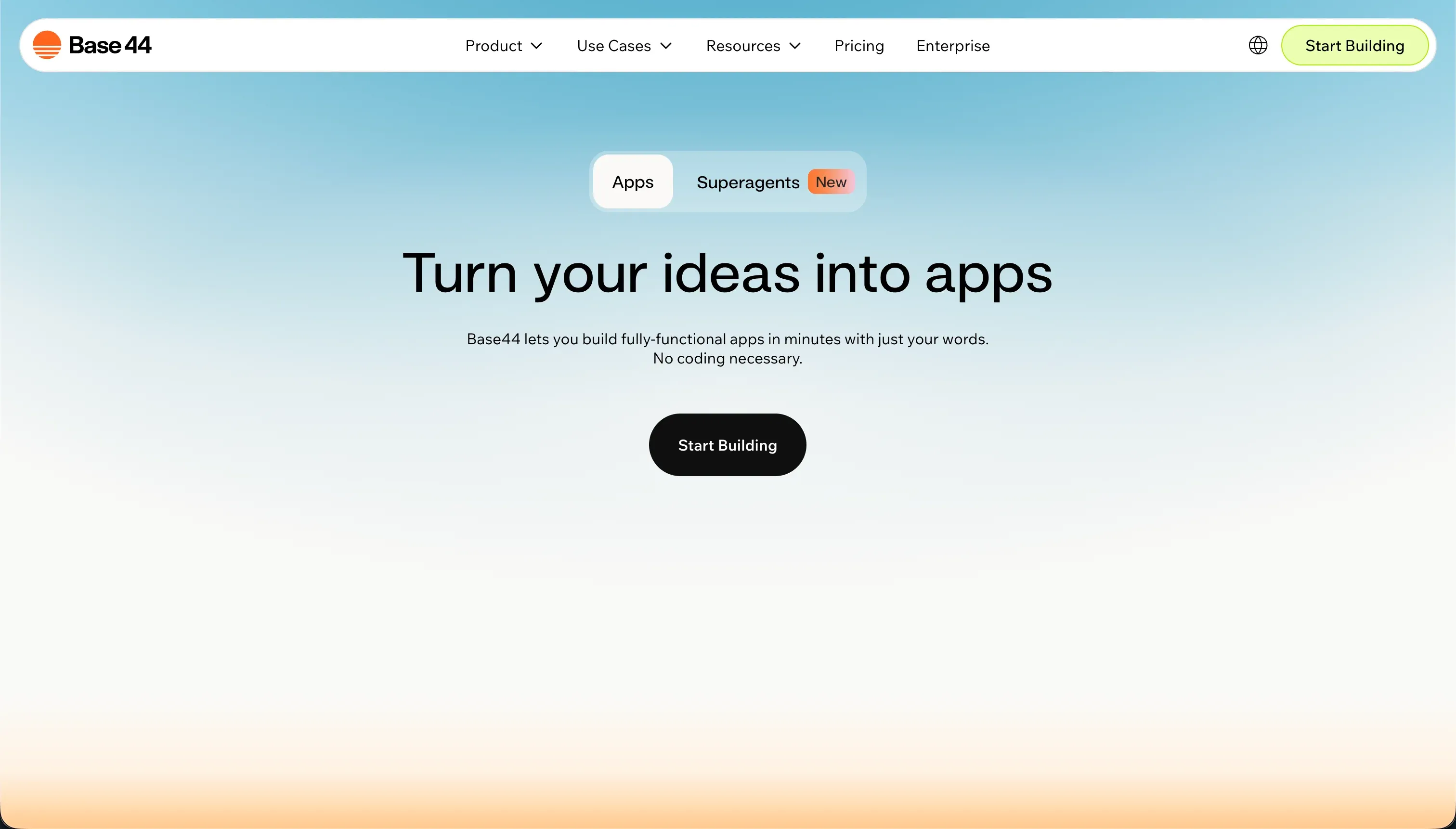
Base44 is an AI-powered all-in-one builder that generates full-stack web apps from conversational prompts. It bundles the interface, managed database, authentication, hosting, and deployment into one environment, which is exactly why it gets attention from non-technical founders who want to skip setup.
In practice, Base44 works through a chat-based builder plus a visual post-generation editor. It can generate a PostgreSQL-backed app, includes built-in auth, offers Discuss Mode for planning without burning message credits, and on paid plans adds features like GitHub sync, backend functions, custom domains, and AI model selection. Its strongest pitch is that you can go from blank page to live URL without configuring infrastructure first.
It is genuinely built for people who value instant scaffolding over long-term control. The frustrated user is the one who needs predictable production behavior, granular security logic, or reliable day-two editing, because Base44’s documented issues include regression loops, weekly instability complaints, and a dual-credit model that can make debugging feel like paying to be punished.
| Spec | Details |
|---|---|
| Primary Stack | Managed PostgreSQL, AI-generated full-stack web app environment |
| Interface | Conversational builder chat plus visual post-generation editor |
| Primary Deployment Target | Base44 cloud hosting with live previews and optional GitHub sync |
| Key Advantage | Fast full-stack scaffolding with database, auth, and hosting included |
What is Softgen?
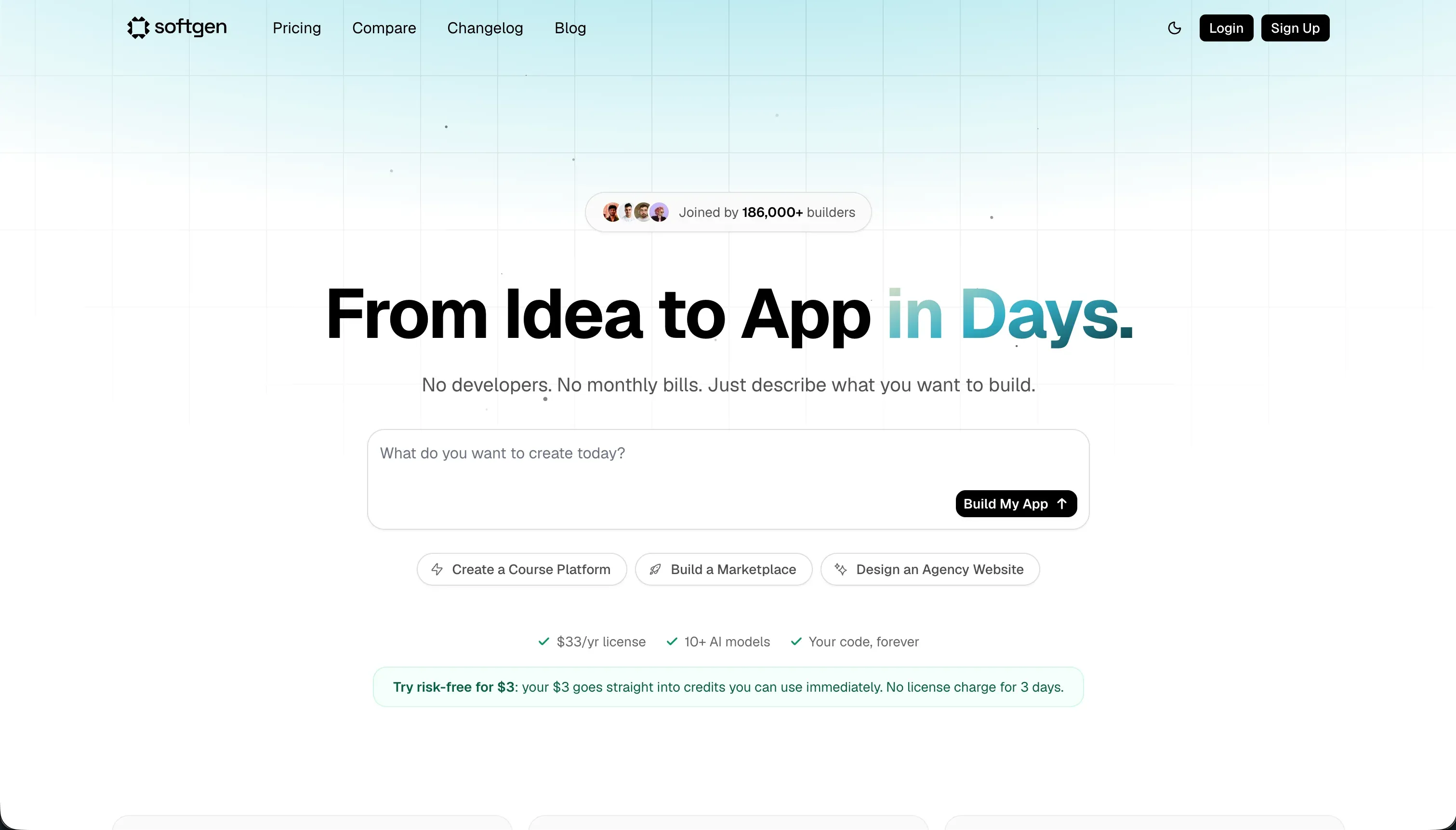
Softgen is a conversational AI application builder focused on generating web apps through chat. It is aimed squarely at creators and indie hackers who want to spin up MVPs, directories, or SaaS-style layouts without paying for a heavy monthly platform plan.
In practice, Softgen revolves around its Cascade AI Agent, which helps outline the app, shape the schema, and generate the UI in plain language. It supports full-stack generation with relational database schemas, authentication, integrations such as Stripe, one-click deployments, custom domains, and code export if you outgrow the platform. The pitch is simple: low entry cost, fast deployment, and an AI assistant handling most of the setup.
It is best suited to users who mainly care about getting an early product on the internet fast and cheaply. The frustrated user is the one who wants pixel-level control, a real drag-and-drop editor, or production-grade maintainability, because Softgen’s reported ceiling is repetitive prompt iteration, template rigidity, and credit burn whenever the first AI draft is not quite right.
| Spec | Details |
|---|---|
| Primary Stack | AI-generated web apps with relational database schema and auth |
| Interface | Cascade AI Agent and conversational editing workflow |
| Primary Deployment Target | Softgen hosting with one-click deployment and custom domains |
| Key Advantage | Very low base access cost plus code export for MVP builders |
The Core Difference
The biggest difference is not raw AI generation. It is how much platform you get around the prompt. Base44 tries to be the fuller managed app environment, while Softgen is the leaner, cheaper AI scaffolding option with fewer claims to operational depth.
- Base44 runs as a heavier all-in-one builder with managed database, auth, hosting, a visual tweak layer, and a credit system that extends beyond building into live app actions.
- Softgen runs as a lighter chat-first generator that keeps entry cost low and code export available, but leans more heavily on prompt iteration and has a lower customization ceiling.

Head-to-Head Comparison
We evaluated both platforms across four core categories.
1. Developer Experience & Iteration Speed
Base44 is excellent at the first 30 minutes. You can prompt an app into existence, use Discuss Mode before building, and then make lightweight tweaks in its click-to-edit visual layer. For founders who hate setup work, that matters. You are not wiring auth, provisioning a database, or figuring out hosting before seeing something real.
The problem is what happens after the first pass. Multiple user reports describe regression loops where fixing one issue creates several more, and some users claim the builder goes down almost once a week. Because edits consume message credits, iteration can become financially irritating fast, especially when one Reddit user reported burning over 400 credits while the app kept breaking.
Softgen also optimizes for quick starts, and its structured conversational flow can be easier to approach than a raw blank prompt. Cascade AI Agent helps map the app and schema before generation, which lowers the initial planning burden for indie hackers building a directory, a simple SaaS shell, or a landing-plus-dashboard concept.
But once you move from broad scaffolding to precise edits, Softgen becomes slower. Reviews consistently point to prompt loops for layout tweaks, and the lack of a drag-and-drop editor means every revision routes back through chat. That is manageable for small projects, but it gets tiresome when you are nudging spacing, structure, or component behavior repeatedly.
Edge: Softgen, because both rely on prompting, but Base44’s documented regression loops and credit-draining bug cycles make day-to-day iteration riskier.
2. Code Quality & Portability
Base44 deserves credit for not being fully sealed shut on the front end. Its Builder plan at $40/month billed annually, or $50 monthly, includes GitHub sync, and that at least gives developers a path to inspect or refine generated front-end code outside the platform.
The catch is that this is not full portability. Product feedback repeatedly notes that the backend and database remain trapped inside Base44’s managed infrastructure, so exporting the UI does not equal migrating the app. If your product logic starts depending on Base44’s closed backend behavior, you still inherit real proprietary lock-in.
Softgen’s positioning is more straightforward here: it allows code export if you outgrow the platform. For developers or technical founders, that makes the initial commitment feel less dangerous than a fully sealed builder, especially given the platform’s low annual access fee of $33.
That said, code export is not the same as polished, enterprise-ready code architecture. The research points to customization beyond the initial AI output sometimes requiring manual coding, which implies the exported result is a starting point, not a clean, hands-off result. Still, on pure exit path, Softgen is easier to defend.
Edge: Softgen, because its value proposition is cleaner on code ownership, while Base44’s front-end export still leaves the backend locked inside its platform.
3. Database & Backend Capabilities
This is where Base44 is stronger on paper. It bundles a managed PostgreSQL database, built-in auth, backend functions on the Builder tier, file storage, and email-sending style infrastructure into the same environment. If your goal is to get a full-stack web app online without touching infrastructure, Base44 gives you more backend surface area than Softgen appears to.
The downside is control and trust. Backend logic is managed entirely by Base44, cannot be directly exported, and users have reported limits tied to LiteLLM-based connections, including latency and constraints when multiple scripts, workflows, or larger datasets are involved. So yes, you get more backend, but not necessarily more confidence.
Softgen supports full-stack generation too, including relational database schemas, authentication, and integrations such as Stripe. For early-stage SaaS concepts, that is often enough. You can get user accounts, payments, and a basic app flow without stitching five tools together.
Still, Softgen looks thinner as a backend platform. The research does not surface the same depth of managed backend feature set or operational controls that Base44 advertises, and critiques focus more on generated layouts than on robust backend operations. That makes Softgen fine for MVP plumbing, but less convincing when backend complexity becomes a differentiator.
Edge: Base44, because it offers the more complete managed backend package out of the box, even if that package comes with lock-in and stability concerns.
4. Hosting & Deployment Options
Base44’s instant hosting is one of its strongest selling points. You generate the app, deploy it on Base44’s cloud, and share a live URL immediately. For demos, internal proofs of concept, or founder validation loops, that convenience is real. Paid plans also add custom domains, which helps if you need something customer-facing quickly.
The issue is reliability. Community feedback includes repeated complaints about server and builder instability, slow support for glitches, and production apps breaking after updates. Hosting is only an advantage if you trust it, and Base44’s public sentiment on that front is mixed at best.
Softgen also offers one-click deployment to its own hosting environment and supports custom domains. That makes it competitive with Base44 for the simple question most buyers ask first: can I get this thing live today without DevOps? The answer appears to be yes.
What Softgen does not appear to promise is a richer managed operations layer beyond that. It looks more like straightforward hosting for generated apps than a deeper operational platform. But unlike Base44, the available research here highlights fewer public complaints around platform instability, which makes Softgen feel less ambitious but also less visibly chaotic.
Edge: Softgen, because both make deployment easy, but Base44’s stronger hosting story is undermined by more visible reliability complaints.
5. AI Quality & Reliability
Base44’s AI can do more in one place than Softgen’s, which is appealing. It generates full-stack apps, supports design tokens for styling themes, and includes Discuss Mode so you can reason through architecture before committing build credits. That is a better planning workflow than many chat-only builders offer.
But reliability is the sore spot that keeps coming up. Reddit complaints cite false positives, destructive updates, and apps becoming unusable after repeated fixes. When the same system both creates and repairs the app, those failure loops matter more than how good the first prompt feels.
Softgen’s AI story is simpler and, in some ways, easier to understand. Cascade helps plan, generate, and revise, and the platform is openly framed around rapid deployment rather than pretending to solve all of software engineering. That honesty helps set expectations.
The weakness is that Softgen appears to operate inside more rigid layout assumptions. Reviews mention template layout constraints and customization ceilings, with some users needing manual code once they push past the default shapes. So the AI may be less destructive than Base44’s reputation suggests, but it is also less flexible.
Edge: Softgen, because Base44 may be more capable on paper, but Softgen appears less prone to the severe reliability complaints that haunt Base44.
6. Learning Curve & Onboarding
Base44 is beginner-friendly in the narrow sense that there is almost no setup. The free plan gives 25 message credits, capped at 5 per day, plus 100 integration credits, which is enough to explore the product without touching infrastructure. That makes the first experience pleasantly simple.
The learning curve rises later, not earlier. Users have to understand the difference between message credits and integration credits, the limits of locked backend logic, and the consequences of AI-generated changes in production. So Base44 is easy to start, but not as easy to reason about once the app becomes business-critical.
Softgen is arguably even easier to understand commercially and conceptually. You pay $33 per year for membership access, then buy AI usage credits as needed. For hobby builders and side projects, that is a very low-friction starting point, and the chat-first workflow is approachable.
The downside is that onboarding stays chat-centric forever. There is no drag-and-drop builder waiting for you after setup, so beginners who expect to graduate from prompting into visual control may hit a wall. It is easier to start than many tools, but not necessarily easier to keep shaping precisely.
Edge: Softgen, because its simpler pricing and lighter promise make onboarding easier to grasp, even though both tools eventually suffer from chat-driven editing fatigue.
Pricing Comparison
Base44:
- Free - $0 with 25 message credits per month, capped at 5 per day, and 100 integration credits.
- Starter - $16/mo billed annually or $20/mo monthly with 100 message credits and 2,000 integration credits.
- Builder - $40/mo billed annually or $50/mo monthly with 250 message credits, 10,000 integration credits, backend functions, custom domain, and GitHub sync.
- Pro - $80/mo billed annually or $100/mo monthly with 500 message credits and 20,000 integration credits.
- Elite - $160/mo billed annually or $200/mo monthly with 1,200 message credits and 50,000 integration credits.
Softgen:
- Annual Membership - $33/year for platform access and hosting rights.
- AI Usage Credits - pay-as-you-go credit packs for generation and updates, with no monthly subscription required beyond membership.
Use Case Fit: When to use which?
When to choose Base44
- Choose Base44 when you want a fuller all-in-one environment with managed database, auth, hosting, and backend functions in one product.
- Choose Base44 when GitHub sync for the front end matters and you are comfortable accepting backend lock-in for speed.
- Choose Base44 when your priority is fast full-stack scaffolding for a prototype or simple internal app, not long-term operational stability.
When to choose Softgen
- Choose Softgen when you want the cheapest serious entry point and prefer annual access plus usage-based credits over a larger monthly plan.
- Choose Softgen when code export matters more than getting a richer managed backend feature set from the platform itself.
- Choose Softgen when you are building an MVP, directory, or lightweight SaaS shell and can tolerate chat-based refinement loops.
When neither Base44 nor Softgen is the right fit
For internal tools and client portals
Neither Base44 nor Softgen is the tool I would trust for operational business software that real teams need to maintain without fear. Both depend heavily on conversational editing, both expose you to prompt-loop fatigue, and both are weaker on the boring but essential parts of business apps: granular permissions, safe iteration, and day-two maintainability.
That is where Softr is the better fit. Softr uses its native Softr Databases first, then connects to 17 external sources if needed, and its AI Co-Builder is only one way to build, not the only way. For internal tools, CRMs, vendor portals, and client dashboards, the visual permission model, built-in auth, role-based visibility, and production-ready hosting age far better than generated-code scaffolds that keep sending you back into chat.
For native mobile apps
Neither Base44 nor Softgen is a real answer if your destination is the App Store or Google Play. They are web-focused builders. You can make responsive apps, but that is not the same thing as generating native mobile binaries with app-store workflows.
For that use case, start with FlutterFlow or Adalo. FlutterFlow is the better pick if you want stronger mobile app structure and more serious product ambitions, while Adalo is simpler for lighter native app projects. If you only need mobile-friendly web access, Glide is also worth a look.
For professional developer environments
Base44 and Softgen are both trying to remove engineering setup, which is useful until you actually need engineering control. Once debugging, source structure, dependency management, or custom workflows matter, both tools start to feel like AI wrappers rather than durable developer environments.
If you want AI help but still want to work like a real dev team, look at Cursor or Replit. Cursor is the better fit if you already live in code and want an AI-native IDE, while Replit is stronger if you want a hosted dev environment you can actually inspect and operate directly.

Verdict
Pick Base44 if you want the more ambitious all-in-one product and your first question is, “Can this give me the database, auth, hosting, and app in one shot?” It is stronger when backend convenience matters more than clean exit paths. The tradeoff is that you accept a more complicated dual-credit model, front-end-only portability, and a noticeably riskier public track record on stability and destructive edits.
Pick Softgen if you are cost-sensitive, want a lighter commitment, and care more about getting exportable MVP code than about having the richest managed platform around it. It is the calmer choice for indie hackers who want to test ideas without stepping into Base44’s heavier lock-in story. The tradeoff is that you accept more visual rigidity, fewer visible operational strengths, and a workflow that still depends heavily on chat whenever the generated result is not quite right.
The broader truth is that neither tool really solves the day-two problem for business apps. They both make generation look easier than maintenance. If you are building internal systems, client portals, or anything where permissions and safe iteration matter more than demo speed, Softr ages better because it gives you AI-first speed without trapping every future change inside a prompt loop.

Summary Comparison Table
| Criterion | Base44 | Softgen |
|---|---|---|
| Best for | Full-stack prototyping with managed backend included | Cheap MVP generation with code export |
| Build paradigm | Conversational AI plus visual tweak layer | Conversational AI through Cascade |
| Pricing model | Monthly plans plus message and integration credits | Annual membership plus pay-as-you-go credits |
| Code export | Front end via GitHub sync on Builder plan | Code export available |
| Backend depth | Managed DB, auth, hosting, backend functions | Relational schema, auth, basic integrations |
| Main risk | Regression loops, instability, backend lock-in | Prompt loops, template rigidity, customization ceiling |
| Learning curve | Easy start, messy later economics and maintenance | Very easy start, but editing remains chat-bound |