

Two AI builders, similar pitches, different approaches to the core problem. Emergent and Softgen both promise to turn a plain-English description into a working full-stack web application - frontend, backend, database, and hosting included. They are aimed at roughly the same audience: technical founders who want to move faster than writing code from scratch, and non-technical builders who need more than a drag-and-drop visual tool. But the way they handle billing, iteration, and customization differs enough that choosing the wrong one for your workflow can be a frustrating and expensive mistake.
Meet the Contenders
Both platforms generate full-stack applications from AI prompts, but the architecture and pricing philosophies behind them are meaningfully different.
What is Emergent?
Emergent (emergent.sh) is a full-stack AI development platform. You describe a product in plain text, and Emergent’s AI agent generates the database schema, backend API routes, frontend components, and managed hosting configuration in a single coordinated pass. Edits and iterations happen through conversational prompts directed at the agent, which plans and applies multi-file changes across the project. The platform supports increasingly complex operations at higher tiers - the Pro plan ($200/month) unlocks a 1 million token context window, Ultra Thinking mode, and custom AI agent configuration.
Emergent positions itself as suitable for both non-technical founders doing rapid prototyping and developers who want the AI to handle scaffolding while they focus on product decisions. The credit-based billing model charges for each AI agent action, which keeps entry costs low but creates unpredictable cost scaling during debugging loops.
| Spec | Details |
|---|---|
| Primary Stack | React / Node.js full-stack generation |
| Interface | Conversational prompt chat with live preview |
| Primary Deployment Target | Emergent managed cloud containers |
| Key Advantage | Comprehensive full-stack scaffolding with hosted deployment from a single prompt |
What is Softgen?
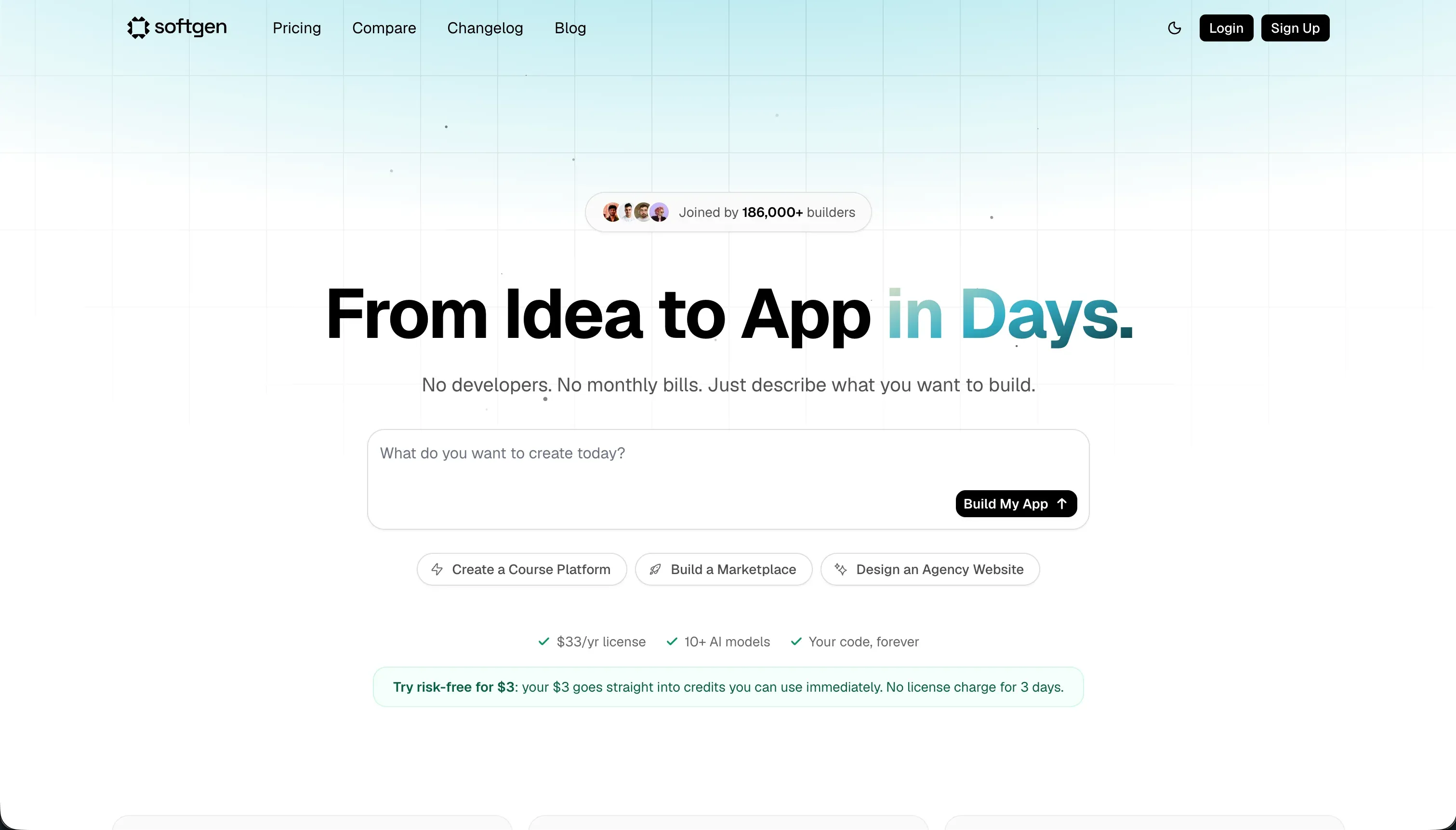
Softgen (softgen.ai) is a chat-based AI application builder built around its Cascade AI agent. The Cascade agent takes a structured conversational approach - it helps you outline your application’s architecture before generating code, which improves prompt clarity for users who are not sure what to ask for. Softgen generates functional user interfaces, relational database schemas, user authentication flows, and integration templates (including Stripe payments) through the chat workspace.
The pricing model is Softgen’s most distinctive feature. Instead of a monthly subscription with included credits, Softgen charges an annual platform membership fee ($33/year) plus separate pay-as-you-go AI usage credits. This structure makes Softgen cheaper to start with for users who build in bursts and do not need sustained month-to-month iteration.
| Spec | Details |
|---|---|
| Primary Stack | React / Node.js with relational database support |
| Interface | Cascade AI conversational workspace |
| Primary Deployment Target | Softgen hosted environment |
| Key Advantage | Annual membership model - no monthly subscription required for platform access |
The Core Difference
Emergent and Softgen are both AI-first builders, but they differ in how much latitude they give the AI agent and what that latitude costs you.
Emergent gives the agent broad authority. It can plan and execute multi-file code changes, create custom database schemas, configure backend routing, and iterate on the implementation through repeated loops. This makes it capable of handling more complex, bespoke applications - but it also means the agent can make expensive mistakes across multiple files simultaneously. When an Emergent agent enters a debugging loop, it is not just consuming credits for one operation; it is potentially touching multiple files across the project with each retry, and those changes are not always reversible without triggering additional credit-consuming operations.
Softgen’s Cascade agent is more constrained in scope. The structured planning phase at the start of a project reduces the chance of the AI misinterpreting your intent. But the lack of a visual editing layer means every change - from a button color to a database field - must go through the AI chat interface. Community feedback highlights this as a significant friction point: “no drag-and-drop builder - every iteration requires going back to the AI chat prompt, which can be slower for visual tweaks.” When you want to move a layout element or change a font size, you cannot just click and drag; you have to describe the change in text and hope the AI interprets it correctly the first time.
The practical difference is this: Emergent is more powerful for complex applications but harder to control when things go wrong. Softgen is more predictable for simple applications but slower to iterate visually and limited by its template-driven layout assumptions.

Head-to-Head Comparison
1. Developer Experience & Iteration Speed
Emergent’s agent workspace is fast for initial scaffolding. A detailed prompt describing a CRUD application with user authentication, a relational database, and basic API endpoints can produce a working prototype in minutes. The agent handles multi-file planning, which means it is not just writing one component at a time - it is coordinating changes across the database schema, backend routes, and frontend components in a single pass.
Where the experience breaks down is in iteration depth. As the codebase grows, the agent’s context window fills and it starts making changes with incomplete awareness of what already exists. This is the origin of the regression loops: the agent edits a component, introduces a bug in a related component it has lost track of, and then spends credits fixing the new bug while potentially breaking something else. Documented cases of users spending thousands of dollars across projects where this loop pattern repeated are not edge cases - they are common enough that they are the dominant theme in Emergent’s community feedback. On top of that, container reliability issues (wake errors, production-preview discrepancies) add operational uncertainty for anything beyond a personal prototype.
Softgen’s Cascade agent is slower in raw generation speed but more predictable within its scope. The structured planning phase at the start of each project reduces the AI’s surface area for misinterpretation. The downside is that the chat-only interface makes visual iteration genuinely tedious. Every layout adjustment, every style tweak, every copy change requires articulating the desired outcome in text and waiting for the AI to regenerate. Community reviews note this as a recurring pain point: “fine-tuning visual layouts or alignment through conversational chat can lead to repetitive prompting loops, burning through credits without achieving the exact desired result.” There is no direct manipulation - no clicking on an element to select and modify it.
2. Code Quality & Portability
Emergent syncs generated code to a connected GitHub repository. The code quality on initial generation is generally good - clean component structure, readable backend routing, appropriate database schema design. Quality degrades during extended agent editing sessions, particularly when the agent makes changes across multiple files in response to a complex prompt. Partial function rewrites, renamed variables that break other files, and duplicated logic are recurring patterns in community feedback.
Code portability from Emergent is possible but not seamless. The GitHub sync gives you file access, but the backend deployment is tied to Emergent’s managed container infrastructure. Extracting the full application to run on your own server requires understanding how the container was configured - a meaningful additional step that is not automatic or well-documented.
Softgen’s code export is positioned as a genuine feature for users who outgrow the platform. The exported code covers the frontend and the database schema, and the platform does not claim proprietary ownership of the generated output. However, like Emergent, the exportability of complex projects depends on how much custom logic the AI has embedded in ways that are hard to separate from Softgen’s hosting assumptions. Simple applications export cleanly; complex ones may require developer work to make fully self-hostable.
Both platforms generate standard web technology stacks with no proprietary markup. Neither uses a visual schema that becomes invalid outside the platform.
3. Database & Backend Capabilities
Emergent scaffolds relational database schemas and backend API routes as part of the initial generation. This approach is more scalable than an embedded SQLite solution - the generated database is designed for multi-user scenarios with proper table relationships and API endpoint architecture. The limitation is the absence of any visual database management interface. Schema updates, data migrations, and access control rules all happen through AI prompts, and verifying that those changes are correct requires reading the generated code.
The production environment discrepancy is a documented risk on Emergent. Users have reported that “fixing bugs after deployment was challenging as production does not equal preview” - meaning the application that works in the Emergent preview tab sometimes behaves differently in the live deployment. This gap creates real debugging overhead for production applications.
Softgen’s Cascade agent generates relational database schemas, user authentication, and integration templates (including Stripe) as part of its structured generation flow. The database approach is described as template-driven, which makes the initial output predictable for common use cases but limits flexibility for complex data models. Like Emergent, there is no visual database editor - schema changes go through the AI chat interface. Community reviews from SelectHub’s market analysis note that “user reviews highlight a potential trade-off between speed and long-term maintainability, which is crucial for businesses planning to scale their applications.”
4. Hosting & Deployment Options
Emergent deploys to managed cloud containers automatically. Preview URLs are generated and updated as the agent makes changes, and the Standard plan includes private project hosting. The Pro tier adds high-performance computing resources for more demanding applications. The hosting is zero-configuration from the user’s perspective - you do not choose a server region, configure a web server, or manage SSL certificates.
The reliability of those containers is the known problem. “Error Waking Up Agent” messages, container latency, and blocked backend access during platform issues are documented in community feedback. These are not catastrophic failures, but they are frequent enough to be a meaningful concern for applications that need consistent uptime.
Softgen deploys to its own hosting environment with one-click deployment and custom domain support. The deployment is similarly zero-configuration - you prompt the agent to deploy and the application is published. The hosting infrastructure’s reliability is less documented in community feedback than Emergent’s, which either means it is more stable or that Softgen’s user base has not reached the scale where hosting issues generate significant public discussion.
Neither platform supports native mobile app deployment. Both generate web applications intended to run in a browser on any device.

Pricing Comparison
Emergent uses a monthly credit subscription with annual billing discounts:
- Free ($0/month): 10 credits per month. Useful for testing the platform, not for building anything real.
- Standard ($20/month billed annually, save $36/year): 100 credits per month. Includes GitHub integration, private project hosting, and the ability to purchase credit refills.
- Pro ($200/month billed annually, save $396/year): 750 credits per month. Adds 1M token context window, Ultra Thinking mode, custom AI agents, and high-performance computing.
- Credit refills: $10 for 50 credits. Purchased top-up credits do not expire (unlike monthly subscription credits, which reset each billing cycle).
The critical risk in Emergent’s pricing is the debugging loop multiplier. Each agent action consumes credits - including failed fix attempts. If the agent retries a bug fix five times and fails each time, that is five credit deductions for zero net progress. On the Standard plan with 100 monthly credits, a bad debugging session can consume 20-30% of the monthly allowance. Community reports document cases of the agent undoing completed features and charging credits to rebuild them, with customer support taking five or more days to respond.
Softgen uses a fundamentally different model:
- Annual Membership ($33/year): Covers platform access and hosting rights. This is the only recurring cost when you are not actively building.
- AI Usage Credits: Pay-as-you-go credit packages, purchased separately. You buy credits when you need them and do not pay for idle months.
The practical advantage of Softgen’s model is that dormant projects do not incur monthly fees. If you build a prototype in January and do not touch it until April, you are not paying February or March subscription fees. The disadvantage is that Softgen’s platform capabilities are narrower than Emergent’s, so the lower baseline cost reflects a lower ceiling on what you can build. For focused, simple projects with infrequent iteration, Softgen’s model is more economical. For sustained, complex development with regular AI-assisted iteration, the comparison depends heavily on credit consumption rates.
Use Case Fit: When to use which?
When Emergent makes sense
- You need to scaffold a complex full-stack application with custom database schemas, backend API routing, and managed hosting in a single prompt.
- You are a technical founder or developer who will review the generated code for security issues before deploying to real users.
- You understand the credit billing model and have a budget buffer for debugging loop overhead.
- Your project scope is bounded - you plan to scaffold with Emergent and then export and self-host the result rather than depending on Emergent’s containers indefinitely.
When Softgen makes sense
- You are building a simple to moderate-complexity web application that fits Softgen’s template-driven layout assumptions.
- You work in development bursts rather than continuous iteration - the annual membership model makes economic sense if you are not actively building every month.
- You want the Stripe integration and authentication templates included out of the box without custom prompting.
- You are comfortable with a chat-only interface for all visual changes, including layout and style adjustments.
When neither Emergent nor Softgen is the right fit
Both platforms share a fundamental architectural constraint: they are designed for AI-generated web applications maintained through AI prompts. When your project requirements fall outside that paradigm, forcing either tool into service creates ongoing technical debt and operational risk.
For native mobile apps
Neither Emergent nor Softgen compiles native mobile binaries. They are web builders. If you need a native iOS or Android app with push notifications, offline storage, and direct app store distribution, FlutterFlow is the appropriate tool. FlutterFlow provides a visual builder over Flutter’s mobile widget system and compiles directly to native Dart code with TestFlight and Google Play Console integrations. It is a better fit for native mobile than any prompt-driven web builder.
For internal tools and client portals
For business-critical operational software - client portals, internal CRMs, partner dashboards, team intranets - maintaining a generated codebase creates ongoing risk. Every permission change, schema update, or new feature requires a developer to implement and validate. Non-technical teams cannot safely maintain these systems. When the developer is not available, the tool is effectively broken.
Softr removes that dependency. It connects to Airtable, Google Sheets, or its own native database and provides a fully visual editor for configuring user groups, row-level data access, and conditional block visibility. Team members without technical backgrounds can add users, update data access rules, and modify content independently. Pricing is flat-rate with no credits to manage. The maintenance burden is as low as any business software platform on the market.
For professional developer environments
If you are an experienced developer who wants AI assistance within a real local development workflow - version control, custom package management, full terminal access, multi-language support, collaborative editing - neither Emergent nor Softgen is designed for you.
Cursor provides a VS Code fork with deep local repository context and context-aware multi-file editing. Replit offers a cloud-based development environment with autonomous agent scaffolding, multiplayer collaboration, and autoscaling deployment - suitable for developers who want the speed of AI generation alongside a genuine developer IDE.

Verdict
Emergent and Softgen are genuinely different tools that happen to serve similar audiences. The choice between them depends almost entirely on what you are building and how you expect to iterate on it.
Emergent is the more capable platform for complex, broad-scope applications. If your project needs custom database relationships, multi-step API flows, and sophisticated backend logic, Emergent’s agent can handle it. The cost is unpredictability in billing and reliability. The credit consumption during debugging loops is a documented, structural problem that has cost some users significantly more than their subscription fee implied. Going in without a budget buffer and a technical ability to recognize when the agent is stuck is a real financial risk.
Softgen is the more economical entry point for simpler, constrained projects. The annual membership plus pay-as-you-go credits model is genuinely builder-friendly for intermittent development. The customization ceiling is lower than Emergent’s, and the chat-only iteration interface is slower for visual changes. But for a focused MVP or prototype that fits within Softgen’s supported patterns, it can get you to a working deployment for significantly less than Emergent’s monthly subscription costs.
Neither platform is appropriate for production applications maintained by non-technical teams. For that use case, look at the alternatives section below.

Summary Comparison Table
| Feature | Emergent | Softgen |
|---|---|---|
| Build Paradigm | AI agent, multi-file code generation | Cascade AI conversational workspace |
| Output Type | React / Node.js, managed container | React / Node.js, template-driven output |
| Database | Relational SQL (agent-managed, no visual editor) | Relational schemas + auth templates (chat-driven) |
| Visual Permissions | None (written by AI in code) | None (basic templates via AI prompts) |
| Pricing Metric | Monthly credits (subscription, no rollover) | Annual membership + pay-as-you-go credits |
| Maintenance Burden | High (agent loops, container errors, credit risk) | High (chat-only iteration, no visual editor) |
| Code Export | Yes (via GitHub integration, partial portability) | Yes (code download supported) |