

Same.new and Softgen look similar on the surface because both sell AI scaffolding through chat, but they solve different problems. Same.new is basically a frontend cloning and React-generation tool. Softgen is closer to a conversational full-stack app builder that tries to handle layout, auth, database structure, and deployment in one flow.
The people actually deciding between these two are usually indie hackers, technical founders, and designers trying to avoid a full build from scratch. The real tradeoff is not just speed. It is whether you want a narrow UI-focused tool with exportable React code, or a broader app generator that asks you to trust its chat loop for more of the stack. That choice affects cost, lock-in, and how much cleanup you inherit on day two.
Meet the Contenders
What is Same.new?
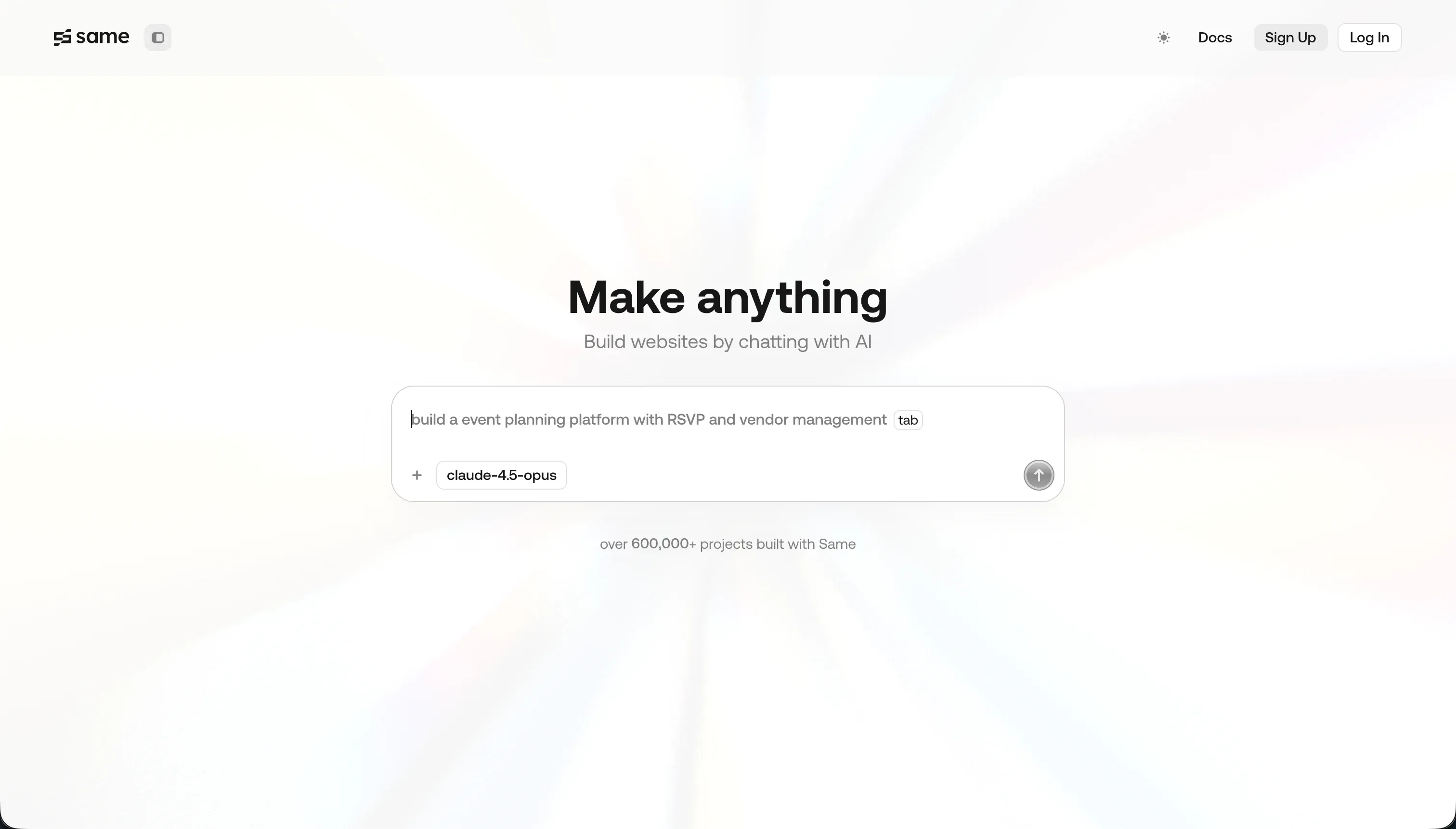
Same.new is a frontend prototyping and UI cloning tool, formerly called Same.dev. Its core pitch is simple: paste in a live website URL, let the AI replicate the look, and get React code you can keep modifying through prompts.
In practice, it works more like a visual reverse-engineering assistant than a complete app builder. Its standout features are URL-based UI replication, conversational edits to generated layouts, forking for design iteration, and code export for React and Tailwind CSS projects. That makes it attractive when you want to copy an existing visual pattern quickly instead of designing from a blank canvas.
It is genuinely built for designers and developers who care most about frontends, not for teams building serious operational software. The people who get frustrated fastest are users expecting stable full-stack behavior, because Same.new has documented complaints around destructive updates, buggy fork behavior on larger files, and projects becoming inaccessible during the Same.dev to Same.new transition.
| Spec | Details |
|---|---|
| Primary Stack | React and Tailwind CSS code generation |
| Interface | URL-based UI cloning plus conversational prompt edits |
| Primary Deployment Target | Exported code for local development environments |
| Key Advantage | Fast replication of simple website layouts from a live URL |
What is Softgen?
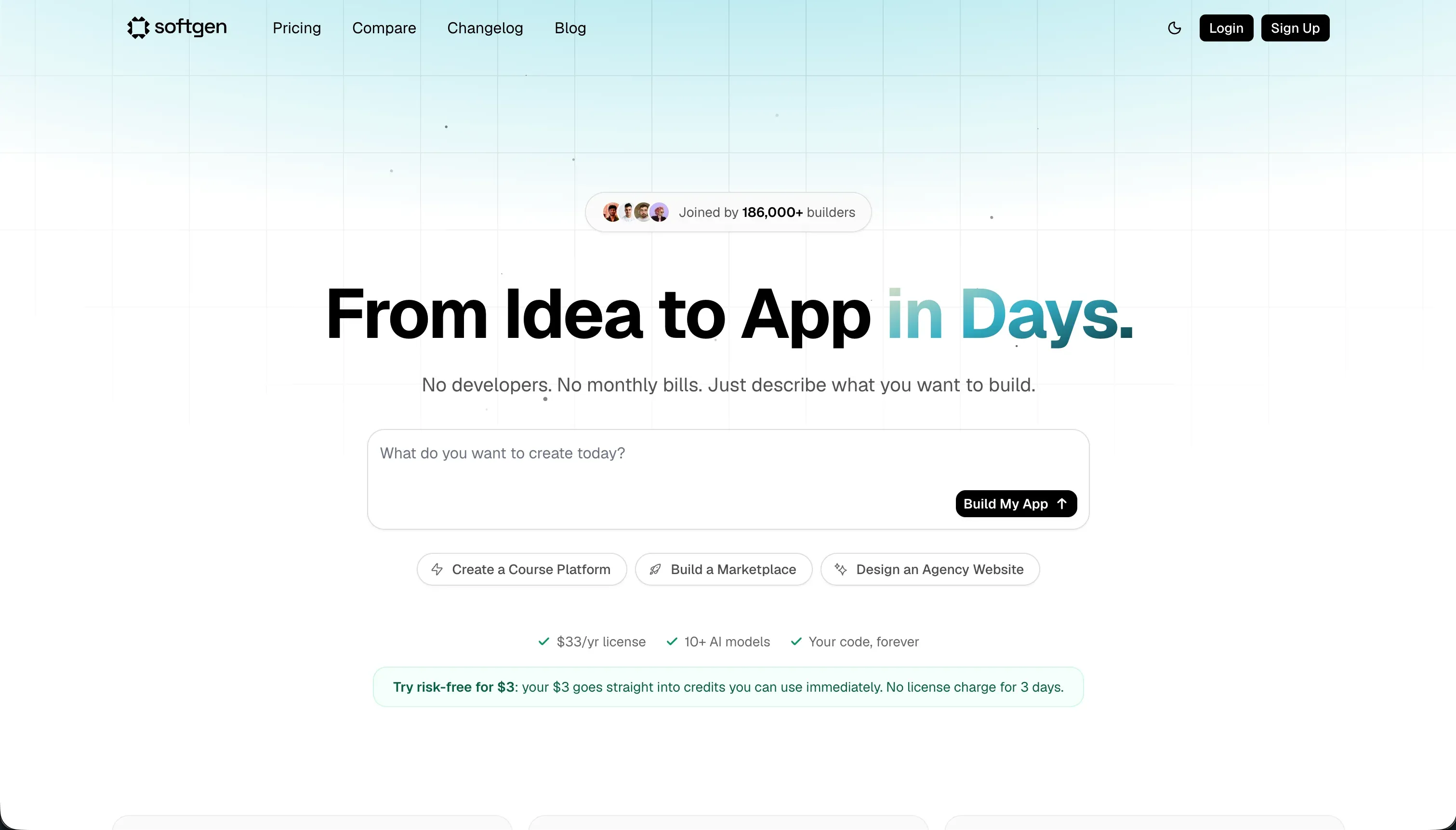
Softgen is a conversational AI application builder aimed at generating broader web apps than a pure UI cloner can. Instead of starting from a URL screenshot of an existing site, you work with its Cascade AI assistant to describe the app you want and let it scaffold the project.
In practice, Softgen tries to cover more of the stack than Same.new. The concrete features that matter are its full-stack generation flow, relational database schema scaffolding, built-in user authentication patterns, one-click deployment, custom domain support, and code export when you want to move beyond the platform. It is designed to be the kind of tool that gets an MVP or SaaS shell online quickly.
It is genuinely built for creators and indie hackers who want to test products without wiring everything manually. The people it frustrates are users who want precise visual control without repeated prompting, because reviews point to customization ceilings, predefined layout constraints, and credit burn whenever active iteration or debugging turns into a chat loop.
| Spec | Details |
|---|---|
| Primary Stack | AI-generated web apps with database, auth, and hosted deployment |
| Interface | Conversational builder via the Cascade AI assistant |
| Primary Deployment Target | Softgen-hosted web apps with custom domains |
| Key Advantage | Broader full-stack scaffolding than a frontend-only cloning tool |
The Core Difference
The biggest difference is scope. Same.new is a UI-cloning specialist that happens to export code, while Softgen is a broader app generator that tries to own more of the product stack.
- Same.new runs as a frontend replication tool first, making it strongest when you want React code from an existing visual reference and weakest when you need stable backend behavior.
- Softgen runs as a conversational full-stack builder first, making it stronger for MVP scaffolding with auth and database setup but more dependent on prompt loops for everyday iteration.

Head-to-Head Comparison
We evaluated both platforms across four core categories.
1. Developer Experience & Iteration Speed
Same.new is fast when the assignment is narrow: clone a page, fork a variation, and export React plus Tailwind. For a designer or frontend engineer trying to recreate an existing marketing page or dashboard shell, the URL-based replication flow is a real shortcut compared with rebuilding everything manually.
The problem is that speed reportedly collapses once you begin iterating on non-trivial layouts. Trustpilot complaints describe simple requested edits causing major code loss, including one review claiming a section reorder destroyed 1,500+ lines of working code. That turns iteration speed into a gamble rather than a reliable workflow.
Softgen gives you a wider starting point than Same.new because it can scaffold interface, auth, database structure, and deployment in one conversational flow. If your goal is to go from idea to rough MVP quickly, that broader starting package can save more time than a pure frontend cloner.
But its iteration model is still chat-first, and that becomes the drag. Reviews specifically point to repetitive prompt loops for visual tweaks and rebuilding sections, with credit usage climbing during debugging. So Softgen often wins the first hour, then slows down in the refinement phase.
Edge: Softgen, because broad app scaffolding beats frontend-only cloning if your goal is to get a working MVP online fast.
2. Code Quality & Portability
Same.new’s strongest portability argument is straightforward code export. It generates React and Tailwind CSS that you can download and move into your own local environment, which is more appealing than a fully closed visual builder when you already have a developer workflow.
That said, exportable code only matters if the generated output survives editing intact. User complaints about destructive updates and unstable forks weaken the portability story, because you may own the code but still inherit messy cleanup. Same.new is portable, not necessarily durable.
Softgen also positions code ownership as part of the product and allows code export for teams that outgrow the hosted builder. That is important, because it means you are not completely trapped inside the platform if the app becomes serious.
The catch is that the exported code may still reflect the limits of a chat-built system. Reviews note that customization beyond the initial output can require manual coding, which means portability exists, but often as an escape hatch into more engineering work. Softgen gives you broader exportable app scaffolding than Same.new, but not necessarily cleaner handoff.
Edge: Softgen, because it exports code from a fuller application scope instead of only a cloned frontend.
3. Database & Backend Capabilities
This is where Same.new mostly stops competing. The product research is explicit that it is a frontend prototyping and UI cloning tool, with no native database layer, no built-in authentication system, and no real backend automation story.
That narrowness is not automatically a flaw if you plan to pair it with your own stack, but it does mean more manual integration work. If you need relational data, user management, or payment logic, Same.new hands that problem back to you or to another tool.
Softgen at least tries to answer the backend question. It can generate relational database schemas, user authentication, and integrations such as Stripe payments, which makes it meaningfully more complete for app scaffolding than Same.new.
Still, it is not a deep backend platform in the sense of offering robust visual administration or advanced permission logic. Research flags basic access control compared with stronger business-app builders, and customization can hit a ceiling without manual coding. So it wins this category, but with limits.
Edge: Softgen, because Same.new is basically frontend-only while Softgen can scaffold auth, database structure, and basic integrations.
4. Hosting & Deployment Options
Same.new’s deployment story is really an export story. You generate the interface, take the React and Tailwind code, and move it into your own development workflow or hosting setup. For developers who already have Vercel, Netlify, or a custom pipeline, that is acceptable.
But it is not a turnkey hosted app platform. You still need to own the deployment chain, and the rebrand history matters here because some users reported projects becoming read-only or inaccessible during the Same.dev to Same.new transition. That hurts trust even before hosting enters the picture.
Softgen offers one-click deployment to its own hosting environment and supports custom domains, which is much closer to what non-technical founders expect from an AI builder. If you want to describe an app and publish it without assembling separate infrastructure, Softgen has the cleaner story.
The tradeoff is deeper platform dependence. Convenience rises, but so does lock-in, because your fastest path is staying inside Softgen’s hosted environment until you decide to export. It is easier at launch, but you are trusting a young platform with more of your production surface area.
Edge: Softgen, because hosted deployment and custom domains beat Same.new’s export-first workflow for most buyers.
5. AI Quality & Reliability
Same.new’s AI is good at the first impression trick: look at a URL and reproduce the aesthetic direction quickly. For simple landing pages and straightforward layouts, that can feel almost magical, especially at the low entry price of $10 per month for Pro with 2 million tokens.
Reliability is where the shine wears off. The documented pain points are severe: destructive code loss, failures on complex layouts, buggy forking on larger files, and community complaints about unpredictable token burn. Same.new can impress in minute one and betray you in minute thirty.
Softgen’s AI is more ambitious because it is trying to plan and scaffold a fuller application rather than just mimic a page. Its Cascade assistant can map features, produce schemas, and modify app structure, which makes the AI feel more useful for product setup than Same.new’s clone-first model.
But the reliability issue does not disappear, it just changes shape. Instead of catastrophic code-loss stories, the main complaint is prompt-loop inefficiency: you keep asking for layout or logic changes, credits keep getting consumed, and the result still may not match what you intended. Softgen is broader, but not especially precise.
Edge: Softgen, because its AI covers more of the application lifecycle even if both tools struggle with dependable refinement.
6. Learning Curve & Onboarding
Same.new is easier to understand immediately because the mental model is obvious: paste in a URL, get a clone, keep prompting. For frontend-focused users, that makes onboarding short and concrete, and the low-cost Pro tier at $10 per month lowers the risk of trying it.
What it does not solve is the learning curve after generation. Once outputs break or complex states fail to clone correctly, you are back in normal developer territory, cleaning up React and CSS yourself. So it is easy to start, but not always easy to finish with confidence.
Softgen’s onboarding is conceptually broader because it asks users to describe an application, not just a page. That can actually help non-designers who think in workflows, data, and product requirements rather than visual references. The $33 yearly membership also keeps the entry barrier low.
However, the broader scope means there is more to manage mentally from the start. You are not only shaping the interface, you are also shaping app structure, auth, and data. Once customization goes beyond the defaults, the lack of drag-and-drop precision means users can get stuck in a loop of prompts and manual fixes.
Edge: Same.new, because the UI-cloning workflow is easier to grasp for first-time users than Softgen’s broader application-planning flow.
Pricing Comparison
Same.new:
- Free - $0 with limited tokens for basic UI testing and cloning
- Pro - $10/month including 2 million tokens
- Additional usage - $10 per 2 million tokens, or $5 per million on historical pricing
- Fixed tiers - newer quota-based plans introduced to make billing more predictable
Softgen:
- Annual Membership - $33/year for platform access and hosting rights
- AI Usage Credits - pay-as-you-go credit packs for generation and updates
- No monthly subscription tier was provided beyond the annual membership in the research
Use Case Fit: When to use which?
When to choose Same.new
- Choose Same.new when you need to clone an existing website or UI pattern into React and Tailwind as quickly as possible.
- Choose Same.new when you already have developers and hosting, and only want AI help on the frontend layer.
- Choose Same.new when low upfront cost matters more than backend completeness or long-term stability.
When to choose Softgen
- Choose Softgen when you want a broader MVP scaffold that includes auth, database structure, and hosted deployment.
- Choose Softgen when you prefer describing an app in chat instead of starting from a visual reference URL.
- Choose Softgen when code export matters, but you still want the platform to handle the first full-stack draft.
When neither Same.new nor Softgen is the right fit
For internal tools and client portals
Neither Same.new nor Softgen is the tool I would trust for a serious client portal, internal CRM, partner dashboard, or multi-role operations app. Same.new is too frontend-only, and Softgen still leans too hard on prompt-driven iteration for the kind of permissions, onboarding, and maintenance work that shows up after launch.
This is exactly where Softr fits better. Softr starts with native Softr Databases as the primary data layer, then adds built-in auth, user groups, row-level permissions, workflows, and hosting in one managed system. It is AI-first, but not AI-only: you can scaffold the app with AI and then edit everything visually, which is a much safer day-two story for business software.
For native mobile apps
Both Same.new and Softgen are web-focused builders. Neither is the right answer if the real requirement is shipping native iOS or Android binaries through the App Store or Google Play, with mobile-specific components and packaging built into the workflow.
For that job, look at FlutterFlow first, and then Adalo or Glide depending on how much complexity you need. FlutterFlow is the strongest option here because it is designed around app-building workflows rather than cloned web UI or chat-built web shells.
For professional developer environments
If you are a serious developer who mainly wants AI acceleration inside a real coding workflow, both tools feel constrained in different ways. Same.new is too narrow, and Softgen abstracts too much of the stack into a conversational layer that eventually pushes you back into manual cleanup.
A better route is Cursor or Replit. Cursor is the stronger choice when you want AI inside a real IDE and care about reviewing, editing, and owning the code directly, while Replit is better if you want an integrated cloud development environment with fewer handoffs.

Verdict
Pick Same.new if your job is mostly visual: cloning a page, borrowing a design system, or getting a React frontend scaffold out of an existing site quickly. The tradeoff is that you are accepting a tool with documented instability around edits, forks, and complex layouts, so you need enough frontend skill to clean up whatever the AI breaks.
Pick Softgen if you want a broader app skeleton and care more about getting auth, data structure, and deployment in one shot than about pixel-perfect frontend cloning. The tradeoff is that you are buying into a chat-driven product where customization can turn into repeated prompt loops, manual coding, and unpredictable credit consumption.
The bigger lesson is that both tools are strongest in the prototype phase and weaker once the product needs to survive real change. That is the day-two problem: owning generated code is not the same as wanting to maintain it. For business apps with real users, permissions, and operational workflows, Softr ages better because it gives you a managed foundation instead of handing you fragile AI scaffolding to babysit.

Summary Comparison Table
| Criterion | Same.new | Softgen |
|---|---|---|
| Best for | Frontend cloning and visual remixing | Full-stack MVP scaffolding |
| Build paradigm | URL clone plus prompt edits | Conversational AI app builder |
| Database support | None built in | Relational schema generation |
| Code export | React and Tailwind export | App code export available |
| Pricing metric | Monthly plan plus token usage | Annual access plus pay-as-you-go credits |
| Main risk | Destructive updates and unstable forks | Prompt loops and customization ceiling |
| Maintenance burden | High once clone quality drops | Moderate to high as app complexity grows |