

Same.dev and Bubble both promise to get you from idea to app faster, but they sit in completely different categories. Same.dev (now Same.new) is a front-end cloning tool that turns a website URL into editable React and Tailwind code. Bubble is a full-stack visual programming platform that builds, hosts, and runs complete web applications with a database, workflows, and privacy rules.
The people choosing between these two are usually founders, designers, and small teams trying to ship something quickly without a large engineering budget. What is at stake is not just how fast you get a first version, but whether that version is a styled draft you still have to wire up, or a working application that can take real users. Pick wrong and you either inherit a backend you have to build from scratch, or you commit to a platform whose billing and lock-in get harder to escape as you grow.
Meet the Contenders
What is Same.dev?
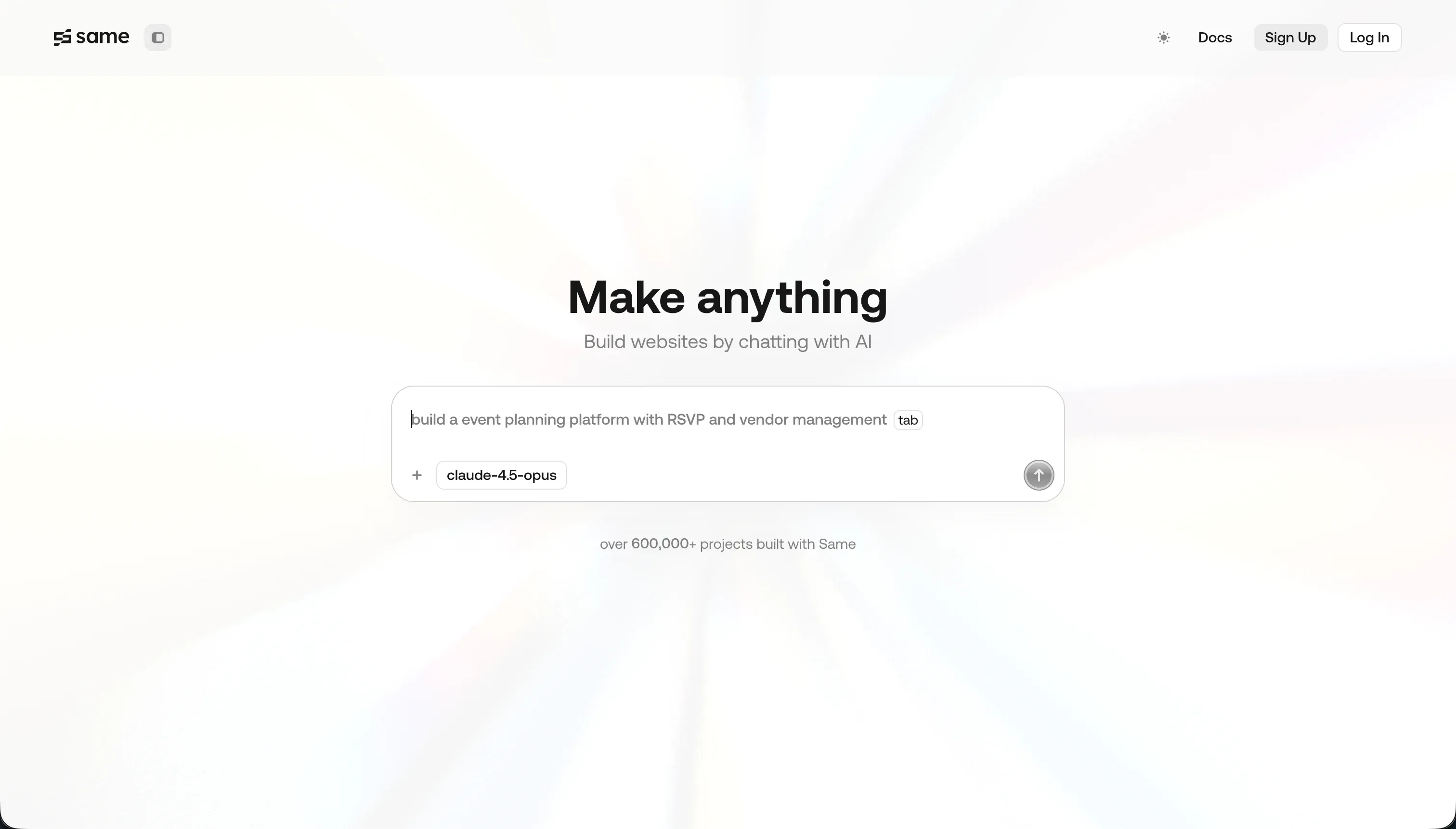
Same.new, formerly known as Same.dev, is a generative AI front-end utility for cloning and prototyping user interfaces. You paste a live website URL, the AI parses the page’s HTML structure and CSS variables, and it converts that into a React and Tailwind CSS codebase you can keep editing.
In practice, Same.dev works through conversational prompts. You can re-align sections, change colors, add components, or fork an existing draft to branch out a new design version, all by typing commands to the AI assistant. It also exports the generated React and Tailwind code, so you can pull it into a local development environment, and Pro adds GitHub integration and custom domain hosting. The important limitation is scope: it compiles the front end only, with no database, no authentication, and no server-side APIs.
Same.dev is genuinely built for designers and front-end developers who want to replicate a visual layout from a URL and walk away with raw React code to build on. It gets frustrating fast for anyone trying to ship a real product, because users report that simple prompts can trigger destructive edits, that forking larger projects often fails, and that the Same.dev to Same.new rebrand locked some active paid projects to read-only.
| Spec | Details |
|---|---|
| Primary Stack | AI front-end compiler outputting React and Tailwind CSS |
| Interface | Conversational chat prompts plus URL-to-UI cloning |
| Primary Deployment Target | Exported React code deployed to your own host (e.g. Vercel) |
| Key Advantage | Fast cloning of a website’s layout into editable, exportable front-end code |
What is Bubble?
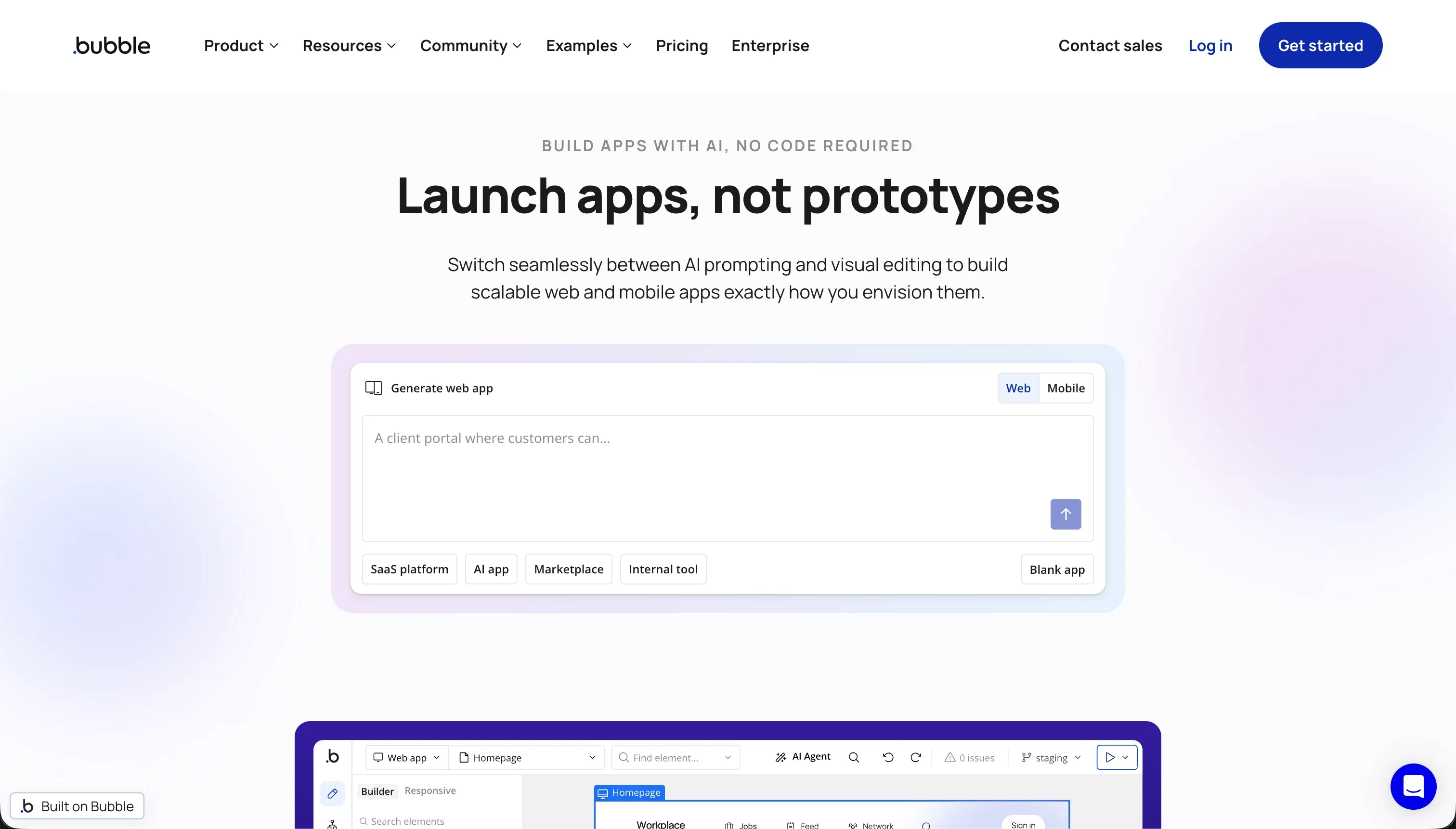
Bubble is a visual programming platform that lets you build, host, and scale full-stack web applications without writing code. Founded in 2012, it is one of the most mature no-code platforms, pairing a drag-and-drop interface designer with a visual workflow logic engine and a managed relational database.
In practice, Bubble is built for logic-heavy apps. Its pixel-level editor gives you fine-grained control over layouts, its workflow builder defines multi-step conditionals and scheduled backend events, and its database supports custom data types, relationships, and bulk operations. Server-side privacy rules govern which roles can search, view, or edit specific records, and a marketplace of over 8,000 plugins adds things like Stripe payments, maps, and analytics. The API Connector links REST services and external AI systems.
Bubble is built for founders and experienced builders shipping marketplaces, SaaS platforms, and custom social networks where complex logic matters more than speed. It gets demanding for non-technical operators, because mastering relational data, workflow conditionals, and security rules is essentially software engineering, the editor can consume 3 to 5 GB of RAM and lag on large apps, and there is no code export if you ever want to leave.
| Spec | Details |
|---|---|
| Primary Stack | Visual workflow engine plus managed relational database, hosted by Bubble |
| Interface | Pixel-level drag-and-drop editor with visual logic builder |
| Primary Deployment Target | Bubble-hosted web apps on its own servers, custom domains on paid plans |
| Key Advantage | Deep custom logic, relational data, and 8,000+ plugins in one full-stack platform |
The Core Difference
The biggest difference is not how fast you reach a first screen. It is how much of an actual application each tool builds for you, and what you are stuck with afterward.
- Same.dev clones a website’s front end into editable React and Tailwind code, leaving the database, auth, and backend for you to build and host yourself.
- Bubble builds and hosts a complete full-stack app with a database, workflows, and privacy rules, in exchange for proprietary lock-in and usage-based Workload Unit billing.

Head-to-Head Comparison
We evaluated both platforms across six categories that matter when picking between a front-end cloner and a full-stack builder.
1. Scope: Front-End Only vs Full-Stack
Same.dev is deliberately narrow. It compiles the front-end layout from a URL into React and Tailwind, which is great for landing pages, component mockups, and clickable layout prototypes. If your need is visual replication, it does that job in seconds and hands you clean copyable code.
The flip side is everything it does not do. There are no managed database tables, no logins, and no APIs, so the moment you want a form to save entries securely or a multi-user system, you are coding and connecting a backend like PostgreSQL yourself. For a real business system, that is most of the actual work left undone.
Bubble covers the whole stack. The same platform gives you the interface, a relational database with custom data types and relationships, a workflow engine for backend logic, and server-side privacy rules, all hosted by Bubble. You can build a two-sided marketplace with booking flows and messaging without leaving the tool.
That breadth is also why Bubble is heavier to learn. Designing data tables, structuring one-to-many relationships, and writing workflow conditionals is essentially software engineering, and non-technical founders often spend weeks in tutorials before building something efficient. The scope is real, but so is the ramp.
Edge: Bubble, because it builds an actual full-stack application while Same.dev only produces a front-end draft you still have to wire up.
2. Code Quality & Portability
Same.dev wins clearly on code ownership. It outputs standard React and Tailwind CSS that you can export, run locally, and deploy yourself, which means you are never fully trapped inside the platform. If the cloned layout is simple, the code is clean enough to build on directly.
The caveats are real, though. Syncing to GitHub requires the Pro plan, and the AI struggles to replicate complex interactive state and nested grids, so larger clones need extensive manual developer cleanup. The export is genuine, but it is a starting point, not a finished codebase.
Bubble offers essentially no portability. It is a proprietary walled garden where you can export database rows as CSV, but the application logic, workflows, layouts, and front-end elements cannot be taken out at all. Users describe migrating off Bubble as next to impossible, requiring a complete rewrite of the entire app.
That lock-in is the most consistent complaint about Bubble. As one Reddit user put it, you will be locked in and unable to move out easily once you choose it. For a quick MVP that may be acceptable, but for anything you expect to own long term, it is a heavy commitment.
Edge: Same.dev, because it exports real React and Tailwind code while Bubble offers no application-level export and severe lock-in.
3. Database & Backend Capabilities
Same.dev has no backend story to tell. There is no managed database, no relational tables, and no built-in authentication, so any data layer is something you architect, code, and host separately. The tool simply was not designed to store or secure data.
For its intended use, that is fine. A landing page or component mockup does not need a database. But it means Same.dev cannot, on its own, power anything with stored records, user accounts, or business logic, which rules out client portals, CRMs, and internal tools entirely.
Bubble is the opposite. Its managed relational database lets you create custom data types, define relationships, run bulk operations, and enforce server-side privacy rules that validate access per role. Combined with the visual workflow engine and the API Connector, it can handle genuinely complex backend logic.
The weak spots show up at scale. Bubble runs on a traditional SQL relational database that is strong for transactional apps but not ideal for high-throughput read and write, and users report lag on large databases and complex real-time search. The capability is there, but it needs careful optimization to stay fast.
Edge: Bubble, because it ships a real relational database with privacy rules that Same.dev has no answer for.
4. Pricing & Billing Predictability
Same.dev is cheaper to start. The free tier covers basic UI testing, and Pro is $10 per month with 2 million tokens included, with extra tokens at $5 per million. The problem is that prompting changes consumes tokens, and when the AI introduces bugs, fixing them burns more, so costs can creep up on heavy iteration.
Same.dev clearly heard this. It moved from a pure pay-as-you-go model to fixed-tier plans specifically because users complained about unpredictable token burn. The entry cost stays low, but the billing model still ties spend to how much you prompt rather than to a flat app fee.
Bubble’s pricing is higher and more volatile. Paid plans run from $69 per month for Starter to $649 per month for Team, but the real swing factor is Workload Units, which charge for server compute like database searches and workflow runs. A few hundred users running inefficient queries can drain a monthly allowance in days.
The result is bills that jump unexpectedly. Users report production costs spiking from $69 to over $1,500 a month, and expert reviewers note the WU model is hard to forecast. Bubble also shuts apps down when a paid plan lapses to free-tier limits, replacing the homepage with a warning screen.
Edge: Same.dev, because its entry price is low and its token model, while imperfect, is far less likely to produce four-figure surprise bills than Bubble’s Workload Units.
5. Reliability & Maintenance
Same.dev’s reliability is its weakest area. Trustpilot reviewers report destructive AI edits, including a case where a simple section reorder destroyed more than 1,500 lines of working code, and the fork feature frequently fails on larger files. That fragility makes it risky for anything you cannot afford to lose.
The rebrand made it worse for some users. The transition from Same.dev to Same.new locked active paid projects to read-only, leaving people temporarily unable to edit work they had paid for. For a tool meant to scaffold drafts you export quickly, that may be tolerable, but it is a clear warning against depending on it long term.
Bubble is more battle-tested, having run since 2012, but it has its own maintenance burden. The editor is notorious for eating 3 to 5 GB of RAM and lagging on complex apps, often requiring page refreshes, and reliance on community plugins means an abandoned integration can break a critical workflow without warning.
There are also harder failures. Users have reported apps shutting down entirely when a paid plan reverted to free-tier limits, and Stripe payment integration has been described as inconsistent. Bubble is the more dependable of the two for a live app, but it still demands ongoing attention and optimization.
Edge: Bubble, because despite its editor lag and plugin risks, it is far more stable for a real application than Same.dev’s destructive edit loops.
6. Learning Curve & Onboarding
Same.dev is easier to start with for its narrow purpose. Paste a URL, get a cloned front end, and tweak it through chat. If you understand basic web layout, there is very little to learn before you see a result, which is why builders praise how quickly it turns a reference site into React files.
That simplicity comes from doing one thing. As soon as you need backend logic, the learning curve does not extend within Same.dev, it just hands the hard parts to you. You move from an easy tool to writing API endpoints and database code on your own, which is a steep jump for non-developers.
Bubble has a famously steep curve. While a simple landing page is quick, building a production app means mastering relational data design, workflow conditionals, API configuration, and security rules, which reviewers describe as essentially developer-level work. Non-technical founders often spend weeks or months in tutorials first.
The payoff is that the learning stays inside one platform. Once you understand Bubble’s logic, you can build complex interactions without ever leaving it or coding a separate backend. The cost is that the upfront investment is real, and many users underestimate how much conceptual depth a secure, efficient app requires.
Edge: Same.dev for an immediate first result, but only because it stops at the front end; Bubble asks more upfront and gives you a complete app in return.
Pricing Comparison
Same.dev:
- Free - $0, limited tokens for basic UI testing and cloning
- Pro - $10/mo, includes 2 million tokens, additional tokens at $10 per 2 million ($5 per million), GitHub integration, custom domain hosting
- Fixed Tiers - tiered pricing based on token quotas, added for more predictable billing
Bubble:
- Free - $0, 50k Workload Units/month, 200 database records, Bubble branding and hosting
- Starter - $69/mo, 175k Workload Units/month, custom domain, branding removal, basic version control
- Growth - $249/mo, 250k Workload Units/month, 2 developer editors, 10-day version history, custom branches
- Team - $649/mo, 500k Workload Units/month, 5 developer editors, 20-day version history, sub-apps and priority support
Use Case Fit: When to use which?
When to choose Same.dev
- Choose Same.dev when you want to clone a website’s layout from a URL and walk away with editable React and Tailwind code to build on.
- Choose Same.dev when you are a designer or front-end developer building visual mockups, landing pages, or clickable prototypes, not a stored-data application.
- Choose Same.dev when you want a low $10 per month entry point and are comfortable owning the backend and hosting yourself.
When to choose Bubble
- Choose Bubble when you need a full-stack app with a real relational database, multi-step workflows, and server-side privacy rules in one platform.
- Choose Bubble when you are building a marketplace, SaaS product, or custom social network with complex logic and have time to learn visual programming.
- Choose Bubble when an 8,000-plugin ecosystem for payments, maps, and analytics matters more than code ownership or predictable billing.
When neither Same.dev nor Bubble is the right fit
For secure internal tools and client portals
If your real need is a client portal, internal tool, or CRM with logins and permissions from day one, neither tool fits cleanly. Same.dev has no backend at all, and Bubble makes you architect a database, build workflow logic, and manage Workload Units before anything is production-ready, which is a lot of work for standard business software.
Softr is built for this exact job. Its AI Co-Builder generates the database, pages, navigation, and user groups from a prompt, then lets you keep editing visually without re-prompting, and every app ships with authentication, granular user groups, row-level permissions, hosting, and SOC 2 Type II compliance built in. For teams that prefer a code-first route on top of existing data, Retool is a sensible alternative that connects directly to your databases and APIs for internal tooling. Both get you to a secure, working app faster than wiring up Same.dev’s front end or optimizing Bubble’s WU bill.
For native mobile apps
If you specifically need native iOS and Android apps published to the App Store and Google Play, neither tool is the right pick. Same.dev only outputs web front-end code, and Bubble’s native mobile packaging is still a maturing public beta that lacks the performance of dedicated native frameworks.
For that job, look at FlutterFlow or Adalo. FlutterFlow is the stronger option when you want serious native-app flexibility and a closer path to real app-store output built on Flutter, while Adalo is the simpler, more beginner-friendly native-mobile builder. Both target native distribution in a way neither Same.dev nor Bubble was designed to handle.
For professional developer environments
If your team wants a real codebase, terminal access, Git workflows, and full control of the stack, a front-end cloner and a closed visual platform both fall short. Same.dev gives you code but no backend or environment, and Bubble locks you inside a proprietary canvas with no export at all.
In that case, look at Cursor or Replit. Cursor suits developers who already live in an IDE and want AI pair-programming on a real codebase, while Replit makes sense if you want a browser-based coding environment with a database, deployment, and runtime tooling built in. Both give the end-to-end ownership that neither compared tool provides.

Verdict
Pick Same.dev if your goal is to clone a website’s front end into editable React and Tailwind code and you genuinely own the backend and hosting yourself. It is a fast, cheap way to scaffold visual layouts, and the code export means you are not trapped. The tradeoff is accepting that it builds no database, no auth, and no logic, plus a real risk of destructive AI edits and the read-only project lockouts that hit users during the Same.new rebrand.
Pick Bubble if you need an actual full-stack application and you are willing to learn visual programming to get it. It gives you a relational database, workflow logic, privacy rules, and an enormous plugin ecosystem in one hosted platform, which Same.dev cannot match. The tradeoffs are a steep learning curve, an editor that lags on large apps, no code export, and Workload Unit billing that can turn a $69 plan into a four-figure bill under production traffic.
The day-two reality is what separates these tools from the alternatives. The first screen is rarely the expensive part; the expensive part is logins, permissions, and every change after launch. For standard business software like portals, CRMs, and internal tools, Softr ages better because it ships auth, permissions, and hosting on day one and lets you edit without re-prompting, while Retool is the stronger fit for developer teams building internal tools on existing data. Between the two compared here, Bubble is the more complete builder and Same.dev the better front-end scaffold, but if your project is real business software, look past both.

Summary Comparison Table
| Criterion | Same.dev | Bubble |
|---|---|---|
| Best for | Cloning front-end layouts into React code | Full-stack apps with complex logic |
| What it builds | Front end only, no backend | Complete app with database and workflows |
| Database & auth | None, you build it yourself | Managed relational database, privacy rules |
| Code export | Yes, React and Tailwind (GitHub on Pro) | No, proprietary lock-in |
| Pricing model | $10/mo Pro plus token usage | $69 to $649/mo plus Workload Units |
| Reliability risk | Destructive AI edits, project lockouts | Editor RAM lag, plugin and WU surprises |
| Learning curve | Low, but stops at the front end | Steep, developer-level concepts |