

Bubble and Softr are both serious no-code platforms with real production deployments behind them. This isn’t a case of an established heavyweight versus a scrappy newcomer - both have years of use and both have genuine strengths. The comparison matters because they’re often evaluated for the same use cases (portals, internal tools, CRMs) while being genuinely different platforms built on different philosophies.
Meet the Contenders
What is Bubble?
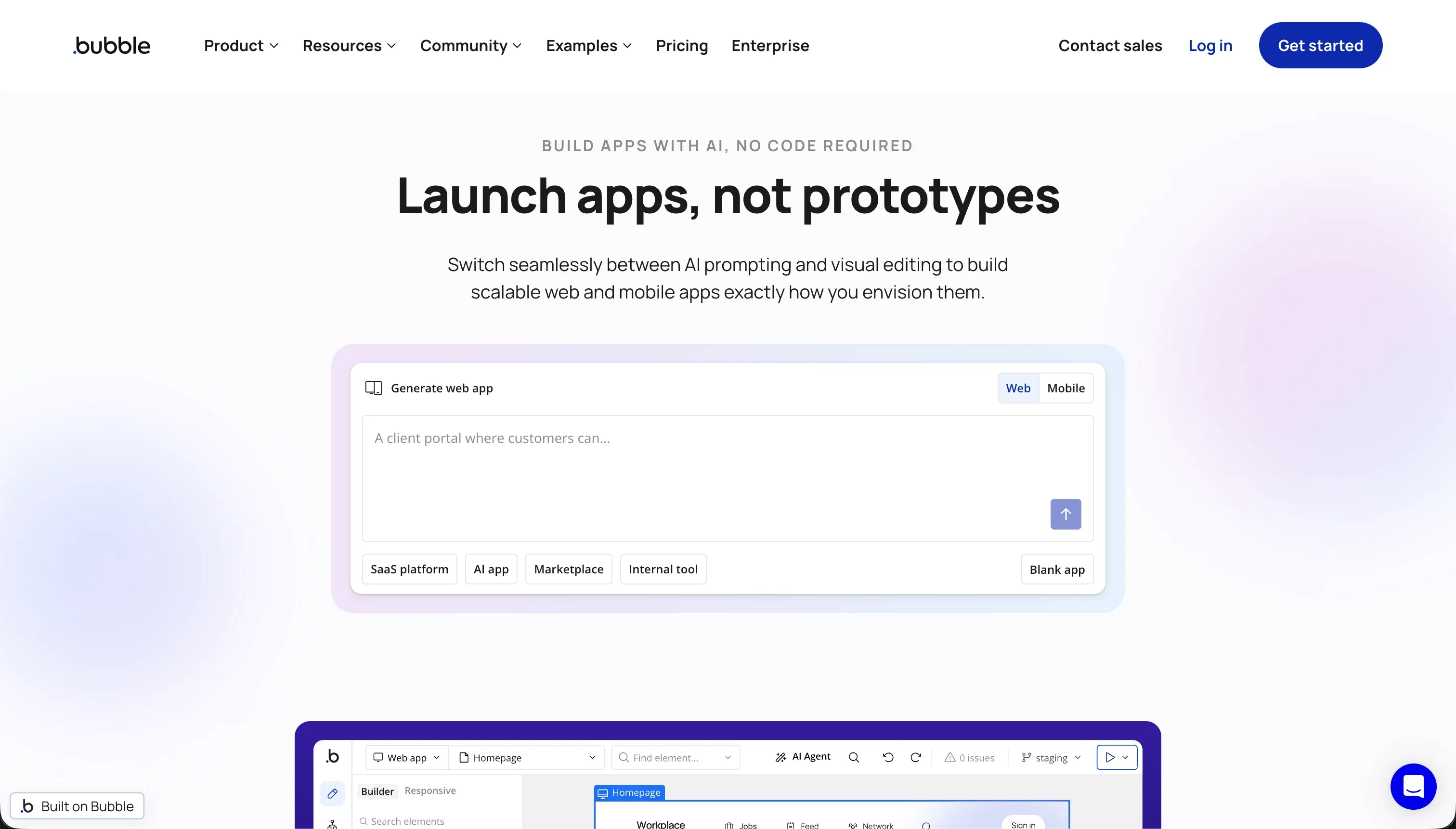
Bubble is a visual programming environment for building web applications without writing code. It provides pixel-level layout control, a multi-step visual workflow builder for complex logic, a managed relational database, and over 8,000 community plugins. Bubble’s power comes from its low-level configurability - you can define custom workflow conditions, API connections, privacy rules, and server-side operations with significant precision. The tradeoff is a steep learning curve and a Workload Unit (WU) pricing model that can produce unpredictable bills as app usage scales.
| Spec | Details |
|---|---|
| Primary Stack | Proprietary visual programming environment |
| Interface | Drag-and-drop editor + visual workflow builder |
| Primary Deployment Target | Bubble Cloud (hosted), dedicated capacity available |
| Key Advantage | Deep workflow logic, pixel-level UI control, large plugin ecosystem |
What is Softr?
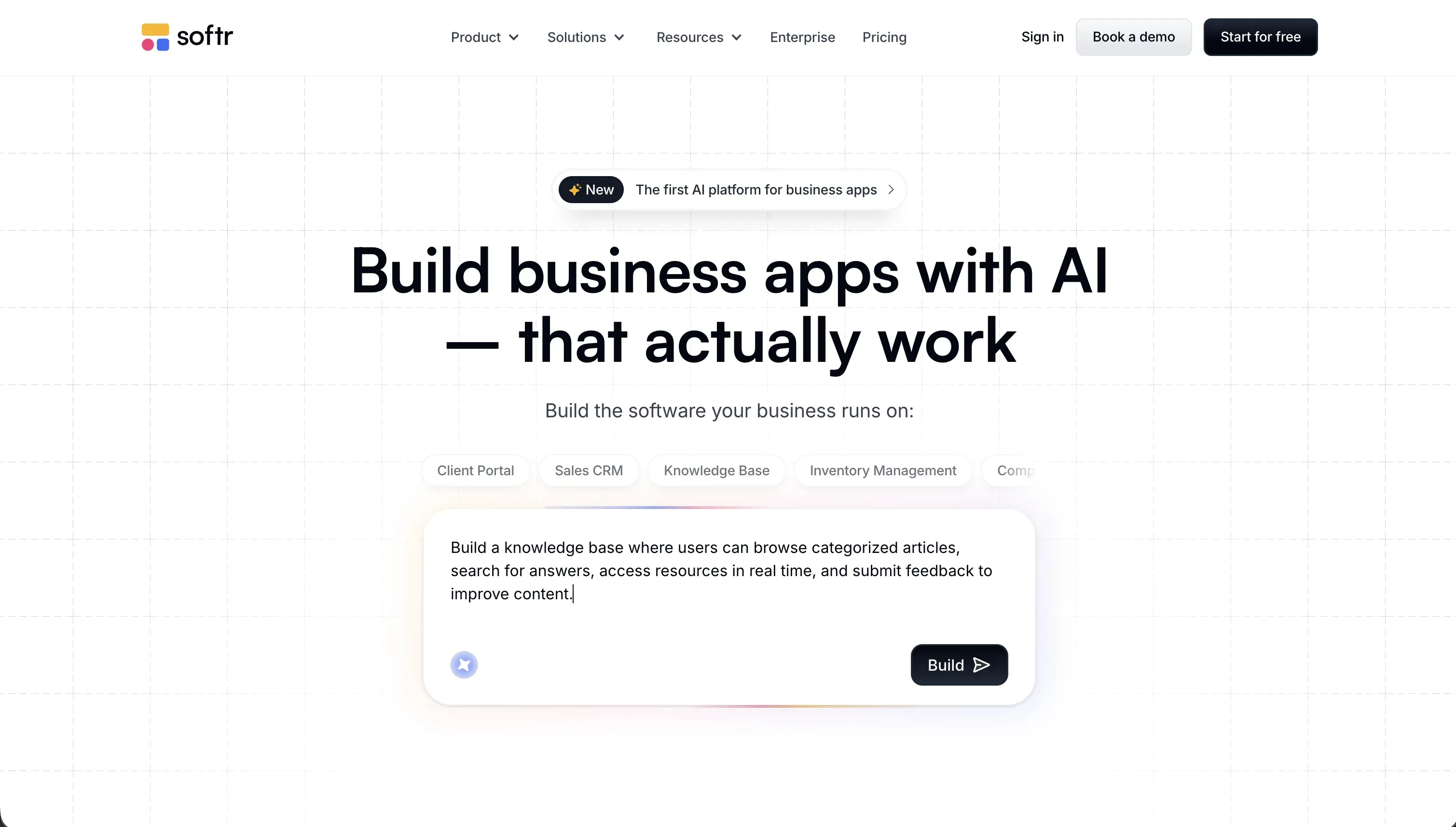
Softr is an AI-powered platform for building business software without code. Describe your app to the AI Co-Builder and it generates a complete, working application - database, pages, navigation, user groups, and business logic - in minutes. Everything is then editable through a visual block editor, or you can start from a template or build from scratch if you prefer. Unlike Bubble’s low-level programming model, Softr provides pre-built, production-tested components covering the most common business app patterns, with granular permissions configured visually rather than through workflow conditions.
| Spec | Details |
|---|---|
| Primary Stack | AI Co-Builder + Visual no-code block editor + Softr Databases + 17 external integrations |
| Interface | AI Co-Builder for generation + visual block editor for all changes |
| Primary Deployment Target | Softr Cloud (hosted), custom domains, white-label |
| Key Advantage | Fast time-to-launch, visual permissions, flat predictable pricing |
The Core Difference
Bubble is a visual programming platform. You’re not writing code, but you’re thinking like a programmer - designing data types, writing workflow logic, setting privacy rules, debugging conditional branches. The power is real: Bubble can handle genuinely complex application logic that most no-code tools can’t touch.
Softr is AI-powered and configuration-based. You can describe your app in plain English and the AI Co-Builder assembles it - database schema, pages, user groups, navigation - ready for real users. After that, everything stays editable through a visual interface. You don’t design the logic from scratch; you co-build with AI, then configure a system that’s already proven in production. This is faster and safer for 90% of business app use cases, but it means some edge-case workflows that Bubble handles easily will require either a workaround or Softr’s Vibe Coding block for custom components.
The practical implication: if your app needs marketplace logic, complex multi-step calculation workflows, or highly custom conditional UI behavior, Bubble’s depth is relevant. If your app is a client portal, CRM, team intranet, inventory tracker, or partner dashboard, Softr gets you there faster with less maintenance risk.

Head-to-Head Comparison
1. Developer Experience & Iteration Speed
Bubble’s editor has a well-documented performance problem at scale. Users with large, complex apps report the editor consuming 5GB or more of RAM per tab on high-end machines, with frequent lag and full browser crashes requiring page reloads. This isn’t an edge case - it’s one of the most consistent complaints in the Bubble community in 2026. Building in Bubble is slow when the project gets big, and debugging is frustrating when the editor itself is unstable.
For new builders, Bubble’s initial learning investment is months, not days. Mastering the workflow editor, understanding database privacy rule scope, and navigating the API connector all require sustained study.
Softr’s iteration experience is faster in both directions - initial setup and ongoing changes. The AI Co-Builder generates a working app from a description in minutes, with the database already structured and user permissions already configured. After that, adding pages, updating database fields, changing permissions, and adjusting layouts are all visual operations that a non-developer can do without training. There’s no equivalent of Bubble’s editor lag.
2. Code Quality & Portability
Neither platform exports raw code. Both are proprietary no-code environments.
The portability difference is at the data layer. Softr’s native database exposes a full REST API and MCP server, so your data is accessible outside the platform regardless of what you decide later. Softr also connects to external data sources you already own - Airtable, Google Sheets, PostgreSQL - meaning those stay in your possession if you ever switch tools.
Bubble’s database is fully contained within Bubble’s infrastructure. Export is possible (CSV rows), but there’s no way to extract app logic, workflows, or UI structure. A long-running Bubble project is essentially impossible to migrate without a full rebuild. Bubble community members frequently describe this as their biggest mistake - choosing Bubble before fully understanding the exit costs.
3. Database & Backend Capabilities
Bubble’s database is powerful within the Bubble environment. You can define complex data types, establish relationships, and create server-side workflows that process data automatically. The privacy rules system, when configured correctly, provides strong row-level security. The challenge is that WU consumption from complex database queries can spike bills dramatically, and optimizing query efficiency requires deep platform expertise.
Softr’s native database (Softr Databases) handles business data well: relational links, rollup fields, row-level permissions, and AI-powered field enrichment that can auto-fill fields with LLM-generated content or live web data. Softr Databases also comes with a native MCP server, so external AI tools like Claude or Cursor can read and write records directly in natural language. For teams that already use Airtable, HubSpot, or other sources, Softr’s 17 external integrations let you connect without migrating a single record.
4. Hosting & Deployment Options
Both platforms host on their own cloud infrastructure. Bubble offers dedicated capacity upgrades for high-traffic apps. Softr offers custom domains on all paid tiers, with white-label branding available for client-facing portals.
Bubble’s plan expiry behavior is a documented operational risk. Multiple users report that when a paid plan lapses or credits are exhausted, Bubble automatically downgrades the app to the free tier - which has a 200-record limit. Apps that exceed this limit get taken offline and display a Bubble error screen rather than the app itself. For client-facing tools, this is a serious production risk.
Softr’s plan transitions are less aggressive. Apps continue to function within plan limits, and the visual editor remains fully accessible regardless of AI credit status.

Pricing Comparison
| Plan | Bubble | Softr |
|---|---|---|
| Free | $0 / 50k WU/month / 200 records | $0 / 5 app users / 5 AI credits |
| Entry paid | $69/month (Starter, 175k WU/month) | $19/month (Basic, 5 Team + 5 Client app users) |
| Mid tier | $249/month (Growth, 250k WU/month) | $99/month (Pro, 10 Team + 50 Client app users) |
| Top tier | $649/month (Team, 500k WU/month) | $329/month (Business, 30 Team + 100 Client app users) |
| Pricing risk | WU overconsumption causes unpredictable upgrades | Flat - no usage-based billing component |
The WU pricing model is Bubble’s most discussed weakness. The issue isn’t that WUs are inherently bad - it’s that WU consumption is hard to predict. An inefficient database search, a poorly scoped recursive workflow, or a sudden traffic spike can consume weeks worth of WUs in an afternoon, forcing a mid-month plan upgrade.
Multiple independent analyses of Bubble’s billing model describe it as difficult to forecast. Users regularly post on Reddit about bills spiking from $69 to $249 or higher without warning - not because of abuse, but because of normal app growth or one inefficient query that wasn’t caught during development.
Softr’s pricing is entirely flat per plan. You know your cost before the month starts.
Use Case Fit: When to use which?
When to choose Bubble
- You’re building a marketplace with complex multi-sided logic (buyers, sellers, escrow, reviews) that requires custom data type relationships and conditional workflow branching.
- You need pixel-level UI control that’s genuinely different from standard business app patterns.
- Your team includes a dedicated Bubble developer willing to invest significant time mastering the platform.
- You’ve budgeted for WU scaling and accepted the vendor lock-in tradeoff.
When to choose Softr
- You’re building a client portal, internal tool, CRM, employee directory, partner dashboard, or similar operational business app.
- Your team needs to maintain the app post-launch without a dedicated developer on call.
- You want predictable pricing that doesn’t spike with app traffic or database usage.
- You need enterprise-grade security out of the box (SOC 2 Type II, data hosted in Germany, GDPR compliant).
- You want to generate a working app from a plain English description and iterate visually from there.
When neither Bubble nor Softr is the right fit
For native mobile apps
Bubble has native mobile support in public beta via BubbleGo, but reviewers consistently describe it as immature relative to dedicated mobile frameworks. Softr produces PWAs rather than native apps. If native iOS and Android app store distribution is a firm requirement, FlutterFlow compiles Flutter’s visual builder directly to native mobile binaries.
For professional developer environments
If your team is primarily developers who want AI assistance inside a proper IDE, neither no-code tool is the right fit. Cursor integrates context-aware AI into VS Code with full local codebase access. Replit provides collaborative cloud development with AI assistance and full virtual machine environments.

Verdict
- Choose Bubble if you’re building genuinely complex custom logic - marketplace mechanics, multi-step conditional workflows, pixel-level UI control - and you have the time to learn the platform and the stomach for WU billing variability.
- Choose Softr if you’re building a business app (portal, internal tool, CRM, employee-facing app) and you want to describe what you need, get a working app in minutes, and maintain it visually without worrying about usage spikes or editor lag.
Summary Comparison Table
| Feature | Bubble | Softr |
|---|---|---|
| Build Paradigm | Visual programming environment | AI Co-Builder + Visual No-Code Editor |
| Output Type | Hosted web app (proprietary) | Hosted web app (proprietary) |
| Database | Proprietary managed DB (CSV export only) | Softr Databases + 17 external integrations |
| Visual Permissions | Privacy rules (powerful but complex) | Visual user groups + row-level security |
| Pricing Metric | Subscription + Workload Units (WU) | Flat subscription tiers |
| Maintenance Burden | High - requires Bubble developer expertise | Low - fully visual after launch |
| Code Export | No | No |
| Native Mobile | Public beta (BubbleGo) | No (PWA-ready) |
| SOC 2 Compliance | Not published | Yes (Business and above) |
| Data Portability | Low (app logic fully proprietary) | Medium (data stays in your connected source) |