

Emergent and Softr both promise to turn a prompt into a working app, but they belong to different categories and create very different day-two realities. Emergent is an AI full-stack code generator that compiles a database, backend routing, and frontend in one pass, then lets you edit through autonomous agents. Softr is an AI-powered no-code platform that configures pre-built, production-tested infrastructure for business apps, with permissions, auth, and hosting built in.
The people actually deciding between these two are usually non-technical founders, operators, and small product teams who want software fast and do not want to staff a developer to babysit it. What is at stake is not just how quickly you get a first demo, but what happens after: whether small edits cost a fortune in credits, whether the app breaks as it grows, and whether you inherit a codebase nobody on the team can maintain. Pick wrong and you either burn budget fixing the same bugs or build on a foundation that cannot carry real users.
Meet the Contenders
What is Emergent?

Emergent is a cloud-based generative AI platform that compiles full-stack web and mobile applications from conversational prompts. You describe the app you want and it scaffolds a PostgreSQL database, backend routing, UI components, and a hosted deployment in a single pass, with public preview links generated automatically.
In practice, Emergent runs on autonomous edit agents. After the initial build, you change components by chatting rather than editing code locally, and the agents attempt to implement your request across both the backend and frontend. It supports task forking so you can branch application states to test changes, and the $200/mo Pro tier adds a 1M context window, Ultra Thinking reasoning modes, and system prompt editing for deeper control. Standard and Pro plans also include GitHub integration, so the generated code is not entirely trapped on the platform.
Emergent is genuinely built for technical founders who want a fast full-stack skeleton for a startup MVP and have the budget to cover credit consumption. It gets frustrating for non-technical operators and for anyone building something that must stay stable, because the edit agents can revert completed work, get stuck in debugging loops, and burn credits fixing errors they introduced.
| Spec | Details |
|---|---|
| Primary Stack | AI-generated full-stack code with a PostgreSQL database and backend routing |
| Interface | Conversational prompt builder driven by autonomous edit agents |
| Primary Deployment Target | Hosted web apps with auto-configured containers and public preview links |
| Key Advantage | Generates a working full-stack code skeleton from a single prompt in minutes |
What is Softr?
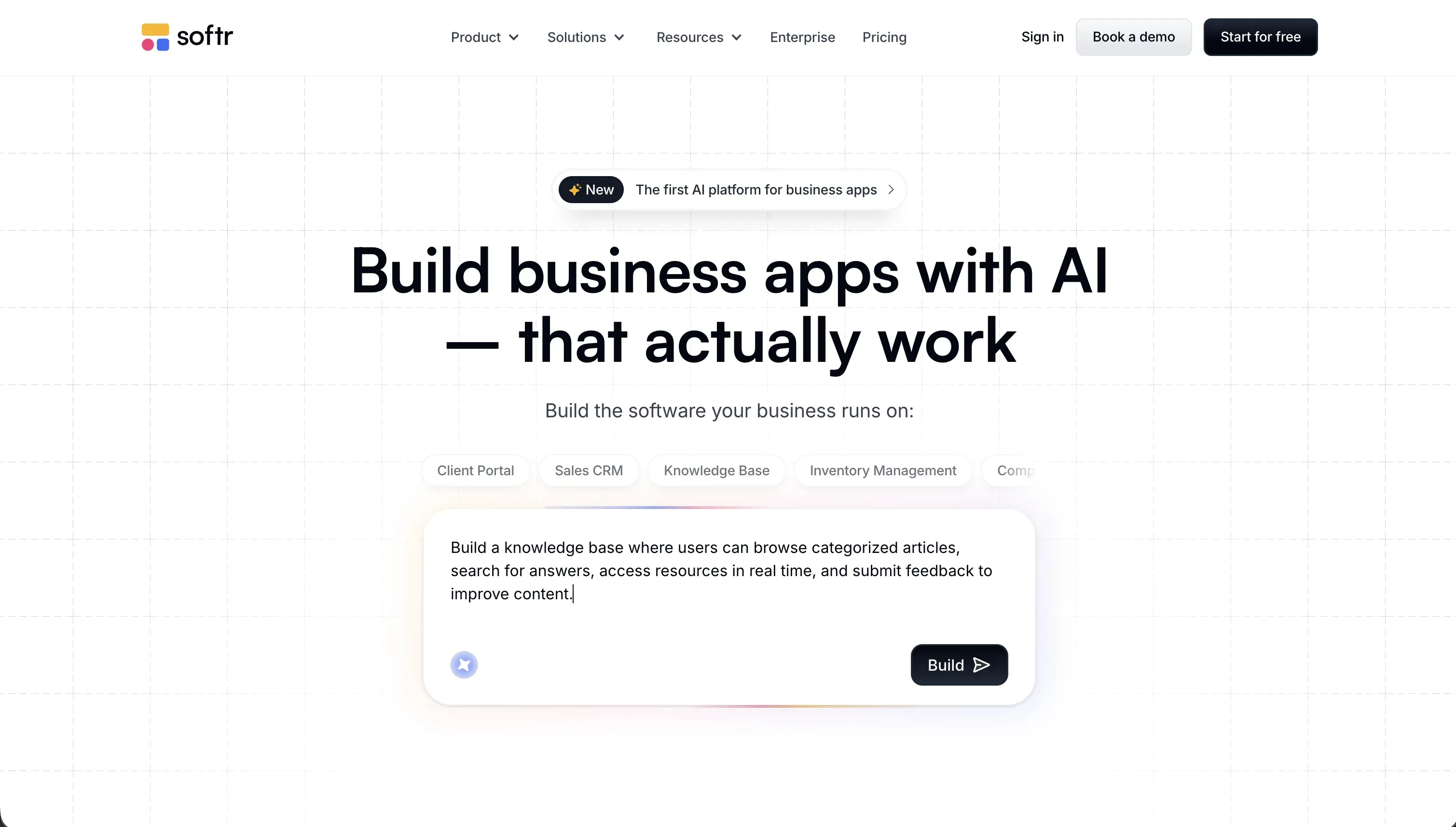
Softr is an AI-powered no-code platform for building business software like client portals, internal tools, CRMs, and team intranets. Used by over 1 million builders, it combines database management, authentication, user permissions, and visual layout editing in one subscription, and its AI Co-Builder can generate the whole app from a description.
In practice, Softr’s key distinction is that it configures pre-styled, responsive blocks instead of generating raw compile-dependent React. You can co-build with AI to produce database schemas, pages, permissions, and navigation in one shot, start from a template, or build block by block manually, and either way there is no generated code to debug. It starts with native Softr Databases, connects to 17+ external sources like Airtable, PostgreSQL, and HubSpot, and includes a Vibe Coding block for custom React components that inherit your app’s styling and permissions without risking core reliability.
Softr is built for operations teams, founders, and IT departments in organizations scaling from SMBs to large Enterprises, enabling them to ship secure client portals, vendor portals, internal databases, and CRMs. It is especially strong for non-technical operators who need a safe, governed environment to build custom tools, replace spreadsheets, and digitalize workflows without shadow IT risks. It remains less ideal for buyers who want native App Store binaries, real-time games, or pixel-by-pixel canvas control.
| Spec | Details |
|---|---|
| Primary Stack | Softr Databases, visual interface blocks, workflows, and native forms |
| Interface | AI Co-Builder plus visual no-code editor with manual configuration parity |
| Primary Deployment Target | Hosted responsive web apps and PWAs for internal tools and external portals |
| Key Advantage | Production-ready permissions and infrastructure with no generated code to maintain |
The Core Difference
The biggest difference is not how fast each tool produces a first version. It is what sits underneath the app after that first version: generated code you must maintain, or configured infrastructure you never touch.
- Emergent generates a real full-stack codebase from prompts and relies on autonomous edit agents to change it, which means speed up front but credit burn, regression loops, and maintenance overhead later.
- Softr configures pre-built no-code infrastructure with permissions and auth baked in, prioritizing stable business software and predictable flat pricing over owning generated code.

Head-to-Head Comparison
We evaluated both platforms across six core categories.
1. Developer Experience & Iteration Speed
Emergent is genuinely fast at the first build. It can produce working backend routing, database tables, and styled UI blocks in under 10 minutes from a single prompt, which makes it an effective sandbox for a solo founder validating an idea. Task forking adds to this by letting you branch application states and test modifications without losing your starting point.
The trouble starts at iteration. Because edits run through an autonomous edit agent, a change as small as adjusting a button color or a text field can boot an agent that scans the whole codebase and consumes credits. As the codebase grows, the context window struggles, and users report agents reverting completed work, reintroducing bugs, or getting stuck in debugging loops, with one account describing the same bugs fixed five or more times.
Softr’s first run is also prompt-driven and quick, but iteration works differently. The AI Co-Builder generates the database, pages, navigation, and user groups, and then you keep editing visually without going back to the AI for every change. Moving a block, adding a page, or changing a permission is a direct manual action in the studio, so the cost of a small change is your time, not a credit charge plus a risk of regression.
That difference compounds on day two. Emergent feels faster in the opening sprint, but Softr is far easier to evolve because nothing gets recompiled under you when you make a change, and the app does not break in ways you then have to pay an agent to repair.
Edge: Softr, because both start fast, but Softr lets you iterate without credit charges or regression loops eating into completed work.
2. Code Quality & Portability
Emergent actually competes here, which is unusual for an AI builder. It generates a full-stack codebase and offers GitHub integration on Standard and Pro, so you can export your source rather than being fully locked in. For a technical founder who wants to take the skeleton and continue in a real IDE, that is a meaningful escape hatch.
The caveat is quality and completeness. Users report that production does not equal preview, that the backend generation can be smooth while production readiness depends heavily on logic complexity, and that the code degrades once the project gets large. Exporting the frontend and backend to GitHub also does not cleanly carry the relational database and integrations, so the migration still needs developer configuration.
Softr does not offer code export, and it is honest about why: there is no generated code underneath. It configures pre-built no-code infrastructure, so you are not handed a React repository to own or maintain. If your benchmark is shipping and owning a custom codebase, that is a real limitation compared to Emergent.
Where Softr protects you is at the data layer. Softr Databases are native, and any external sources you connect, such as Airtable or PostgreSQL, keep the records in systems you already control. You give up code ownership in exchange for never inheriting code debt, which for a non-technical team is often the better trade.
Edge: Emergent, because it genuinely exports a codebase via GitHub, even if production quality and database migration are imperfect.
3. Database & Backend Capabilities
Emergent provisions a PostgreSQL database and backend routing automatically as part of the scaffold, which is a real relational backend rather than a spreadsheet wrapper. For an MVP that needs auth, data entry forms, and basic relations, that is a strong starting point generated in minutes.
The weakness is durability. Because the backend is generated code running in isolated containers, community feedback warns of a scale wall once the codebase grows past a few thousand lines, with broken pages and edit agents that struggle to maintain context. Container “wake” errors can also block backend access entirely for days, which is a hard problem when the database is the heart of your app.
Softr starts with native Softr Databases that support relational links and row-level permissions, and it can also sync with 17+ external sources including Airtable, PostgreSQL, and HubSpot. Because the database is managed infrastructure rather than generated code, you do not hit the same regression and container-wake failures when you make changes.
The bigger advantage is how tightly the data connects to the app layer. Permissions, logged-in user filters, forms, and the AI Co-Builder all sit on top of the same governed structure, and SQL plus REST API sync is available on the Business plan for connecting existing systems. For internal tools and multi-tenant portals, that coherence beats a generated backend you cannot fully trust at scale.
Edge: Softr, because its governed native database and permission model stay stable as the app grows, where Emergent’s generated backend hits a scale wall.
4. Hosting & Deployment Options
Emergent handles hosting for you, auto-configuring container environments and generating public preview links so you can share a working app immediately. For a fast prototype, not having to set up infrastructure is a real convenience, and the GitHub integration means you can move the code elsewhere if you outgrow the hosted setup.
The reliability story is weaker. Users report that production does not match preview, making post-deployment bug fixing challenging, and that container wake errors and blocked backend access stall projects with slow support turnaround. So deployment is easy to trigger, but the deployed result is not consistently dependable once the app is business-critical.
Softr also hosts everything for you, but with a business-software posture. Every app ships with authentication, user management, permissions, hosting, and security from the start, supports custom domains on paid plans, and delivers a responsive web app or PWA without a handoff to engineering. You publish something real without managing servers or compiler builds.
The tradeoff is that Softr does not give you self-hosting or native binaries, and it does not hand you the underlying code. But for the typical buyer here, a stable hosted portal that does not diverge between preview and production is worth more than the flexibility Emergent offers on paper.
Edge: Softr, because both auto-host, but Softr’s deployments are stable and production-consistent rather than preview-to-production guesswork.
5. AI Quality & Reliability
Emergent’s AI is the entire product, not an add-on. The edit agents generate and modify full-stack code, and the Pro plan adds a 1M context window and Ultra Thinking reasoning for multi-step database and security work. When it works, the breadth of what a single prompt produces is the main reason people try it.
The reliability problem is the flip side of that ambition. Because every change runs through an agent that spends credits, and because the agents can introduce bugs and then loop trying to fix them, the AI’s failures cost you money directly. Analysis cited from wavespeed.ai notes the agent can get stuck in infinite debugging loops consuming credits to fix errors it created, and users describe charges where nearly all the spend went to repeated work.
Softr’s AI is broad but not load-bearing in the same way. The AI Co-Builder generates the app, database schema, blocks, and user groups, and keeps helping inside the editor, but every AI-built piece has a manual visual fallback. The Database MCP Server even lets external assistants like Claude or Cursor read and write your schema by prompt.
That design makes Softr’s AI more reliable in practice. It uses credits ranging from 5 on Free to 100 on Business, but running low does not freeze the project because the same changes can be made manually. AI accelerates the work instead of becoming a mandatory dependency you pay for on every edit.
Edge: Softr, because its AI speeds up building without becoming a paid dependency, while Emergent’s agent failures translate directly into wasted credits.
6. Pricing Model & Predictability
Emergent’s credit model is the single most-criticized part of the product. Standard is $20/mo for 100 credits and Pro is $200/mo for 750 credits billed annually, but monthly credits do not roll over, and the edit agent consumes them on nearly every action. Top-ups exist at $10 for 50 credits and never expire, but they only kick in after monthly credits are gone, so heavy editing months get expensive fast.
The pain compounds with documented billing complaints. Users report being charged credits to fix bugs the AI itself introduced, and several describe auto-renewal on packages they believed were one-time purchases. One widely shared account totaled nearly $10,000 AUD before abandoning the platform. The cost is hard to forecast because it scales with how much the AI struggles, not how much value you get.
Softr charges flat monthly rates tied to features and database rows, not per-action credits or per-user seats. Free is $0, Basic is $19/mo, Pro is $99/mo, and Business is $329/mo billed annually, and plans support up to 30 Team and 100 Client app users on Business without per-seat licensing. App collaborators who build are unlimited, so adding teammates does not inflate the bill.
This is the clearest dimension of the comparison. Softr’s bill is the same whether you make one change or one hundred, while Emergent’s bill rises with every edit and every bug the agent reopens. For anyone running a budget, predictability wins.
Edge: Softr, because flat feature-based pricing is easy to forecast, while Emergent’s credit burn is unpredictable and punishes iteration.

Pricing Comparison
Emergent:
- Free - $0, 10 free monthly credits, build web and mobile experiences, core platform features
- Standard - $20/mo billed annually, 100 credits/mo, private project hosting, GitHub integration, task forking, purchase extra credits
- Pro - $200/mo billed annually, 750 credits/mo, 1M context window, Ultra Thinking, system prompt editing, custom AI agents, high-performance computing
- Enterprise - Custom pricing, custom seat limits, SSO/SAML, advanced privacy, single-tenant, custom SLAs
- Top-ups - $10 for 50 credits (never expire, consumed after monthly credits)
Softr:
- Free - $0, 5 app users, 5,000 database records, 500 workflow actions, 5 AI credits
- Basic - $19/mo billed annually, 5 Team + 5 Client app users, 50,000 database records, 2,500 workflow actions, AI credits included, custom domains
- Pro - $99/mo billed annually, 10 Team + 50 Client app users, 500,000 database records, 10,000 workflow actions, 50 AI credits, custom user groups and permissions
- Business - $329/mo billed annually, 30 Team + 100 Client app users, 1,000,000 database records, 25,000 workflow actions, 100 AI credits, SQL databases and REST API sync
- Custom - Custom pricing
Use Case Fit: When to use which?
When to choose Emergent
- Choose Emergent when you are a technical founder who wants AI to scaffold a full-stack code skeleton, including a PostgreSQL database, for a startup MVP.
- Choose Emergent when you want GitHub export and the option to continue the code in your own environment, and you can configure the database migration yourself.
- Choose Emergent when you have the budget to absorb credit consumption and can manually maintain or repair the generated code when agents introduce bugs.
When to choose Softr
- Choose Softr when you are building a real internal tool, CRM, vendor portal, or client portal that needs authentication and granular user groups from day one.
- Choose Softr when you want AI to accelerate setup but still need full visual control over pages, blocks, permissions, and database structure afterward, with no generated code to maintain.
- Choose Softr when predictable flat pricing matters more than owning the source code, and you do not want edit charges or regression loops draining your budget.
When neither Emergent nor Softr is the right fit
For native mobile apps
Neither Emergent nor Softr is the right pick if your real requirement is publishing native iOS and Android binaries to the App Store and Google Play. Emergent can compile simple layouts for mobile browsers, but its mobile workflows are documented as significantly less mature than its web compiler, and Softr ships responsive web apps and PWAs rather than native compiled packages.
For that job, look at FlutterFlow or Adalo. FlutterFlow is the stronger option when you need serious native-app flexibility and a real path to app-store output, while Adalo is the simpler choice if you want a more beginner-friendly native-mobile builder.
For internal tools and client portals
If your project is a business app that real users depend on, an internal CRM, a vendor portal, or a client dashboard, Emergent’s generated-code approach is a poor fit, since its own profile notes that securing stable business systems in isolated containers is difficult and the edit-agent billing punishes constant small changes. This is the use case Softr was built for.
In that case, Softr is the natural choice, with authentication, dynamic user groups, and row-level permissions on every plan, native Softr Databases or 17+ external connectors, and no generated code to break. For teams that want a more code-first internal tool with direct SQL and API access, Retool is the other sensible option, since it pairs a component-based builder with developer-grade data connectivity.
For professional developer environments
If your team wants source control, terminal access, package management, and the ability to own the full stack as a real codebase, both Emergent and Softr are the wrong abstraction. Emergent generates code but routes you through agents rather than a real development workflow, and Softr deliberately hides code altogether.
Here, look at Cursor or Replit. Cursor fits developers already living in an IDE who want AI pair-programming on a real repository, while Replit makes more sense if you want a browser-based coding environment with a database, terminal, and deployment tooling built in.

Verdict
Pick Emergent if you are technical, want AI to generate a full-stack code skeleton fast, and accept the tradeoffs that come with it. It can produce a working backend, database, and UI in minutes, and GitHub export gives you a real escape hatch. The cost is real: unpredictable credit burn, edit agents that revert work and loop on bugs, container wake errors, and a scale wall once the codebase grows. You are buying speed and code ownership, and paying for it in maintenance and money.
Pick Softr if the app needs to behave like dependable business software rather than a prototype. It gives you authentication, granular permissions, native databases, and flat pricing, and because there is no generated code, you never inherit regression loops or billing spikes. The tradeoff is that you do not own a codebase and cannot ship native App Store apps, so it is the wrong tool if code ownership or native mobile is the goal.
The day-two reality decides most of these choices. The first version of an app is rarely the expensive part; the expensive part is every change after launch, especially when more people rely on it and a broken edit touches real operations. Emergent makes that day-two cost both unpredictable and high, while Softr keeps it flat and stable. Between these two, Softr ages better for internal tools and portals, and Emergent remains a fast but costly sketchpad for technical founders; if you outgrow both, Replit or Cursor are the next places to look depending on how much control you want.

Summary Comparison Table
| Criterion | Emergent | Softr |
|---|---|---|
| Best for | Full-stack MVP skeletons for technical founders | Production business apps and portals |
| Build paradigm | AI-generated full-stack code via edit agents | AI Co-Builder plus visual no-code editor |
| Output type | Generated code in hosted containers | Configured no-code infrastructure |
| Database | Auto-generated PostgreSQL backend | Softr Databases first, plus 17+ external sources |
| Visual permissions | Limited, must be coded and secured manually | Granular user groups and row-level restrictions |
| Pricing metric | Per-action credits that do not roll over | Flat plans by features, records, and app users |
| Code export | Yes, via GitHub on Standard and Pro | No |