

Bolt and Emergent sit in the same broad category of AI app builders, but they come from slightly different instincts. Bolt behaves more like a browser-based coding environment with AI scaffolding layered on top, while Emergent leans harder into full-stack prompt generation with hosting and backend setup included. Both promise you can type a prompt and get a working app quickly.
The people actually deciding between them are usually technical founders, indie hackers, and semi-technical operators trying to skip weeks of setup. What matters is not just who generates a prettier first draft, but who burns less money in revision loops, who gives you a cleaner exit path, and who collapses under complexity later. This is a real tradeoff between environment control, billing predictability, and how much maintenance pain you are willing to absorb after the demo works once.
Meet the Contenders
What is Bolt?
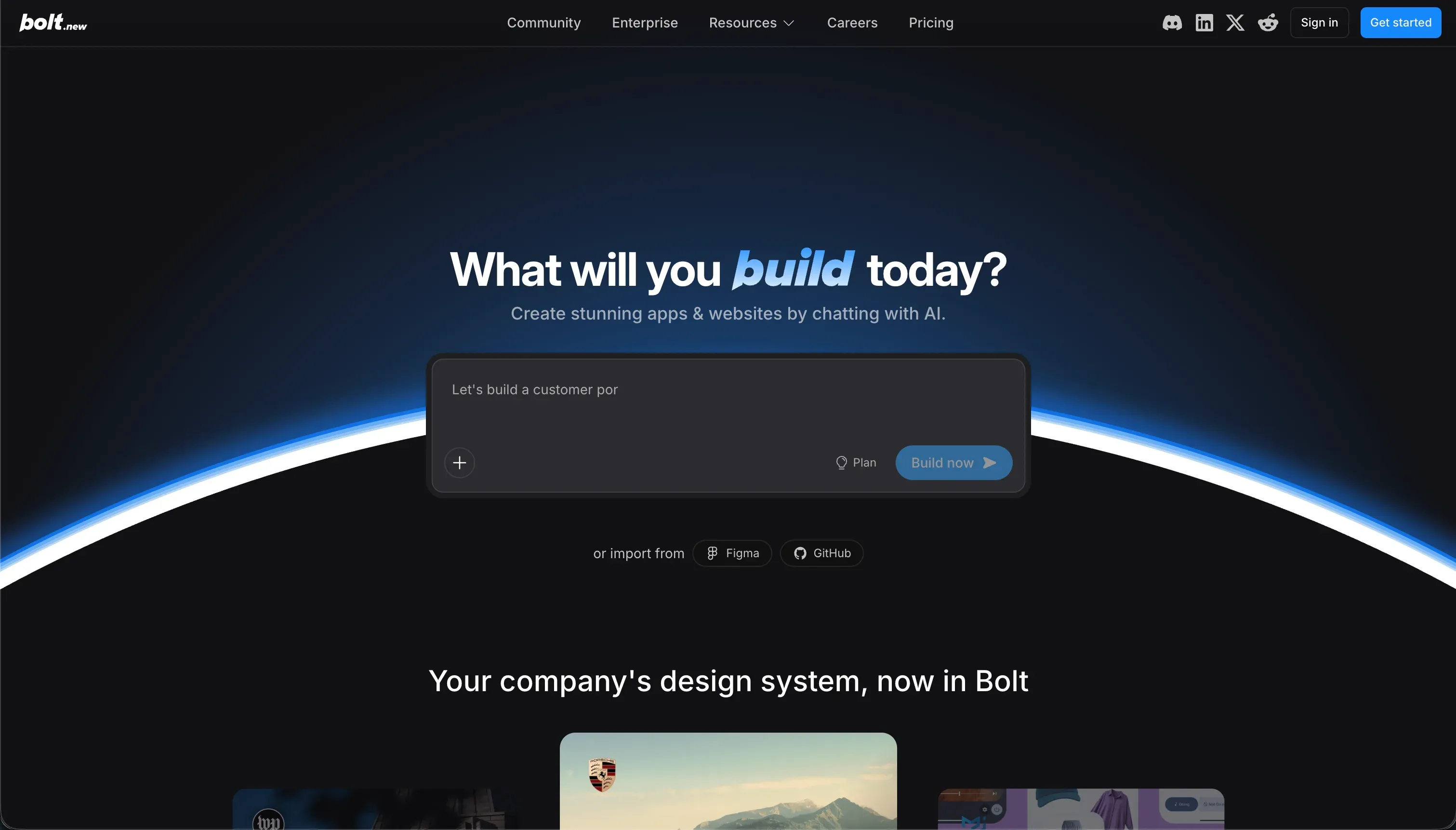
Bolt is an AI-powered app builder that feels closer to a browser IDE than a pure chat toy. It is built for people who want fast prompt-to-app generation but still want to inspect files, run a dev server, and keep some control over the app’s architecture.
In practice, Bolt runs a full Node.js environment in the browser through WebContainers, so you can install npm packages, execute terminal commands, and preview changes live while the AI writes React, Node.js, routing, styling, and PostgreSQL schema code. It also supports GitHub sync, code export, Figma and Storybook imports, and built-in hosting on .bolt.host with paid custom domains.
It is genuinely attractive for developers, technical founders, and tinkerers who want AI scaffolding without giving up the feeling of working in a real code workspace. The people who get frustrated are usually non-developers who expected a one-prompt product, because Bolt still asks you to debug, reason about architecture, and survive token-burning edit loops when the generated code drifts or breaks.
| Spec | Details |
|---|---|
| Primary Stack | AI-generated React and Node.js code with routing, state management, styling, and PostgreSQL schemas. |
| Interface | Browser-based editor with WebContainers, terminal access, live preview, and AI prompt iteration. |
| Primary Deployment Target | Hosted web apps on Bolt Cloud and .bolt.host, with Netlify deployment options. |
| Key Advantage | Real browser-native dev environment plus code export and GitHub sync. |
What is Emergent?

Emergent is an AI-powered full-stack application builder designed to generate frontend, backend, database, and hosting from natural-language prompts. Its pitch is simpler than Bolt’s: tell it what you want, let the platform scaffold the whole thing, and keep refining through chat.
In practice, Emergent offers prompt-to-application scaffolding, conversational revisions, and built-in cloud deployment with public preview links. Its paid plans add GitHub integration, task forking, a 1M context window on Pro, system prompt editing, custom AI agents, and top-up credits for overages.
It is built for founders and builders who want the shortest path from idea to a live full-stack skeleton without thinking much about setup. The users who get angry are the ones who hit credit-draining edit agents, repeated bug-fixing charges, preview-versus-production mismatches, or larger codebases where community reports say the platform becomes unstable and expensive fast.
| Spec | Details |
|---|---|
| Primary Stack | AI-generated full-stack web apps with frontend, backend, database routing, and managed hosting. |
| Interface | Conversational prompt builder with iterative revisions and built-in public previews. |
| Primary Deployment Target | Managed web deployment through Emergent’s hosted platform. |
| Key Advantage | Very fast all-in-one scaffolding with backend, database, and hosting bundled from the first prompt. |

The Core Difference
The biggest gap is not raw generation speed. It is whether you want AI scaffolding inside something that resembles a real development environment, or a more opinionated all-in-one generator that hides more of the stack until it starts costing you.
- Bolt runs like a browser-native coding workspace where AI helps scaffold and edit code, but still leaves you with developer-style responsibilities.
- Emergent runs like a more self-contained full-stack generator where the AI handles more of the initial setup, but also becomes the main bottleneck when revisions and credit burn pile up.

Head-to-Head Comparison
We evaluated both platforms across four core categories.
1. Developer Experience & Iteration Speed
Bolt is strong in the first hour because the workflow feels tangible. You can prompt the app into existence, inspect the files, run terminal commands, install npm packages, and use the live preview while the AI edits the project. For technical users, WebContainers are the real selling point because the environment behaves more like a stripped-down cloud IDE than a black-box app wizard.
The weakness is iteration drift. User reports mention Bolt rewriting functioning code, burning tokens during diff-based edits that do not stick, and even throwing “project too large” limits that can block further prompts. So while the interaction model is better than pure chat builders, the day-to-day experience still degrades once the project gets bigger or the AI starts fixing its own mistakes badly.
Emergent is also fast at the start, arguably even more direct for non-developers because it bundles frontend, backend, database routing, and hosting into one prompt-driven path. If your goal is simply to get a full-stack skeleton online with minimal setup thinking, Emergent’s framing is easier to grasp than Bolt’s more developer-fluent environment.
The problem is that Emergent’s iteration model appears harsher once edits begin. Community complaints repeatedly describe the edit agent undoing completed work, charging credits for bug fixes, and forcing users to repay for the same changes multiple times. That means iteration can feel fast until it suddenly becomes expensive, repetitive, and hard to trust.
Edge: Bolt, because its browser IDE model gives technical users a more usable editing loop than Emergent’s heavier reliance on paid revision agents.
2. Code Quality & Portability
Bolt has the cleaner portability story of the two. It lets you export standard React and Vite codebases and sync with GitHub, which means a developer can pull the project out, inspect it, version it, and continue elsewhere without begging the platform for an escape hatch.
That does not mean the code is always clean. Research points to generated output that often needs manual refinement before it is production-ready, and some users complain about complete overhauls of existing UI or build failures after updates. Still, if you care about code ownership, Bolt at least gives you something real to take with you.
Emergent does offer GitHub integration on Standard and above, which is useful, but the research here is much thinner on true exportability and much louder on platform dependency. Most of the value is tied to its managed generation loop, managed hosting, and credit-driven edit flow rather than to a strong “take the whole thing and leave” story.
That matters because user complaints focus less on owning the code and more on paying repeatedly to stabilize it. If the platform keeps charging credits for fixes and the generated project diverges between preview and production, portability becomes more theoretical than practical for non-experts.
Edge: Bolt, because code export and GitHub sync are more clearly part of the product rather than an afterthought.
3. Database & Backend Capabilities
Bolt can scaffold backend logic and PostgreSQL schemas from prompts, which is useful for getting a web app moving without manual setup. It also offers Bolt Cloud hosting with integrated user management and authentication, so the stack feels broader than a frontend-only generator.
But there is a catch: Bolt lacks a native database admin interface, so structural backend changes still flow through code or prompts instead of a proper visual control layer. The product research explicitly flags this as a weakness, and user discussions around backend choices often drift toward external tools because Bolt itself is not the easiest place to operate app data after generation.
Emergent’s pitch is stronger on the all-in-one full-stack story. It scaffolds backend schema, database routing, and deployment from a single prompt, which makes it appealing to founders who do not want to think about Supabase, auth providers, or separate infra choices at the outset.
The problem is trust and scalability. Community feedback says production readiness drops as logic gets more complex, larger repositories break down more easily, and backend access can become blocked during container issues. So Emergent looks more complete on day one, but less reassuring once the backend becomes something you actually need to operate safely.
Edge: Emergent, because it does a better job bundling backend and database setup in the initial generation flow, even if long-term control looks shakier.
4. Hosting & Deployment Options
Bolt gives you several pragmatic deployment paths. You can publish to .bolt.host, use paid custom domains, or deploy to Netlify, which gives technical teams more flexibility than a single in-house deployment lane. That matters if you want to move fast without fully surrendering where the app ends up.
The downside is reliability under load and complexity. Research notes browser memory problems, WebContainer crashes, and build failures on larger projects, which means the convenience can evaporate once the workspace gets heavy. Flexible deployment is good, but it does not automatically equal a stable production workflow.
Emergent keeps deployment even simpler on paper because built-in cloud deployment and public previews are part of the core experience. For non-technical users, that is appealing: fewer infrastructure choices, less configuration, and a shorter path from prompt to shareable app.
Yet the community feedback is much harsher here. Users report preview-versus-production discrepancies, blocked backend access during deployment issues, and slow support response when containers fail. So Emergent wins on simplicity of the first publish, but loses confidence once something goes wrong in production.
Edge: Bolt, because its deployment options are broader and less locked to a single fragile hosted path.
5. AI Quality & Reliability
Bolt’s AI is good at fast scaffolding and decent at iterative refactoring when the project is still small. Features like prompt enhancement and AI-powered debugging make the initial build loop feel polished, and the live preview gives instant feedback while the AI writes changes.
The problem is reliability over time. Multiple user reports describe Bolt burning tokens on unnecessary errors, rewriting working code, and failing to preserve recent edits. The criticism that Bolt still acts like a one-shot generator rather than a truly agentic system is important, because it explains why fixes can feel brute-force instead of precise.
Emergent’s AI can generate full-stack app skeletons very quickly and lower the barrier for people who want a broad application from a plain-English prompt. The Pro plan’s 1M context window, system prompt editing, and custom AI agents suggest the team is pushing toward more configurable high-end generation.
But the public complaints are much uglier. Users report infinite debug loops, credits consumed for bugs the platform caused, repeated rollback of completed work, and stories of massive spending with poor outcomes. When the platform’s main promise is AI execution, that level of credit-coupled unreliability is a serious structural flaw.
Edge: Bolt, because both tools suffer regression risk, but Emergent’s credit-charged failure loops sound materially worse.
6. Learning Curve & Onboarding
Bolt is easier for developers than for true beginners. If you already understand packages, file structures, deployments, and why browser terminal access matters, Bolt feels intuitive because it maps onto familiar coding habits. The free plan with 1M tokens and a 150K daily cap is also a decent playground for testing the workflow.
For non-technical users, though, the learning curve is deceptive. You may not need local setup, but you still need to think like a developer when errors appear, auth gets messy, or the AI produces code you must inspect manually. Bolt removes environment friction more than it removes engineering complexity.
Emergent is easier to understand in the first session because the model is simpler: prompt the app, let the system scaffold everything, and keep refining by conversation. That makes it more approachable for founders and operators who do not care about developer ergonomics and just want visible output quickly.
The catch is that the learning curve reappears as billing pain and trust issues rather than as visible technical concepts. Once the edit agent starts consuming credits for revisions, failed runs, or bug fixes, a beginner can end up paying to discover the limits of the platform. In other words, Emergent feels easier upfront, but not necessarily safer to learn on.
Edge: Emergent for first-hour simplicity, because its prompt-first model is more approachable than Bolt’s browser-IDE mindset.

Pricing Comparison
Bolt:
- Free - $0 with 1M tokens per month, a 150K daily cap, basic hosting, and public-only projects.
- Pro - starts at $25/month with 10M tokens, private projects, custom domains, and token rollover up to 2 months.
- Teams - starts at $30/member/month with 10M tokens per member, centralized billing, and team access controls.
- Pro scaling tiers - $50 for 26M tokens, $100 for 55M tokens, with higher intermediate tiers up to $2,000 for 1.2B tokens per month.
- Teams scaling tiers - $60 per member for 26M tokens, $110 per member for 55M tokens, $210 per member for 120M tokens, with higher tiers up to $2,000 per member for 1.2B tokens.
Emergent:
- Free - $0 with 10 monthly credits and core platform features.
- Standard - $20/month billed annually with 100 credits per month, private project hosting, GitHub integration, task forking, and optional extra credit purchases.
- Pro - $200/month billed annually with 750 credits per month, a 1M context window, Ultra Thinking, system prompt editing, custom AI agents, and high-performance computing.
- Enterprise - custom pricing with custom seat limits, SSO/SAML, advanced privacy, single-tenant setup, and custom SLAs.
- Top-ups - 50 extra credits for $10, or sometimes $8 for 50 credits under certain overage structures or promotions.
Use Case Fit: When to use which?
When to choose Bolt
- Choose Bolt when you want AI scaffolding inside a browser environment that still feels like real development, with terminal access, npm installs, and file-level visibility.
- Choose Bolt when code export and GitHub sync matter, and you have the technical skill to clean up the generated React and backend logic afterward.
- Choose Bolt when you are building a web app prototype or SaaS MVP and value architecture control more than fully managed convenience.
When to choose Emergent
- Choose Emergent when you want the shortest path from plain-English prompt to a hosted full-stack app with backend, database routing, and preview links included.
- Choose Emergent when you are less interested in dev-environment control and more interested in one tool handling the initial scaffold end to end.
- Choose Emergent when your project is still small, experimental, and simple enough that credit unpredictability and platform regressions are acceptable risks.
When neither Bolt nor Emergent is the right fit
For internal tools and client portals
Neither Bolt nor Emergent is a great answer when the job is an operational system that real employees, vendors, or clients will use every day. Both tools can generate something impressive quickly, but both still push you back into debugging, prompt loops, and fragile generated logic once permissions, workflows, and data visibility get serious.
That is where Softr is the better fit. It starts with Softr Databases as the native foundation, then layers in visual user groups, row-level permissions, authentication, hosting, and workflows from day one. Its AI Co-Builder is the fast path, but not the only path, which matters because running low on AI credits does not stop you from maintaining the app manually in the visual editor.
For native mobile apps
Neither Bolt nor Emergent is the right pick if your real requirement is app-store distribution with native iOS or Android binaries. Bolt is primarily for web apps and community feedback explicitly notes it cannot publish Apple App Store-ready builds, while Emergent’s mobile workflows are described as less mature than its core web experience.
If mobile is the product, start with FlutterFlow for the more serious native route, or look at Adalo and Glide for easier app-first builders. Those tools are built around mobile delivery itself rather than stretching a generated web app into something mobile-ish later.
For professional developer environments
If you want AI help inside a more serious long-term coding setup, neither of these is the cleanest answer. Bolt gets closer because of WebContainers and code export, but it is still constrained by browser runtime limits and token economics. Emergent is even further from this use case because its strength is full-stack generation, not disciplined developer control.
That is where Cursor or Replit make more sense. Cursor is the stronger pick if you already work in a local professional workflow and want AI tightly integrated into real code editing, while Replit is better if you want a fuller cloud development environment without leaning so hard on expensive prompt-based app generation.
Verdict
Pick Bolt if you are a technical founder or developer who wants AI scaffolding without giving up the feeling of working in a real environment. The tradeoff is that you are still accepting token caps, manual cleanup, and the possibility that the AI will rewrite or destabilize working code. But among these two, Bolt gives you the better escape hatch because the code is exportable and the workflow is closer to actual software development.
Pick Emergent if your main priority is getting a full-stack app scaffolded with the least setup thought possible. The tradeoff is sharper: you are buying into a credit-driven system that community feedback repeatedly describes as expensive, unstable, and prone to making you pay again for revisions or bug-fixing loops. That can be tolerable for small experiments, but it is a rough basis for anything you plan to rely on.
This is the part a lot of buyers miss: code ownership is useful, but day-two maintenance matters more than the first wow moment. Bolt is the more credible choice of these two, yet both still hand non-developers too much hidden engineering work once the app grows. If the real project is a business app with users, permissions, records, and workflows, Softr usually ages better because it gives you production-ready structure without trapping every change behind another prompt and another billable fix.

Summary Comparison Table
| Criterion | Bolt | Emergent |
|---|---|---|
| Best for | Technical builders who want AI scaffolding in a browser IDE | Founders who want fast all-in-one full-stack scaffolding |
| Build paradigm | Browser-native coding workspace plus AI generation | Conversational full-stack app generation |
| Output type | Exportable React/Vite-style web app code | Managed generated full-stack web app |
| Database | AI-generated schemas, but no strong native DB admin layer | AI-generated backend and database routing in one flow |
| Pricing metric | Monthly token caps with daily limits and scaling tiers | Monthly credits plus paid top-up credits |
| Code export | Yes, with GitHub sync and code ownership | GitHub integration, but weaker export story |
| Maintenance burden | High, but more manageable for developers | Very high once edit loops and credit burn start |