

Adalo and Softr sit in different corners of the no-code market, which is exactly why people end up comparing them. Adalo is a mobile-first visual builder aimed at simple apps and MVPs, while Softr is an AI-powered platform for operational business software such as portals, CRMs, and internal tools. The real choice is not just editor preference, but whether you need a prototype-friendly mobile canvas or a production-ready business stack.
This comparison is really for founders, operators, and product teams trying to avoid the wrong kind of lock-in. Pick wrong, and you either overbuild a simple app or hit a wall when permissions, data scale, and real users arrive. The stakes are time, maintenance burden, and whether your app is still usable on day two instead of just impressive on day one.
Meet the Contenders
What is Adalo?
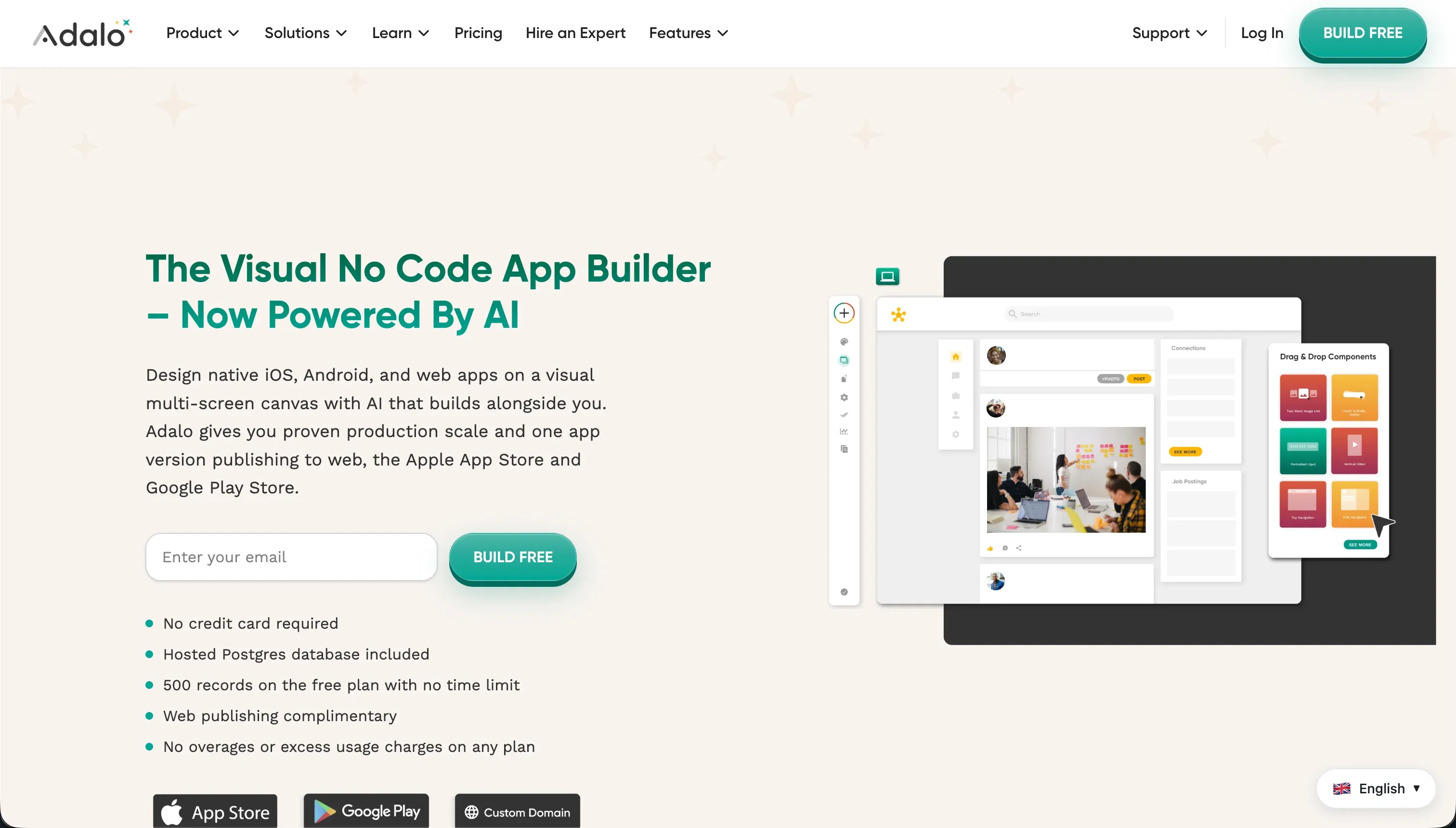
Adalo is a no-code visual builder for mobile and web apps. It is best known for letting non-developers design screens on a drag-and-drop canvas and publish either to the web or to native mobile app stores.
In practice, Adalo works like a classic visual builder: you place UI elements on screens, store records in its built-in relational database, and wire up actions for navigation, updates, and notifications. It also offers REST API connections, Airtable integration on higher plans, and a component marketplace for add-ons like Stripe or audio players. The upside is quick initial scaffolding for small apps. The downside is that many users report sluggish performance, brittle integrations, and fixed-width layouts that feel awkward on larger screens.
Adalo is genuinely built for creators, designers, and founders who want to get a simple mobile app or MVP into users’ hands without learning a full framework. It gets frustrating for teams building multi-role business software, especially when they need granular permissions, large datasets, or dependable support once the app becomes operational rather than experimental.
| Spec | Details |
|---|---|
| Primary Stack | Adalo visual builder with built-in relational database and action workflows |
| Interface | Drag-and-drop screen canvas with actions, forms, and marketplace components |
| Primary Deployment Target | Web publishing plus native mobile app store submission |
| Key Advantage | Fast path to simple mobile MVPs without needing Flutter or React Native |
What is Softr?
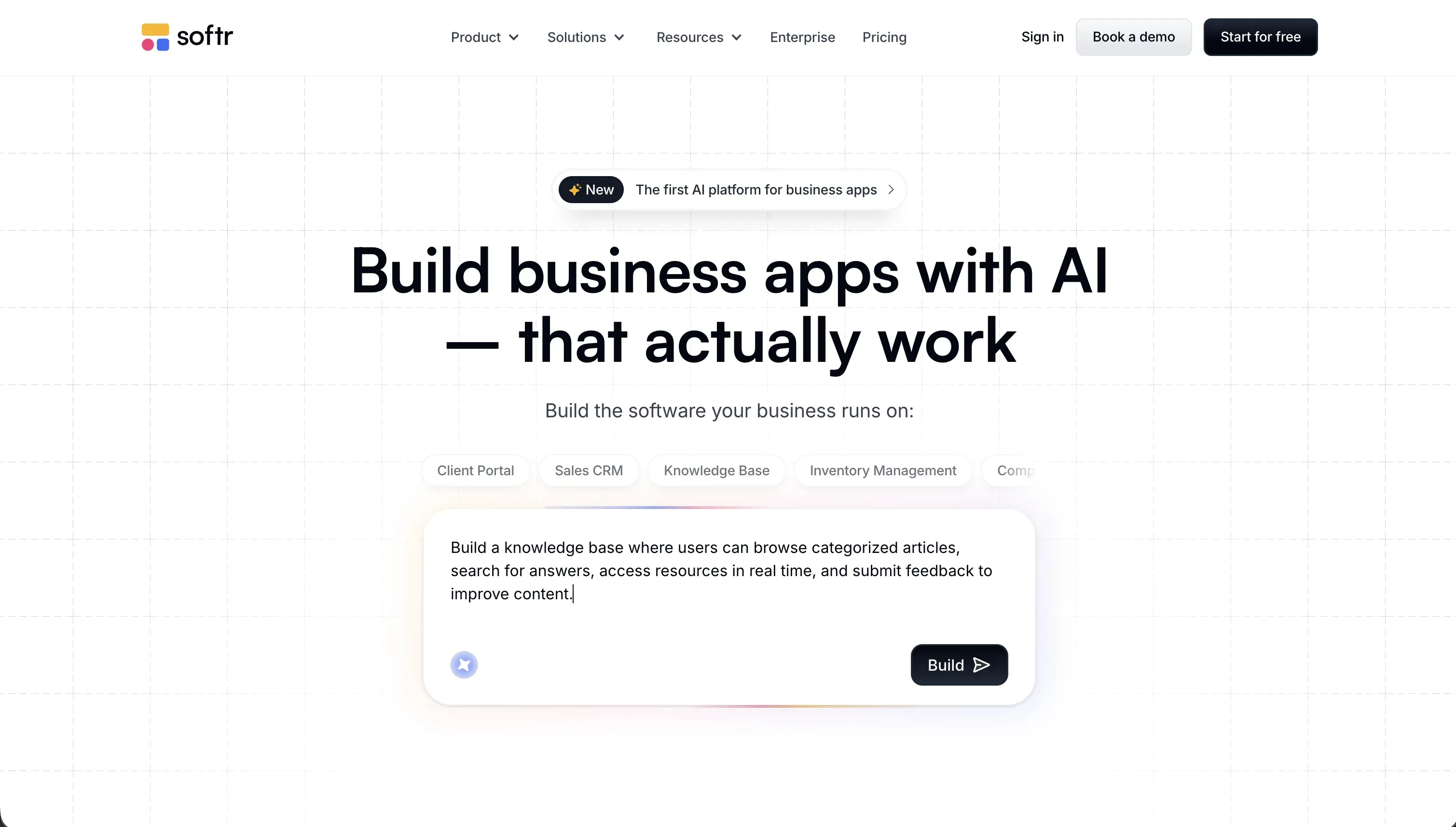
Softr is an AI-powered platform for building business software without code. Instead of starting from a blank canvas, you can describe the app you need and Softr’s AI Co-Builder creates the database, pages, navigation, and user logic for you, then lets you refine everything visually.
In practice, Softr is built around four native layers: Softr Databases, the interface builder, Workflows, and standalone Forms. Its strongest features are the AI Co-Builder, granular user groups and row-level permissions, and the ability to ship apps with auth, hosting, and security already built in. Softr Databases are the default foundation, and the platform also connects to 17 external sources when needed. If you need something custom, the Vibe Coding block can generate a specific UI component without turning the whole app into an unmaintainable codebase.
Softr is genuinely built for business operators, founders, and department leads creating internal tools, CRMs, inventory systems, intranets, and client portals. It is a much better fit than Adalo when the app must support real users, real permissions, and ongoing operational changes without sending the team into endless rebuild cycles.
| Spec | Details |
|---|---|
| Primary Stack | Softr Databases, visual interface builder, Workflows, and AI Co-Builder |
| Interface | Visual block-based editor with AI-assisted app creation and in-editor editing |
| Primary Deployment Target | Hosted web apps and PWAs with custom domains |
| Key Advantage | Production-ready business apps with granular permissions and built-in infrastructure |
The Core Difference
The biggest difference is not no-code versus no-code. It is prototype-oriented mobile app building versus production-oriented business app building.
- Adalo is a mobile-first canvas builder that helps you assemble simple apps quickly, but asks you to accept tighter database limits, weaker permission controls, and more fragility as the app grows.
- Softr is an AI-first but not AI-only business app platform that gives you a stable database, auth, permissions, workflows, and visual editing from the start, so the app is meant to survive real operational use.

Head-to-Head Comparison
We evaluated both platforms across four core categories.
1. Developer Experience & Iteration Speed
Adalo is approachable at the start. Its visual canvas is easy to grasp, especially if your mental model is screens, buttons, forms, and simple actions. Compared with heavier tools, it has a shorter onboarding curve, and it can get a basic mobile MVP live without asking you to understand a full dev stack.
The problem is what happens after the first version. Multiple Capterra reviewers describe basic functionality as tedious to build, with one calling forgot-password flows and multiple-image uploads a “long tedious process.” Others report that changing external API definitions can mean starting over from scratch. That is not fatal for a throwaway MVP, but it is bad news for an app you expect to evolve weekly.
Softr is faster for structured business apps because it removes a lot of setup Adalo still makes you assemble manually. The AI Co-Builder can generate the database, pages, user groups, and navigation in one shot, and then you can edit visually without being trapped in a prompt loop. That hybrid flow matters because AI is the fastest path in, but not the only path forward.
It is not a free-form mobile canvas, so designers who want pixel-positioned screen composition may find it less playful than Adalo. But for the kinds of apps Softr targets, the iteration loop is much healthier: add a field, change a permission, adjust a block, or update a workflow without rebuilding the whole thing. User feedback repeatedly points to teams getting portals and internal tools live in hours or days rather than weeks.
Edge: Softr, because it gets you to a maintainable business app faster instead of just to a first draft faster.
2. Code Quality & Portability
Adalo is not a code-first environment, and it is not sold around exportable ownership. What you get is convenience inside Adalo’s builder and deployment flow, especially for app store publishing, but not the kind of portability technical teams expect from a real codebase. The platform is best treated as a hosted no-code runtime rather than a stepping stone to a clean engineering handoff.
That lock-in gets more painful when the app becomes business-critical. Users have reported brittle external API editing and data export issues, including one complaint that exported database file links did not come along properly. If your exit plan depends on taking a clean system elsewhere later, Adalo is weak here.
Softr also does not give you raw code export, so if your priority is owning a deploy-anywhere codebase, neither of these tools is ideal. Softr’s argument is different: it gives you stable hosted infrastructure and data portability rather than frontend code files. That is a fair trade for operators who care more about running the app than maintaining source code.
The key distinction is that Softr reduces the practical pain of staying on-platform. Softr Databases can be exported, and if you use external sources, that data remains in those systems. More importantly, you are not managing a generated codebase that drifts over time. For business teams, that usually matters more than theoretical code ownership they would never realistically maintain themselves.
Edge: Softr, because neither tool is truly code-portable, but Softr offers the safer long-term lock-in story through data portability and lower maintenance.
3. Database & Backend Capabilities
Adalo includes a built-in relational database, which is enough for small apps and straightforward record relationships. For a lightweight directory, booking flow, or small user app, that can be perfectly serviceable. It also supports Airtable and REST APIs on higher tiers, which gives you some escape hatches beyond the default internal database.
The ceiling shows up quickly. Adalo’s plans cap records hard: 200 on Free, 10,000 on Starter, 30,000 on Professional, 100,000 on Team, and 250,000 on Business. Research and user feedback both point to scaling issues, slow queries, and weak support for more complex external-source workflows. For business apps with evolving schemas and multiple user types, that is a cramped backend story.
Softr’s default answer is Softr Databases, which is exactly how it should be positioned because the native stack is where the platform is strongest. You get a relational database, linked records, rollups, row-level permissions, CSV import, and instant triggers with Workflows. Record limits are dramatically higher than Adalo’s, from 5,000 on Free up to 1,000,000 on Business.
If your data already lives elsewhere, Softr also connects to 17 external sources, including Airtable, Google Sheets, HubSpot, Notion, and SQL databases on higher plans. That matters because the app does not have to be a toy database trapped in a single builder. Add the MCP server for AI assistants like Cursor, and Softr starts looking much more like operational infrastructure than a simple frontend shell.
Edge: Softr, because its native database is built for business-scale records, permissions, and workflows rather than just basic app storage.
4. Hosting & Deployment Options
Adalo’s best deployment argument is obvious: it can package apps for the web and for native app stores. If your success metric is “I need something on iOS and Android without learning Flutter,” Adalo has a real advantage over web-only builders. For founders testing a consumer concept, that can be enough reason to choose it.
But deployment flexibility is not the same as deployment reliability. Users have reported internal server errors hitting paying customers, native Android performance that felt roughly 10 times slower than the same PWA, and recurring support delays when apps went down. Shipping to an app store is nice. Shipping something dependable is better.
Softr is web-first, not native-app-store-first. It publishes hosted apps and PWAs, which is the right tradeoff for most internal tools and client portals where browser access, magic links, and secure permissions matter more than app store badges. It also gives you custom domains, SPA mode, and hosting out of the box.
For teams building operational software, this is usually a better deployment model than pretending every workflow app should be a native mobile product. Softr apps are ready with auth, user management, permissions, and hosting on publish. The limit is clear, though: if true native binaries and app store distribution are non-negotiable, Softr is not trying to be FlutterFlow.
Edge: Adalo for app store publishing, but Edge overall for reliability and practical deployment goes to Softr.
5. AI Quality & Reliability
Adalo is behind the market here because it effectively has no meaningful native AI story. There is no built-in AI app generation, no vibe coding layer, and no AI-assisted editing flow comparable to newer platforms. That makes Adalo feel dated in a market where builders increasingly expect help with schema creation, UI setup, and repetitive configuration.
Oddly, that absence is not only a weakness. It also means Adalo is not pretending to solve app complexity with prompts alone. Still, if you want AI scaffolding to accelerate work, Adalo simply does not have a competitive answer today.
Softr is AI-first, but the important nuance is that it is not AI-only. The AI Co-Builder can generate the database, pages, blocks, user groups, and navigation from a plain-language prompt, then continue editing inside the studio with context awareness. On top of that, Softr has a Vibe Coding block, AI database helpers, AI agents in database fields, Ask AI, and AI-enabled workflows.
The reliability angle is where Softr separates from vibe-coding hype. AI is used to accelerate a stable no-code foundation, not replace it. If credits run low, you can still keep building manually. That is a much healthier model than systems where every fix depends on another prompt and another chance to break what already worked.
Edge: Softr, because Adalo barely competes on AI, while Softr uses AI to speed up a stable platform instead of forcing you into prompt dependency.
6. Learning Curve & Onboarding
Adalo’s surface-level learning curve is lighter than many advanced app builders. If you can think in screens and user actions, the canvas is straightforward, and that is why it still attracts creators and founders who find tools like Bubble too dense. For first-time no-code builders making something simple, that matters.
The trouble is that ease at the start does not necessarily translate into confidence later. Reviewers complain about poor UX, buggy basics, and support that tells them to search the academy or hire an expert. A tool that looks beginner-friendly but becomes frustrating as soon as requirements get real is not actually beginner-friendly in the long run.
Softr is easier for business users because the platform is opinionated about what a real app needs: database, auth, permissions, pages, and workflows. The AI Co-Builder reduces blank-canvas paralysis, while templates and manual building stay available for teams that prefer direct control. That mix keeps onboarding fast without forcing a single workflow on everyone.
There is still product depth here, especially once you move into custom user groups, workflows, and external integrations. But the learning curve is much more aligned to operators than to hobbyist app designers. Reviews repeatedly describe Softr as intuitive, easy to navigate, and fast to implement for internal tools and portals, which is exactly the segment it is targeting.
Edge: Softr, because Adalo is easier only at the toy-app stage, while Softr stays understandable as the app becomes real.
Pricing Comparison
Adalo:
- Free - $0/month, 1 published web app, 200 database records per app, Adalo branding.
- Starter - $36/month billed annually or $45/month billed monthly, 1 published web app, custom domain, 10,000 database records.
- Professional - $52/month billed annually or $65/month billed monthly, 2 published apps including 1 native app, custom fonts, Airtable integration, 30,000 database records.
- Team - $160/month billed annually or $200/month billed monthly, 5 published apps, native supported, team collaboration, 100,000 database records.
- Business - $200/month billed annually or $250/month billed monthly, 10 published apps, priority support, 250,000 database records.
Softr:
- Free - $0/month, 10 app users, 5,000 database records, 500 workflow actions, 5 AI credits.
- Basic - $49/month billed annually or $59/month billed monthly, 20 app users, 50,000 database records, 2,500 workflow actions, 10 AI credits.
- Professional - $139/month billed annually or $167/month billed monthly, 100 app users, 500,000 database records, 10,000 workflow actions, 50 AI credits.
- Business - $269/month billed annually or $323/month billed monthly, 500 app users, 1,000,000 database records, 25,000 workflow actions, 100 AI credits.
- Custom - custom pricing, custom app users, records, workflow actions, and AI credits.
Use Case Fit: When to use which?
When to choose Adalo
- Choose Adalo when your main goal is a simple mobile MVP and native app store publishing matters more than deep business logic.
- Choose Adalo when you are working with a small dataset and can stay comfortably inside its record limits and simpler role model.
- Choose Adalo when you want a lighter mobile-first canvas and do not need built-in AI, advanced workflows, or enterprise-style permissions.
When to choose Softr
- Choose Softr when you are building an internal tool, CRM, partner portal, or client-facing workflow app that real users will depend on.
- Choose Softr when you need user groups, row-level permissions, hosted auth, and a database that can grow from 5,000 to 1,000,000 records depending on plan.
- Choose Softr when you want AI to accelerate setup but still want full visual control afterward, instead of being trapped in prompt-only edits.
When neither Adalo nor Softr is the right fit
For full code ownership and a real developer workflow
If your team wants exportable code, direct control over the stack, and the ability to keep evolving the product outside a proprietary builder, neither Adalo nor Softr is the best answer. Adalo is a closed no-code platform, and Softr deliberately prioritizes managed infrastructure over raw code export. In that scenario, tools like Replit or Cursor make more sense because they operate in an actual coding environment rather than abstracting it away.
Replit is better when you want to ship and host directly inside a browser-based dev environment, while Cursor is better when you already have developers and want AI integrated into a real IDE workflow. Both beat Adalo and Softr when the deciding factor is long-term code ownership rather than no-code speed.
For highly custom web apps with deeper visual logic
If your app is neither a simple mobile MVP nor a structured operational portal, you may be in the awkward middle where Adalo is too limited and Softr is too opinionated. That usually means you need more control over custom states, complex frontend behaviors, or unusual product logic than either of these tools is built to handle elegantly.
In that case, Bubble or WeWeb are the stronger picks. Bubble is better for complex visual workflow logic and deeply custom web app behavior, while WeWeb is better if you want a more developer-friendly frontend layer on top of external backends. Both beat Adalo and Softr when flexibility matters more than simplicity.

Verdict
Pick Adalo if your real requirement is mobile-first distribution and you are honest that the app is still basically an MVP. It is the better fit for simple consumer-style apps where getting onto app stores matters more than deep permissions, large datasets, or long-term operational reliability. The tradeoff is that you are accepting tighter ceilings, more fragility, and a weaker day-two story.
Pick Softr if the app is tied to how a business actually runs. It is the stronger choice for client portals, internal tools, CRMs, inventory systems, and multi-role workflows because the database, authentication, permissions, hosting, and automation are built in from the start. The tradeoff is that you are choosing structured business software over native app store packaging.
The day-two reality is where this comparison stops being close. Adalo can get a small app live, but Softr is far better at surviving change, scale, and real operational use. If neither model fits because you need either full code ownership or much deeper custom logic, move to Replit, Cursor, Bubble, or WeWeb instead of forcing the wrong platform to become something it is not.

Summary Comparison Table
| Criterion | Adalo | Softr |
|---|---|---|
| Best for | Simple mobile MVPs and lightweight consumer apps | Business apps, portals, CRMs, and internal tools |
| Build paradigm | Mobile-first visual canvas | Visual builder plus AI Co-Builder |
| Output type | Web apps plus native mobile publishing | Hosted web apps and PWAs |
| Database | Built-in relational DB with strict record caps | Softr Databases plus 17 external source connections |
| Permissions | Basic roles and manual visibility workarounds | User groups, row-level security, and page rules |
| Pricing model | Per-plan limits tied closely to record counts and published apps | Flat plans by app users, records, workflows, and AI credits |
| Maintenance burden | Higher once the app grows past prototype scope | Lower because auth, hosting, permissions, and workflows are built in |