

Same.dev and Base44 both promise to turn an idea into software fast, but they hand you very different things at the end. Same.dev, now rebranded as Same.new, is a front-end cloning tool: paste a URL, get a React and Tailwind version of that interface, and edit it by chatting with an AI. Base44 is a full-stack generator that produces a UI, a managed PostgreSQL database, user authentication, and hosting from a single prompt.
The people choosing between them are usually founders and builders trying to ship something quickly without standing up infrastructure. What is really at stake is not the first demo, which both can produce, but everything after it: who owns the code and data, how the bill behaves when the AI misfires, and whether the app survives contact with real users. Pick wrong, and you either ship a pretty front-end with no backend or a full-stack app that breaks every time you ask it to change.
Meet the Contenders
What is Same.dev?
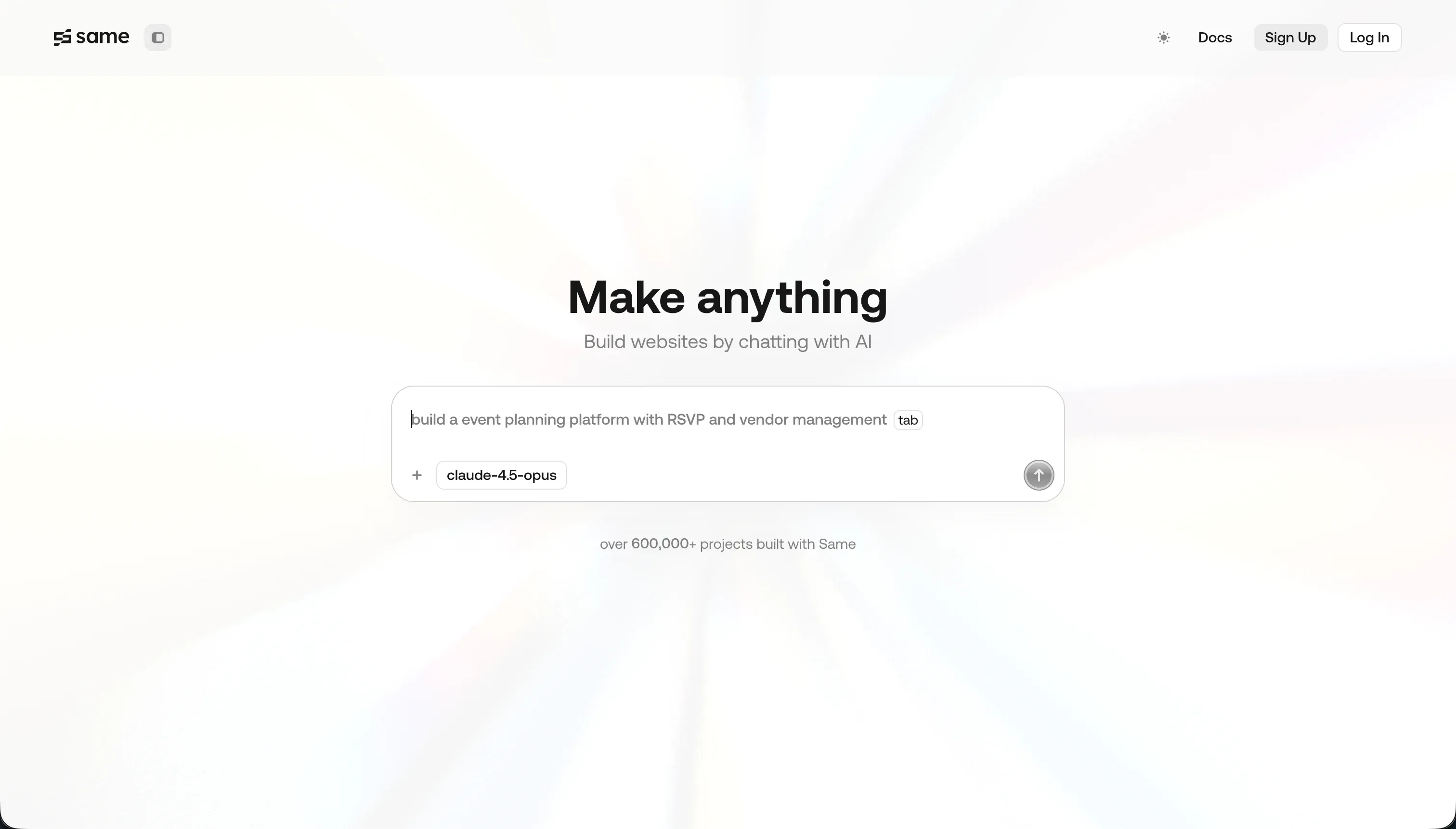
Same.dev, now Same.new, is a generative AI front-end utility built to clone and prototype user interfaces. You paste a live website URL, and the AI parses the page’s HTML structure and CSS variables, converting the design into a React and Tailwind CSS codebase you can keep editing.
In practice, Same.new works best when your goal is visual: replicating a landing page, mocking up component spacing, or scaffolding a clickable layout to test a design direction. You edit by typing commands to a chat assistant, and you can fork components to branch different versions. The hard limit is that it compiles the front-end only. There are no managed database tables, no APIs, and no sign-in system, so a form that needs to save data securely requires you to write endpoints and connect a PostgreSQL database by hand.
Same.new is genuinely useful as a fast prototyping playground at a low price, with Pro starting at $10/month. It gets risky once you push it past simple clones. Paid subscribers report that prompting the AI to reorder sections or add elements has destroyed thousands of lines of working code, and the transition from Same.dev to Same.new locked some active paid projects into read-only, leaving users without access to their work.
| Spec | Details |
|---|---|
| Primary Stack | URL-to-React cloning engine that outputs React and Tailwind CSS code |
| Interface | Conversational chat assistant editing generated front-end code |
| Primary Deployment Target | Exportable front-end code for local dev or hosts like Vercel |
| Key Advantage | Very fast visual cloning of a website layout from a single URL |
What is Base44?
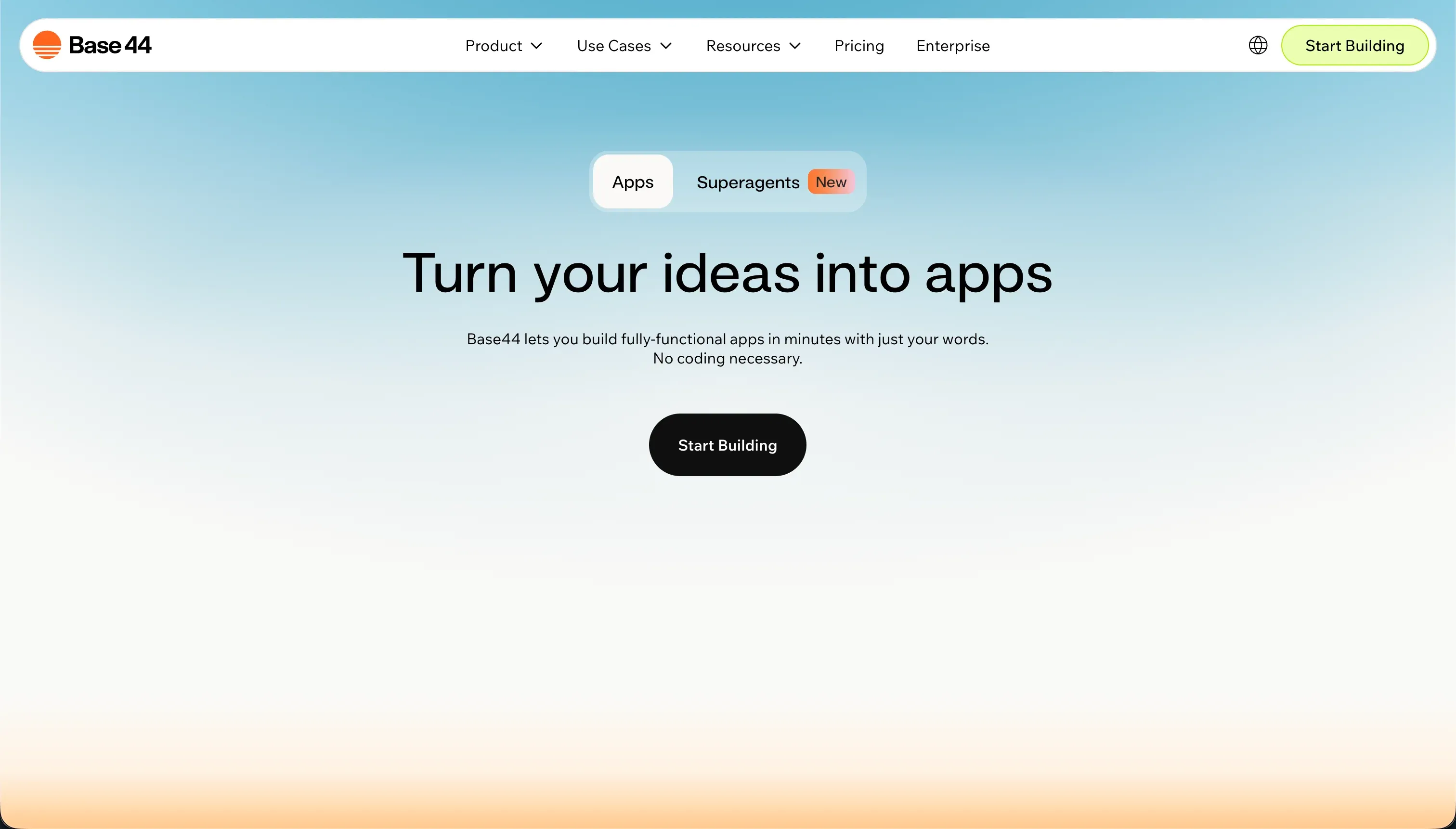
Base44 is an AI-powered full-stack application creator that turns conversational descriptions into web systems. From a plain-English prompt it generates the UI, business logic, a PostgreSQL database schema, user authentication, and hosting in one pass, all inside a single dashboard.
In practice, Base44 is aimed at builders who want to avoid configuring servers, database engines, or code files. It has a Discuss Mode for brainstorming architecture without spending message credits, an Idea Library of templates, design tokens you apply with single-word prompts, and a click-to-tweak visual editor for adjusting colors, spacing, and typography after generation. Front-end code can be exported to GitHub, though the database and backend logic stay locked to Base44’s infrastructure.
Base44 is strong for fast MVP scaffolding and basic database apps like dashboards, project trackers, and simple login portals. It struggles once you need stability or true SaaS features. Builders report weekly builder and server outages, regression loops where the AI breaks working pages, and difficulty implementing per-user billing or workspace-level data isolation. Its permissions are basic role settings rather than the granular, field-level control that production portals require.
| Spec | Details |
|---|---|
| Primary Stack | Conversational AI generating front-end plus managed PostgreSQL and auth |
| Interface | Conversational builder chat plus click-to-tweak visual editor |
| Primary Deployment Target | Instant hosting on Base44’s cloud with shareable live URLs |
| Key Advantage | One-pass full-stack generation with database, auth, and hosting included |
The Core Difference
The biggest difference is scope. One tool stops at the interface; the other tries to own the whole stack, including your data.
- Same.dev is a front-end cloning utility that turns a URL into editable React and Tailwind code, with no backend, database, or auth, so you own the front-end and build everything else yourself.
- Base44 is a full-stack conversational generator that bundles UI, a managed database, auth, and hosting, which is more complete but keeps your backend and data locked inside its closed infrastructure.

Head-to-Head Comparison
We evaluated both platforms across six core categories.
1. Output Scope & What You Actually Get
Same.new produces a front-end and nothing more. You get clean, copyable React and Tailwind code that mirrors the layout you cloned, which is exactly what a designer or developer wants when the plan is to build on top of it. For visual drafts, marketing sections, and component mockups, that focused output is a feature, not a limitation.
The flip side is that “front-end only” means there is no database, no API, and no authentication. The moment your project needs to save a record, log a user in, or enforce who sees what, Same.new hands the work back to you. That is a hard stop for anyone hoping to ship a functioning app rather than a styled shell.
Base44 gives you a far more complete package from one prompt: UI, business logic, a PostgreSQL database, auth, and hosting. For a founder who wants a working MVP today, that breadth is the whole appeal, and it is genuinely more than Same.new attempts.
The catch is that the completeness comes with strings. The backend logic runs entirely on Base44’s closed cloud, the auth screens cannot be branded, and complex needs like multi-tenant isolation are difficult. So you get more out of the box, but less of it is truly yours to control or move.
Edge: Base44, because it delivers a working full-stack app rather than a front-end shell, even though that app comes with real backend constraints.
2. Code Quality & Portability
Same.new is the more portable of the two for what it covers. The output is standard React and Tailwind, downloadable and deployable to a host like Vercel, so a developer can take the front-end and keep working in a normal toolchain. There is no backend to trap, because there is no backend at all.
The limitation is that GitHub sync and ongoing project work require the $10/month Pro plan, and the export only ever covers the interface. You get clean front-end ownership, but you are still on the hook for engineering everything behind it, which narrows how useful that portability really is.
Base44 technically supports code export, but it is gated and partial. You must subscribe to the $50/month Builder tier to sync the front-end to GitHub, and even then the database and backend logic stay locked inside Base44. One reviewer estimated a $480 annual cost just to get the build off the platform.
That backend lock-in is the core portability problem. Your front-end might leave, but your data and logic, the parts that actually represent the app, cannot follow without a rebuild. For anyone worried about long-term ownership, that is a heavier constraint than Same.new’s front-end-only scope.
Edge: Same.dev, because it gives clean standard front-end code with no backend lock-in, whereas Base44 traps your data and logic in its cloud.
3. Database & Backend Capabilities
Same.new has no native backend story at all. There are no managed tables, no relations, and no auth layer. If you want a form to persist data, you write the API endpoints and connect a PostgreSQL database yourself. For a pure prototyping tool, that is by design, but it means Same.new simply does not compete on this axis.
That is fine if you treat it as a front-end scaffolder feeding a backend you build elsewhere. It is a dealbreaker if you expected a no-code path to a working data-driven app, because the hardest engineering is exactly the part Same.new leaves to you.
Base44 is clearly ahead here, since a managed PostgreSQL database and built-in auth come standard. From a prompt it structures tables, configures sign-in, and wires the front-end to the data, which is a real backend out of the box and the main reason people pick it over a front-end tool.
The weaknesses show up at scale. Base44 routes through LiteLLM, which introduces API limits and latency on large datasets and PDFs, and builders report that it is hard to make an app SaaS-ready with multi-user support and data isolation. The backend exists, but it is shallow and not built for complex production systems.
Edge: Base44, because it ships a real managed database and auth that Same.dev lacks entirely, despite scaling limits.
4. Reliability & Edit Stability
Same.new’s reliability problem is destructive editing. Because the AI rewrites the codebase in response to prompts, a routine request can do real damage. Paid users have reported that reordering sections destroyed more than 1,500 lines of working code, and forking larger projects frequently fails. The rebrand from Same.dev also locked some active paid projects into read-only.
That fragility undercuts the speed advantage. Quick cloning is great, but if iterating on the clone risks wiping your progress, the time saved up front gets spent again on recovery. It works best as a one-shot scaffolder rather than something you iterate on heavily.
Base44 has the same destructive pattern plus infrastructure instability. Reviewers describe regression loops where one fix spawns several new bugs, prompts that overwrite functional pages, and apps breaking in production after AI updates. Multiple users keep GitHub backups specifically to recover from bad builds.
On top of that, builders report server and builder outages occurring almost weekly, which is a serious risk for anything client-facing. Between fragile AI edits and shaky uptime, Base44 asks you to accept meaningful operational risk for the convenience of full-stack generation.
Edge: Same.dev, narrowly, because both suffer destructive AI edits, but Base44 adds frequent server outages that put live apps at risk.
5. Pricing Predictability
Same.new is cheap to start and simple in structure. Pro is $10/month with 2 million tokens, and extra tokens are $5 per million. For light front-end work, that is hard to beat, and the recent fixed-tier plans were added specifically to give users more predictable billing.
The hidden cost is retry burn. Every prompted change consumes tokens, so when the AI introduces bugs, fixing them eats into your pool. A messy session chasing a broken layout can quietly drain tokens, which is the exact complaint that pushed the platform toward fixed tiers in the first place.
Base44’s dual-credit model is more powerful but harder to forecast. Message credits are spent building, integration credits are spent when your live users query the database or send emails, and plans run from Free to Elite at $160/month annually. The two meters mean costs depend on both how much you build and how much your app gets used.
The bigger issue is that credits do not roll over and regression loops burn them fast. One user reported spending over 400 credits while the AI repeatedly broke their app. So an active app, or a buggy build session, can exhaust an allowance and force add-on purchases, making real monthly costs genuinely hard to predict.
Edge: Same.dev, because its lower entry price and single token meter are easier to forecast than Base44’s dual-credit model that scales with usage.
6. Learning Curve & Audience Fit
Same.new is approachable for its niche. If you can paste a URL and describe a tweak in chat, you can use it, and developers comfortable with React will feel at home in the exported code. The mental model is small because the tool does one thing: clone and edit a front-end.
The friction appears when non-developers expect more. Because there is no backend, anyone hoping to build a complete app hits a wall the tool never warns them about, and bridging that gap requires real coding skill. So the easy learning curve only holds if your expectations match its narrow scope.
Base44 is built to feel beginner-friendly, with zero setup, conversational building, Discuss Mode for planning without spending credits, and a click-to-tweak editor for visual changes. For a non-technical founder, getting a first full-stack draft live is genuinely fast and requires no infrastructure knowledge.
The catch is that the friendly start gives way to developer-level problems. Debugging regression loops, managing credit budgets, and working around backend limits all demand more sophistication than the onboarding suggests. The learning curve does not disappear, it just moves downstream to maintenance.
Edge: Base44 for getting a complete first draft live without setup; Same.dev for developers who want clean front-end code and accept they will build the rest.

Pricing Comparison
Same.new:
- Free - $0, limited tokens for basic UI testing and cloning
- Pro - $10/mo, 2 million tokens included, GitHub integration, custom domain hosting; additional tokens at $10 per 2 million ($5 per million)
- Fixed Tiers - tiered pricing based on token quotas, added for more predictable billing
Base44 (billed annually):
- Free - $0, 25 message credits/mo (max 5/day), 100 integration credits, PostgreSQL DB, auth, analytics
- Starter - $16/mo ($20 monthly), 100 message credits, 2,000 integration credits, unlimited apps, in-app code edits
- Builder - $40/mo ($50 monthly), 250 message credits, 10,000 integration credits, backend functions, custom domain, GitHub sync
- Pro - $80/mo ($100 monthly), 500 message credits, 20,000 integration credits, AI model select, premium support
- Elite - $160/mo ($200 monthly), 1,200 message credits, 50,000 integration credits, priority support
Note that Same.new’s tokens and Base44’s credits are both consumed by retries and bug fixes, so neither headline price reflects what a messy build session actually costs.
Use Case Fit: When to use which?
When to choose Same.dev
- Choose Same.dev when you want to clone a website’s front-end layout from a URL and get editable React and Tailwind code to build on.
- Choose Same.dev when you are a developer or designer who will own the backend yourself and just need a fast visual scaffold.
- Choose Same.dev when budget is tight, the project is a prototype or mockup, and you do not need a database, auth, or hosting included.
When to choose Base44
- Choose Base44 when you want a quick full-stack MVP with a managed database and auth from a single prompt and have no infrastructure to set up.
- Choose Base44 when you are validating an idea fast and can tolerate regression loops, credit burn, and occasional outages.
- Choose Base44 when you accept that the backend and your data will live on Base44’s closed cloud rather than in systems you control.
When neither Same.dev nor Base44 is the right fit
For stable client portals and internal tools
Neither tool is built for production business software with real users. Same.new has no auth or permissions at all, and Base44 offers only basic role settings with no field-level control, unbranded login screens, and reports of apps breaking in production after AI updates. For a portal that handles client data, that is too fragile.
For that job, look at Softr or Replit. Softr is an AI-powered platform for business software, where the AI Co-Builder generates the database, pages, navigation, and user groups from a prompt, but every change can also be made manually in the visual editor, so running low on AI credits never blocks you. It includes built-in auth, granular user groups, row-level restrictions, SOC 2 Type II compliance, and EU data hosting in Germany, with Softr Databases first and 17 external sources like Airtable available after. Replit suits developer-leaning teams who want a real code-first environment with proper infrastructure and ownership.
For complex web apps with deeper logic
If your app needs unusual UX flows, heavy logic orchestration, or genuine SaaS features like per-user billing and multi-tenant isolation, both tools will frustrate you. Same.new stops at the front-end, and Base44’s backend is shallow and locked, with builders reporting it is not built for SaaS natively.
That is where Bubble makes more sense. Bubble is the heavyweight choice for complex visual web app logic and gives you far more control over data structures and workflows than a conversational generator. It is a steeper learning curve, but it is built to carry real application complexity.
For native mobile apps
If you need native iOS and Android binaries in the App Store and Google Play, neither tool fits. Same.new produces web front-end code, and Base44 deploys responsive web apps on its own cloud, not native packages.
For that, look at FlutterFlow or Adalo. FlutterFlow is the stronger option for serious native-app flexibility and a closer path to real app-store output, while Adalo is the more beginner-friendly native-mobile builder.

Verdict
Pick Same.dev if your need is narrow and visual: cloning a front-end layout from a URL into clean React and Tailwind that you, or a developer on your team, will build the rest around. It is cheap, fast, and focused, and its code is reasonably portable because there is no backend to trap. The tradeoff is that it leaves all the hard engineering, data, auth, and logic, to you, and its AI edits can wipe working code, so treat it as a scaffolder, not a finishing tool.
Pick Base44 if you want a complete full-stack MVP today and are willing to accept the costs that come with it. It genuinely delivers a database, auth, and hosting from a prompt, which Same.new never attempts. But you are accepting backend lock-in, an unpredictable dual-credit bill, regression loops, and roughly weekly outages, which is a lot of risk for anything beyond a throwaway prototype.
The day-two reality decides this. The first build is rarely the expensive part; the expensive part is every change after, and both tools make changes risky in their own way. Between the two, Same.dev is the safer, more honest pick for what it claims to do, while Base44 over-promises on production readiness. If the real goal is a stable portal or internal tool, neither should be your destination: look at Softr for no-code business software or Replit if you want a code-first foundation you fully control.

Summary Comparison Table
| Criterion | Same.dev | Base44 |
|---|---|---|
| Best for | Cloning front-end layouts from a URL | Quick full-stack MVPs from a prompt |
| Output scope | Front-end React and Tailwind only | UI plus database, auth, and hosting |
| Database & backend | None, you build it yourself | Managed PostgreSQL, but shallow and locked |
| Code portability | Standard front-end code, exportable | Front-end export gated; backend locked in |
| Pricing model | Token-based, from $10/mo Pro | Dual credit, Free to $160/mo Elite |
| Reliability | Destructive AI edits, rebrand lockouts | Destructive edits plus weekly outages |
| Production portals | No auth or permissions | Basic roles only, no field-level control |