

Choosing between Lovable and Same.new is really a choice between two different kinds of AI scaffolding. Lovable is a full-stack prompt-to-app builder, while Same.new is a frontend cloning and UI replication tool. They overlap just enough to confuse buyers, but they solve different layers of the stack.
The people actually deciding between these two are usually founders, indie hackers, and product teams trying to save time on early builds. What is at stake is not just speed, but how much cleanup, lock-in, and billing pain you inherit after the first impressive demo. If you pick the wrong one, you either overpay for a frontend problem or underbuy for a real app problem.
Meet the Contenders
What is Lovable?
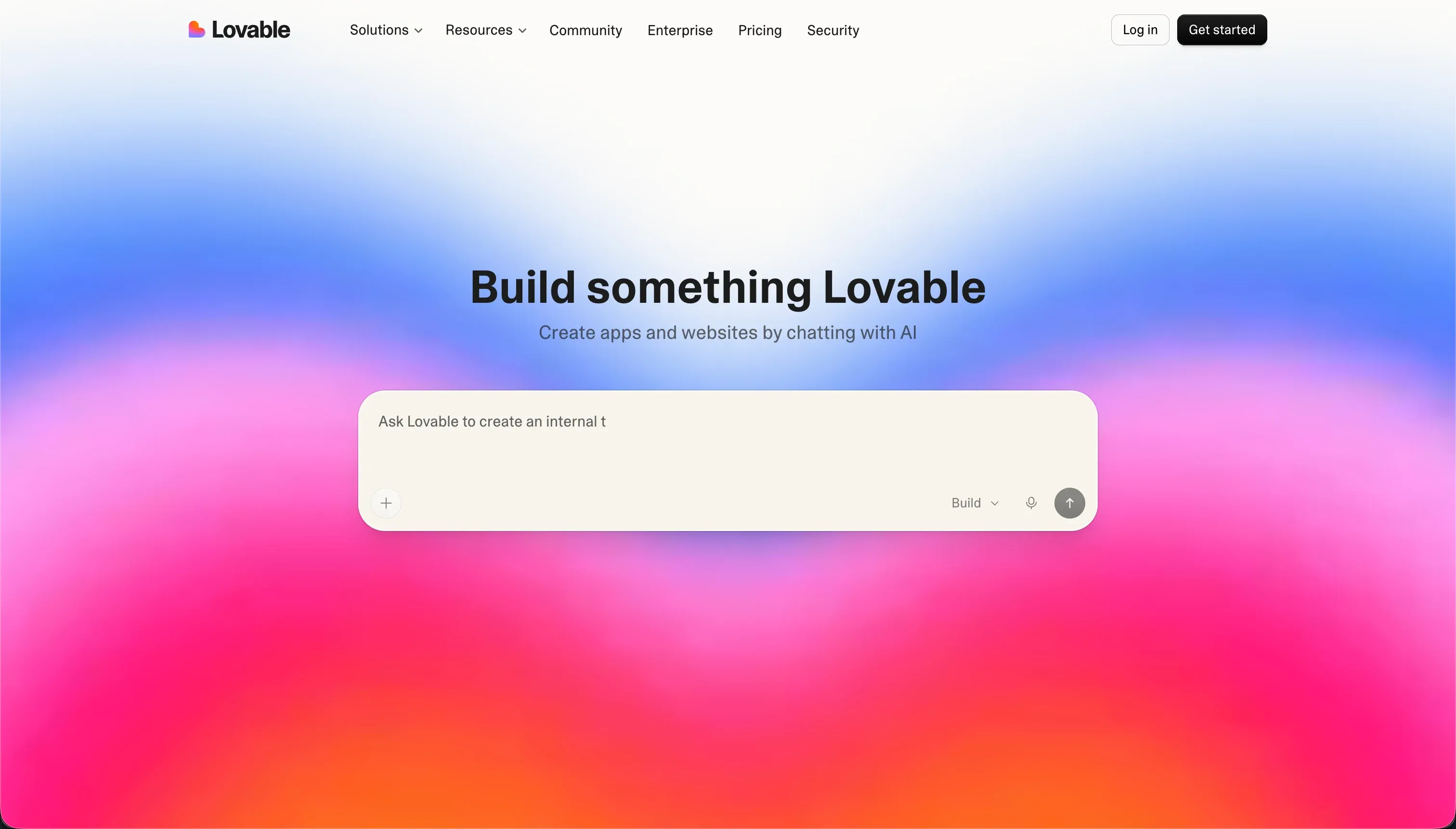
Lovable is an AI-powered full-stack application builder that turns natural language prompts into a React frontend, a Node.js backend, and a Supabase database. It is one of the better-known vibe-coding tools because it promises to scaffold a usable web app from a single chat thread.
In practice, Lovable works by generating the whole stack for you and then letting you keep iterating through prompts. Its notable capabilities include direct Supabase integration for database and auth bootstrapping, GitHub sync for taking the code elsewhere, Figma import for turning design assets into React components, context connectors for tools like Linear and Notion, and pre-publish security scans that check dependencies and Supabase RLS policies.
It is genuinely built for founders and builders who want to get a SaaS-style web app online quickly and are comfortable treating AI as a junior full-stack teammate. It gets frustrating for users who expected a low-maintenance visual builder, because once the app gets more complex, they still have to reason about schema design, security rules, regression bugs, and credit burn like a developer.
| Spec | Details |
|---|---|
| Primary Stack | React frontend, Node.js backend, Supabase database |
| Interface | Conversational prompt builder with iterative code generation |
| Primary Deployment Target | Lovable Cloud with custom domains on paid plans |
| Key Advantage | Fast full-stack scaffolding with GitHub sync and built-in Supabase setup |
What is Same.new?
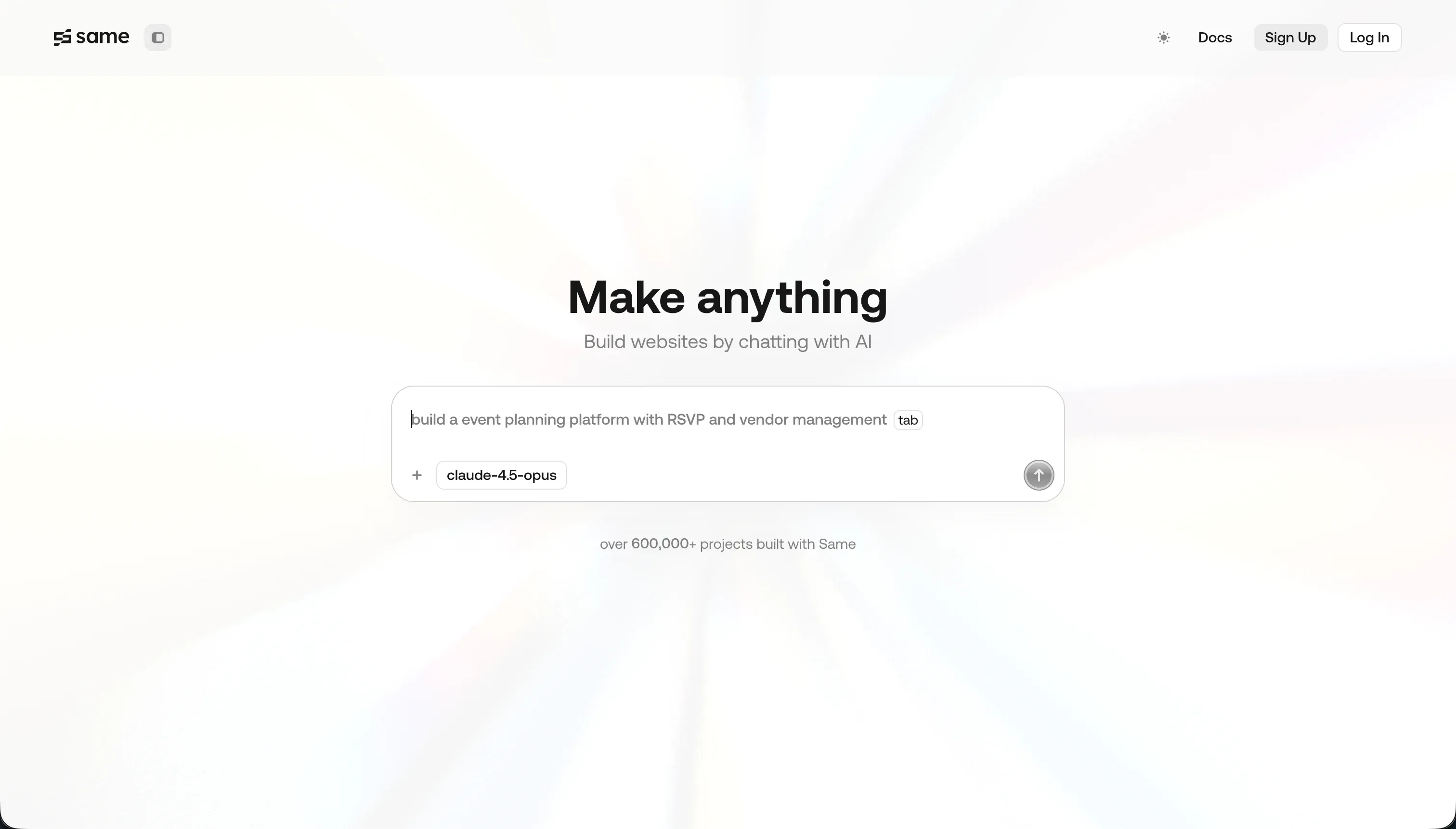
Same.new is a frontend prototyping and UI cloning tool that copies the visual structure of a live website from its URL and turns it into editable React code. It started life as Same.dev and is best understood as a design replication tool, not a full application platform.
In practice, you paste in a URL, let the agent recreate the layout, then keep modifying the generated interface through conversational prompts. Its core features are UI cloning from live websites, code export for React and Tailwind CSS, forking for design variation, and low-cost token-based plans that make it accessible for quick visual experiments.
It is genuinely built for designers, frontend developers, and founders who mainly care about getting a visual shell or landing-page-like interface into code fast. It becomes frustrating for anyone who assumes that cloned UI equals a production app, because Same.new does not solve authentication, databases, workflows, or reliable handling of complex interactive state.
| Spec | Details |
|---|---|
| Primary Stack | React code with Tailwind CSS output |
| Interface | URL-based UI cloning plus conversational editing |
| Primary Deployment Target | Frontend prototype export to local development environments |
| Key Advantage | Fast visual replication at a low starting price |
The Core Difference
The biggest difference is simple: Lovable tries to generate an entire app stack, while Same.new tries to replicate and edit the frontend layer. One is broader and riskier; the other is narrower and easier to reason about.
- Lovable runs as a full-stack AI builder that scaffolds frontend, backend, database, and deployment in one prompt loop, but that breadth creates more maintenance and security overhead.
- Same.new focuses on cloning and modifying UI code from existing websites, which makes it more limited but also more honest about what it is actually good at.

Head-to-Head Comparison
We evaluated both platforms across four core categories.
1. Developer Experience & Iteration Speed
Lovable is impressive in the first hour. You can describe a product idea in plain English and get a React frontend, backend logic, and Supabase schema without manually wiring the stack, which is why it keeps attracting startup founders who want to move from idea to demo fast.
The problem is that iteration often turns into a credit-burning repair loop. User reports describe prompts that now consume roughly 3 to 4 credits instead of the older 0.5 to 1 range for lighter tasks, and several complaints center on regression bugs where Lovable says it fixed an issue but the issue is still there or a new one appears.
Same.new is narrower, so the iteration model is easier to understand. Paste a URL, get a cloned interface, tweak sections by chat, fork variants, and export the React and Tailwind output. For simple visual work, that can feel faster than asking a full-stack builder to hallucinate an entire app shell from scratch.
But its update loop has a nastier failure mode: destructive edits. Trustpilot complaints mention simple actions like section reordering wiping out 1,500-plus lines of working code, and larger projects reportedly trigger buggy fork behavior, so speed drops fast once the cloned UI becomes layered or fragile.
Edge: Same.new, because its narrower scope makes the editing loop easier to predict, even if its destructive update bugs are real.
2. Code Quality & Portability
Lovable’s strongest argument is that it generates a real codebase instead of trapping you in proprietary visual blocks. GitHub sync is built in, and the output is framed around readable React and TypeScript that developers can continue in local IDEs like Cursor.
That said, code ownership is not the same as clean migration. Community feedback repeatedly notes that exported code often needs serious cleanup before a team would want to own it long-term, and backend portability gets murkier if your database setup has drifted into Lovable-managed infrastructure or custom Lovable Cloud behavior.
Same.new also gives you code export, but the scope is smaller and therefore easier to inspect. If your goal is to grab a React and Tailwind front-end scaffold, tweak the styling, and move into your own repo, the output is conceptually easier to separate from the platform than a whole AI-generated stack.
The limitation is that the exported code is mostly visual scaffolding, not application architecture. You are exporting a cloned frontend shell, not a finished product, so portability is decent for designers and frontend engineers but much less meaningful for teams hoping to migrate a real app with business logic.
Edge: Lovable, because full-stack GitHub sync matters more than frontend-only export if code ownership is your priority.
3. Database & Backend Capabilities
This is where Lovable clearly operates in a different category. It has built-in Supabase integration for managed PostgreSQL, auth, real-time sync, and prompt-generated schema setup, so it can actually scaffold a working app backend rather than just a visual mock.
The tradeoff is that this power comes with real developer overhead. Supabase Row Level Security still needs to be reasoned about carefully, custom triggers and schema changes can require manual intervention, and community complaints include backend lock-in concerns such as autonomous migrations toward Lovable Cloud behavior.
Same.new does not really compete here because it is not trying to. It is a frontend cloning tool, so there is no native database, no auth stack, no workflow engine, and no business-logic layer beyond whatever frontend code you manually bolt on later.
That limitation can actually be a positive if you only wanted visual scaffolding and planned to bring your own backend. But for non-technical teams comparing these tools as app builders, Same.new simply has no answer for data modeling, permissions, or backend state.
Edge: Lovable, because Same.new is fundamentally frontend-only and has no built-in backend story.
4. Hosting & Deployment Options
Lovable gives you a more packaged deployment path. You can deploy through Lovable Cloud, get staging URLs quickly, and use custom domains on paid plans, which lowers the barrier to sharing a working app with stakeholders.
The downside is dependence on Lovable’s hosted environment and cloud behavior. Some user complaints specifically mention preview-versus-production gaps and discomfort around platform-controlled backend moves, which is exactly the kind of hidden deployment risk that shows up after the demo phase.
Same.new is less opinionated here because it is mostly an export-and-continue tool. That means fewer baked-in deployment conveniences, but also less pressure to trust an all-in-one hosting layer you did not ask for.
In practical terms, that also means more work. You still need to handle hosting, backend connections, auth, and production hardening yourself or in another tool, so Same.new is weaker if what you wanted was a fast hosted app instead of a code starting point.
Edge: Lovable, because it actually gives you a fuller deploy path instead of stopping at frontend code.
5. AI Quality & Reliability
Lovable’s AI is more ambitious. It tries to coordinate multi-file changes, backend logic, database structure, and UI changes from the same conversation, which is why the first prototype often feels magical compared with narrower tools.
Ambition is also where reliability breaks down. The public complaints are unusually specific: regression loops, vague fixes that do not actually resolve bugs, timed-out builds on more complex logic, and reports that what looks functional in preview is still far from production-ready.
Same.new’s AI has a simpler job: visually replicate and edit interfaces. On clean, relatively simple pages, that narrower task often works well enough, especially if you are cloning layout, spacing, typography, and general page composition.
But Same.new has its own reliability baggage. Trustpilot users report destructive updates, broken forks on larger files, and instability around the rebrand from Same.dev to Same.new that left some paid users with inaccessible or read-only projects.
Edge: Same.new, because its AI does less and therefore fails in more understandable ways than Lovable’s broader full-stack agent.
6. Learning Curve & Onboarding
Lovable has a low initial learning curve because the prompt-first interface hides setup complexity well. A beginner can get something recognizable online without manually creating the React app, wiring Supabase, or building auth from scratch.
The hidden learning curve arrives later. To make Lovable safe and durable, you still need to understand enough about database schema, auth, RLS, API behavior, and debugging generated code to catch the AI when it drifts, so it often starts beginner-friendly and ends developer-heavy.
Same.new is easier to understand conceptually. Clone a site, tweak the interface, export the code. There are fewer moving parts, and the Pro plan starts at $10 per month with 2 million tokens, so the cost of experimenting is lower than jumping into a full-stack credit economy.
Its onboarding breaks when users confuse a cloned UI with a finished product. Because it does not solve the backend, teams without frontend experience may get stuck right after the pretty part is done, especially if they hit token burn or code-loss bugs while trying to keep iterating.
Edge: Same.new, because the product scope is smaller and the mental model is easier to grasp upfront.

Pricing Comparison
Lovable:
- Free - $0 with 5 daily credits, up to 50 per month, for public projects and GitHub sync.
- Pro - starts at 25€/mo with 100 monthly credits, plus private projects, custom domains, 3 editors, and credit rollover.
- Business - starts at 50€/mo with 100 monthly credits, plus advanced design templates, SSO integration, data training opt-out, and custom user limits.
- Enterprise - custom pricing with custom messaging limits, dedicated support, audit logs, and custom integrations.
- Pro credit scaling shown in research: 200 credits for 50€, 400 for 100€, 800 for 200€, 1,200 for 294€, 2,000 for 480€, and up to 10,000 for 2,250€.
- Business credit scaling shown in research: 200 credits for 100€, 400 for 200€, 800 for 400€, with the 10,000-credit tier at 4,300€.
Same.new:
- Free - $0 with limited tokens for basic UI testing and cloning.
- Pro - $10/mo including 2 million tokens.
- Additional usage - $10 per 2 million tokens, or $5 per million tokens, based on the pricing documentation cited in research.
- Fixed tiers - tiered plans introduced later for more predictable billing, but the exact prices were not provided in the research.
Use Case Fit: When to use which?
When to choose Lovable
- Choose Lovable when you need a full-stack web app scaffold with a real database, auth, and deployment path from the same prompt workflow.
- Choose Lovable when GitHub sync and the ability to keep developing in your own IDE matter more than having a stable visual builder.
- Choose Lovable when you accept that AI speed up front may turn into manual cleanup, Supabase security work, and higher credit spend later.
When to choose Same.new
- Choose Same.new when your main problem is recreating or remixing a frontend quickly from an existing website URL.
- Choose Same.new when you want low-cost visual scaffolding in React and Tailwind without paying for a full-stack AI platform.
- Choose Same.new when you already have developers or another stack for backend logic and just need the interface layer fast.
When neither Lovable nor Same.new is the right fit
For internal tools and client portals
Neither Lovable nor Same.new is a strong choice for business apps that need reliable permissions, maintainable CRUD, user groups, and day-two edits by non-developers. Lovable can scaffold the stack, but you still inherit Supabase security, prompt-driven edits, and debugging debt. Same.new is even further away because it only handles the frontend shell.
That is where Softr is the more pragmatic option. Softr starts with native Softr Databases, then lets you build internal tools, client portals, CRMs, and dashboards with built-in auth, granular user groups, row-level restrictions, and workflows. It is AI-first, but not AI-only, so you can co-build with AI and then edit visually without spending every future change in prompt credits.
For native mobile apps
Neither tool is built for shipping true native iOS and Android binaries. Lovable produces web applications, and Same.new is even narrower because it is mostly frontend cloning for the browser. If App Store or Google Play distribution is the real requirement, you are comparing the wrong pair.
Use FlutterFlow if you need serious native mobile output and deeper app logic, or look at Adalo and Glide for simpler mobile-first builders. Those tools are far better aligned with actual app-store deployment than trying to stretch a web-focused AI generator or a UI cloner into mobile production.
For professional developer environments
If you are already technical and want AI help inside a more conventional development workflow, both Lovable and Same.new can feel oddly constraining. Lovable hides too much behind prompt loops, and Same.new is too specialized around cloning UI. Neither replaces a proper development environment for long-lived engineering work.
This is where Cursor or Replit make more sense. Cursor gives you AI directly inside a real IDE with better control over code review and debugging, while Replit offers a fuller hosted dev environment for coding, running, and iterating without pretending the hard parts of software engineering disappeared.

Verdict
Pick Lovable if you need the broadest possible AI scaffolding and you are intentionally optimizing for speed to first full-stack prototype. The tradeoff is obvious: you are signing up for a credit-based prompt loop, Supabase security overhead, and the very real chance that the last 30 percent of the build turns into manual debugging and cleanup.
Pick Same.new if your real task is interface replication, design remixing, or getting a frontend shell into React quickly without paying for a full-stack generator. The tradeoff is that you are buying a narrower tool with no real backend answer, plus some documented instability around destructive edits, forks, and the platform transition from Same.dev to Same.new.
The bigger lesson is that both tools are strongest on day one, not day two. If the project is becoming a real business system with users, permissions, workflows, and operational data, a tool like Softr usually ages better because it gives you built-in infrastructure, native Softr Databases, and visual maintenance instead of endless prompt repair loops.

Summary Comparison Table
| Criterion | Lovable | Same.new |
|---|---|---|
| Best for | Full-stack SaaS-style web app scaffolding | Frontend cloning and UI mockup replication |
| Build paradigm | Conversational AI app generation | URL-based UI cloning plus prompt editing |
| Database | Supabase integration | No native database layer |
| Pricing metric | Monthly plans plus credits | Monthly tokens / token tiers |
| Code export | GitHub sync and code ownership path | React and Tailwind export |
| Maintenance burden | High once app logic gets complex | Moderate for simple UI, high if you expect full-app behavior |
| Best day-two fit | Technical teams who can clean up generated code | Frontend teams who only needed a visual starting point |