

Lovable and Bubble represent two fundamentally different bets on how web applications should be built. One generates real code from a text prompt and hands it to you. The other runs your entire application on its own proprietary visual runtime. Both have millions of users and vocal communities, and both have real failure modes that those communities document in detail.
This comparison covers what actually matters when you’re choosing between them: how iteration feels day-to-day, what happens when things break, what the lock-in looks like, and when neither option is the right choice.
Meet the Contenders
What is Lovable?
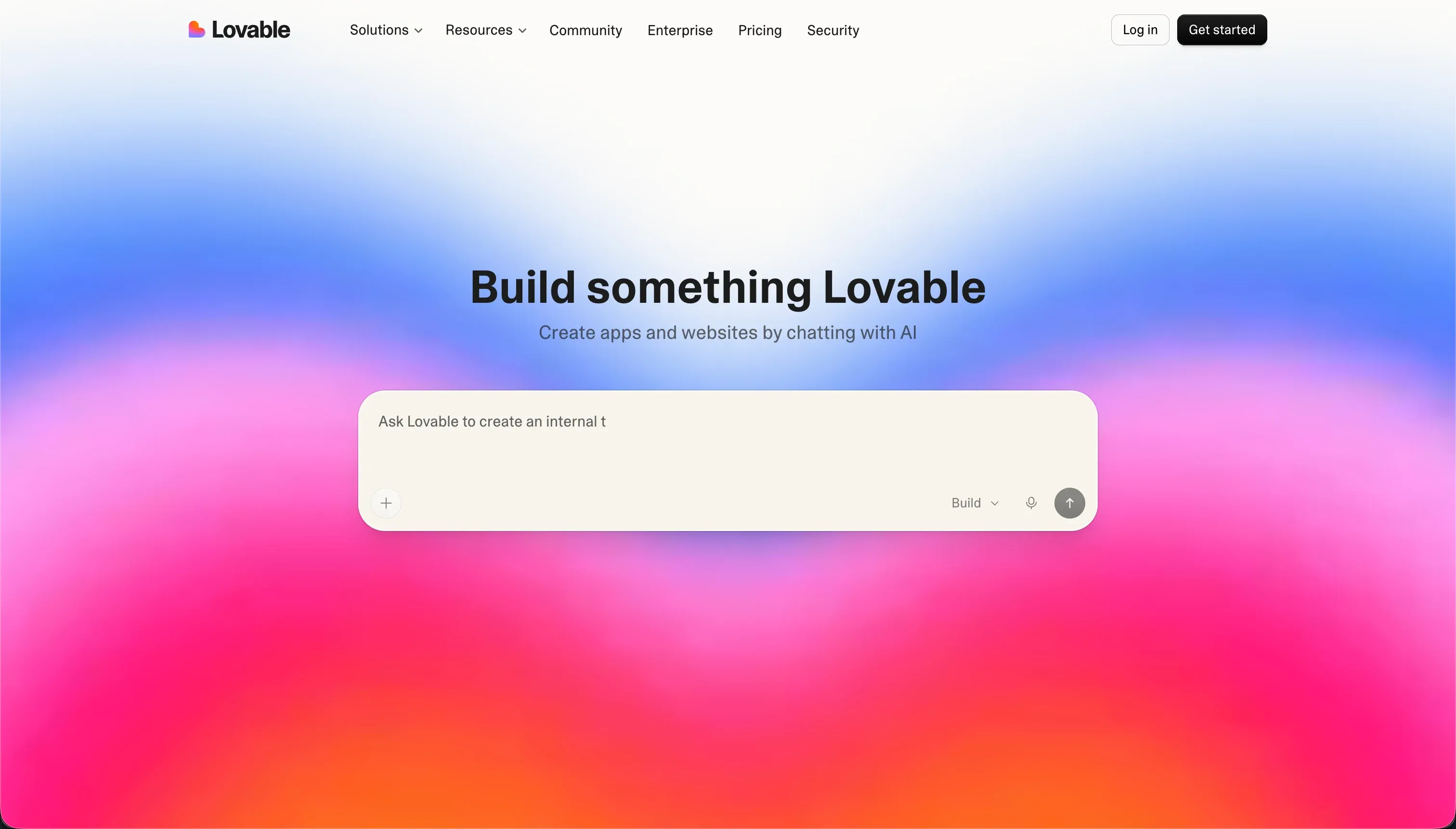
Lovable is an AI-powered full-stack app builder. You describe your application in natural language and Lovable generates a React, TypeScript, and Supabase-backed codebase in minutes. It’s aimed at technical founders and developers who want to go from idea to working prototype quickly, with a GitHub-connected workflow so they can take the codebase local whenever they need to.
| Spec | Details |
|---|---|
| Primary Stack | React, TypeScript, Vite, Tailwind CSS, Supabase |
| Interface | Natural language chat + visual preview |
| Primary Deployment Target | Lovable Cloud or GitHub push |
| Key Advantage | Exportable React codebase, fast initial generation |
What is Bubble?
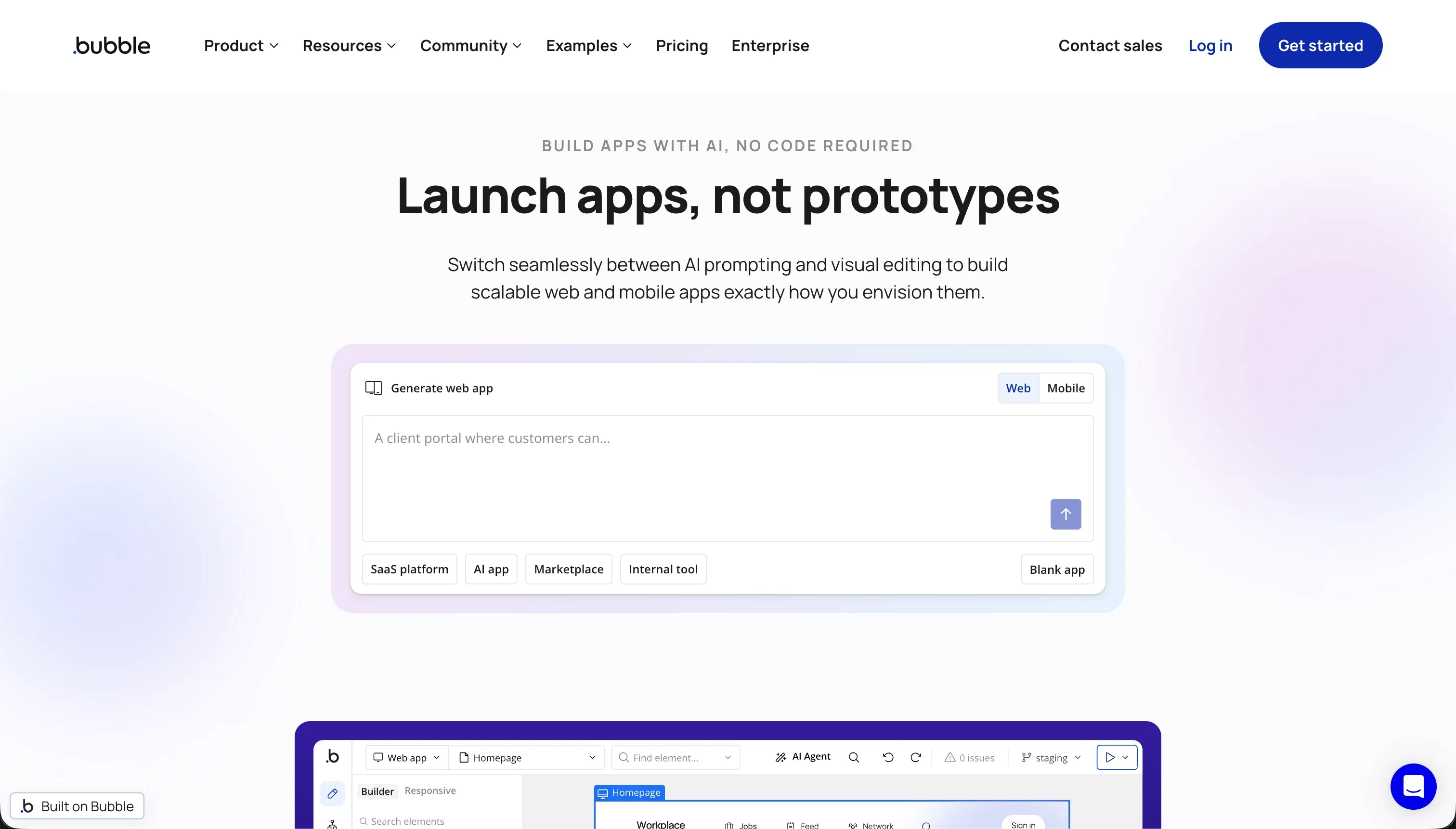
Bubble is a visual programming platform. There’s no AI generation - you build applications by dragging, dropping, and configuring elements in a visual editor, then defining behavior through a workflow system that mirrors how software logic works. It’s been around since 2012 and has one of the largest no-code ecosystems in the world: over 8,000 plugins, an active forum, and a massive library of templates.
| Spec | Details |
|---|---|
| Primary Stack | Proprietary visual runtime + managed relational DB |
| Interface | Drag-and-drop visual editor + workflow builder |
| Primary Deployment Target | Bubble Cloud (shared or dedicated capacity) |
| Key Advantage | Deep workflow customization and complex app logic |
The Core Difference
Lovable and Bubble are attacking the same problem - “build apps without a full dev team” - from opposite directions.
Lovable uses AI as the primary mechanism. The AI writes your code, configures your database, and generates your components. When it works, it’s fast. When it breaks, you’re debugging AI-generated code.
Bubble uses visual programming as the primary mechanism. You configure everything explicitly - layouts, database types, workflow logic, privacy rules. It’s more work upfront, but what you build is deliberate and auditable. There’s no AI guessing at your intent.
The philosophical trade-off: Lovable trades control for speed. Bubble trades speed for depth.

Head-to-Head Comparison
1. Developer Experience & Iteration Speed
Lovable’s generation experience is fast and impressive for the first few hours. Describe a feature, and it appears. The quality starts degrading over time. When a complex bug appears, Lovable can enter regression loops - it confirms that it’s fixed a problem, then generates the same broken behavior on the next reload. Users have described it as “burning credits to patch the same issues” while the app regresses.
Bubble’s iteration experience is different: slower upfront, more controlled as you go. Every action you take is deliberate - you drag, configure, and test. Bugs in Bubble usually mean you mis-configured a workflow or privacy rule, not that an AI misunderstood you. The downside is performance: Bubble’s editor is notoriously resource-heavy. Users with large projects report the editor consuming 5GB+ of RAM per browser tab, with regular freezes requiring page restarts.
2. Code Quality & Portability
Lovable generates standard, non-proprietary React and TypeScript code that syncs to GitHub. You can open it in any IDE and continue development. The code quality is generally good on initial generation; the problem is maintenance. After multiple AI-driven edits, the codebase can accumulate inconsistencies, injected tracking tags, and hard-to-trace dependencies.
Bubble has no code to export. The application lives entirely in Bubble’s runtime. You can export data rows, but the UI, logic, workflows, and database schema are all proprietary. If you need a feature Bubble doesn’t support, or if Bubble’s pricing becomes unsustainable, the only option is a full rebuild on a different platform. G2 reviewers consistently flag this as the platform’s most significant long-term risk.
3. Database & Backend Capabilities
Lovable connects to Supabase and generates a PostgreSQL schema. The concern is security: Supabase Row Level Security policies are AI-generated, and a misconfigured RLS rule can silently expose one user’s data to another. Additionally, if you don’t connect a private Supabase instance from day one, Lovable may automatically migrate your database to Lovable Cloud - adding compute charges.
Bubble provides a managed relational database with full relationship support. Privacy rules are configured visually and explicitly, making security more auditable. The limitation is performance at scale: Bubble’s database is not optimized for high-throughput read/write operations. Inefficient search queries can consume large numbers of Workload Units, causing unexpected billing spikes.
4. Hosting & Deployment Options
Lovable deploys to Lovable Cloud with auto-generated staging URLs. Custom domains are supported on paid plans. The “Hotel California” database policy is a known issue: databases can end up on Lovable Cloud without explicit consent if a private Supabase instance isn’t connected upfront.
Bubble hosts on its own infrastructure, with options for shared capacity (Starter/Growth/Team plans) and dedicated capacity for enterprise workloads. It’s reliable for most production apps. The risk is the abrupt plan downgrade: users report that when a subscription lapses, apps are immediately restricted to the Free plan’s 200-record limit, and apps can go down mid-operation if the plan isn’t renewed in time.

Pricing Comparison
The pricing structures are very different, and the one that’s cheaper depends heavily on usage patterns.
Lovable Pro starts at €25/month for 100 credits. Credit usage has inflated over time, with prompts consuming 3-4 credits where they used to cost 1. Heavy builds or bug-fixing loops can exhaust a monthly pool quickly. Scaling to 400 credits costs €100/month; 10,000 credits run €2,250/month.
Bubble starts at $69/month (Starter), then $249/month (Growth), $649/month (Team). Billing is based on Workload Units - server compute consumed by database queries and workflow actions. Efficient, well-optimized apps can stay on lower tiers indefinitely. Poorly-optimized ones can spike unexpectedly. Several community members have documented bills jumping from $69 to $249 without warning after a traffic increase.
For early prototyping: Lovable is cheaper. For established apps with controlled logic: Bubble’s flat tiers can be more predictable. But both platforms can surprise you financially if you’re not careful.
Use Case Fit: When to use which?
When to choose Bubble
- You’re building a complex multi-user SaaS with intricate workflow logic, custom data relationships, and conditional business rules.
- You’re comfortable investing 2-4 weeks into learning the platform before shipping.
- You’re planning to stay on the platform long-term and are comfortable with the vendor lock-in trade-off.
- You need a large plugin ecosystem and an established community for support.
When to choose Lovable
- You want to scaffold a React SaaS MVP quickly and plan to export the codebase to a developer or local IDE shortly after.
- Code ownership matters to you and you want the option to leave the platform without rebuilding from scratch.
- You need a fast proof of concept and aren’t blocked by the credit-based billing model.
When neither Lovable nor Bubble is the right fit
Both platforms have real limitations that make them the wrong choice for entire categories of projects.
For native mobile apps
Lovable generates web applications only. Bubble’s native mobile feature is still maturing and relies heavily on third-party wrappers. If you need a native iOS or Android app with proper push notifications and app store presence, FlutterFlow is the purpose-built option. It compiles directly to native Flutter/Dart code.
For internal tools and client portals
If your team is non-technical, both platforms create long-term maintenance problems. Lovable generates code that needs a developer to maintain. Bubble’s workflow system is powerful but requires significant expertise to audit and update safely.
Softr is built specifically for this use case. It provides pre-built, production-ready components for client portals, internal tools, CRMs, and dashboards - all configurable through a visual editor without code. User permissions are granular and point-and-click. The AI Co-Builder generates complete applications from a prompt, but every setting it creates can also be adjusted manually. So non-technical team members can maintain and evolve the app without developer involvement. Over 1 million builders use Softr for exactly this type of operational software.
For professional developer environments
Neither Lovable nor Bubble is the right tool for an experienced developer who wants AI assistance inside a real coding environment. Cursor is a VS Code fork with deep codebase indexing and multi-file editing that runs inside your local project. For collaborative cloud development, Replit provides full virtual machines with live multiplayer coding and Replit Agent for backend scaffolding.

Verdict
- Choose Bubble if you’re building a complex, logic-heavy web application and you’re prepared to invest in learning the platform. The depth of workflow control and plugin ecosystem is unmatched in visual no-code.
- Choose Lovable if you want fast scaffolding of an exportable React codebase and plan to take over development locally. Better for SaaS MVPs than for long-term maintained apps.
Summary Comparison Table
| Feature | Lovable | Bubble |
|---|---|---|
| Build Paradigm | AI Code Generation | Visual Programming |
| Output Type | React / TypeScript (exportable) | Proprietary runtime (no export) |
| Database | Supabase (may migrate to Lovable Cloud) | Managed relational DB (no export) |
| Visual Permissions | AI-generated Supabase RLS | Explicit visual privacy rules |
| Pricing Metric | Subscription + Credits | Subscription + Workload Units |
| Maintenance Burden | High (developer needed for code) | Medium-High (platform expertise required) |
| Code Export | Yes - full codebase via GitHub | No |