

This is a real tradeoff between two very different categories of app builder. Lovable is an AI scaffolding tool for web apps that generates a React, Node, and Supabase stack from prompts, while FlutterFlow is a visual Flutter IDE aimed at native mobile and cross-platform apps. They overlap just enough to confuse buyers, but under the hood they solve different problems.
The people actually deciding between them are usually founders, freelancers, and product teams trying to compress build time without locking themselves into a dead end. The stakes are not just speed, but what happens after the first demo: debugging, backend security, code ownership, and whether your monthly bill grows with every prompt or collaborator. If you choose the wrong one, you either end up fighting AI chat loops on a web stack or learning Flutter concepts you never wanted to touch.
Meet the Contenders
What is Lovable?
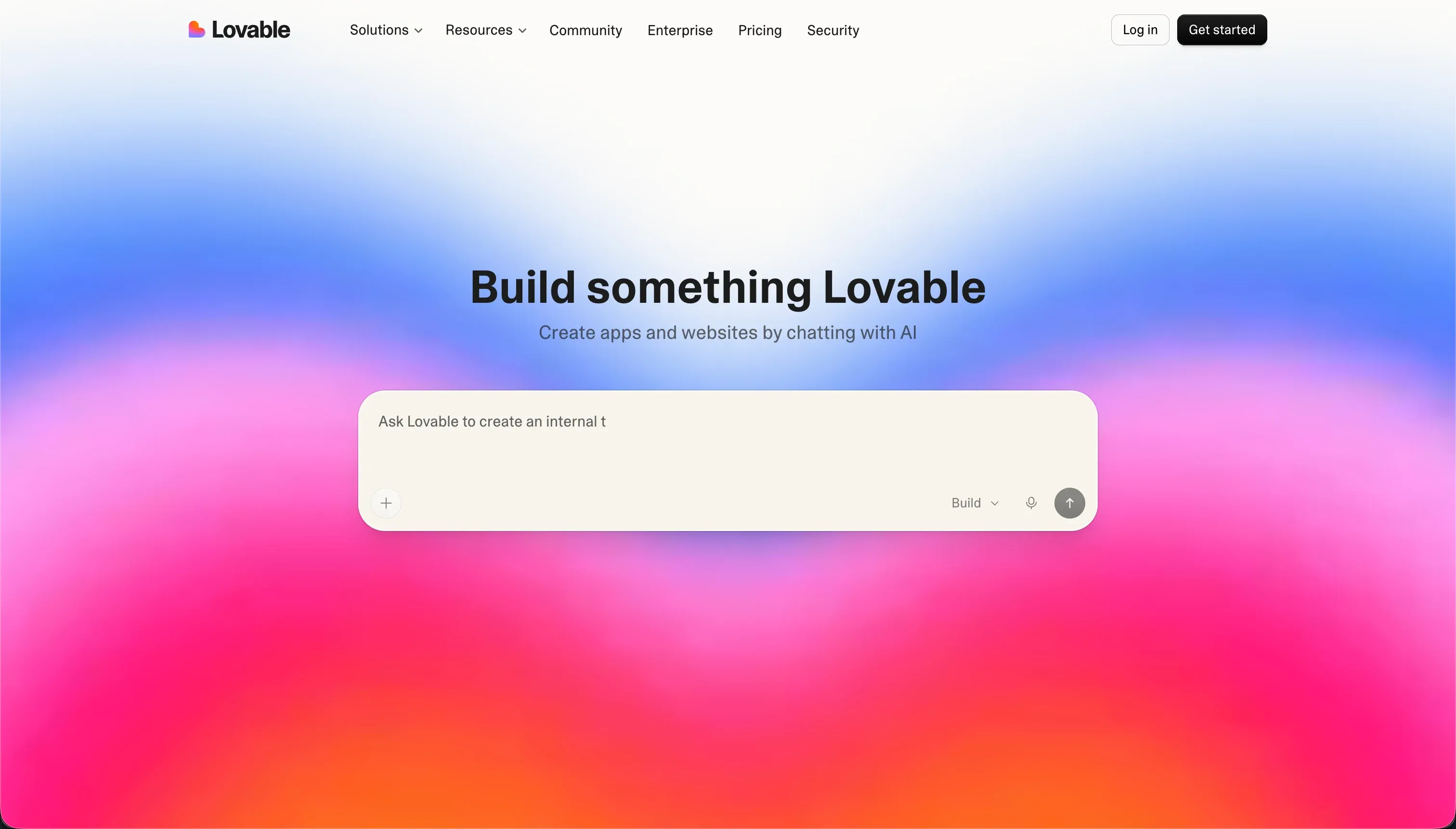
Lovable is an AI-powered full-stack web app builder that turns natural language prompts into a React frontend, Node.js backend, and Supabase database. Its pitch is simple: describe the product, let the AI scaffold the stack, then keep iterating in conversation until you have something launchable.
In practice, Lovable works like a vibe-coding workflow more than a classic visual builder. You prompt for changes, it edits multiple files for you, can sync projects to GitHub, supports Figma import, and deploys through Lovable Cloud with custom domains on paid plans. It also includes pre-publish security scans and can pull project context from tools like Linear, Notion, Jira, and Confluence.
It is genuinely built for founders and builders who want a fast web prototype and care about getting exportable React and TypeScript out of the process. It becomes frustrating for people who thought prompting would remove engineering concerns, because Supabase security, credit consumption, and the final debugging passes still tend to demand a developer mindset.
| Spec | Details |
|---|---|
| Primary Stack | React frontend, Node.js backend, Supabase database |
| Interface | Conversational prompt builder with iterative code generation |
| Primary Deployment Target | Lovable Cloud for web apps, with GitHub sync for external development |
| Key Advantage | Fast prompt-to-web-app scaffolding with exportable React and TypeScript |
What is FlutterFlow?
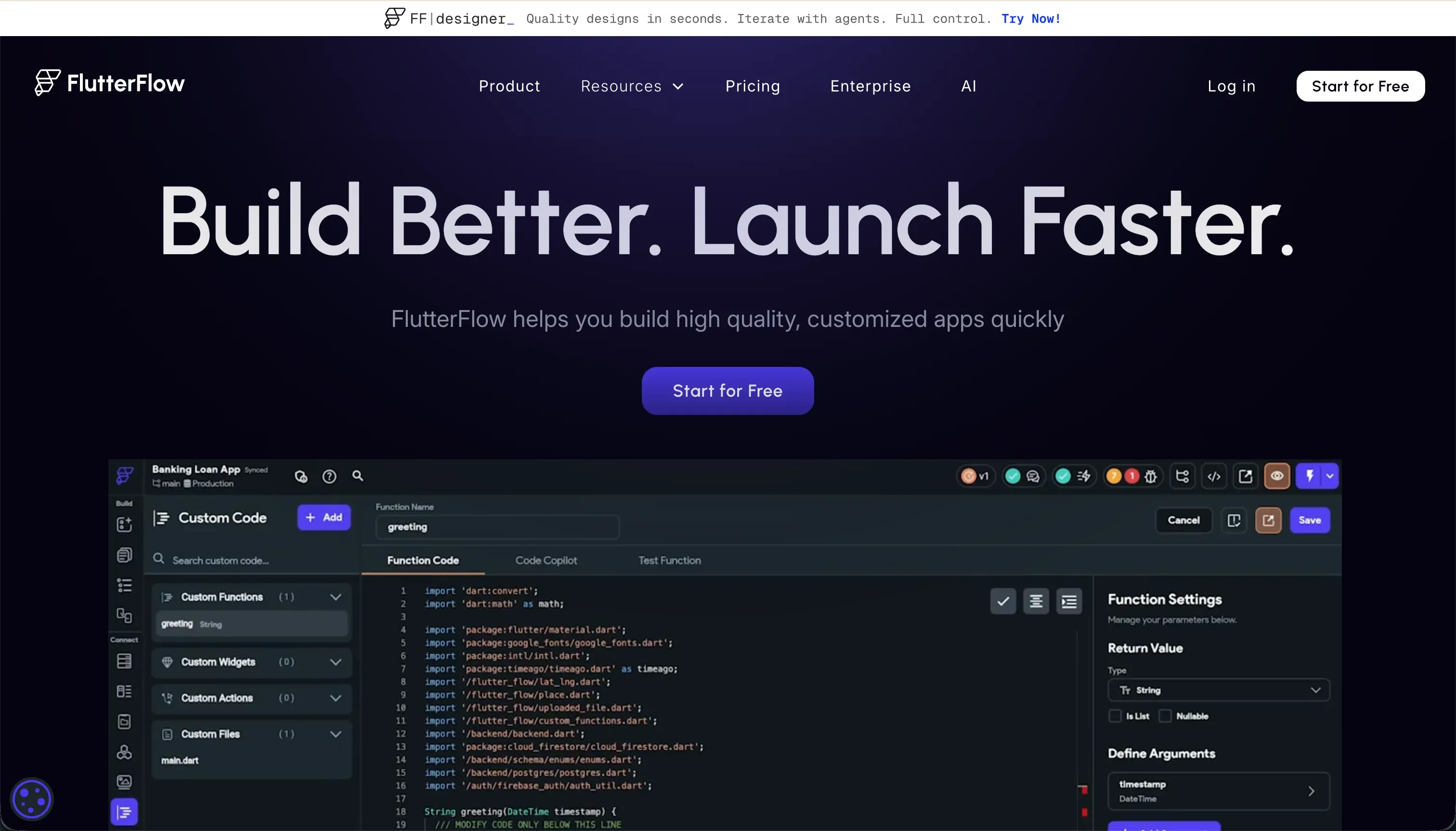
FlutterFlow is a visual builder for native mobile and web applications built on top of Flutter. Instead of prompting out a JavaScript stack, you assemble screens, logic, and data connections through a visual editor that ultimately produces Dart code and deployable mobile builds.
In practice, FlutterFlow feels more like a proprietary visual IDE than an AI chat product. Its core strengths are the drag-and-drop Flutter widget builder, FlutterFlow AI Gen for screens and code snippets, direct App Store deployment flows, and full Dart code export with Git integration on higher tiers. It also supports Firebase, Supabase, and REST APIs, which makes it more flexible than mobile-only no-code tools.
It is genuinely built for designers, freelancers, and developers who want to ship native iOS and Android apps without hand-writing every Flutter widget. It frustrates people who expected a simple no-code canvas, because once layouts, state, API logic, and backend rules get real, you are effectively learning Flutter concepts through someone else’s UI.
| Spec | Details |
|---|---|
| Primary Stack | Flutter framework with Dart code output |
| Interface | Visual Flutter widget builder with AI generation features |
| Primary Deployment Target | Native iOS and Android apps, plus web deployment |
| Key Advantage | Direct native app creation with full Dart code export |
The Core Difference
The biggest difference is not AI versus no-code. It is generated web stack versus visual native app stack.
- Lovable is best understood as AI scaffolding for web products, where the speed comes from prompting out React and Supabase, but the cost is ongoing dependence on prompt quality, credits, and code debugging.
- FlutterFlow is a visual Flutter IDE for native mobile apps, where the speed comes from drag-and-drop screens and action logic, but the cost is a steeper learning curve and more explicit backend setup.

Head-to-Head Comparison
We evaluated both platforms across four core categories.
1. Developer Experience & Iteration Speed
Lovable wins the first hour. You can go from blank page to a working web prototype in minutes by describing the product in plain English, and features like Figma import, GitHub sync, and one-click Lovable Cloud deployment reduce the usual setup tax.
The problem is what happens after that first burst. User reports repeatedly describe regression loops where a fix introduces new bugs, and some Reddit users say prompts that once cost around 1.2 credits now burn 3 to 4 credits each, turning iteration into a billing problem as much as a product problem.
FlutterFlow is slower to start because you build through Flutter widget trees, action panels, and backend connectors rather than pure chat. But once you understand its interface, repeated screen edits, state changes, and navigation flows can feel more deterministic than re-prompting an AI agent every time.
That said, users regularly complain about browser lag on projects with more than 12 screens and about debugging flows without clear error messages. So iteration is steadier than Lovable in some cases, but it is not exactly light or frictionless.
Edge: FlutterFlow, because it is slower at the start but less likely to trap you in prompt-driven rework loops that keep consuming credits.
2. Code Quality & Portability
Lovable’s strongest argument is that it generates real React and TypeScript and syncs to GitHub. If you are a founder planning to hand the project to developers later, that is materially better than a closed visual runtime with no exit path.
But the export story is less clean than the marketing implies. Multiple users report that the generated code is fine for scaffolding but messy to port cleanly at scale, and several reviews explicitly recommend treating Lovable output as a prototype that developers should rebuild properly.
FlutterFlow offers full Dart code export on paid plans, plus Git integration on Pro and Teams. For mobile teams already aligned around Flutter, that portability is real and often more useful than React export if the end goal is App Store distribution.
The catch is that exported FlutterFlow projects still reflect FlutterFlow’s architecture and conventions. Users migrating away describe the code as feeling locked into the platform’s patterns, and custom widget limits mean some advanced Flutter capabilities stay awkward until you leave the builder.
Edge: FlutterFlow, because its code export is more aligned with a real production path for native apps, while Lovable’s exports are often treated as scaffolds rather than finished foundations.
3. Database & Backend Capabilities
Lovable makes backend bootstrapping feel easy because Supabase auth and PostgreSQL appear almost instantly in the generated app. For a solo founder building a quick SaaS MVP, that fast provisioning is one of its main strengths.
The downside is that database security and relationship logic do not become simple on their own. The research specifically flags Supabase RLS setup as manual overhead, and community complaints include broken relationships, backend migrations users did not want, and a recurring feeling of being too dependent on whatever schema the AI invented.
FlutterFlow gives you more explicit backend choice through Firebase, Supabase, and REST APIs. That is better if you want to model the backend deliberately instead of inheriting an AI-generated stack you barely understand.
But explicit control means explicit setup pain. FlutterFlow users still need to configure database rules, auth, and API structures manually, which is exactly why many non-developers bounce off the product once the app moves beyond simple screens and CRUD.
Edge: FlutterFlow, because neither tool truly simplifies backend complexity, but FlutterFlow at least makes the setup explicit instead of hiding risk inside AI-generated Supabase decisions.
4. Hosting & Deployment Options
Lovable is optimized for web deployment. Lovable Cloud gives you quick production URLs, staging-style previews, and custom domains on paid plans, which is great if your end product is a browser app and you want almost no deployment ceremony.
The concern is trust and control. The research includes user complaints about deployment discrepancies between preview and production, and some serious Reddit criticism about database lock-in and unexpected backend migrations makes the convenience feel less safe than it first appears.
FlutterFlow’s deployment story is built around native distribution. On Pro, you get codeless deployment to Google Play and Apple TestFlight or App Store pipelines, plus APK downloads on Standard, which is exactly the right answer if your product belongs in an app store.
Its weakness is web. Flutter web can be heavy, and the research specifically calls out initial load latency and resource-heavy output on web apps, so FlutterFlow is simply less attractive when the primary target is a browser-based product.
Edge: split by target, but overall FlutterFlow wins because it has a credible native deployment answer while Lovable is limited to web delivery.
5. AI Quality & Reliability
Lovable is fundamentally an AI-first product, so when it works, the result comes together remarkably fast. A single prompt can scaffold UI, backend, auth, and integrations, and context connectors from tools like Notion or Jira can feed the model better product context.
But this is also where the harshest complaints land. Users describe the agent claiming bugs are fixed when they are not, burning credits in repetitive debug loops, and struggling with the final 30 percent of business logic that separates a convincing demo from a dependable product.
FlutterFlow AI Gen is more modest in scope. It can generate UI screens, components, custom Dart functions, and some database structures, but it is not the center of the entire product the way Lovable’s prompting loop is.
That lower ambition is actually a reliability advantage. You are less exposed to catastrophic AI drift, but also less likely to get a full app generated from one prompt, so the AI here is useful acceleration rather than a full substitute for product assembly.
Edge: FlutterFlow, because its AI does less but fails less dramatically than Lovable’s full-stack prompting loop.
6. Learning Curve & Onboarding
Lovable is easier to approach as a beginner because the interface starts with plain English rather than widgets, layout constraints, or state models. If all you want is a web prototype and you are comfortable asking for changes conversationally, it feels more accessible than most dev-adjacent builders.
The trap is that the easy onboarding can hide a hard second phase. Once you have to reason about Supabase security, broken edits, code quality, and credit budgets, the product starts demanding more technical judgment than its front door suggests.
FlutterFlow has a steeper learning curve from day one. Reviews repeatedly mention buried features, too many switches and menus, and the need to understand Flutter layouts, conditional actions, state management, and backend logic.
The upside is honesty. FlutterFlow does not pretend native apps are simple, so the learning curve is visible early, and teams that invest in it know they are adopting a real visual development environment rather than a lightweight AI shortcut.
Edge: Lovable, because it is easier to get started with, even if that ease often proves misleading once production concerns show up.

Pricing Comparison
Lovable:
- Free - $0 with 5 daily credits, up to 50 per month, for public projects and GitHub sync
- Pro - starts at 25€/mo with 100 monthly credits, private projects, custom domains, 3 editors, and credit rollover
- Business - starts at 50€/mo with 100 monthly credits, advanced design templates, SSO integration, data training opt-out, and custom user limits
- Enterprise - custom pricing with custom messaging limits, dedicated support, audit logs, and custom integrations
- Credit scaling examples - Pro: 200 credits for 50€/mo, 400 for 100€/mo, 800 for 200€/mo, 2,000 for 480€/mo, up to 10,000 for 2,250€/mo; Business: 200 credits for 100€/mo, 400 for 200€/mo, 800 for 400€/mo, up to 10,000 for 4,300€/mo
FlutterFlow:
- Free - $0 with the visual builder, Firebase integration, and basic UI components
- Standard - $22/mo annually or $30/mo monthly, with APK downloads, custom domain, code export, and local run
- Pro - $50/mo annually or $70/mo monthly, with full code export, Git integration, push notifications, codeless App Store deployment, and translation
- Teams - $50/seat/mo annually or $70/seat/mo monthly, with collaborative building, shared design library, and team billing
Use Case Fit: When to use which?
When to choose Lovable
- Choose Lovable when your real goal is a web MVP or SaaS prototype and you want AI to scaffold React, Node, and Supabase fast.
- Choose Lovable when GitHub sync and exportable TypeScript matter more to you than visual control or native mobile output.
- Choose Lovable when you are comfortable treating the generated app as a starting point that developers may need to clean up later.
When to choose FlutterFlow
- Choose FlutterFlow when you need native iOS or Android apps and want a visual path to App Store deployment.
- Choose FlutterFlow when your team is willing to learn Flutter-style concepts in exchange for full Dart code export.
- Choose FlutterFlow when you want more deterministic screen building and action logic than an AI prompt loop can usually provide.
When neither Lovable nor FlutterFlow is the right fit
For internal tools and client portals
Neither Lovable nor FlutterFlow is a great default for operational business apps used by employees, clients, vendors, or partners. Lovable pushes you into AI-generated web stacks and Supabase security work, while FlutterFlow pushes you into Flutter concepts, backend setup, and a mobile-first architecture that is often overkill for CRMs, intranets, dashboards, or multi-role portals.
That is where Softr is the more pragmatic answer. Softr Databases come built in first, and it also connects to 17 external sources after that, while auth, user groups, row-level restrictions, hosting, and workflows are already handled visually. Its AI Co-Builder can generate the app for speed, but unlike Lovable, every page, permission, database field, and workflow can also be edited manually, so you are not trapped in prompt loops on day two.
For professional developer environments
If you actually want an environment for serious coding, debugging, and ownership, both of these tools can feel halfway committed. Lovable gives you code but still routes too much through an AI chat loop, and FlutterFlow gives you exportable Dart but keeps you inside a proprietary visual abstraction for much of the build.
For teams that want a real development workflow, look at Cursor or Replit. Cursor is the stronger fit if you already have a codebase and want AI inside a real IDE, while Replit is better if you want hosted development, runtime, and deployment in one place without forcing everything through either Lovable’s credit-driven AI scaffolding or FlutterFlow’s visual widget model.
For simpler native app builders
FlutterFlow is powerful, but it is not always the right answer if you need mobile distribution without taking on a pseudo-IDE learning curve. Lovable is not a substitute here at all, because it does not compile native mobile binaries for App Store release.
If your app is simpler and mobile-first, Glide or Adalo can be a better fit. They are less flexible than FlutterFlow, but they usually demand less understanding of widget trees, backend rules, and custom Dart plumbing, which makes them easier for lightweight internal mobile apps, field tools, and simple customer-facing mobile experiences.

Verdict
Pick Lovable if you are trying to get a web product visible fast and you value AI scaffolding plus GitHub sync more than stability. The tradeoff is obvious: you are accepting credit-driven iteration, reported regression loops, and a backend story that still expects you to understand Supabase once the prototype becomes real.
Pick FlutterFlow if the product belongs on iOS or Android and you want native app delivery without writing every Flutter widget by hand. The tradeoff here is different but just as real: you are accepting a steeper learning curve, heavier builder ergonomics, and a development model that still expects you to think in terms of state, actions, layouts, and backend configuration.
The day-two reality is that both tools hand more engineering responsibility back to you than their first-run experience suggests. Lovable gives you code ownership but not low-maintenance ownership, and FlutterFlow gives you native reach but not simplicity. For business apps like client portals, internal tools, CRMs, and operational dashboards, Softr usually ages better because the database, permissions, auth, workflows, and hosting are already production-safe, and its AI is an accelerator rather than the only way to make changes.

Summary Comparison Table
| Criterion | Lovable | FlutterFlow |
|---|---|---|
| Best for | Fast web MVPs and AI-generated SaaS scaffolds | Native mobile apps with visual Flutter building |
| Build paradigm | Conversational AI scaffolding | Visual Flutter IDE with optional AI assistance |
| Output type | React and TypeScript web app | Flutter and Dart app for iOS, Android, and web |
| Database model | Supabase-first generated backend | Firebase, Supabase, and REST integrations |
| Pricing metric | Subscription plus monthly credits | Subscription, with Teams priced per seat |
| Learning curve | Easy start, harder day-two maintenance | Steep from the start, but more explicit |
| Code export | GitHub sync for React and TypeScript | Full Dart export on paid plans |