

Base44 and Mocha sit in the same broad category of AI app builders, but they solve different parts of the problem badly in different ways. Base44 is a live full-stack AI scaffolding platform with managed hosting and database infrastructure. Mocha was a prompt-to-app builder with code export, but it is now a sunset product heading toward shutdown.
The people actually comparing these two are usually founders, operators, or indie builders trying to move fast without hiring a full team. What is at stake is not just first-week speed, but whether you are buying yourself lock-in, migration work, or an app that gets harder to trust with every edit. Base44 risks credit burn and platform dependence. Mocha risks becoming a dead end because the product itself is going away.
Meet the Contenders
What is Base44?
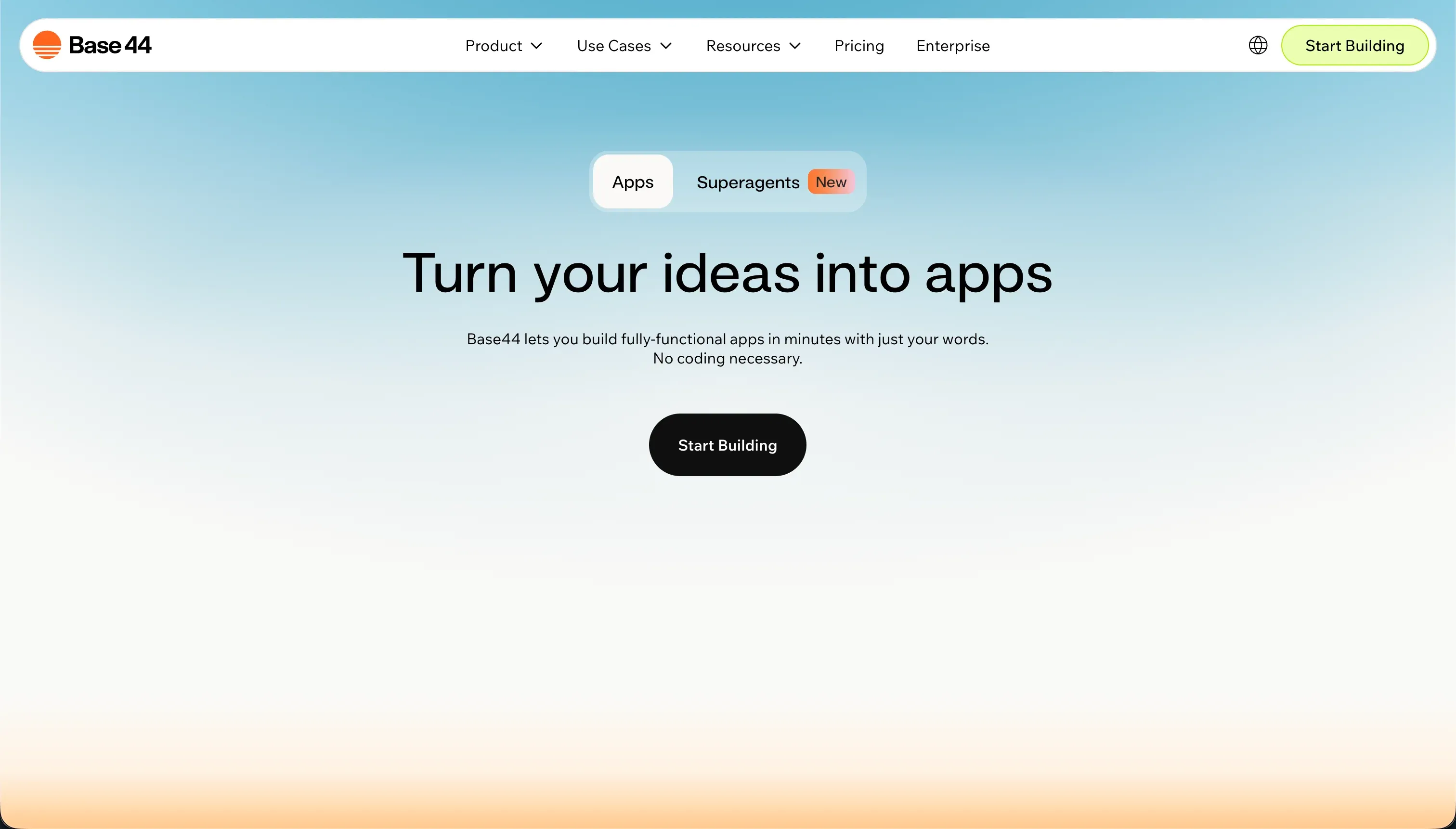
Base44 is an AI-powered all-in-one builder that generates full-stack web applications from conversational prompts. It bundles UI generation, a managed PostgreSQL database, user authentication, and hosting into one environment, so the initial experience feels pleasantly low-friction.
In practice, Base44 works like a chat-driven app generator with a few visual assists layered on top. You can use Discuss Mode to brainstorm without spending message credits, then switch into the builder to generate an app, tweak layouts in the visual post-generation editor, and export frontend code through GitHub on higher plans. The catch is that the backend remains on Base44 infrastructure, and its dual credit model means both app edits and live user actions can consume quotas.
It is genuinely built for people who want quick MVP scaffolds without touching setup, especially non-technical founders and operators. It is a frustrating fit for anyone who needs production stability, predictable billing, or clean backend ownership, because user reports repeatedly mention regression loops, downtime, and AI fixes that create new bugs while burning credits.
| Spec | Details |
|---|---|
| Primary Stack | Managed React frontend plus PostgreSQL database on Base44 infrastructure |
| Interface | Conversational AI builder with Discuss Mode and a click-to-tweak visual editor |
| Primary Deployment Target | Base44 cloud hosting, with GitHub sync for frontend code on Builder plan and above |
| Key Advantage | Very fast full-stack scaffolding with auth, database, and hosting included from the first prompt |
What is Mocha?
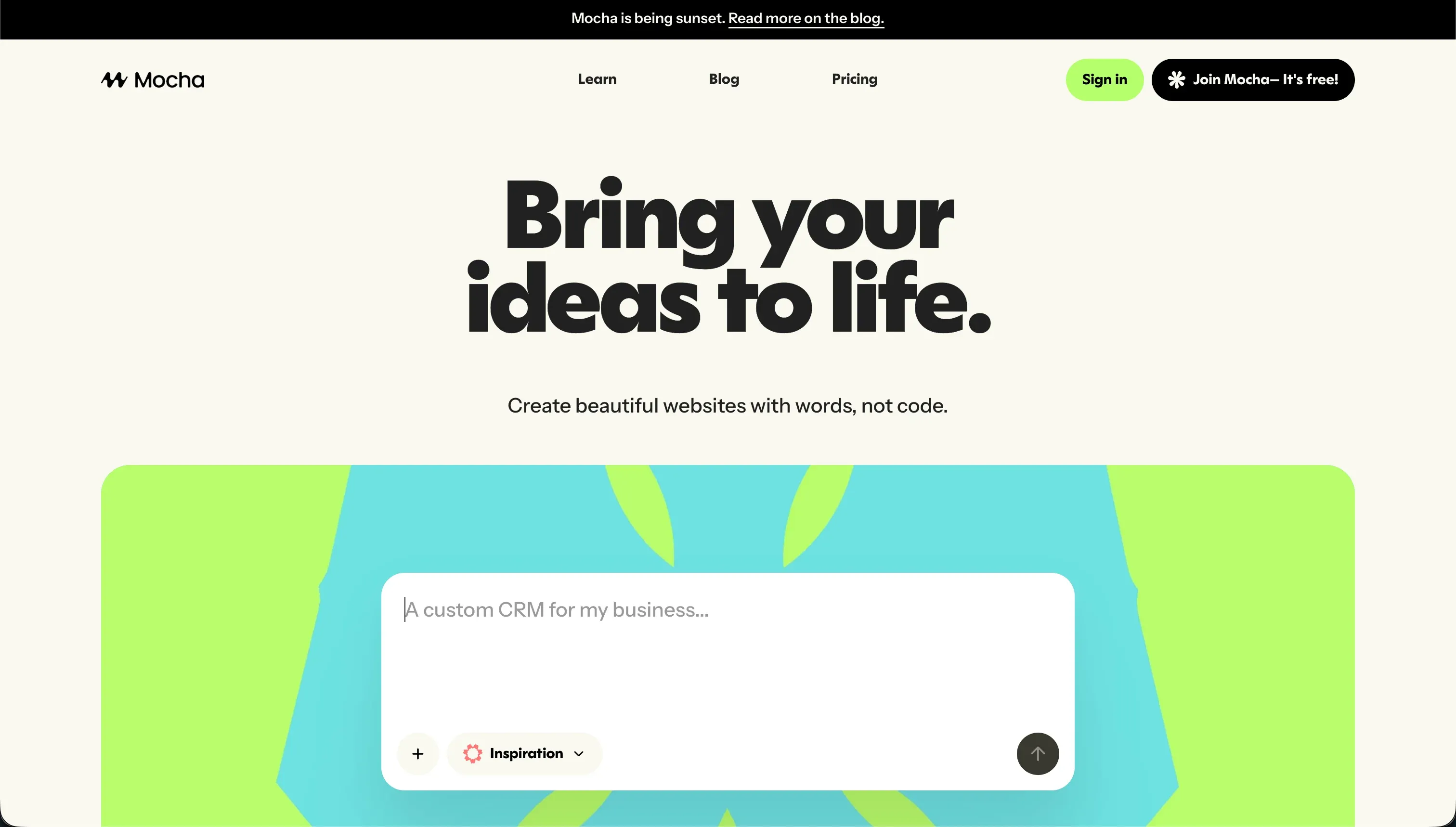
Mocha is an AI-powered no-code app builder, formerly called Srcbook, that generates web apps from text instructions. It ships with an integrated SQLite database, built-in authentication, one-click publishing, and full code export, which made it attractive for lightweight MVP work.
In practice, Mocha tries to handle the whole prompt-to-app loop for you: generate the UI, spin up backend routes, wire the SQLite database, and even auto-attempt bug fixes when deployment or compilation errors appear. That sounds good until the credit meter starts spinning, because users reported that automated bug-resolution loops could consume hundreds of credits, and customization beyond the first generated version often required manual coding anyway.
It was built for creators and startup founders validating simple SaaS concepts, directories, and basic utilities. Today, though, the most important fact is not a feature but a deadline: Mocha is shutting down on August 1, 2026, so new builders who choose it are effectively choosing a migration project at the same time.
| Spec | Details |
|---|---|
| Primary Stack | Prompt-generated web app stack with managed SQLite database and hosted deployment |
| Interface | Conversational prompt-to-app builder with automated bug-fix attempts |
| Primary Deployment Target | Mocha-hosted web apps with custom domains on paid tiers and full code export |
| Key Advantage | Complete source-code export, which reduces long-term lock-in compared with closed hosted builders |
The Core Difference
The biggest difference is not frontend polish. It is where the long-term risk lives: Base44 is still running but traps your backend inside its platform, while Mocha offers code export but is itself shutting down.
- Base44 optimizes for zero-setup AI scaffolding inside a managed cloud, but the tradeoff is dual-credit billing, partial code ownership, and backend lock-in.
- Mocha leaned harder into exportable code and simple prompt-based app generation, but its shutdown date makes every new project a temporary one by definition.
Head-to-Head Comparison
We evaluated both platforms across four core categories.
1. Developer Experience & Iteration Speed
Base44 is strong at the first 30 minutes. You describe an app in plain English, get UI, auth, database, and hosting in one pass, and can use Discuss Mode to workshop ideas without spending message credits. For a founder trying to get a prototype in front of someone today, that convenience is real.
The trouble starts after the scaffold. Multiple user reports describe regression loops where fixing one issue creates several more, along with weekly instability and wasted credits during repeated repair attempts. If your workflow depends on many small iterations, the chat-first model starts feeling less like acceleration and more like roulette.
Mocha was also designed for fast first-pass generation. It could create a basic web app from a prompt, wire up a SQLite database, include Google sign-in, and publish with one click, which made it approachable for simple trackers, calculators, and lightweight MVPs.
But iteration quality was shaky. Reviews noted that once the initial output needed deeper customization, manual coding often crept in, and automated bug-resolution cycles could burn through large credit chunks while leaving the app broken. On top of that, there is now a hard platform deadline, so even a smooth first week still ends in migration work.
Edge: Base44, because it is still an active product and its initial scaffolding flow is more usable than Mocha’s now time-limited path.
2. Code Quality & Portability
Base44 deserves some credit here because it is not a total black box. On the Builder plan at $40 per month annually or $50 monthly, you can sync frontend code to GitHub and refine the UI in a more traditional workflow.
That said, the portability story is only partial. Product Hunt feedback and community reports make the same point repeatedly: the frontend can leave, but the database and backend logic remain trapped in Base44’s hosted infrastructure. If you need a true exit path, frontend-only export is not the same thing as ownership.
Mocha’s cleanest advantage was always full code export. You could download the complete React and backend source code of a project, which is a materially better exit path than tools that let you export only a frontend shell.
The obvious downside is timing. Full export matters less when the platform itself is sunsetting, because the export path stops being a nice option and becomes mandatory. You still may need to rework hosting, infrastructure, auth, and any Mocha-specific assumptions after export, especially if the app began as a fragile AI-generated prototype.
Edge: Mocha, because full code export beats Base44’s frontend-only GitHub sync if portability is the specific question.
3. Database & Backend Capabilities
Base44 runs on a managed PostgreSQL database, which is a more serious backend foundation than SQLite for anything beyond toy scope. It also includes built-in authentication, file storage, email sending, and backend functions on higher tiers, so the headline capability set is broader than many lightweight AI builders.
The weakness is control. Backend logic is hosted and managed entirely by Base44, and structural changes often rely on prompting rather than direct ownership. Research and user complaints also point to limitations around SaaS-style multi-user support and workspace-level isolation, which matters if you are thinking beyond a demo.
Mocha’s integrated SQLite database was fine for lightweight apps, early concepts, and single-project simplicity. Combined with built-in auth and generated backend routes, it lowered setup overhead for founders who just wanted to prove an idea.
But SQLite is a narrower foundation for scaling web applications, and Mocha’s access-control model was never a standout. The bigger problem now is practical rather than architectural: even if SQLite is enough for your current scope, building new backend dependencies on a product with a public shutdown date is hard to justify.
Edge: Base44, because managed PostgreSQL and broader built-in backend services are more credible than Mocha’s SQLite setup for anything moderately serious.
4. Hosting & Deployment Options
Base44 handles deployment directly in its own cloud and gives you instant live previews, which is one of the product’s core appeals. You do not need to wire infrastructure before sharing something with stakeholders, and custom domains arrive on the Builder tier.
Still, deployment convenience is undercut by trust issues. Users have reported recurring server and builder instability, including comments that the platform seemed to go down almost once a week. Instant hosting is nice, but not if you are nervous about the app changing or failing underneath you.
Mocha also leaned into one-click publishing. Even the free Starter plan allowed one published deployment, while paid plans added custom domains and more app slots, which was enough for test launches and early customer demos.
The shutdown makes this category brutal for Mocha. Hosted deployment is only useful if the host remains a viable home, and here the company has already told users to export data or migrate before August 1, 2026. There is no long-term hosting story left to evaluate.
Edge: Base44, because a shaky live hosting platform still beats a hosting platform with a public expiration date.
5. AI Quality & Reliability
Base44’s promise is ambitious: generate the full stack, iterate through conversation, and let the AI handle much of the grunt work. Features like Discuss Mode and post-generation editing show that the team understands the real workflow is not one prompt, but many rounds of refinement.
Unfortunately, user sentiment on reliability is rough. Research cites false positives, destructive updates, and instances where a builder tried to fix problems only to create ten more, while consuming hundreds of credits in the process. That pattern makes the AI feel expensive precisely when it is supposed to be saving time.
Mocha also tried to smooth over AI fragility by automatically detecting and fixing deployment or compilation errors during iteration. In theory, that is a useful layer for non-technical users who do not want to debug raw stack traces.
In practice, the same mechanism became one of its main complaints. Reviews said the AI could enter repair loops that consumed hundreds of credits while failing to restore a usable app, and the platform never built a reputation for highly reliable second-step refinement. When the AI fixer itself is a credit sink, trust evaporates fast.
Edge: neither, but Base44 wins by a hair only because Mocha combined similar reliability issues with an end-of-life deadline.
6. Learning Curve & Onboarding
Base44 is easier to start than to master. The zero-setup environment is legitimately beginner-friendly, and its Free plan includes 25 message credits, 100 integration credits, basic auth, database, and analytics, which is enough to test the waters without touching infrastructure.
Where the learning curve sneaks in is after onboarding. Once you need stable edits, better permissions, or clarity around why credits are disappearing, you are no longer just describing an app. You are managing an AI workflow with billing consequences and backend constraints, which is a different skill than simple no-code building.
Mocha’s onboarding was also simple on paper. The free Starter plan gave 120 credits per month, one published app deployment, and basic templates, and the product came pre-configured with database, auth, and hosting so you could get moving fast.
But it was less forgiving once you left the golden path. Reviews specifically noted that customization beyond the initial output could require manual coding, which means the product was easy for first contact but not always easy for sustained ownership. Add the shutdown announcement, and even onboarding now comes with an immediate migration mental load.
Edge: Base44, because both tools are easy to start, but Mocha’s shutdown makes even its onboarding feel temporary and compromised.
Pricing Comparison
Base44:
- Free - $0 with 25 message credits per month, capped at 5 per day, plus 100 integration credits.
- Starter - $16/month billed annually or $20/month billed monthly, with 100 message credits and 2,000 integration credits.
- Builder - $40/month billed annually or $50/month billed monthly, with 250 message credits, 10,000 integration credits, backend functions, custom domain, and GitHub sync.
- Pro - $80/month billed annually or $100/month billed monthly, with 500 message credits and 20,000 integration credits.
- Elite - $160/month billed annually or $200/month billed monthly, with 1,200 message credits and 50,000 integration credits.
Mocha:
- Starter - $0/month with 120 credits, 1 published app deployment, and basic templates.
- Bronze - $20/month with 1,500 credits, up to 5 apps, and custom domains.
- Silver - $50/month with 4,500 credits, up to 15 apps, and priority support.
- Gold - $200/month with 25,000 credits, up to 25 apps, and early access to features.
- Paid plans allowed credit top-ups when monthly quotas were exhausted.
Use Case Fit: When to use which?
When to choose Base44
- Choose Base44 when you need a still-operating prompt-to-app platform that can scaffold UI, auth, database, and hosting in one go.
- Choose Base44 when frontend GitHub sync matters more to you than full backend portability and you can tolerate managed-platform dependence.
- Choose Base44 when you are validating a web app idea quickly and the app is simple enough that credit burn, instability, and limited SaaS architecture are acceptable risks.
When to choose Mocha
- Choose Mocha when you already have an app there and your immediate goal is exporting code or data before the August 1, 2026 shutdown.
- Choose Mocha when full source-code export is the single deciding factor and you are comfortable taking over hosting and maintenance yourself right away.
- Choose Mocha when you only need a short-lived prototype from an existing account and you would never bet a new production workflow on a sunsetting platform.
When neither Base44 nor Mocha is the right fit
For internal tools and client portals
Both Base44 and Mocha run into the same Day Two problem for business software: they can generate a demo, but they hand too much maintenance, debugging, and permission logic back to the builder. If you are building an employee tool, CRM, vendor portal, or partner dashboard, the real requirement is not code generation. It is stable auth, granular permissions, secure data access, and a system non-developers can safely update next month.
That is where Softr is the better fit. Softr starts with its own native Softr Databases, then layers a visual interface builder, workflows, and user groups on top, so you can co-build with AI and still switch to direct visual editing whenever you want. The big difference is that AI is optional, not mandatory, which means running low on AI credits does not trap you in a prompt loop just to change a field, a page rule, or a visibility setting.
For native mobile apps
Neither Base44 nor Mocha is the right answer if your real target is the Apple App Store or Google Play Store. They are web-focused AI builders, so even when they move fast, you are still ending up in browser territory rather than a proper native mobile distribution workflow.
For that use case, look at FlutterFlow or Adalo. FlutterFlow is the stronger option when you want more serious native app control and a mobile-first workflow, while Adalo is simpler for lighter no-code mobile projects. Either way, both are better aligned to app-store shipping than trying to stretch Base44 or Mocha into a job they were not built for.
For professional developer environments
If you are technical enough to care about version control, direct code ownership, package management, and an environment that behaves more like an actual dev tool, neither product is ideal. Base44 abstracts too much behind a managed platform, and Mocha’s shutdown makes it a poor foundation for any serious engineering workflow.
In that case, Cursor or Replit make more sense. Cursor is better when you want AI deeply integrated into a real coding environment you control, while Replit is stronger when you want an in-browser IDE with deployment workflows. Both beat Base44 and Mocha for builders who actually want to own the software lifecycle, not just prompt at it.

Verdict
Pick Base44 if you want the classic AI scaffolding trade: fast first-pass generation, a managed PostgreSQL backend, and a still-live hosted platform. The tradeoff is obvious and non-trivial: you accept dual-credit billing, partial code ownership, and a steady stream of user-reported instability that can turn simple fixes into expensive debugging sessions.
Pick Mocha only if you are already on Mocha and need to get out cleanly. Its full code export is better than Base44’s partial portability, but that advantage is now mostly defensive because the product is shutting down on August 1, 2026. As a fresh buy in 2026, Mocha is hard to defend.
The broader lesson is that both tools are strongest on Day One and shakier on Day Two. If the project is a real business app with employees, clients, vendors, or sensitive records, the better aging path is usually something like Softr, where auth, permissions, hosting, data structure, and maintenance live in a visual system instead of in endless prompt-and-repair loops.

Summary Comparison Table
| Criterion | Base44 | Mocha |
|---|---|---|
| Best for | Quick web MVP scaffolds on a live hosted platform | Exporting an existing project before shutdown |
| Build paradigm | Conversational AI plus visual post-generation tweaks | Prompt-to-app generation with automated bug-fix attempts |
| Database | Managed PostgreSQL | Managed SQLite |
| Code export | Frontend GitHub sync only on Builder tier | Full source-code export |
| Pricing model | Subscription plus message and integration credits | Subscription plus monthly credits and top-ups |
| Maintenance burden | High once prompt loops and regressions appear | Very high now because shutdown forces migration |
| Long-term risk | Backend lock-in and unstable iteration | Platform end-of-life on August 1, 2026 |