

Choosing between Lovable and Mocha is really a choice between two kinds of AI app builder risk. Lovable is an active full-stack code generation tool built around React, Node.js, and Supabase, while Mocha is a simpler prompt-to-app builder built around hosted web apps, SQLite, and code export. Both promise fast prototypes, but they differ sharply on backend depth, portability, and whether the product will even exist in a few months.
The people actually comparing these two are usually founders, indie hackers, and operators trying to ship something without hiring a full team. What is at stake is not just first-day speed, but day-two cost, debugging pain, and whether you can keep evolving the app after the AI gets confused. With Lovable, the risk is credit burn and prompt-loop maintenance. With Mocha, the risk is much simpler: the platform is shutting down, so every build now has an expiration date.
Meet the Contenders
What is Lovable?
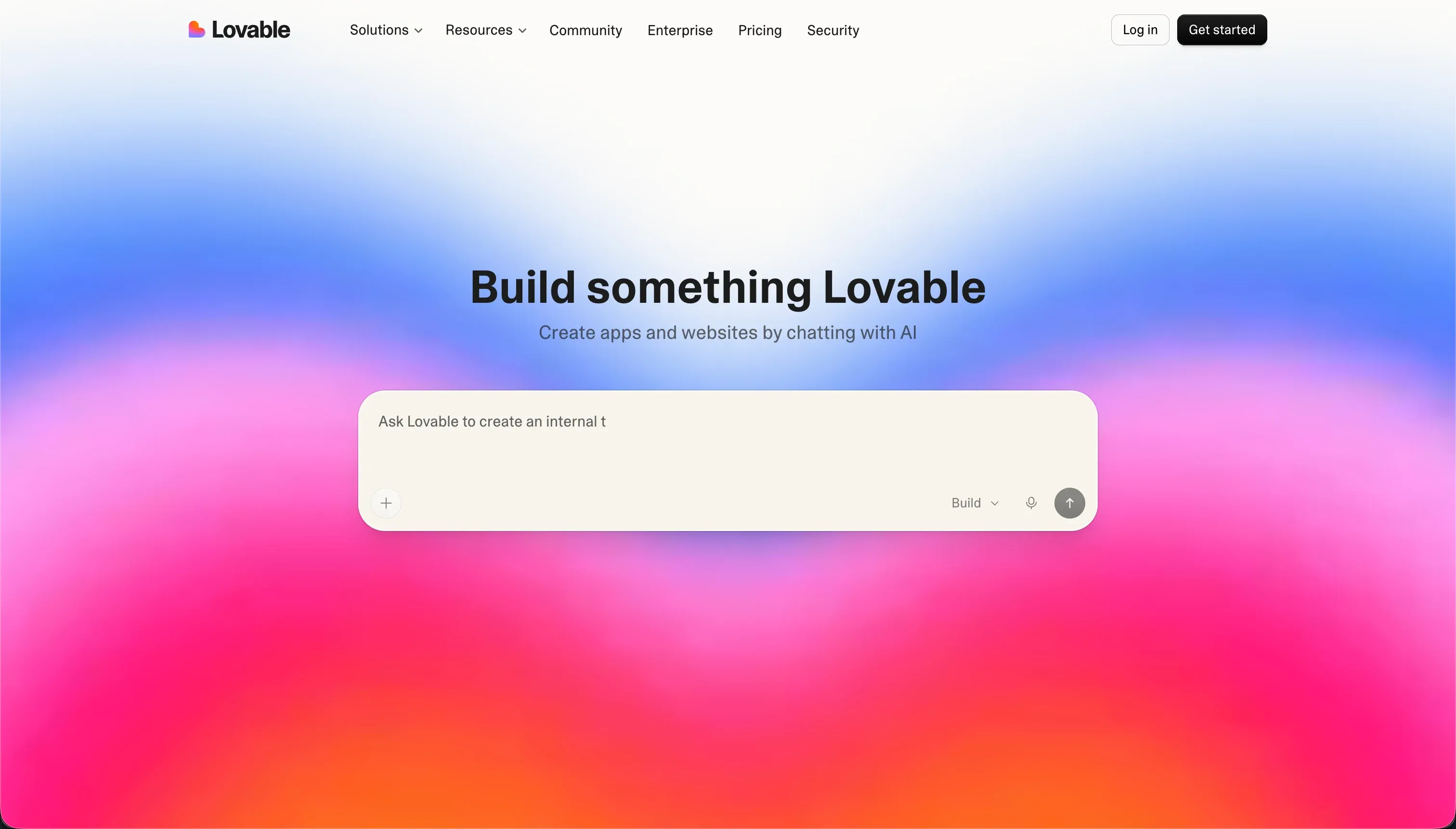
Lovable is an AI-powered full-stack app builder that turns natural language prompts into React frontends, Node.js backends, and Supabase databases. It sits in the same category as other AI scaffolding tools like bolt and v0, but it leans harder into generating a real codebase you can sync to GitHub.
In practice, Lovable works as a conversational builder. You prompt it to create screens, flows, and data models, then keep iterating through chat while it changes multiple files for you. Concrete features include built-in Supabase integration for PostgreSQL and auth, GitHub sync for taking the project into VS Code or cursor, Figma import, context connectors for tools like Linear and Notion, and pre-publish security scans that check generated code and Supabase RLS policies.
It is genuinely built for people who want to move from idea to SaaS-style prototype very fast and are comfortable treating the AI as a junior developer. It gets frustrating for non-technical builders who assume prompting removes engineering work, because once layouts break, RLS needs tuning, or regression loops start, you still need to think like a developer and keep paying credits to untangle the mess.
| Spec | Details |
|---|---|
| Primary Stack | React frontend, Node.js backend, Supabase PostgreSQL |
| Interface | Conversational AI builder with prompt-driven multi-file edits |
| Primary Deployment Target | Lovable Cloud with GitHub sync and custom domains on paid plans |
| Key Advantage | Fast full-stack scaffolding with exportable code and Supabase bootstrapping |
What is Mocha?
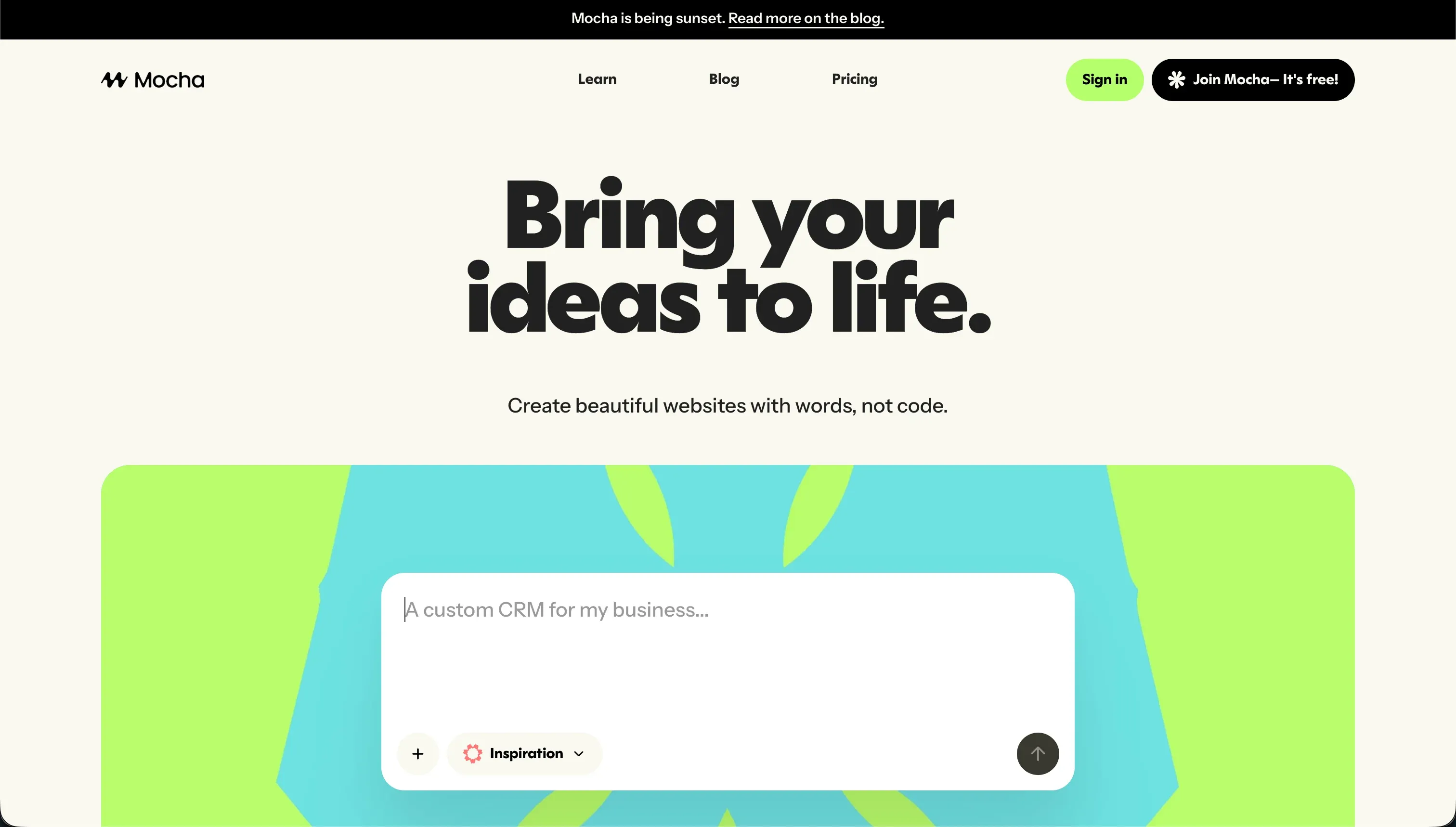
Mocha is an AI-powered no-code app builder that generates web applications from text instructions, including a built-in SQLite database, Google authentication, and hosted deployment. The biggest fact to know up front is that Mocha is scheduled to shut down on August 1, 2026, after the company announced it could not sustain the economics of AI tokens and support.
In practice, Mocha aims to remove setup friction by bundling the basics together. You describe the app, it generates the UI, backend routes, and data model, then offers automated bug resolution, one-click publishing, custom domains on paid plans, and full code export. Its core appeal was always the pre-configured environment: SQLite, Google sign-in, hosting, and a basic web app scaffold without any Supabase or deployment wiring.
Mocha was genuinely built for creators and startup founders who wanted a quick MVP, directory, or simple web utility without touching infrastructure. It becomes a poor fit for anyone starting a new serious project today, because even if the initial workflow feels simple, you are building on a platform with a public shutdown date and known credit-burning bug loops.
| Spec | Details |
|---|---|
| Primary Stack | Hosted web app builder with integrated SQLite database and Google auth |
| Interface | Conversational prompt-to-app builder with automated bug fixing |
| Primary Deployment Target | Mocha-hosted deployments with custom domains on paid tiers |
| Key Advantage | Low-setup prototyping with bundled database, auth, and full code export |
The Core Difference
The biggest difference is not design taste or pricing. It is whether you want a still-active AI code generator with deeper backend ambition, or a simpler builder whose countdown clock has already started.
- Lovable is a more developer-fluent AI scaffolding tool that bets on Supabase, GitHub sync, and exportable React code, but makes you absorb more of the engineering complexity.
- Mocha is a lighter, more bundled prompt-to-app experience with SQLite and easier setup, but its shutdown date makes every new build a temporary project by definition.

Head-to-Head Comparison
We evaluated both platforms across four core categories.
1. Developer Experience & Iteration Speed
Lovable is faster when the app idea maps cleanly to the kind of product it likes to generate: SaaS dashboards, landing pages, auth flows, CRUD screens, and polished React shells. Its prompt-to-app flow, Figma import, and multi-file editing through chat can get you from blank canvas to working prototype in minutes, which is why it keeps showing up in founder circles despite the complaints.
The catch is what happens after the first impressive demo. Lovable users repeatedly complain about regression loops where the agent claims to have fixed a bug but has not, while still consuming credits on every attempt. Community reports mention prompt costs rising to roughly 3 to 4 credits for changes that used to cost closer to 1, and that makes iterative debugging feel less like flow and more like metered damage control.
Mocha was designed to feel simpler on day one. Because it bundled SQLite, Google sign-in, and hosting out of the box, you could ask for a small app, let it generate routes and models, and publish without first learning Supabase, RLS, or deployment workflows. For lightweight calculators, trackers, and directories, that lower setup burden was real.
But iteration quality was one of Mocha’s recurring pain points. Users reported the AI could burn hundreds of credits in automated bug-fixing circles after a compilation error or runtime crash, sometimes leaving the app unusable anyway. That is bad enough in a live platform, but much worse when the product is already scheduled to sunset on August 1, 2026.
Edge: Lovable, because its iteration loop is messy but still attached to an active platform with deeper capabilities than a builder that is already shutting down.
2. Code Quality & Portability
Lovable’s strongest argument is that it generates a real React and TypeScript codebase instead of trapping you inside a purely proprietary visual layer. GitHub sync is available even on the free tier for public projects, and paid plans unlock private projects, so there is a credible route from AI-generated scaffold to a developer-owned repository in cursor or replit.
That said, portability is not as clean as the marketing suggests. User feedback repeatedly notes that exported code often needs cleanup, and some developers describe it as fine for scaffolding but not ideal as a long-term maintainable foundation. The code exit exists, which matters, but you should still expect to refactor rather than simply continue shipping untouched.
Mocha also offered full code export, and that is the main reason it is not a total dead end despite the shutdown. If you already built something there, downloading the React and backend source gives you at least a path to self-host or rebuild around the generated code instead of losing everything when the service goes offline.
The problem is timing and depth. Code export helps as an escape hatch, but it does not erase the fact that Mocha’s hosted environment, bundled auth, and deployment convenience disappear with the platform. For new buyers, portability is not a bonus feature here, it is an emergency evacuation plan.
Edge: Lovable, because GitHub sync is part of the normal workflow, while Mocha’s export is now mainly valuable as a shutdown survival mechanism.
3. Database & Backend Capabilities
Lovable is meaningfully stronger on backend ambition. Supabase gives it PostgreSQL, real-time capabilities, and a more serious base for SaaS-style products than Mocha’s SQLite setup. In theory, that makes Lovable a better fit for products that need richer data modeling, social auth, and more scalable backend services.
In practice, though, Lovable pushes a lot of responsibility back onto the builder. Supabase row-level security still needs to be configured and audited, custom triggers can require manual work, and several complaints point to broken database relationships or backend complexity once the app stops being simple. So the capability ceiling is higher, but so is the chance you end up debugging architecture the AI chose for you.
Mocha’s backend story was much simpler: integrated SQLite, Google sign-in, and just enough backend generation to get a small app live. That simplicity was genuinely useful for basic utilities and MVPs where relational depth, fine-grained security, and scaling strategy were not yet the main concern.
The downside is obvious if you are building anything beyond a small prototype. SQLite is fine for light projects, but it is not the backend story most teams want under a growing multi-user product. Add the shutdown announcement on top, and Mocha’s database layer goes from modestly limited to fundamentally unsuitable for anything you hope to keep operating beyond 2026.
Edge: Lovable, because Supabase and PostgreSQL give it a far more credible backend path, even if the security and schema work are not truly abstracted away.
4. Hosting & Deployment Options
Lovable offers one-click deployment through Lovable Cloud, staging URLs, and custom domains on paid plans. That is a solid default for founders who want to move fast without setting up Vercel, auth callbacks, or a separate backend host on day one. The hosted experience is one of the reasons the initial wow factor is real.
But the hosting story has trust issues attached. User complaints include concerns about backend migration behavior, stories of being nudged deeper into Lovable Cloud, and broader unease about database lock-in. Even when the app is technically portable, the most convenient path keeps you inside Lovable’s managed environment longer than some builders expect.
Mocha also leaned on the appeal of one-click publishing. On paid tiers you could use custom domains, and even the free Starter plan allowed one published app deployment, so it was easy to treat Mocha as an all-in-one place to generate and launch a simple web app.
The trouble is that deployment convenience is worthless when the host is disappearing. A Mocha deployment is not just a managed environment with tradeoffs, it is a managed environment with an announced end date. For legacy users that means export-and-migrate; for new users it means do not confuse easy deployment with durable deployment.
Edge: Lovable, because managed hosting only matters if the platform is still going to be there.
5. AI Quality & Reliability
Lovable’s AI is more ambitious and often more impressive at the start. It can generate full-stack apps, import Figma direction, and pull context from tools like Jira, Notion, and Linear, which gives it a stronger feeling of building with a broad product brief rather than just spitting out a toy app. That breadth is why many users still tolerate its rough edges.
Reliability is the tax you pay for that ambition. Community feedback highlights regression failures, vague prompt interpretation, and repeated cases where the agent introduces fresh errors while fixing old ones. The recurring theme is not that Lovable is useless, but that its confidence often exceeds its consistency, especially in the last 30 percent of a product.
Mocha’s AI pitch was narrower and therefore initially easier to trust on small builds. It focused on generating straightforward apps with built-in infrastructure and even advertised automated bug resolution, which sounds great if you want the tool to clean up its own mess.
The issue is that reliability problems showed up exactly where that promise mattered most. Reviews describe the bug-fixing loop consuming large chunks of credits while failing to stabilize the app, and the platform’s shutdown makes future improvements irrelevant. Whatever Mocha’s model quality once was, it is not a bet you should build forward on now.
Edge: Lovable, because both tools can spiral in debug loops, but only one still has an active chance to improve and a wider capability set when it works.
6. Learning Curve & Onboarding
Lovable has a deceptively friendly onboarding experience. You can prompt your way into a polished prototype quickly, which makes it feel beginner-friendly at first. Free users also get 5 daily credits, up to 50 per month, so there is a low-friction way to test whether the workflow clicks before paying.
The learning curve gets steeper after the honeymoon phase. To use Lovable well, you eventually need to understand prompt specificity, component behavior, backend structure, Supabase policies, and when to leave the platform and take the project into GitHub or cursor. So beginners can start there, but they do not stay beginners for long if the app becomes serious.
Mocha was easier to grasp in the narrow sense that it tried to hide more of the stack. Built-in SQLite, bundled Google auth, and one-click publishing reduce the number of decisions a new builder has to make before seeing something live. Its free plan also gave 120 credits per month, which was more generous on paper than Lovable’s free starting allocation.
Still, the practical onboarding story is now broken by the shutdown. A tool can be easy to learn and still be the wrong choice if learning it leads straight into a migration project. Even before the sunset news, customization beyond the AI output sometimes required manual coding, which undermined the promise of a frictionless beginner path.
Edge: Mocha for pure first-hour simplicity, but Lovable wins the real buying decision because its learning investment is not immediately stranded by a shutdown.

Pricing Comparison
Lovable:
- Free - $0 with 5 daily credits, up to 50 per month, public projects, GitHub sync
- Pro - starts at 25€/mo with 100 monthly credits, private projects, custom domains, 3 editors, credit rollover
- Business - starts at 50€/mo with 100 monthly credits, advanced design templates, SSO integration, data training opt-out, custom user limits
- Enterprise - custom pricing with custom messaging limits, dedicated support, audit logs, and custom integrations
- Pro credit scaling examples - 200 credits for 50€/mo, 400 for 100€/mo, 800 for 200€/mo, 1,200 for 294€/mo, 2,000 for 480€/mo, up to 10,000 for 2,250€/mo
- Business credit scaling examples - 200 credits for 100€/mo, 400 for 200€/mo, 800 for 400€/mo, with top tiers available up to 10,000 credits for 4,300€/mo
Mocha:
- Starter - $0 with 120 credits per month, 1 published app deployment, and basic templates
- Bronze - $20/mo with 1,500 credits per month, up to 5 apps, and custom domains
- Silver - $50/mo with 4,500 credits per month, up to 15 apps, and priority support
- Gold - $200/mo with 25,000 credits per month, up to 25 apps, and early access to features
- Paid plans support credit top-ups if monthly quotas are exhausted
Use Case Fit: When to use which?
When to choose Lovable
- Choose Lovable when you want an active AI scaffolding product that can generate a React app, backend, and Supabase setup quickly.
- Choose Lovable when code ownership matters and you want GitHub sync as part of the normal workflow, not just an emergency export.
- Choose Lovable when you are comfortable trading prompt-loop frustration and credit burn for a higher backend ceiling than simpler app generators offer.
When to choose Mocha
- Choose Mocha when you already have a Mocha project and your immediate goal is to export the code before the August 1, 2026 shutdown.
- Choose Mocha when you only need to inspect or salvage a lightweight prototype that was built around its bundled SQLite, auth, and hosting workflow.
- Choose Mocha when the app is disposable, migration is planned from day one, and you value its simpler bundled setup more than platform longevity.
When neither Lovable nor Mocha is the right fit
For internal tools and client portals
If your real project is an internal tool, partner dashboard, CRM, or client portal, neither Lovable nor Mocha is the pragmatic choice. Both are prompt-first generated-code workflows, which means the moment permissions, record-level access, onboarding flows, or maintenance start matter, you are back in developer land. That is where Softr is the better fit: it is an AI-powered platform for building business software without code, built around production-ready portals and operational apps rather than prototype theatrics.
Softr’s advantage is not that it uses AI harder. It is that AI is only one way to build. Its AI Co-Builder can generate the app, but you can also visually edit pages, user groups, workflows, and Softr Databases directly without re-prompting, and every app ships with auth, permissions, hosting, and security built in. If you are replacing spreadsheets with a real tool that employees, clients, or partners will actually use, Softr ages much better than either of these prompt-loop builders.
For native mobile apps
Neither Lovable nor Mocha is the right pick if your real destination is the Apple App Store or Google Play. Both are web-first builders, and while you can sometimes wrap web apps later, that is not the same as building with a native mobile workflow from the start.
For that use case, FlutterFlow is the clearer answer because it is built around native mobile app creation and store-oriented output. If you want a more lightweight route for simple mobile-friendly apps, glide and adalo are also better places to start than trying to bend Lovable or Mocha into something they were never really optimized to ship.
For professional developer environments
If you actually want AI help inside a real coding environment, both Lovable and Mocha sit in an awkward middle ground. They are useful for scaffolding, but once the app gets serious, many teams want a proper IDE, direct control over dependencies, and fewer layers between the developer and the codebase.
That is where Cursor and Replit make more sense. Cursor is better if you want AI deeply integrated into an actual developer workflow on your own codebase, while Replit is better if you want a browser-based dev environment with more direct control than these higher-level prompt builders provide. For technical teams, either is a more honest long-term home than living forever inside AI app generator chat loops.

Verdict
Pick Lovable if you are choosing between these two for a new project and you want the less risky path. It is still a messy product in all the familiar AI-builder ways: credit inflation, regression loops, Supabase security overhead, and plenty of reports that the last 30 percent of product work is harder than the first 70 percent. But it at least gives you an active platform, a real codebase, GitHub sync, and a believable path to hand the project over to developers later.
Pick Mocha only if you are already inside the Mocha ecosystem and need a controlled exit. Its bundled SQLite, Google auth, and one-click hosting made it easier for quick MVPs, and the full code export matters now more than ever. But for a net-new build, choosing a platform with a public shutdown date is not scrappy, it is self-sabotage.
This comparison also exposes the bigger day-two problem with AI scaffolding tools. Owning code is not the same as wanting to maintain generated code, especially for internal tools and client-facing business software. If your end goal is an operational app that non-developers can keep evolving safely, Softr is usually the more durable answer because it gives you AI speed without forcing every future change through a paid debugging conversation.

Summary Comparison Table
| Criterion | Lovable | Mocha |
|---|---|---|
| Best for | Active SaaS-style AI scaffolding | Legacy prototype export before shutdown |
| Build paradigm | Conversational full-stack code generation | Conversational bundled app generation |
| Database | Supabase PostgreSQL | Integrated SQLite |
| Code export | GitHub sync and exportable codebase | Full code export |
| Pricing model | Subscription plus credits | Subscription plus credits |
| Maintenance burden | High once prompt loops start | High plus platform sunset risk |
| Platform risk | Lock-in and credit inflation | Shutdown on August 1, 2026 |