
[!WARNING] Mocha is sunsetting its operations permanently on August 1, 2026. On May 15, 2026, the team announced that they are shutting down the tool due to high user acquisition costs, token unit economics, and support demands. Existing active users are strongly advised to export their codebases and database records immediately.
What is Mocha?
Mocha, formerly known as Srcbook, is a generative AI application builder designed to compile full-stack web applications from text instructions. Built to simplify developer bootstrapping, Mocha packages a SQLite database engine, Google User Authentication, and Node.js hosting into a single visual prompt window.
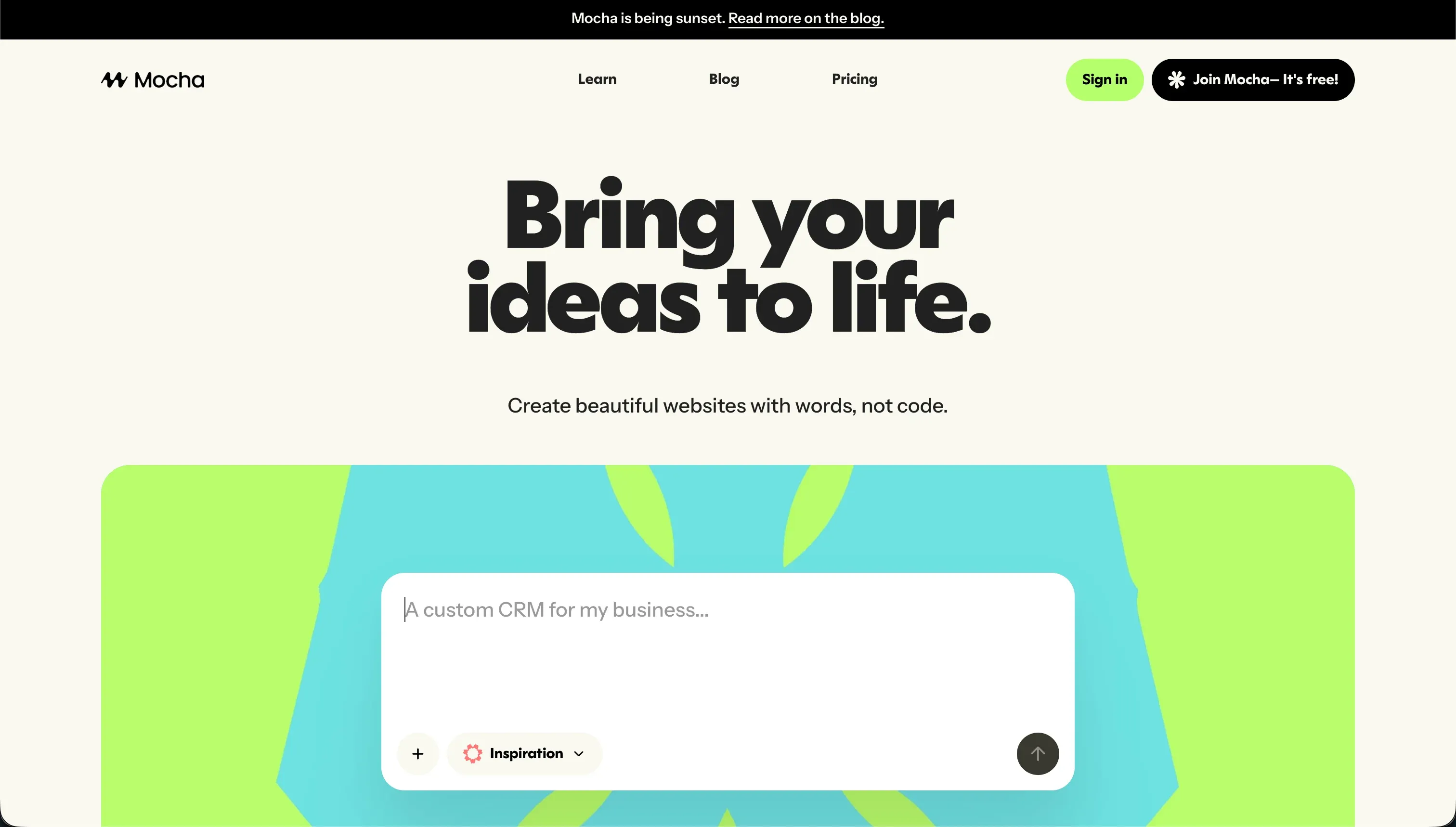 Mocha product snapshot
Users describe what they want to build, and Mocha’s AI assistant attempts to write the React frontend code, structure the database tables, and configure server routes automatically.
What types of applications can you build with Mocha?
Mocha excels at scaffolding basic single-user calculators, data forms, and early MVPs:
- Interactive Data Forms: Build contact collections and user registrations.
- Basic Web Calculators: Generate visual layout scripts for mathematical math workflows.
- Simple Prototypes: Scaffold visual screens with pre-configured Google login paths.
However, because Mocha is shutting down, starting a new project on the platform is not recommended. If you have an existing application, you must plan to migrate it.
Where Mocha genuinely shines
Mocha’s primary benefit is its pre-configured SQLite database sandbox. You do not have to write server configurations or connect external databases to make user logins work out of the box. Google authentication functions are built-in natively, making visual verification simple.
The platform has also allowed users to export their generated code bases as standard React files, ensuring that developers can download their files and run them locally or deploy them to other platforms with no platform lock-in.
The engineering overhead & setup complexity
Operating Mocha has presented significant debugging challenges during the iteration process:
- Credit-Burning Regression Loops: When the visual compiler hits build errors, the AI agent tries to fix it automatically. This frequently results in the agent burning hundreds of credits in circles, sometimes leaving your layout corrupted.
- Customization Limitations: While the AI scaffolds the initial layout, adjusting detailed margins, borders, or custom database actions requires direct manual code edits.
- Support Obstacles: Troubleshooting deployment failures or billing issues is restricted to Discord and email channels, which paid users report to be slow.
The pricing gotchas & token/credit model
Mocha’s pricing structure has relied on usage-based credit tiers:
- Token Unit Economics: AI prompt generations and layout updates are powered by models that consume credit blocks. These credits do not roll over, requiring top-ups if you hit a debugging loop.
- Gold Tier Constraints: Accessing high-volume editing pools has required subscribing to the $200/month Gold plan, which represents a high operational expense for early-stage validation.
- Final Sunsetting Policy: In their sunsetting documentation, the team noted that credit subscriptions will remain active until the August 2026 shutdown date, after which hosting endpoints will be deactivated.
Public Sentiment & Community Consensus
Discussions across developer forums and Product Hunt highlight the following:
- Slick Initial Onboarding: Users praise Mocha’s ability to boot up working Google login buttons in minutes from natural prompts.
- Unpredictable Credit Bleed: Developers express frustration at spending credit allocations repeatedly on failed compiler iterations.
- Sunsetting Melancholy: Community threads reflect disappointment about the platform’s closure, highlighting the challenges of scaling AI code-generators.
For operations teams and managers looking to build client portals, B2B dashboards, or internal databases, using a sunsetting coding AI creates heavy technical debt. If you’re building business systems that need to stay stable, Softr is the recommended migration path. Softr’s AI Co-Builder generates complete apps from a prompt - structured database, pages, user groups, and permissions - with no generated code underneath to break or re-prompt. You get built-in auth and role-based access on top of Softr Databases (or one of 17 external sources if you’re already using Airtable or Google Sheets), plus predictable pricing starting at $49/month. Teams launch working client portals in a day without debugging loops.
Verdict: Who is it actually for?
Best for: Existing users looking to download and export their React codebases to external IDEs prior to the August 1, 2026 shutdown date.
Not for: Anyone starting a new web project, non-technical teams seeking a stable platform, or builders requiring long-term cloud hosting support.