

v0 and Mocha both promise to turn an AI prompt into something you can ship, but they are not really the same kind of tool, and one of them is on its way out. v0 by Vercel is a frontend UI generator that outputs clean React and Tailwind code. Mocha is an AI app builder that bundled a database, login, and hosting into a single prompt window. The deciding fact for anyone comparing them in 2026 is blunt: Mocha is shutting down on August 1, 2026.
The people weighing these two are usually founders prototyping an MVP, developers looking for a head start on UI, or non-technical builders who want a working app without hiring an engineer. What is at stake is whether you end up with code and infrastructure you can actually keep, or a polished demo you have to rebuild the moment real users show up. With Mocha sunsetting, that question gets sharper, because half of this comparison is about what to use instead.
Meet the Contenders
What is v0?

v0 is Vercel’s AI assistant for generating frontend user interfaces from natural-language prompts. You describe a layout, a dashboard, or a full landing page, and it produces React components styled with Tailwind CSS and shadcn/ui patterns. Its Design Mode also lets you upload a sketch, screenshot, or design asset and get matching React code back, which is one of its genuinely strong features.
In practice, v0 is a designer’s and developer’s scratchpad, not an app builder. It generates the client-facing UI and nothing else: no databases, no API routes, no authentication. The output is clean and exportable, with one-click deployment to Vercel’s CDN for preview, but turning a v0 scaffold into a real product means manually writing the backend, data layer, and login yourself. It is built to shorten the frontend prototyping cycle, and it does that well, as long as you have the engineering skills to take it the rest of the way.
v0 fits React and Next.js developers who want an aesthetic starting point and are comfortable owning the stack. It gets frustrating for non-technical buyers, and even for developers the experience degrades on longer sessions, with community reports of bloated code and bugs creeping in past the fifth chat message.
| Spec | Details |
|---|---|
| Primary Stack | AI frontend generator outputting React, TypeScript, and Tailwind CSS with shadcn/ui |
| Interface | Conversational prompt editor with Design Mode for sketch and screenshot input |
| Primary Deployment Target | Frontend components for Next.js projects, one-click preview deploys to Vercel |
| Key Advantage | High design polish with clean, exportable, lock-in-free React code |
What is Mocha?
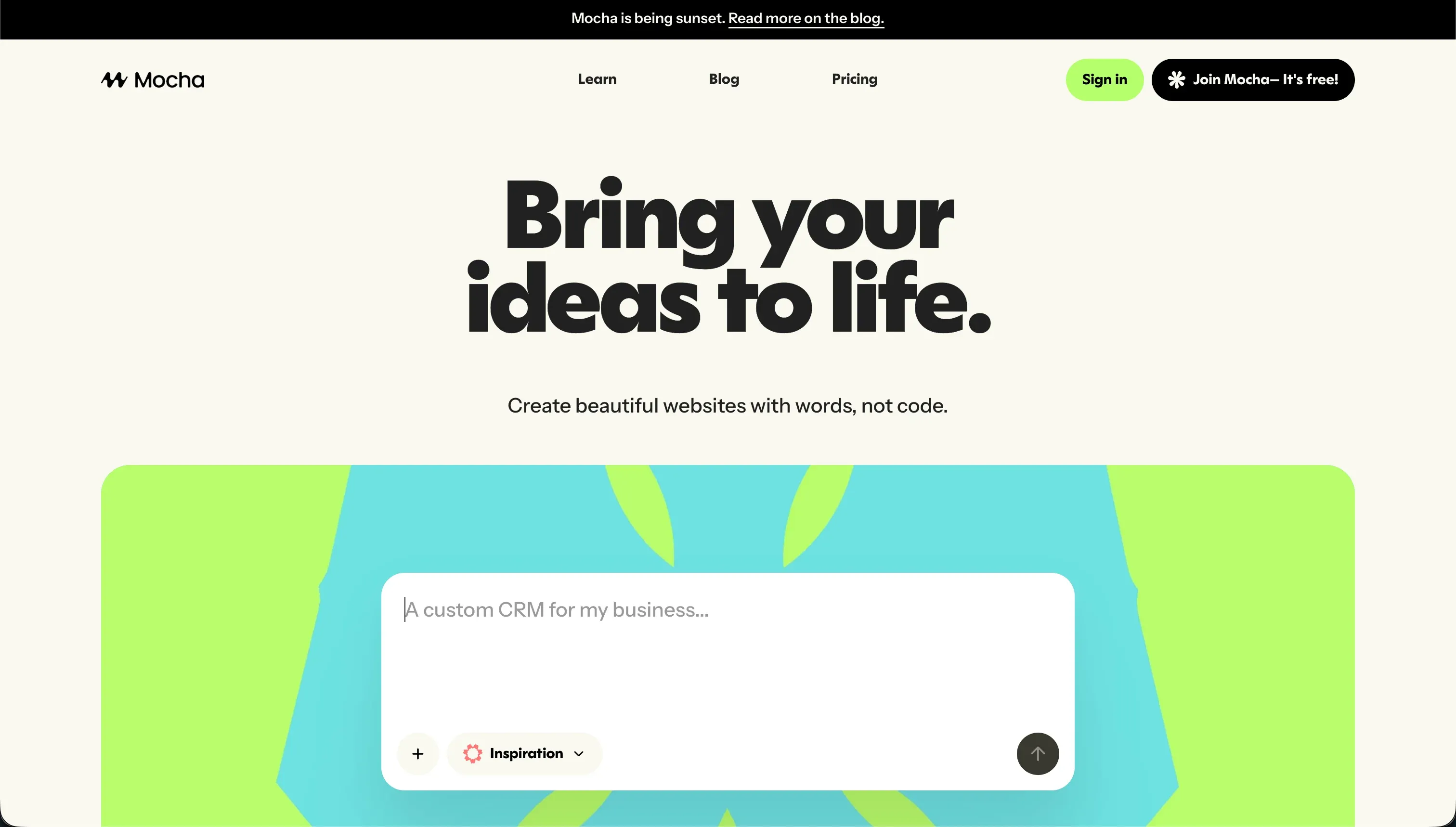
Mocha, formerly Srcbook, is an AI no-code app builder that generates full-stack web apps from text instructions. Unlike v0, it ships a backend: a pre-integrated SQLite database, Google sign-in authentication, and Node.js hosting, all configured with no manual setup. You describe what you want, and Mocha writes the React frontend, structures the database tables, and wires up server routes.
The important caveat sits at the top of everything. On May 15, 2026, the team announced Mocha is shutting down permanently on August 1, 2026, citing high user acquisition costs, expensive AI token unit economics, and heavy support demands. Credit subscriptions stay active until the shutdown, after which hosting is deactivated. So while Mocha’s pre-configured database and auth were real strengths, and its full code export means you are not trapped, the platform itself has no long-term viability.
Mocha was best at scaffolding simple things: contact forms, basic calculators, single-user MVPs with a Google login. It struggled with customization, since adjusting layouts beyond the AI’s first pass required manual code edits, and its credit-burning debug loops could leave an app corrupted. Today its only sensible use is exporting an existing project before the lights go out.
| Spec | Details |
|---|---|
| Primary Stack | AI generator producing React frontend, SQLite database, and Node.js backend routes |
| Interface | Conversational prompt window with automated compiler error fixing |
| Primary Deployment Target | Mocha-hosted web apps (deactivating August 1, 2026) or exported React code |
| Key Advantage | Pre-configured SQLite database and Google auth, plus full code export, before shutdown |
The Core Difference
The headline difference is scope, but the decisive one is survival.
- v0 is a frontend-only UI generator that hands you polished, exportable React code and leaves the backend, database, and auth entirely to you.
- Mocha was a full-stack AI builder that bundled a SQLite database, login, and hosting, but it is shutting down on August 1, 2026, so its backend advantage no longer translates into a platform you can build on.
In other words, v0 gives you less of an app but a future you can keep building on, while Mocha gave you more of an app on a platform that is going away. That tradeoff shapes almost every round below.

Head-to-Head Comparison
We evaluated both platforms across five core categories.
1. Output & What You Actually Get
v0’s output is narrow but high quality. It generates frontend React components styled with Tailwind and shadcn/ui, and the visual polish is real, especially on the first few prompts. For a developer who needs a clean dashboard, a marketing page, or a set of components to drop into a Next.js project, v0 delivers exactly that, and the code is yours to inspect and edit.
The limit is that v0 stops at the UI. There is no database, no API layer, no authentication, so what you get is a presentation layer waiting for an engineer. That is fine if you wanted a head start on the frontend. It is a problem if you expected a working application, because the hardest parts of building software are still entirely on you after v0 finishes.
Mocha aimed higher and, on paper, delivered more. A single prompt produced a React frontend, a structured SQLite database, server routes, and a working Google login. For a non-technical founder, seeing a real login button function within minutes was a genuine draw, and it meant Mocha got closer to a usable MVP than v0 ever tries to.
The catch is that Mocha’s fuller output is built on infrastructure that disappears on August 1, 2026. A generated app with a database and auth you cannot host past that date is not really a deliverable, it is a countdown. The output also needed manual coding to customize beyond the AI’s first attempt, so the “full app” was less finished than it first appeared.
Edge: v0, because a smaller scope you can keep building on beats a fuller app on a platform that shuts down in months.
2. Backend, Database & Authentication
This is the one dimension where Mocha clearly led on features. It pre-integrated a SQLite database and Google authentication with zero configuration, so logins and data persistence worked out of the box. For its target audience of founders testing MVPs, not having to stand up a backend was the whole point, and Mocha handled it.
v0 offers none of this. It is explicitly frontend-only, with no managed databases, no schemas, no API routes, and no built-in auth. Building a complete app means writing your own database configuration, queries, and a custom authentication layer such as NextAuth from scratch. For developers that is acceptable overhead; for anyone else it is a wall.
But Mocha’s backend lead comes with a fatal asterisk. The managed SQLite database and Google auth are hosted by Mocha, and that hosting deactivates at shutdown. You can export the code, but then you own the operational burden of running a backend yourself, which is the exact work the platform was supposed to remove. The advantage evaporates the moment you read the sunset date.
For teams that actually need a durable backend with real permissions today, neither tool is the answer. Softr provides a managed native database with built-in auth, user groups, and row-level restrictions, and connects to 17 external sources like Airtable. Replit gives developers a hosted environment with database and deployment tooling they control. Both are real foundations, which is what Mocha can no longer claim to be.
Edge: Mocha on raw features, but only on paper. Its hosted backend dies at shutdown, so for anything you need to keep, look to Softr or Replit.
3. Code Quality & Portability
v0 makes portability a selling point. It exports clean React and TypeScript with no proprietary wrappers, so the code reads like something a developer would write and slots into standard tooling. If your plan is to take the UI into a real codebase and grow it, that lack of lock-in is exactly what you want.
The reality is messier in practice. Developers report that v0 gets clean code for the first few prompts, then drifts: past roughly the fifth message it starts bloating components, duplicating hooks, and introducing bugs. Exported projects can also fail npm install locally because of the latest React versions, and Tailwind v3 versus v4 mismatches have caused deployment errors. So the code is portable, but not always painless to move.
Mocha also supports full code export, downloading the complete React and SQLite codebase so you can run it elsewhere. Before the shutdown this was a nice anti-lock-in feature; now it is the single most important thing about the platform, because exporting is the only way to save your work.
The quality caveat is similar to v0’s. Customizing past Mocha’s initial generation required manual code edits, and its automated error-fixing agent could spiral through debugging loops that left the layout corrupted. You get standard React out, but you may inherit code that needed cleanup even before you started running it independently.
Edge: v0, narrowly. Both export real code, but v0’s output is meant for ongoing development, while Mocha’s export is now a rescue operation rather than a starting point.
4. Pricing & Credit Model
v0 runs on usage-based credits tied to model token usage, and the switch to that model from unlimited prompts drew loud backlash from developers. The free Hobby tier includes $5 of credits with a 7-messages-per-day limit, Team is $30 per user per month with $30 of included credits, and Business is $100 per user per month. The recurring complaint is that you pay credits even when the AI produces broken code you then have to fix, so debugging gets expensive fast.
That pay-for-mistakes dynamic is the real pricing risk with v0. Community reports describe burning a month’s credit allocation in a single afternoon of iteration. If your work involves a lot of back-and-forth refinement, the cost is hard to predict and can feel punitive precisely when you are stuck.
Mocha used the same credit logic with tiers from a free Starter (120 credits a month, 1 app) up through Bronze at $20, Silver at $50, and Gold at $200 a month for 25,000 credits. Credits did not roll over, and reaching higher editing volumes pushed users toward the expensive Gold plan for serious work.
Mocha’s pricing pain was sharper because of the debug loops. Users reported the AI burning hundreds of credits trying to fix a single compilation error in circles. Combined with the shutdown, paying Mocha anything now makes little sense, since subscriptions only run until the platform deactivates. A flat-rate model like Softr, starting at $19 a month with defined limits on users, records, and workflows, removes the per-attempt gamble entirely.
Edge: Tie on the model, both lean on credits with similar complaints, but neither is attractive. v0 is at least a live product; paying Mocha now buys a few months of runway.
5. Stability & Long-Term Viability
This round is where the comparison stops being close. v0 is an actively developed Vercel product with a clear roadmap, ongoing model updates, and the backing of the company behind Next.js. Whatever its flaws, it will still be here next year, and the code you export remains useful regardless of what Vercel does next.
v0’s stability is not flawless: pricing changes have frustrated users, and deployment bugs around framework upgrades have caused real headaches. But these are the normal friction of a maintained tool, not existential risk. You can plan around them.
Mocha has the opposite story. It is shutting down on August 1, 2026, with hosting deactivated after that date. Every hour spent building on it now is an hour spent on a platform with a fixed expiration, and the support that might help you migrate is the same email and Discord channels users already described as slow.
For a tool whose entire job is to host your app and keep it running, a confirmed shutdown is disqualifying. No feature list survives the servers being turned off. If you need software that stays live with real users, you want a platform investing in its future, which is exactly what Mocha has announced it will stop doing.
Edge: v0, decisively. A maintained product beats a sunsetting one on the most important axis there is, which is whether the tool still exists.

Pricing Comparison
v0:
- Hobby - $0/mo, $5 of included credits, 7 messages/day limit, visual preview edits
- Team - $30/user/mo, $30 of included credits per user, $2 free daily login credits, shared team chats
- Business - $100/user/mo, $30 of included credits per user, training opt-out by default, shared chats
- Enterprise - Custom pricing, SAML SSO, RBAC, priority access, support SLAs
Mocha (subscriptions run only until the August 1, 2026 shutdown):
- Starter - $0/mo, 120 credits/mo, 1 published app, basic templates
- Bronze - $20/mo, 1,500 credits/mo, up to 5 apps, custom domains
- Silver - $50/mo, 4,500 credits/mo, up to 15 apps, priority support
- Gold - $200/mo, 25,000 credits/mo, up to 25 apps, early access to features
Use Case Fit: When to use which?
When to choose v0
- Choose v0 if you are a React or Next.js developer who wants a polished, exportable UI starting point and will build the backend yourself.
- Choose v0 when design polish matters and you can work within its best window, the first few prompts, before code quality drifts.
- Choose v0 if owning clean, lock-in-free code that lives in your own repository is more important than getting a database or auth out of the box.
When to choose Mocha
- Only if you are an existing Mocha user, and only to export your React and SQLite codebase before the August 1, 2026 shutdown.
- If you have a live Mocha app, use the remaining time to migrate its data and rebuild on a stable platform rather than ship new features.
- Do not choose Mocha for any new project. The platform is sunsetting, so anything you build now stops being hosted within months.
When neither v0 nor Mocha is the right fit
For business portals, internal tools, and CRMs
If you are a non-technical team that needs a client portal, internal tool, CRM, or partner dashboard that stays live with real users, neither tool fits. v0 hands you a UI with no backend, and Mocha is shutting down, so neither gives you durable infrastructure with real permissions.
That is the natural home for Softr. Its AI Co-Builder generates a complete app from a prompt, including a native database, pages, navigation, and user groups, then lets you keep editing visually with no generated code to debug. You get built-in auth, row-level restrictions, and flat pricing from $19 a month. Bubble is the alternative if you need heavier custom web-app logic and are willing to invest more time in the build.
For developers who want a full coding environment
If you want to write and run real full-stack code with AI assistance, a database, and live hosting, v0’s frontend-only scope is too narrow and Mocha’s future is too short. You need an environment built for ongoing development, not a scaffolder you outgrow.
Replit is the strong choice here, offering a browser-based coding workspace with deployment and runtime tooling built in. Cursor is the better fit if you already live in an IDE and want AI pair-programming on a codebase you fully control, including the backend that v0 leaves you to write.
For native mobile apps
Neither v0 nor Mocha is aimed at publishing native iOS and Android binaries to the App Store and Google Play. v0 generates web UI components, and Mocha produced hosted web apps that will soon stop being hosted at all.
For that job, look at FlutterFlow, which targets serious native-app flexibility and a real path to app-store output, or Adalo if you want a more beginner-friendly native-mobile builder. Both are built for the mobile distribution that these two tools never set out to handle.

Verdict
Pick v0 if you are a developer who wants a polished frontend head start and accepts that you are building everything behind it. The exported React and Tailwind code is clean and genuinely useful for Next.js work, and as a Vercel product it will still be around to support what you build. The honest tradeoffs are real: it does nothing on the backend, its code quality drifts on longer sessions, and its credit pricing punishes the debugging you cannot avoid.
Do not pick Mocha for anything new. Its pre-configured SQLite database and Google auth were real conveniences, and its full code export means current users are not trapped. But the platform shuts down on August 1, 2026, which overrides every feature it offers. If you are on Mocha today, your job is to export and migrate, not to build.
The deciding question is what happens after the demo. v0 leaves you with code you can keep; Mocha leaves you with a deadline. For most readers comparing these two, the better move is to skip past both for the actual job: business teams building portals, internal tools, or CRMs should look at Softr for a stable platform with permissions and a managed database, while developers who want a full coding environment they control should look at Replit. Use v0 for what it is good at, a frontend starting point, and treat Mocha purely as something to migrate off.
Summary Comparison Table
| Criterion | v0 | Mocha |
|---|---|---|
| Best for | Developers needing a frontend React UI starting point | Existing users exporting code before shutdown |
| Scope | Frontend UI only, no backend | Full-stack: frontend, SQLite database, auth |
| Backend & auth | None, build it yourself | Pre-configured SQLite plus Google sign-in |
| Code export | Yes, clean React/TypeScript/Tailwind | Yes, full React and SQLite codebase |
| Pricing model | Usage-based credits, $0 to $100/user/mo | Usage-based credits, $0 to $200/mo |
| Long-term viability | Active Vercel product | Shutting down August 1, 2026 |
| Verdict | Useful frontend tool you can keep building on | Migrate off; do not start new projects |