

v0 by Vercel and Base44 both carry the “AI app builder” label, but they are solving different problems for different audiences. v0 is Vercel’s AI-powered frontend generation tool, producing clean React and TypeScript components from natural language prompts - and nothing else. Base44 is a conversational full-stack builder that generates entire applications from a single prompt, including a PostgreSQL database, user authentication, and hosted deployment. The comparison is worth making because both tools get searched by people who want to “build an app with AI” - but the person who wants exportable frontend code and the person who wants a working hosted application without writing a line of code need very different things.
Meet the Contenders
Understanding what each platform was designed to do - and what it deliberately omits - is the most important step before evaluating either.
What is v0?
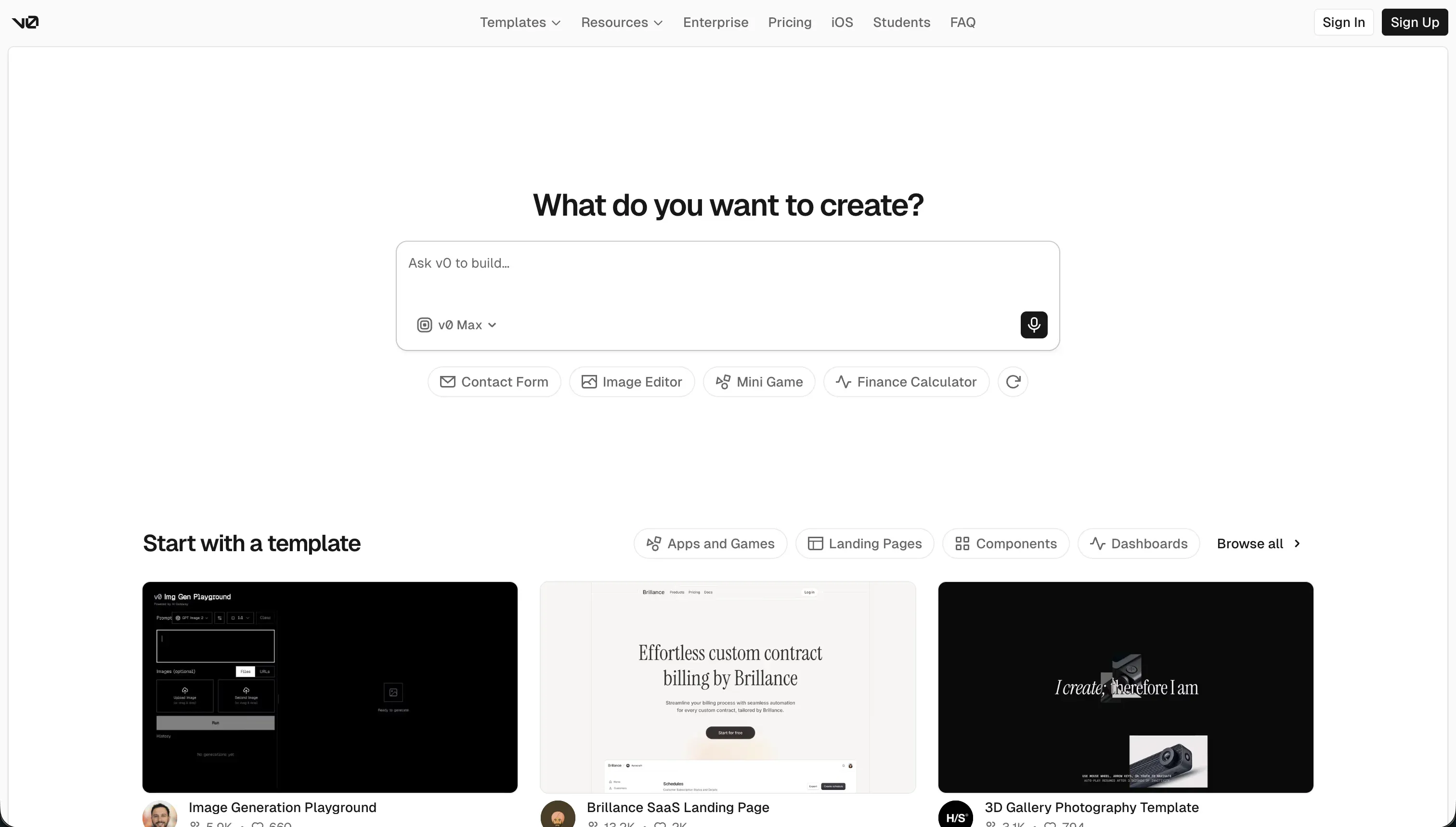
v0 is Vercel’s AI-powered UI generation tool. You describe an interface in plain text, and v0 produces React components with TypeScript interfaces, styled using Tailwind CSS and shadcn/ui design primitives. The output can be deployed to Vercel in one click or exported to GitHub for use in any local development environment. v0 also supports a design mode where you can upload sketches or screenshots to generate matching code. It does not provide any database, authentication, backend logic, or state management. v0 is a frontend code generator positioned as a developer productivity tool within Vercel’s broader hosting ecosystem.
| Spec | Details |
|---|---|
| Primary Stack | React, TypeScript, Tailwind CSS, shadcn/ui |
| Interface | Conversational text prompt + design-mode image upload |
| Primary Deployment Target | Vercel hosting (one-click deploy) or GitHub export |
| Key Advantage | Clean, exportable, framework-standard React component output |
What is Base44?
Base44 is an AI-powered full-stack application builder. You describe your application in plain English, and Base44 generates the entire product: UI components, PostgreSQL database schema, user authentication flows, and hosted deployment - in one pass. A “Discuss Mode” lets you brainstorm and explore architecture options with the AI before committing to a build. Post-generation, a click-to-tweak visual editor allows direct layout and styling adjustments without re-prompting. The platform integrates with GitHub for frontend code export (on higher plans), and hosts applications on its own cloud infrastructure. Its dual credit model - separate billing for build credits and runtime integration credits - distinguishes it from single-metric systems used by most competitors.
| Spec | Details |
|---|---|
| Primary Stack | AI-generated frontend + managed PostgreSQL database |
| Interface | Conversational Discuss Mode + click-to-tweak visual editor |
| Primary Deployment Target | Base44 hosted cloud (custom domain on Builder plan+) |
| Key Advantage | Full-stack app generation (UI + DB + auth + hosting) in one prompt |
The Core Difference
The comparison between v0 and Base44 is fundamentally a comparison between a code generator and an application generator.
v0 generates code files - React components, TypeScript interfaces, Tailwind classes. You take those files and use them as building blocks in a larger development project. The value is in the artifact: clean, portable, framework-standard code that a developer owns and controls completely. The limitation is equally clear: those files are frontend-only. Nothing connects to a database, nothing handles user authentication, nothing runs on a server. v0 gives you 20% of an application and asks you to build the rest.
Base44 generates applications - running, hosted, database-connected products that real users can log into and interact with. The value is in the completeness: you describe what you want, and the platform builds the entire stack. The limitation is equally clear: the application lives on Base44’s infrastructure. The database is Base44’s. The backend is Base44’s. You cannot move the application as a unit to another platform - you can export frontend code on higher plans, but the database and backend stay behind. And the AI-generated nature of the application means bugs and regressions are a recurring operational risk, not a one-time setup challenge.
For a non-developer who needs a working product today, Base44 is more capable than v0. For a developer who needs code they can own and extend, v0 is more appropriate. The decision between them is less about features and more about whether you can accept the respective limitations: v0’s incompleteness, or Base44’s lock-in and instability.

Head-to-Head Comparison
1. Developer Experience & Iteration Speed
v0’s initial generation speed is excellent within its scope. For common UI patterns - data tables, dashboard layouts, login forms, pricing pages, navigation headers - v0 produces polished, well-structured React components quickly. The design-mode feature, where you upload an image or screenshot and get matching code, is a genuinely useful addition for translating design references into working component stubs. For developers doing rapid UI prototyping, this workflow is meaningfully faster than writing components from scratch.
The iteration experience deteriorates on longer sessions. Community feedback on Reddit is consistent that v0’s code quality degrades past the fifth or sixth prompt message in a session. One reviewer described the output becoming “very buggy code” after initial generation. The context window drift means that v0 can lose track of the existing component structure and start generating redundant or conflicting code. When this happens, the developer must manually audit and reconcile the generated output - which erases much of the speed advantage. The switch from unlimited prompts to metered credit billing in 2025 made these session-length degradation issues more expensive, as failed or regressed generations still consume credits.
Base44’s iteration experience is faster for non-developers building whole applications, but has a well-documented reliability problem. The “Discuss Mode” planning step is genuinely useful - it surfaces the AI’s interpretation of your requirements before any credits are spent on building, allowing course correction before the generation begins. For straightforward apps, the prompt-to-working-application flow is impressive. The instability starts when you hit the platform’s edges: complex multi-user logic, specific edge cases in database queries, or particular visual layout requirements. Reddit’s Base44 community is full of accounts of regression loops where the AI’s fixes create new bugs, users spend 150 message credits chasing a resolution, and the app ends up less functional than before the debugging attempt started. One user summarized it as: “every time it fixed one [bug] it created 10 more.”
2. Code Quality & Portability
v0’s code quality is high by the standards of AI-generated frontend code. It uses shadcn/ui components, which are themselves well-maintained, accessible, and production-tested. The Tailwind utility classes follow standard patterns. TypeScript interfaces are generally accurate for the component shapes generated. For a developer who wants a professional starting point for a component - rather than having to write boilerplate from scratch - v0’s output is often usable as-is with minor adjustments.
The portability friction is worth acknowledging. Users on Reddit have documented cases where running v0-generated projects locally produces dependency conflicts, particularly around Tailwind CSS version mismatches and React peer dependency incompatibilities. One thread specifically noted that “Vercel has intentionally made it extremely annoying to migrate from v0 to a real IDE.” The code is portable in principle - it is standard React - but the setup friction in practice can require developer time to resolve. The hallucination issue is also present: v0 occasionally generates imports for non-existent npm packages or deprecated subcomponents from libraries like lucide-react, requiring manual correction.
Base44’s code quality is harder to evaluate because users do not normally interact with the underlying code. On plans that include GitHub export, the frontend code is available for inspection and modification. The concern flagged in community reviews is that the generated code reflects AI choices about component structure and styling that may not align with the developer’s preferences or the team’s existing conventions. More significantly, the database schema and backend logic are not exportable - they exist only as Base44’s managed infrastructure. If the AI generates a problematic database relationship or an inefficient query pattern, there is no direct way for a developer to fix it at the code level. You must prompt the AI to fix it, which costs credits, and may trigger a regression.
3. Database & Backend Capabilities
v0 provides no backend capabilities. This is by design and stated clearly in Vercel’s documentation. v0 is a UI generation layer, and backend integration is the developer’s responsibility. For developers building on Supabase, Firebase, a custom Node.js API, or a headless CMS, v0’s frontend-only output is a reasonable fit - you generate the UI scaffold and connect it to your backend manually. For non-developers expecting v0 to provide a complete application, the absence of any backend infrastructure is a blocking issue.
Base44’s backend is its differentiating strength. The managed PostgreSQL database supports automatic schema generation from prompts, with tables, fields, and relationships created by the AI based on your application description. User authentication is included out of the box with standard email registration and login. The platform handles hosting, deployment, and infrastructure maintenance automatically. For a non-developer building an internal tool or MVP, this eliminates the weeks of backend setup that would otherwise be required.
The reliability concerns around Base44’s backend are significant and worth detailing. Server downtime is a recurring community complaint - one Reddit user reported the platform going down “almost once a week,” which is concerning for any production application. The LiteLLM connection layer that manages Base44’s AI integrations introduces external API rate limits that can affect application performance under load. The dual-credit runtime billing model means that user actions in the published application (database queries, emails, LLM calls) consume integration credits - which can create unexpected cost spikes as application traffic grows. And the closed-backend model means that security and performance issues in the generated code cannot be fixed directly; they must be resolved through AI prompting, which consumes more credits.
4. Hosting & Deployment Options
v0 integrates natively with Vercel’s hosting infrastructure, and the one-click deployment from the v0 interface to a Vercel preview URL is seamless. Vercel’s CDN-backed global infrastructure is one of the better hosting platforms in the frontend ecosystem, with edge functions, performance analytics, and straightforward custom domain configuration. For developers already working within the Vercel ecosystem, this integration is genuinely convenient.
The dependency on Vercel’s ecosystem is also a gravitational pull that some developers find limiting. v0-generated projects use Next.js configuration patterns that optimize for Vercel’s specific infrastructure. While you can export the code and deploy elsewhere, doing so on Netlify or Cloudflare Pages can require adjustments to Next.js-specific configurations. This is not vendor lock-in in the strict sense - the code is portable - but there is meaningful friction in deploying v0 output to non-Vercel infrastructure.
Base44 hosts applications entirely on its managed cloud infrastructure, with instant live URLs after generation and custom domain support on the Builder plan and above. One-click deployment with no infrastructure configuration is Base44’s deployment story, and for non-technical users it works exactly as described. The risk is the same as with any fully managed platform: you have no control over infrastructure decisions, server location, performance tuning, or deployment scheduling. If Base44’s infrastructure has an outage - which community reports suggest is not infrequent - your application is down and you cannot do anything about it except wait.
Pricing Comparison
v0 uses a credit-based model (introduced in 2025 after significant community pushback against the unlimited-prompts transition):
- Free: $0/month - $5 of monthly credits, 7-message daily limit
- Team: $30/user/month - $30 of monthly credits, $2 daily login credits, shared chats and centralized billing
- Business: $100/user/month - $30 of monthly credits per user, training opt-out by default, shared chats
- Enterprise: Custom - SAML SSO, RBAC, priority access, guaranteed SLAs
Credit consumption depends on model selection: v0 Mini runs $1/1M input and $5/1M output tokens; v0 Pro runs $3/1M input and $15/1M output; v0 Max runs $5/1M input and $25/1M output; v0 Max Fast runs $30/1M input and $150/1M output. Selecting the highest-performance model for complex UI generation can exhaust a monthly credit budget in a single working day.
Base44 uses a dual-credit system where message credits (for building) are separate from integration credits (for runtime user actions):
- Free: $0/month - 25 message credits (max 5/day), 100 integration credits - database, auth, and analytics included
- Starter: $16/month (annually) / $20/month - 100 message credits, 2,000 integration credits - unlimited apps, in-app code edits
- Builder: $40/month (annually) / $50/month - 250 message credits, 10,000 integration credits - backend functions, custom domain, GitHub sync (code export requires this tier or higher)
- Pro: $80/month (annually) / $100/month - 500 message credits, 20,000 integration credits - AI model selection, premium support
- Elite: $160/month (annually) / $200/month - 1,200 message credits, 50,000 integration credits - max credits, priority support
The code export requirement - available only from the Builder tier ($40/month annually, or $480/year) - is a particularly notable constraint. Users who want to own their frontend source code must commit to a meaningful annual cost before they can even evaluate whether the code quality warrants that investment.
The dual-credit model’s runtime billing is the hidden cost that surprises most new users. Integration credits are consumed by every user action that touches the database, sends an email, or calls an AI function. A busy application with hundreds of active users taking multiple actions per day can exhaust integration credits rapidly, adding unpredictable variable costs on top of the fixed subscription.
Use Case Fit: When to use which?
When to choose v0
- You are a React or Next.js developer who needs to quickly prototype UI component structures before building out a full-stack application.
- Your team already has a backend infrastructure (Supabase, a custom API, a headless CMS) and you need a frontend scaffolding accelerator to connect to it.
- You are building a design-to-code workflow where designers produce wireframes and you need to generate matching React component structures as a starting point.
- You need clean, standard-framework code that you can import into an existing project, modify freely, and deploy on any hosting provider.
- You want to stay within the Vercel ecosystem and benefit from seamless one-click deployment integration.
When to choose Base44
- You are a non-developer or early-stage founder who wants to go from a text description to a complete, hosted, working web application without writing any code.
- Your application requires a managed database, user authentication, and hosting without any external configuration.
- You are building a straightforward MVP - an internal tool, a simple CRM, a directory, a form-driven workflow tool - and you prioritize speed-to-working-product over code ownership.
- You are comfortable with the platform’s reliability risks and can tolerate occasional downtime and debugging credit consumption.
- You understand and can manage the dual-credit billing model’s runtime cost implications.
When neither v0 nor Base44 is the right fit
Both v0 and Base44 have use cases they handle well. But several common project types fall outside what either platform can reliably deliver.
For native mobile apps
v0 generates browser-based React components with no mobile build pipeline. Base44 deploys responsive web applications. Neither platform produces native iOS or Android binaries for app store submission. A v0 project could theoretically be wrapped in Capacitor for mobile distribution, but this requires developer setup and produces a webview wrapper rather than a native application. Base44 has no mobile packaging functionality at all.
For native App Store and Google Play distribution, FlutterFlow is the standard. Its Flutter-based widget engine compiles to native Dart code for both platforms, producing applications that pass App Store review standards and perform like native apps. FlutterFlow has a steeper learning curve than both v0 and Base44, but for mobile-first projects requiring store distribution, it is the appropriate tool.
For internal tools and client portals
v0 cannot build business applications - its frontend-only output requires an entire backend stack to be built alongside it. Base44 can generate simple business tools from prompts, but its regression loop issues, server reliability problems, backend lock-in, and limited permission granularity make it a risky foundation for operational software that non-technical teams need to maintain.
For client portals, team intranets, vendor dashboards, and multi-user operational tools, Softr is the more reliable platform. Softr’s AI Co-Builder generates complete apps from a prompt - including database schema, pages, navigation, and user permission rules - and the resulting application runs on stable no-code blocks that non-technical team members can edit and maintain without developer assistance. Softr provides click-to-configure user groups with granular row-level database security, supports 17+ native data integrations, ships with SOC 2 Type II compliance, and uses flat subscription pricing that makes long-term cost planning straightforward. Unlike Base44’s dual-credit runtime billing model, Softr’s pricing does not increase based on how much your users interact with the application.
For professional developer environments
Experienced developers will find both v0 and Base44 limiting in different ways. v0’s context window drift degrades code quality on longer sessions, and its frontend-only scope means developers still need to build the entire backend themselves. Base44’s closed backend gives developers no way to inspect or directly fix generated code.
For professional development work, Cursor is the standard AI-assisted coding environment - a VS Code fork that indexes your local codebase and provides context-aware multi-file editing for full-stack projects. For cloud-based collaborative development with backend services and database management, Replit runs persistent virtual machine containers with Replit Agent for autonomous coding tasks.

Verdict
v0 and Base44 serve genuinely different buyers, and conflating them because both use AI to generate applications leads to bad purchasing decisions.
Choose v0 if you are a developer who wants fast, clean, exportable React UI components as a prototyping accelerator. It is excellent at generating polished frontend scaffolds from text descriptions. Accept that it is frontend-only, that session length degrades code quality, and that the credit billing model rewards short focused sessions rather than extended iteration. Used as a UI starting point that gets handed off to a full development environment immediately, v0 delivers real value.
Choose Base44 if you want a complete working application - database, auth, hosting, and UI - generated from a prompt, and you are willing to accept the operational trade-offs: backend lock-in (the database and backend stay on Base44), server reliability issues (downtime is a documented recurring complaint), regression loop risk during complex debugging, and a dual-credit billing model where both building and runtime user activity costs money. For simple internal tools or MVPs where you prioritize speed over long-term ownership, Base44 delivers a more complete product than v0. Just go in with realistic expectations about what the AI can sustain as your app grows in complexity.
Summary Comparison Table
| Feature | v0 | Base44 |
|---|---|---|
| Build Paradigm | AI-Generated React UI Components | Full-Stack AI App Generation (UI + DB + Auth) |
| Output Type | Exportable React / TypeScript / Tailwind code | Managed hosted web application |
| Database | None (external required) | Built-in managed PostgreSQL |
| Visual Permissions | None | Basic roles (not field/button-level granularity) |
| Pricing Metric | Subscription + credit metering per model | Subscription + dual credits (build + runtime) |
| Maintenance Burden | High (developer must build all backend) | Medium (platform-managed but regression loop risk) |
| Code Export | Yes (GitHub sync, all plans) | Frontend only, Builder plan ($40/mo annually) and above |