

Lovable and v0 look similar from a distance, but they sit in different parts of the AI app builder market. Lovable is a full-stack AI scaffolding tool that aims to generate frontend, backend, and database layers together, while v0 is really a frontend code generator for React interfaces. That sounds like a simple feature gap, but it changes everything about cost, lock-in, and how much real engineering work is still waiting for you after the demo looks good.
The people deciding between these two are usually founders, product teams, and developers trying to move faster without signing up for a six-month build. What they are really choosing is not just output quality, but where the complexity lands: inside AI prompt loops, or back on the engineering team. If you misread that tradeoff, you either pay for a lot more backend work than expected or you inherit a generated stack that becomes annoying to maintain by week two.
Meet the Contenders
What is Lovable?
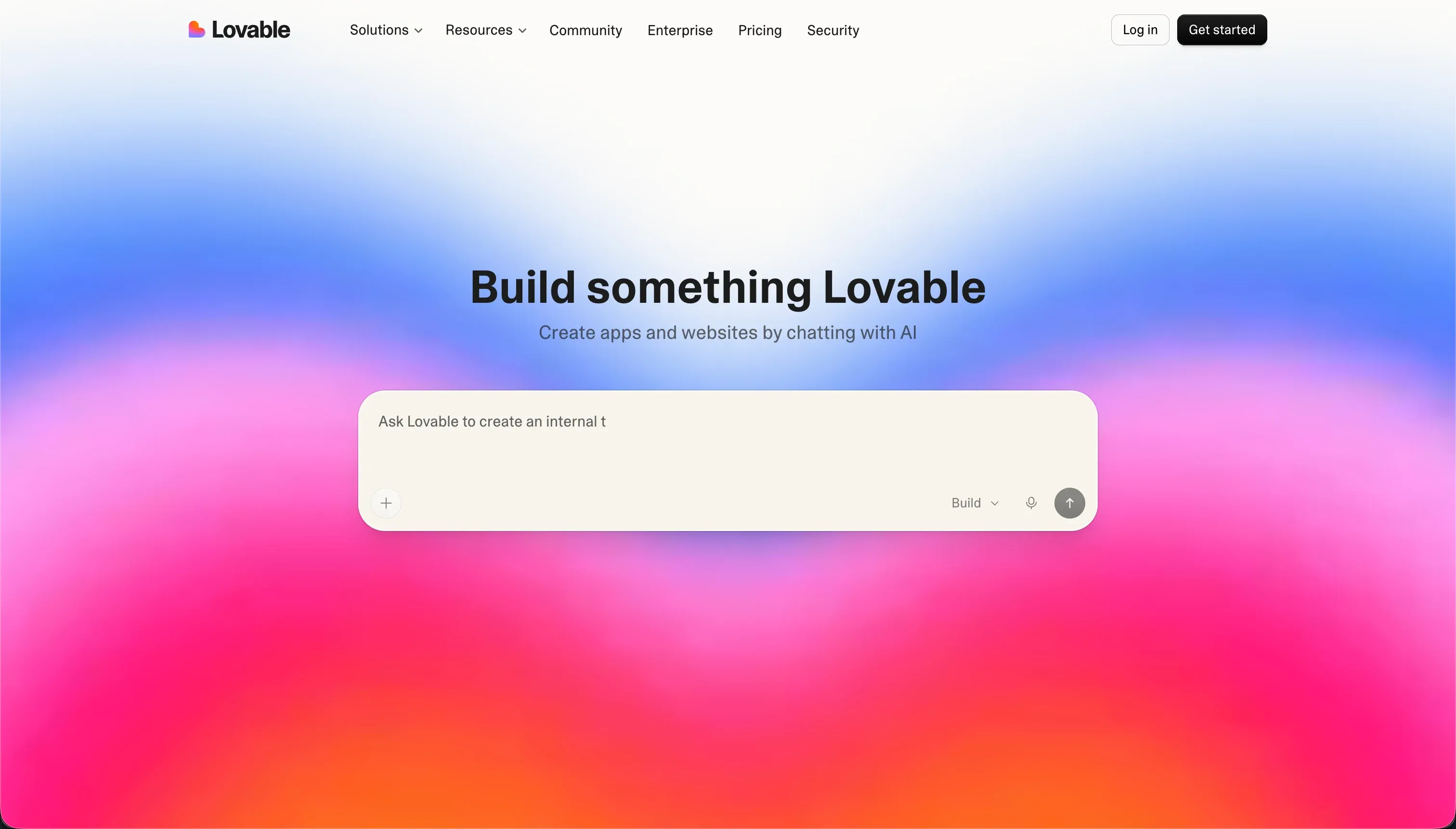
Lovable is an AI-powered full-stack application builder that turns natural-language prompts into React frontends, Node.js backends, and Supabase databases. It sells the dream of describing an app once and getting a working stack rather than just a UI mockup.
In practice, Lovable works through a conversational vibe-coding workflow where you keep asking for edits and the tool changes multiple files for you. Its concrete selling points are prompt-to-app generation across frontend and backend, built-in Supabase integration for database and auth, GitHub sync, Figma import, one-click deployment, and pre-publish security scans that check generated code and Supabase RLS policies.
It is genuinely built for founders and builders who want to get a SaaS-style prototype online fast without wiring infrastructure manually. The people who get frustrated are usually the ones trying to push it into production-grade business logic, because they run into credit inflation, prompt-driven debugging loops, and the uncomfortable reality that a generated full stack still needs someone thinking like a developer.
| Spec | Details |
|---|---|
| Primary Stack | AI-generated React frontend, Node.js backend, and Supabase database/auth |
| Interface | Conversational prompt builder with iterative multi-file code edits |
| Primary Deployment Target | Lovable Cloud with custom domains on paid plans |
| Key Advantage | Full-stack scaffolding from one prompt, not just frontend components |
What is v0?
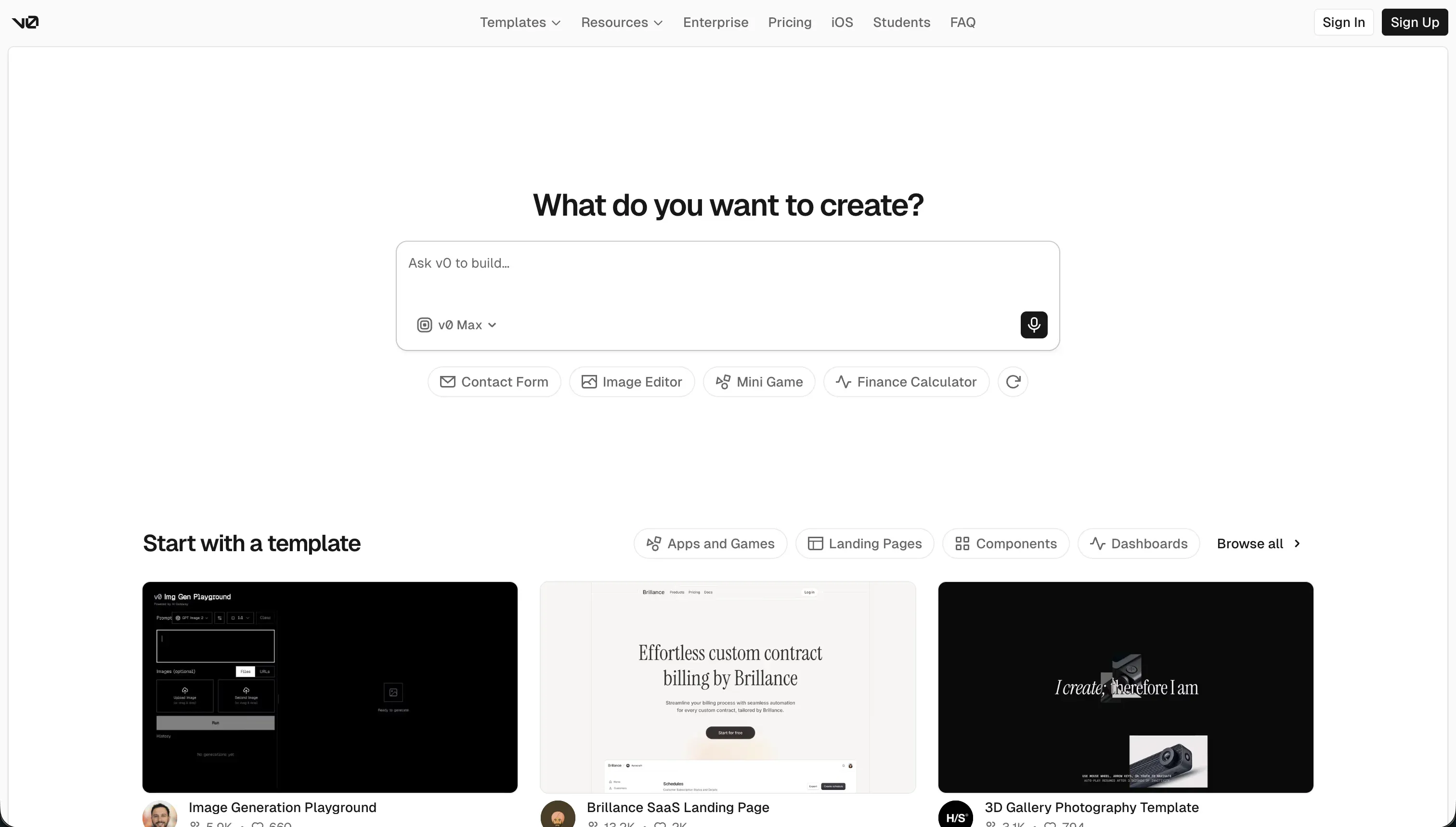
v0 is Vercel’s AI-powered frontend generation assistant for creating responsive React interfaces from natural-language prompts. It is best understood as a UI code generator, not a true all-in-one app builder.
In practice, v0 generates React and TypeScript components using shadcn/ui patterns and Tailwind CSS, then lets you iterate through chat, visual edits, or design-mode inputs like sketches and screenshots. Its most concrete capabilities are GitHub sync, editable source code, one-click Vercel deployment, and multiple model tiers such as v0 Mini, Pro, Max, and Max Fast with token-based usage pricing.
It is genuinely built for developers, designers, and product teams who want polished frontend scaffolding quickly and already know how the rest of the stack will be handled. The people who get annoyed are usually non-technical buyers or founders expecting backend, auth, and database features to exist, because v0 leaves all of that wiring to you and can get buggy after longer chat sessions.
| Spec | Details |
|---|---|
| Primary Stack | AI-generated React and TypeScript UI using Tailwind CSS and shadcn-style patterns |
| Interface | Chat-based frontend generator with visual edits and design-mode input |
| Primary Deployment Target | Vercel deployments and Git-synced frontend projects |
| Key Advantage | High-polish frontend code generation with cleaner exportability than most AI builders |
The Core Difference
The biggest difference is where each tool stops. Lovable wants to own more of the application stack, while v0 mainly wants to generate the interface layer and leave the rest to you.
- Lovable runs as a full-stack AI scaffolder, so it can generate more on day one but also exposes you to more backend lock-in, security overhead, and regression risk.
- v0 runs as a frontend code generator, so it is narrower and less magical, but usually clearer about the fact that you still need your own backend, auth, and data architecture.

Head-to-Head Comparison
We evaluated both platforms across four core categories.
1. Developer Experience & Iteration Speed
Lovable is more exciting in the first hour because it can generate a fuller application from a single prompt instead of just a UI shell. Getting a React frontend, Node backend, Supabase database, and deployment path in one motion is genuinely fast when it works.
The problem is that iteration quality appears to fall off once you start fixing bugs or nudging complex behavior. User reports specifically complain about regression loops, repeated failed fixes, and prompts that now consume around 3 to 4 credits each instead of the roughly 1.2 some early users remember, which makes routine debugging feel expensive and erratic.
v0 is narrower, but that often makes the workflow easier to reason about. If your job is to scaffold a page, a dashboard shell, or a set of components, it is fast, visually strong, and closely aligned with the React and Vercel ecosystem.
Its weakness is chat drift and degraded output after a short conversation. Community complaints repeatedly mention quality dropping after around 5 to 10 prompts, with code getting bloated or buggy, so iteration stays fast only as long as the request stays local and frontend-specific.
Edge: v0, because its narrower scope creates fewer moving parts and less chaos during normal iteration.
2. Code Quality & Portability
Lovable does have a real code ownership story on paper. It generates standard React and TypeScript code, supports GitHub sync, and is clearly friendlier to downstream developer handoff than a closed visual builder.
But the portability story is weaker than the marketing implies. Multiple user complaints say exported code is messy, not truly production-clean, and often still requires a developer to rebuild large parts in the real stack, especially once the generated app has gone through several prompt-edit cycles.
v0 is stronger and more honest here because it is fundamentally producing inspectable React and TypeScript UI code rather than pretending to hand you a full portable application. GitHub sync and standard framework alignment make it easier to move those components into an existing codebase.
That said, portability is only as good as the generated frontend quality. Developers still report bloated Tailwind output, odd component structure, and hallucinated imports, so you are exporting real code, not necessarily clean code you never have to touch again.
Edge: v0, because its export story is simpler, cleaner, and less entangled with a managed backend.
3. Database & Backend Capabilities
This is Lovable’s most obvious advantage over v0. It ships with Supabase integration, can scaffold database schemas, and gives non-experts a faster route to a full-stack prototype with auth and data already in the picture.
The catch is that backend convenience turns into backend responsibility very quickly. Lovable still leaves you dealing with Supabase configuration, RLS policies, and structural trust issues, and user feedback includes unusually sharp complaints about backend lock-in and even unwanted migration behavior around Lovable Cloud versus private Supabase setups.
v0 does not really compete here because it is frontend-only. It has no built-in relational database, no native auth module, and no serious backend layer beyond what you choose to attach yourself.
That sounds like a weakness because it is one, but it is at least an honest weakness. v0 does not pretend your backend is solved, which means technical teams can pair it with their own architecture instead of trying to reverse-engineer AI-generated database logic later.
Edge: Lovable, because it at least gives you a starting backend and database path where v0 gives you none.
4. Hosting & Deployment Options
Lovable aims for a one-click deployment story through Lovable Cloud, which is useful for demos and rapid MVP launches. Paid plans also add private projects and custom domains, so you can move from prototype to a more presentable live environment without much setup.
The downside is trust in the hosted stack. Complaints about preview-versus-production gaps, instability, and database/backend lock-in make the deployment experience feel more fragile once real users or real data enter the picture.
v0 benefits from sitting inside the Vercel ecosystem, which gives it a cleaner deployment lane for frontend work. If your output is a marketing page, dashboard shell, or component library headed to Vercel anyway, the handoff is straightforward.
But again, deployment here is frontend deployment, not app deployment. You still need to separately handle APIs, databases, auth, and operations, and community reports about framework version issues such as Tailwind or PostCSS mismatches show that even the frontend deployment story is not always seamless.
Edge: v0 for frontend deployment clarity, because Lovable’s fuller hosting promise comes with more operational baggage.
5. AI Quality & Reliability
Lovable is more ambitious, and sometimes that ambition pays off with impressive first-pass results. It can generate layout, business logic, database structure, and integrations in a way that feels much closer to an autonomous app builder than a UI assistant.
Unfortunately, its biggest strengths are also where the failures become more expensive. Research and user sentiment repeatedly mention regression problems, false fixes, and credit-draining debug loops, which is much worse when the AI is touching backend and security layers rather than just a component tree.
v0 is often praised for producing polished, modern-looking frontend output quickly, especially for shadcn-style interfaces and visual prototyping. That narrower design focus gives it a cleaner reputation for aesthetic output than most AI full-stack builders.
Reliability still drops as sessions get longer or requests become more complex. User complaints about the tool crumbling after the fifth message, inventing bad imports, or rebuilding components from scratch instead of using existing libraries suggest that its AI is best used in shorter, more controlled bursts.
Edge: v0, because it fails on a smaller surface area and is therefore easier to recover from.
6. Learning Curve & Onboarding
Lovable feels easier to beginners because its promise is simple: describe the app, let the AI scaffold the stack, keep chatting until it looks right. The free plan also lowers the barrier with 5 daily credits up to 50 per month, so you can explore the workflow without paying immediately.
But that ease is front-loaded. Once the app needs proper permissions, schema changes, bug fixes, or security review, the learning curve shifts from prompting to real software judgment, and users who expected a low-code experience often discover they are now managing a generated codebase and Supabase setup indirectly.
v0 is a bit more honest from the start about who it is for. If you already know React, Vercel, Tailwind, or at least the idea of a frontend component tree, the tool makes immediate sense and does not hide the fact that you are still in developer territory.
For non-technical users, though, it is arguably harder because there is no illusion of full app completion. The 7 messages per day limit on free, token-priced models, and the need to manually connect backend systems mean beginners can get a nice-looking UI quickly and still have no real product underneath it.
Edge: v0 for technical users, because its limits are clearer and less likely to mislead people about what has actually been built.

Pricing Comparison
Lovable:
- Free - $0 with 5 daily credits, up to 50 per month, plus public projects and GitHub sync.
- Pro - starts at 25€/month with 100 monthly credits, private projects, custom domains, 3 editors, and credit rollover.
- Business - starts at 50€/month with 100 monthly credits, advanced design templates, SSO integration, data training opt-out, and custom user limits.
- Enterprise - custom pricing with custom messaging limits, dedicated support, audit logs, and custom integrations.
- Pro credit scaling examples - 200 credits for 50€/month, 400 for 100€/month, 800 for 200€/month, 1,200 for 294€/month, 2,000 for 480€/month, up to 10,000 for 2,250€/month.
- Business credit scaling examples - 200 credits for 100€/month, 400 for 200€/month, 800 for 400€/month, up to 10,000 for 4,300€/month.
v0:
- Free - $0/month with $5 of monthly credits, Vercel deployment, visual edits, and a 7 messages per day limit.
- Team - $30/user/month with $30 of included monthly credits per user, plus $2 of free daily credits on login, shared chats, and centralized billing.
- Business - $100/user/month with $30 of included monthly credits per user, plus $2 of free daily credits on login, shared chats, centralized billing, and training opt-out by default.
- Enterprise - custom pricing with SAML SSO, RBAC, priority access, guaranteed support SLAs, and training opt-out.
- Model rates - v0 Mini costs $1 per 1M input tokens and $5 per 1M output, v0 Pro costs $3 and $15, v0 Max costs $5 and $25, and v0 Max Fast costs $30 and $150.
Use Case Fit: When to use which?
When to choose Lovable
- Choose Lovable when you want AI to scaffold more than just the UI and you are willing to accept Supabase and prompt-loop complexity to get there faster.
- Choose Lovable when you are building a startup prototype that may later be handed off to developers through GitHub sync and exported React code.
- Choose Lovable when having database and auth bootstrapped immediately matters more than predictable iteration costs or long-term maintainability.
When to choose v0
- Choose v0 when you mainly need polished React frontend scaffolding and already know how your backend, database, and auth will be handled.
- Choose v0 when code portability and a cleaner GitHub-to-Vercel workflow matter more than getting a one-prompt full stack.
- Choose v0 when you want a narrower tool that is less likely to entangle you in backend lock-in, even if it means doing more engineering yourself.
When neither Lovable nor v0 is the right fit
For internal tools and client portals
Neither Lovable nor v0 is the pragmatic choice if you are building an internal tool, CRM, partner dashboard, or client portal that real employees and external users will use every day. Lovable gives you AI-generated full-stack code that still leaves permissions, security, and day-two maintenance resting on generated logic, while v0 does not even try to solve auth, data governance, or multi-role app behavior.
This is where Softr is the better fit. It starts with Softr Databases as the native option, then layers on visual user groups, row-level permissions, workflows, hosting, and authentication from day one, with AI as a co-builder rather than the only control surface. If your app needs to stay maintainable by operators instead of just developers, Softr ages much better than either of these tools.
For native mobile apps
Neither tool is right if your real requirement is shipping a native iOS or Android app through the App Store or Google Play. Lovable and v0 are both web-first code generation tools, and while you can sometimes adapt output for mobile contexts, neither is a native mobile builder in the way teams usually mean it.
Start with FlutterFlow if native mobile is a serious requirement, or look at Adalo and Glide if you want a more approachable mobile-first builder. Those tools beat both Lovable and v0 here because they are designed around mobile app packaging and mobile UX instead of asking you to retrofit a generated web stack into an app-store product.
For professional developer environments
If what you actually want is a real development environment with terminal access, repo control, debugging, and direct architectural ownership, both tools feel partial. Lovable hides too much behind AI scaffolding and managed integrations, while v0 is too thin because it mainly solves the UI layer and leaves you stitching the rest together.
In that case, Cursor or Replit are stronger choices. Cursor makes more sense if you already work locally and want AI inside a serious IDE, while Replit is better if you want a browser-based dev environment that still behaves like a real coding workspace rather than a prompt wrapper.

Verdict
Pick Lovable if you want AI to scaffold a fuller product quickly and you are comfortable trading predictability for that convenience. The tradeoff is real: you accept heavier prompt dependence, credit inflation risk, Supabase security overhead, and a much higher chance of day-two debugging loops once the generated stack stops behaving.
Pick v0 if you mainly need frontend output and already understand that backend, auth, and data are still your problem. The tradeoff is that it is less magical and less complete, but also usually less deceptive: you get polished UI code, better portability, and a workflow that fits technical teams more naturally.
That is the uncomfortable truth in this comparison: one tool promises more than it can reliably maintain, and the other solves less than many buyers hope. For real business apps such as internal tools, partner dashboards, and client portals, Softr is often the better long-term answer because it starts with Softr Databases, permissions, auth, and workflows already built in, while still letting teams co-build with AI instead of depending on prompt loops forever.

Summary Comparison Table
| Criterion | Lovable | v0 |
|---|---|---|
| Best for | Fast full-stack SaaS-style prototypes | Polished React UI generation |
| Build paradigm | Conversational full-stack AI scaffolding | Frontend-focused code generation |
| Database | Supabase integration built in | No native database layer |
| Visual permissions | Handled indirectly through generated backend logic and RLS | No native permissions system |
| Pricing metric | Monthly plans plus credit tiers | Seat pricing plus token-credit usage |
| Maintenance burden | Higher once prompt edits touch backend logic | Lower scope, but more manual engineering required |
| Code export | GitHub sync with partial portability concerns | Cleanest export story of the two |