

v0 by Vercel and Bubble.io have been trading spaces on “best app builder” lists for years despite being built on completely different philosophies. v0 is Vercel’s AI-powered UI generator - it produces clean React and TypeScript components from natural language prompts, and it stops there. Bubble is a decade-old visual programming platform that lets non-developers build full-stack applications with its own proprietary database, workflow engine, and plugin marketplace. The comparison is genuinely useful because both tools attract founders and product teams looking to build faster, but the gap between what they deliver is enormous. Understanding that gap before you commit six months of work to either platform is time well spent.
Meet the Contenders
These two platforms are competing for the same budget category - “tools to build apps without a full engineering team” - but they deliver very different things.
What is v0?
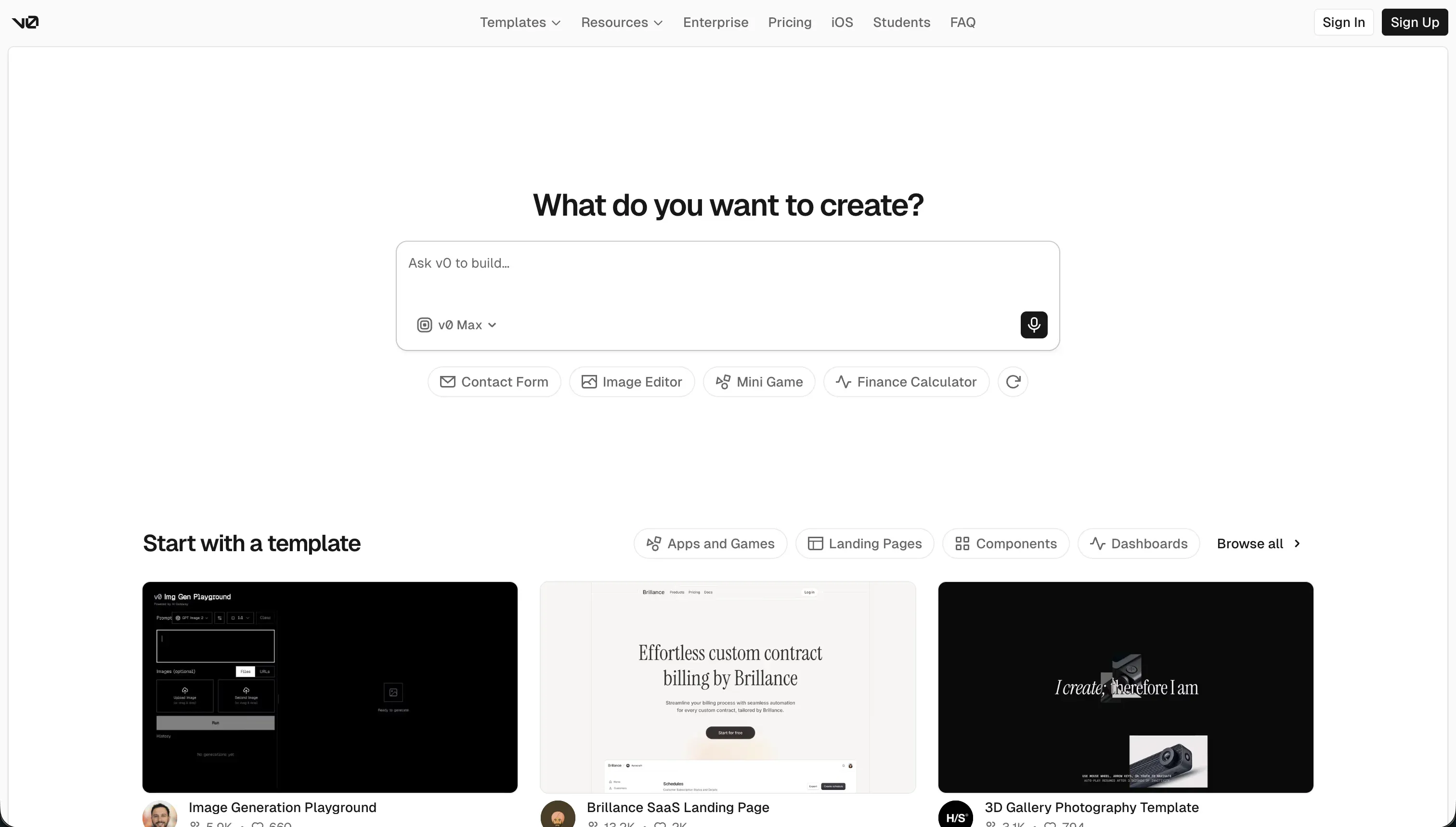
v0 is Vercel’s AI-powered frontend generation tool. You describe a user interface in plain text, and v0 generates React and TypeScript components styled with Tailwind CSS and shadcn/ui - Vercel’s preferred design system. The generated code is clean, exportable, and deployable on Vercel’s hosting infrastructure with one click. v0 integrates with GitHub for version control and supports a design mode where you can upload sketches or screenshots to generate matching UI code. What v0 does not provide is any backend, database, authentication, or application state management. It is a UI code generator, positioned as the first step in a developer’s workflow rather than a complete application builder.
| Spec | Details |
|---|---|
| Primary Stack | React, TypeScript, Tailwind CSS, shadcn/ui |
| Interface | Conversational text prompt + design-mode image upload |
| Primary Deployment Target | Vercel hosting (one-click deploy) |
| Key Advantage | Clean, exportable, production-grade React component output |
What is Bubble?
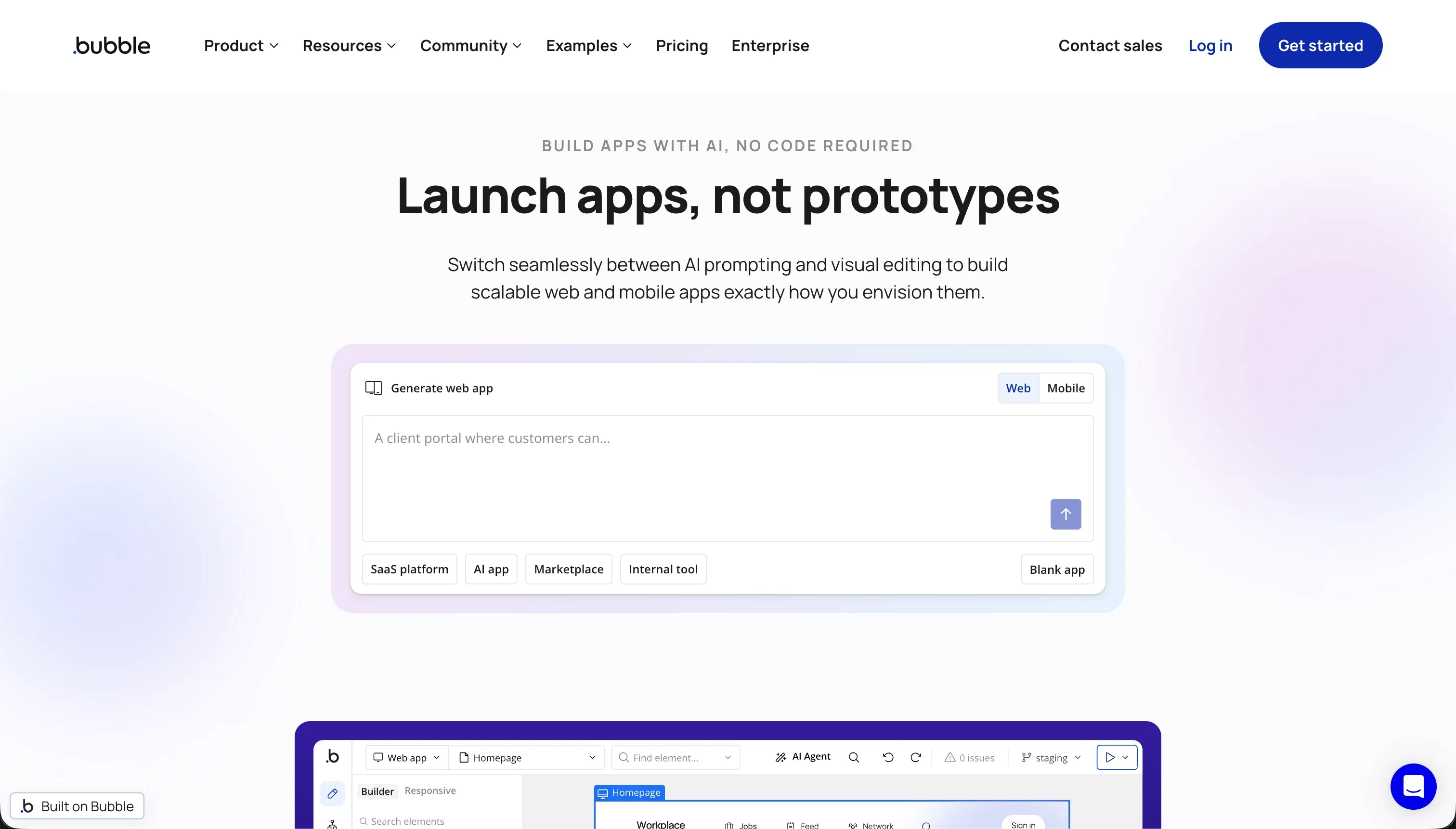
Bubble is a full-stack visual programming platform that has been building the no-code category since 2012. It uses a pixel-level drag-and-drop editor for UI design, a visual workflow builder for application logic, a managed relational database with custom privacy rules, and an API connector for external integrations. With over 8,000 community plugins, a global builder ecosystem, and a Workload Unit-based pricing model tied to computational usage, Bubble is one of the most mature and deeply capable no-code platforms available. Its ceiling is high, but so is its learning curve, and its vendor lock-in is complete.
| Spec | Details |
|---|---|
| Primary Stack | Proprietary visual programming (Bubble Engine) |
| Interface | Drag-and-drop pixel editor + visual workflow builder |
| Primary Deployment Target | Bubble Cloud (managed, with dedicated capacity options) |
| Key Advantage | Deep application logic, 8,000+ plugins, mature ecosystem |
The Core Difference
The difference between v0 and Bubble is a difference in philosophy, not just features.
v0 is rooted in the developer-tools tradition. It generates standard, framework-idiomatic code that developers own and operate. It has no opinions about your database, your hosting outside of Vercel, or your authentication provider. It generates a UI artifact and leaves everything else to the developer. This gives it maximum flexibility and zero lock-in, at the cost of being incomplete as a standalone product.
Bubble is rooted in the visual programming tradition. It replaces code with a proprietary system of visual elements, workflows, and data types. Everything you build lives inside Bubble’s runtime - there is no code to export, no configuration file to tweak, no server to access directly. This complete abstraction lets non-developers build genuinely complex applications, but it creates permanent dependency on Bubble’s infrastructure, pricing, and development roadmap.
Put plainly: v0 gives you a component. Bubble gives you an application. But Bubble keeps the application and charges you rent for life. v0 gives you the component outright and bills you for the generation credits. For a developer building on their own stack, v0 makes more sense. For a non-developer who needs a complete working product, Bubble is more capable - though the long-term costs and constraints deserve serious scrutiny before committing.

Head-to-Head Comparison
1. Developer Experience & Iteration Speed
v0’s initial generation speed is impressive. A detailed UI description produces a structured, styled React component in seconds - and for common patterns (data tables, login forms, dashboards, pricing pages), the output quality is genuinely high. The design mode adds another useful dimension: upload a hand-drawn sketch or a Figma screenshot and v0 attempts to generate matching code. For rapid prototyping of interface ideas before committing to implementation, this workflow is faster than most alternatives.
The iteration experience deteriorates past the first five or so prompts. Community reviews on Reddit are consistent on this point: v0’s code quality degrades significantly as the chat session lengthens. One reviewer described it as “very buggy code” past the fifth message. Another noted that v0 “often tries to build components from scratch instead of leveraging existing libraries” even when explicitly prompted to use specific packages. The credit model compounds this - failed attempts still consume credits, and debugging sessions can burn through a daily credit allowance quickly. After Vercel’s 2025 pricing shift from unlimited prompts to a metered credit system, Reddit documented widespread traffic drops and user departures from the platform.
Bubble’s development experience is qualitatively different. Because everything is configured visually rather than generated through prompts, there are no AI regression loops or credit-burning debug cycles for backend logic. You configure a workflow visually, test it, and adjust it - the iteration loop is deterministic. The downside is performance: the Bubble editor is notorious for high memory consumption. Multiple reports on Reddit describe editors consuming 5GB+ of RAM per browser tab on complex projects, with regular freezes even on high-specification machines.
2. Code Quality & Portability
v0’s code output is its strongest suit. It generates standard React functional components, TypeScript interfaces, and Tailwind utility classes. The output integrates cleanly into Next.js projects, which is Vercel’s primary target framework. Components use shadcn/ui primitives, which are themselves well-maintained, accessible, and widely adopted in the React ecosystem. For a developer who wants a professional starting point for UI components without writing boilerplate, v0’s output is often genuinely useful rather than just adequate.
The portability critique is real but nuanced. Users on Reddit have documented cases where running a v0-generated project locally is harder than expected: dependency conflicts between React versions, PostCSS and Tailwind version mismatches between v0’s generation environment and local setups, and npm install errors caused by incompatible peer dependencies. One Reddit thread specifically called out that “Vercel has intentionally made it extremely annoying to migrate from v0 to a real IDE,” suggesting the friction is at least partially deliberate. The code is portable in theory; the setup friction in practice can be significant.
Bubble’s portability is zero. This is documented fact, not opinion. The entire application - UI, logic, data schema, privacy rules, plugin configurations - lives in Bubble’s proprietary format. You cannot export it, inspect the underlying code, or run it anywhere else. G2 reviewers are explicit about this constraint. One puts it bluntly: “You will at some point realize you can’t achieve something specific. It’s expensive. You’ll be locked in.” The only exit path from Bubble is a complete rewrite, which means every hour invested in building on Bubble is a sunk cost if you ever need to migrate.
3. Database & Backend Capabilities
v0 has no backend capabilities. It does not connect to databases, does not generate API routes, does not handle authentication, and does not manage server-side state. When developers complain that v0 “hallucinates” imports, they are often referring to cases where v0 generates code that references backend functions or data-fetching utilities that do not exist in the generated frontend scaffold. The developer must write all of that logic separately and integrate it with the v0-generated UI components.
Bubble’s backend is where its maturity genuinely shows. The managed relational database supports custom data types, multi-table relationships, bulk operations, and scheduled database triggers. The privacy rules system provides server-enforced access control - defining exactly which user roles can search, view, or modify specific fields across the entire database. The API Connector allows REST integrations to external platforms, CRM systems, and AI services. With over 8,000 community plugins, Bubble has integrations for nearly every common use case - Stripe payments, authentication providers, file storage, email delivery, and more.
The operational risks of Bubble’s backend are equally well-documented. The Workload Unit (WU) billing model ties your monthly costs to the computational efficiency of your database queries and workflows. Poorly optimized workflows can trigger massive WU spikes without warning. One Reddit user described receiving a bill that pushed them from the Starter tier ($69/month) to the Growth tier ($249/month) overnight due to a single unoptimized search query. The database also has known performance limitations for high-throughput workloads - real-time collaboration features or high-frequency inventory updates can cause noticeable lag under production load.
4. Hosting & Deployment Options
v0 integrates tightly with Vercel’s hosting infrastructure, which is one of the most respected CDN-backed deployment platforms in the frontend ecosystem. One-click deploy from the v0 interface pushes your generated project directly to a Vercel preview URL. Production deployments with custom domains, edge functions, and performance analytics are all available through the Vercel dashboard. For developers already in the Vercel ecosystem, the deployment integration is seamless and fast.
The caveat is that v0’s tight coupling with Vercel - while technically avoidable - creates a gravitational pull toward Vercel’s paid hosting tiers. Community feedback suggests this is part of v0’s strategic design: generate UI on v0, deploy on Vercel, stay in the Vercel billing ecosystem. Developers who export code to alternative hosting providers (Netlify, Cloudflare Pages, Render) report occasional incompatibilities related to Next.js configuration assumptions baked into v0’s generated output.
Bubble’s cloud infrastructure handles all hosting on its managed servers, with shared capacity for standard plans and dedicated server options for high-traffic applications. Custom domains with SSL, staging environments, and version history are available on paid plans. The major operational risk is Bubble’s behavior when accounts hit usage limits: users on Reddit have reported their applications being completely shut down and replaced with a Bubble error screen when paid plan credits expired and the app automatically reverted to the free tier - which has a hard 200-record database limit. For production business applications, this kind of interruption risk is concerning.

Pricing Comparison
v0 uses a credit-based model introduced in 2025 that replaced its previous unlimited-prompts approach:
- Free: $0/month - $5 of included monthly credits, 7 messages per day limit
- Team: $30/user/month - $30 of included monthly credits, $2 of daily login credits, shared chats and centralized billing
- Business: $100/user/month - $30 of included monthly credits per user, training opt-out by default
- Enterprise: Custom - SAML SSO, RBAC, priority access, guaranteed SLAs
Model rates determine how quickly credits are consumed: v0 Mini costs $1/1M input tokens and $5/1M output tokens, while v0 Max Fast costs $30/1M input tokens and $150/1M output tokens. Users doing active UI iteration on complex components and selecting the v0 Max model can exhaust their monthly credits in a single day, which is exactly what the Reddit community documented when the pricing change launched.
Bubble uses Workload Units (WUs) as its primary billing metric:
- Free: $0/month - 50,000 WUs/month, 200 database records (a very tight limit), limited collaboration
- Starter: $69/month - 175,000 WUs/month
- Growth: $249/month - 250,000 WUs/month
- Team: $649/month - 500,000 WUs/month
- Dedicated capacity: Available as an add-on for high-traffic production applications
The Free plan’s 200-record database limit is practically unusable for anything beyond a proof-of-concept. Even a modest contact management app for a small business would exceed this within days. The WU model’s unpredictability is its biggest community criticism - the billing formula is complex, and seemingly simple app features (like a search with multiple data constraints) can consume orders of magnitude more WUs than expected. Expert analysis from LowCode Agency has noted that Workload billing can reach thousands of dollars without prior warning if workflows are not architected carefully.
Use Case Fit: When to use which?
When to choose v0
- You are a React or Next.js developer who wants to prototype UI components quickly before building out a full-stack application.
- You need clean, standard-framework React code that you can import into an existing codebase or open in a local IDE.
- Your team has a backend already (Supabase, a custom API, a headless CMS) and you need a fast frontend scaffolding layer to connect to it.
- You are building a design-to-code workflow where designers produce wireframes and you need to generate matching React component structures rapidly.
- You want to deploy on Vercel and benefit from the tight one-click deployment integration.
When to choose Bubble
- You are a non-developer or a small team without full-time engineering resources who needs a complete, functional web application.
- Your application requires complex conditional workflow logic, multi-step automations, and custom data relationships that would take a developer weeks to implement from scratch.
- You are comfortable with permanent platform dependency and are confident Bubble’s pricing trajectory will remain viable for your use case at scale.
- You need access to Bubble’s large plugin marketplace for specific integrations (Stripe, authentication providers, mapping tools) without writing custom integration code.
- Your application has moderate traffic and a manageable database record count that keeps WU consumption predictable.
When neither v0 nor Bubble is the right fit
v0 and Bubble each represent valid but narrow approaches to application development. For many real-world project types, neither is the right tool.
For native mobile apps
v0 generates React web components with no mobile build pipeline integration. Bubble has native mobile support in public beta, but reviewer consensus places it as a maturing feature rather than a production-ready mobile development platform. Neither tool produces native iOS or Android binaries that meet modern app store performance and UX standards.
For native mobile app store distribution, FlutterFlow is the appropriate tool. It is built on Flutter’s widget tree, compiles to native Dart code for both iOS and Android, and its output passes App Store and Google Play review standards. It has a steeper learning curve than both v0 and Bubble, but the resulting applications are genuinely native rather than web wrappers.
For internal tools and client portals
v0 cannot build business applications without a developer building the entire backend separately. Bubble can - but its Workload Unit billing unpredictability, steep learning curve for complex permissions, and complete vendor lock-in make it a high-risk long-term choice for operational business software.
For client portals, vendor dashboards, team intranets, and multi-user operational tools, Softr is the more appropriate platform. Softr provides click-to-configure user groups with granular row-level data security, supports 17+ native data integrations (Airtable, HubSpot, Google Sheets, Postgres, and its own high-performance Softr Databases), and ships with SOC 2 Type II compliance by default. Its AI Co-Builder generates complete apps from a prompt, and unlike Bubble’s Workload Unit model, Softr’s pricing is flat and predictable. Non-technical teams can maintain and extend Softr apps without developer support - which is the fundamental promise that Bubble makes but frequently struggles to deliver in practice.
For professional developer environments
Both v0 and Bubble have significant limitations for experienced engineers. v0’s frontend-only output means developers must build the entire backend themselves anyway. Bubble’s proprietary system offers no code access and no debugging tools beyond the visual workflow inspector.
For professional development environments, Cursor provides context-aware AI assistance inside a full VS Code-compatible IDE, with multi-file editing, local codebase indexing, and the full flexibility of a traditional development environment. For cloud-based collaborative development with backend services, Replit runs persistent virtual machine containers with Replit Agent for autonomous coding tasks and built-in database and deployment tools.

Verdict
v0 and Bubble are genuinely different tools that will rarely appeal to the same builder.
Choose v0 if you are a developer who wants fast, clean React component scaffolding and you are building on a stack where the backend already exists or will be built separately. It is excellent at what it does - generating polished UI code - and the code portability is real. The credit model is frustrating for heavy iteration, and the backend-free nature means you are always one component away from needing to do real engineering work. But as a developer productivity tool, v0 is faster than writing boilerplate from scratch.
Choose Bubble if you need a complete, functional web application and you do not have developer resources to build the backend. Bubble’s workflow engine, database privacy rules, and plugin ecosystem give non-developers genuine power to build sophisticated products. Accept going in that you are committing to Bubble’s infrastructure permanently, that Workload Unit billing requires careful architectural attention to avoid cost surprises, and that migration off the platform means a complete rebuild. For projects where those constraints are acceptable, Bubble’s maturity and depth are hard to match in the no-code category.

Summary Comparison Table
| Feature | v0 | Bubble |
|---|---|---|
| Build Paradigm | AI-Generated React UI Components | Visual Programming + Workflow Engine |
| Output Type | Exportable React / TypeScript / Tailwind code | Proprietary managed application (no code export) |
| Database | None (external required) | Built-in managed relational database with privacy rules |
| Visual Permissions | None | Server-side privacy rules per user role |
| Pricing Metric | Subscription + Credit metering per model | Subscription + Workload Units (WUs) per computation |
| Maintenance Burden | High (developer must build all backend components) | Medium-High (visual but complex; WU billing risk) |
| Code Export | Yes (full React project via GitHub sync) | No (data export only; app logic is locked in) |