

Base44 and Retool can both produce usable business software, but they come from very different categories. Base44 is an AI scaffolding tool that tries to generate the whole app from conversation, while Retool is a developer-oriented internal tool builder built around components, SQL, and JavaScript. On paper, both can connect data, ship interfaces, and help teams move faster than a traditional custom build. In practice, the tradeoff is AI speed versus technical control.
The people actually choosing between these two are usually founders, ops teams with some technical help, or product teams trying to avoid a long build cycle. They are not really comparing templates. They are comparing how much engineering they want to do later, how much lock-in they can stomach, and whether pricing stays sane as the app grows. Base44 wins attention with instant generation. Retool wins trust when the people maintaining the app already know how to work with code and databases.
Meet the Contenders
What is Base44?
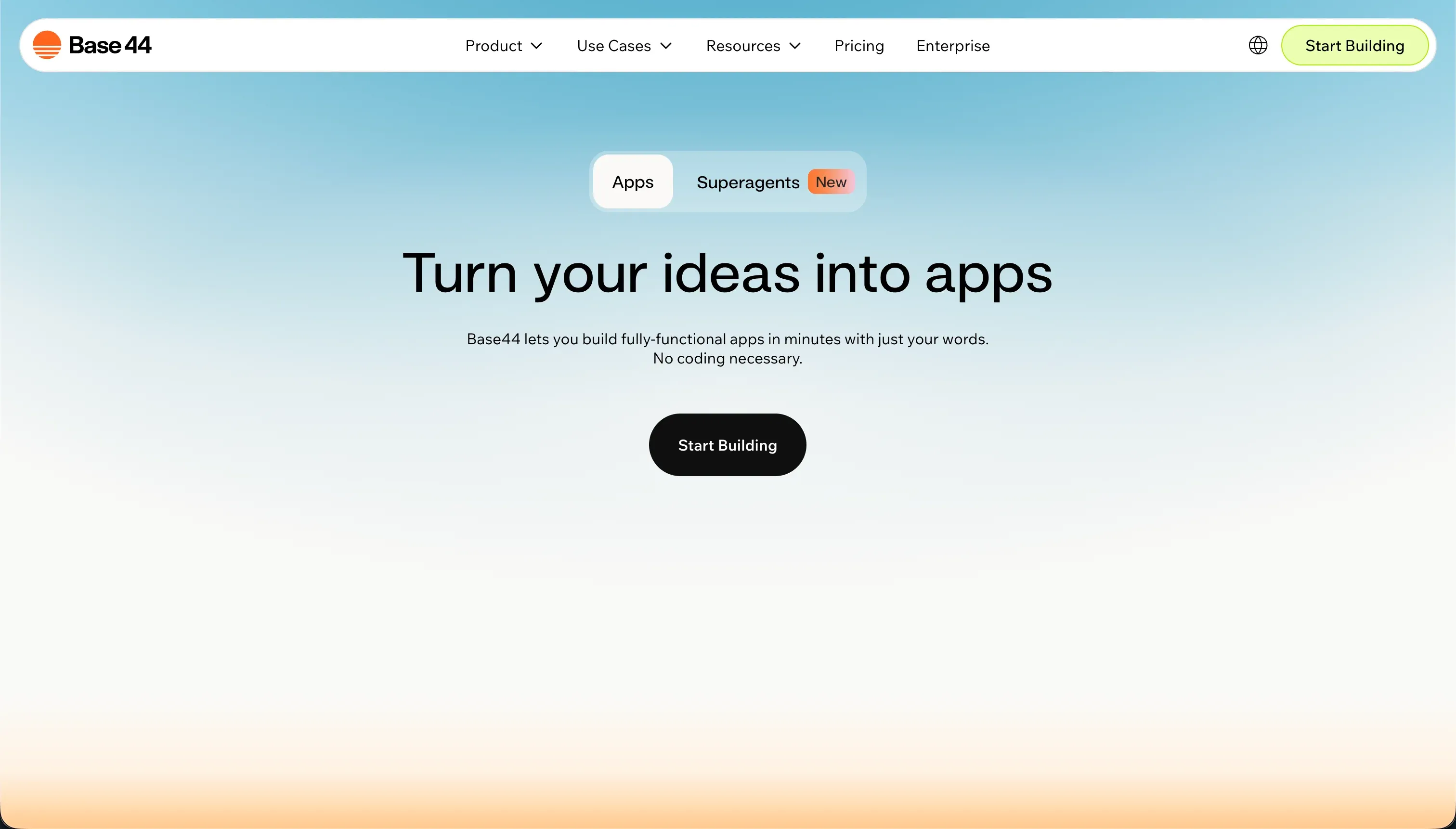
Base44 is an AI-powered all-in-one builder that generates full-stack web apps from conversational prompts. It bundles UI generation, a managed PostgreSQL database, user authentication, and hosting into one prompt-driven workflow.
In practice, you describe the app in chat, let Base44 scaffold the frontend and backend, then keep iterating through its conversational builder and visual post-generation editor. It also offers Discuss Mode for planning without consuming message credits, plus GitHub integration and frontend code export on Builder and higher plans. That makes it appealing for fast MVP scaffolding when you want the database, auth, and hosting handled without setup.
It is genuinely built for makers, non-technical founders, and teams that want a quick web app without touching infrastructure first. It is frustrating for people who need stable iteration, deeper backend control, or predictable billing, because user reports repeatedly mention server instability, regression loops, and credits getting burned while trying to fix what the AI broke.
| Spec | Details |
|---|---|
| Primary Stack | AI-generated frontend with managed PostgreSQL backend and LiteLLM-based connections |
| Interface | Conversational builder chat plus visual post-generation editor |
| Primary Deployment Target | Hosted on Base44 cloud, with GitHub sync for frontend code on Builder and above |
| Key Advantage | Fast full-stack scaffolding with auth, database, and hosting included from the start |
What is Retool?

Retool is a visual builder for internal business tools and dashboards that combines pre-built UI components with custom SQL and JavaScript. It is less an AI app generator and more a fast internal-app layer for teams that already know their systems.
In practice, you assemble interfaces from a component library of 100+ elements, connect them to databases or APIs, and write SQL queries plus JavaScript to handle data flow and state. Retool also includes Retool Database, Retool Workflows, and newer AI features like Retool Vectors and AI agent automation. The value is not instant AI scaffolding, but faster delivery for technical teams building admin panels, ops dashboards, and database utilities.
It is genuinely built for developers, engineering leaders, and technical operators working on internal software. It frustrates non-developers and design-sensitive teams because anything beyond basic layouts usually requires code, external-user auth flows are not native, and the seat-based model gets painful once you move beyond a small internal group.
| Spec | Details |
|---|---|
| Primary Stack | Visual UI builder layered on top of SQL queries, JavaScript logic, APIs, and managed Retool Database |
| Interface | Component canvas with query editors, JS scripting, and workflow builder |
| Primary Deployment Target | Internal business tools, dashboards, and admin apps for teams |
| Key Advantage | Strong database connectivity and developer control without building every admin screen from scratch |
The Core Difference
The biggest gap here is not just AI. It is whether you want the platform to generate the app for you or whether you want to assemble it yourself with real query and scripting control.
- Base44 runs on conversational AI scaffolding, which makes first-pass generation fast but keeps iteration tied to prompts, credits, and a managed backend you do not fully control.
- Retool runs on a developer-centric internal tool model, where visual components speed up delivery but SQL, JavaScript, and query debugging remain part of normal app building.

Head-to-Head Comparison
We evaluated both platforms across four core categories.
1. Developer Experience & Iteration Speed
Base44 is excellent at the first hour. You can prompt an app into existence, get auth and a managed PostgreSQL database without setup, and use Discuss Mode to think through flows without spending message credits. For a rough internal app or quick SaaS mockup, that feels much faster than opening a traditional builder.
The problem is iteration after the shiny demo. Multiple user reports describe regression loops where one fix creates several new bugs, plus downtime and builder instability that can happen almost weekly. Because changes still flow heavily through the AI chat, the editing experience can become slower and more stressful the moment the app needs careful maintenance.
Retool is slower at the start because you usually need to connect real data sources, define queries, and understand how components, state, and events fit together. There is no magical first prompt that gives you a full app, and the product assumes you are comfortable with SQL and JavaScript for anything non-trivial.
Once a technical team is set up, iteration is more controlled. You are editing queries, components, workflows, and scripts directly instead of hoping the model keeps context across prompt loops. That makes daily iteration less flashy than Base44, but usually more dependable for internal tools that live past week one.
Edge: Retool, because slower initial setup is a fair price for edits that are not constantly mediated by an AI repair loop.
2. Code Quality & Portability
Base44 has a real advantage here compared with many AI scaffolding tools because the Builder plan includes GitHub sync and frontend code export. If you want AI to scaffold a UI and then let a developer refine the front end later, that is a credible escape hatch.
But the portability story is incomplete. Research and user feedback consistently note that the backend and database stay trapped inside Base44’s managed infrastructure, so migration is partial rather than full. You may get some source files, but you do not get a clean handoff of the entire system architecture.
Retool is not a code-export-first product, and that matters if your definition of ownership is taking a React app and running it anywhere you like. What you really own in Retool is the logic you write in SQL and JavaScript, plus the fact that your source data usually remains in your own databases and APIs rather than a generated managed backend.
That makes lock-in a little different from Base44. Retool apps are still built inside Retool’s environment, but the business logic is often closer to your actual systems and easier for developers to reason about later. The downside is that you are still dependent on Retool for the UI layer and runtime unless you rebuild elsewhere.
Edge: Retool, because Base44’s frontend export is useful, but Retool keeps more of the real logic anchored to systems your team already controls.
3. Database & Backend Capabilities
Base44 gives you a managed PostgreSQL database and built-in auth out of the box, which is genuinely convenient for getting a full-stack app online without separate setup. For lightweight apps, that can be enough to make the platform feel complete from a single prompt.
The weakness is backend control. Structural changes still rely heavily on prompting, backend logic is managed entirely by Base44, and user complaints point to limitations around SaaS-ready multi-user patterns, workspace isolation, and scaling complex app logic. That makes the backend feel more like generated infrastructure than a durable system you can confidently shape.
Retool is much stronger when your app already lives on top of real databases, REST APIs, or GraphQL services. It directly reads and writes to external systems, ships with Retool Database as a managed PostgreSQL option, and gives developers query-level control instead of hiding data logic behind prompts.
The tradeoff is that Retool does not remove backend complexity for non-technical users. You still need SQL and often JavaScript to handle row filtering, mutations, or complex logic, so the platform is powerful but not forgiving. For a technical internal team, though, that is still a better long-term answer than asking an AI to reconstruct backend behavior repeatedly.
Edge: Retool, because direct database and API control beats a managed prompt-built backend once the app matters.
4. Hosting & Deployment Options
Base44 keeps hosting simple. Apps deploy on Base44’s cloud, live previews are immediate, and sharing a URL with stakeholders is easy. That convenience is a big part of why it works so well for demos and fast experiments.
The concern is reliability confidence. Reddit feedback includes reports of builder outages, server issues, and production apps breaking after changes, which is a nasty combination when the backend is also locked inside the same platform. Easy hosting is less impressive when you do not trust what will still be working next week.
Retool is less about one-click public deployment and more about structured rollout of internal tools. Team and Business plans include release management and commit history, and enterprise buyers can go further with source control, audit logs, and self-hosting on higher tiers.
That said, Retool is not lightweight. Some users complain that apps grow messy, updates can introduce UI bugs, and performance can feel slow. So while its deployment story is more serious for enterprise internal software, it is not exactly elegant or carefree.
Edge: Retool, because its release management and enterprise deployment options are more credible than Base44’s simpler but shakier hosted experience.
5. AI Quality & Reliability
AI is the whole pitch with Base44. It can generate the UI, business logic, database schema, auth, and hosting setup from plain English, and that makes it one of the faster ways to turn a rough idea into a live app. For greenfield exploration, that is the product’s strongest moment.
The problem is that many of the documented complaints are also about the AI itself: false positives, destructive updates, support suggestions the builder cannot execute, and hundreds of credits burned in bug-fixing loops. When AI generation is also the main repair path, bad outputs do not just waste time, they directly consume the budget you need to continue building.
Retool has AI features, but AI is not the center of gravity. Its newer stack includes Retool Vectors and AI agent automation, yet most serious work still happens through components, queries, workflows, and scripts. That means the platform does not promise the same wow moment as Base44.
The upside is reliability of expectations. You are not depending on an AI agent to maintain the whole application architecture, so bugs are usually ordinary tool bugs rather than model regressions that mutate the app in unpredictable ways. Retool’s AI feels additive; Base44’s AI feels existential.
Edge: Retool, because AI is a feature there, not the entire control surface you are forced to trust.
6. Learning Curve & Onboarding
Base44 is easier to understand immediately. The mental model is simple: describe the app, let the AI scaffold it, then keep talking to refine it. Its free plan also lowers the barrier with 25 monthly message credits, capped at 5 per day, plus 100 integration credits.
But that beginner-friendliness fades as complexity rises. Once something breaks, you need good judgment to prompt fixes, recognize regressions, and avoid wasting credits. Several user complaints read like a second learning curve that starts only after the app becomes important, and that is a rough surprise for non-technical builders.
Retool is much harder to learn for non-developers because its value depends on understanding SQL queries, JavaScript, API responses, and internal-tool conventions. The platform is transparent about this, and outside of basic layouts it is not a true no-code experience.
For developers, though, the learning curve is more honest. The skills you use in Retool are portable and familiar, and the platform does not pretend you can ignore how software works. That makes onboarding harsher on day one but less deceptive on day ten.
Edge: Base44 for raw beginner accessibility, because Retool assumes technical skills from the start even if it ages better for developers.
Pricing Comparison
Base44:
- Free - $0 with 25 message credits per month, capped at 5 per day, plus 100 integration credits.
- Starter - $16/month billed annually or $20/month monthly with 100 message credits and 2,000 integration credits.
- Builder - $40/month billed annually or $50/month monthly with 250 message credits, 10,000 integration credits, backend functions, custom domain, and GitHub sync.
- Pro - $80/month billed annually or $100/month monthly with 500 message credits and 20,000 integration credits.
- Elite - $160/month billed annually or $200/month monthly with 1,200 message credits and 50,000 integration credits.
Retool:
- Free - $0 for up to 5 users with database and API connections plus a basic UI library.
- Team - $8/user/month billed annually or $10/user/month monthly with unlimited users, commit history, and release management.
- Business - $40/user/month billed annually or $50/user/month monthly with SSO, granular access controls, and custom JS libraries.
- Enterprise - Custom pricing with self-hosting, audit logs, source control, SLAs, and unlimited scale.
Use Case Fit: When to use which?
When to choose Base44
- Choose Base44 when you want to scaffold a lightweight web app fast and value conversational AI more than deep control.
- Choose Base44 when a partial frontend escape hatch through GitHub sync matters and you can live with the backend staying managed.
- Choose Base44 when the project is a prototype, experiment, or simple internal app where credit unpredictability and regression risk are acceptable.
When to choose Retool
- Choose Retool when you have a technical team building internal tools on top of existing SQL databases or APIs.
- Choose Retool when direct query control, release management, and enterprise deployment options matter more than AI-first generation.
- Choose Retool when the users are mostly internal staff and you can justify seat-based pricing in exchange for a more controlled builder.
When neither Base44 nor Retool is the right fit
For internal tools and client portals
If the real job is building operational software that employees, clients, vendors, or partners will actually use every day, both tools miss in different ways. Base44 is too fragile and credit-dependent for serious day-two maintenance, while Retool is too code-heavy and internal-first for many non-technical teams that just need a secure portal or workflow app.
That is where Softr is the more practical choice. It starts with Softr Databases as the native option, then adds built-in auth, visual user groups, row-level permissions, workflows, and AI Co-Builder support without making AI the only way to edit the app. For CRMs, client portals, intranets, project trackers, or partner dashboards, Softr is usually the cleaner answer because the software remains maintainable after launch.
For native mobile apps
Neither Base44 nor Retool is a serious answer if you need true native mobile apps with App Store or Google Play distribution. Base44 is fundamentally a hosted web-app generator, and Retool is even more desktop-internal in its DNA, with mobile responsiveness requiring extra development work.
If mobile is the actual product, start with FlutterFlow and consider Adalo or Glide depending on how much sophistication you need. FlutterFlow is the stronger choice when native app flows and store deployment matter, while Glide is more approachable for simpler mobile-accessible business apps.
For professional developer environments
If what you really want is a serious coding environment with terminal access, files, package control, and direct ownership of architecture, neither tool fully fits. Base44 keeps too much of the backend inside its managed system, and Retool is powerful but still opinionated around internal app assembly rather than general software development.
That is where Cursor or Replit make more sense. Cursor is the better fit if you already work locally and want AI help inside a real IDE, while Replit is better if you want a browser-based dev environment that feels closer to actual software engineering than either a prompt builder or an internal tool canvas.

Verdict
Pick Base44 if your main priority is first-day speed. It is the more exciting tool for taking a rough idea and getting a web app scaffold with auth, database, and hosting in one pass, and the Builder plan’s GitHub sync gives it a better frontend escape hatch than many AI generators. The tradeoff is brutal, though: you are accepting a dual-credit billing model, a managed backend you do not really own, and repeated user-reported problems with regressions and instability.
Pick Retool if you already have technical people and the project is an internal tool rather than a public-facing product. It is more demanding because SQL, JavaScript, and debugging are part of the workflow, but that same reality makes it more dependable for teams that want direct query control, stronger release management, and better alignment with existing systems. The tradeoff is a steeper learning curve, seat-based pricing, and a UI model that feels more admin-console than polished product.
The deeper lesson is the day-two problem. Base44 gives you AI speed but shaky maintainability, while Retool gives you control but expects real engineering effort forever. If you are actually building business software for real employees, clients, or partners and want something easier to maintain without generated-code debt, Softr usually ages better than either because it starts with production-ready infrastructure, visual permissions, and AI that helps without becoming mandatory.
Summary Comparison Table
| Criterion | Base44 | Retool |
|---|---|---|
| Best for | Fast prototypes and lightweight web apps | Technical internal tools and dashboards |
| Build paradigm | Conversational AI scaffolding | Visual builder plus SQL and JavaScript |
| Database model | Managed PostgreSQL created and shaped largely through AI | Direct connections to databases and APIs, plus Retool Database |
| Permissions | Basic role handling, less granular | Granular access controls, but often code-driven |
| Pricing model | Dual credit system with message and integration credits | Per-user seat pricing |
| Code export | Frontend GitHub sync on Builder and above | No real app export focus, logic stays in Retool |
| Maintenance burden | High once AI edits start regressing | Moderate to high, but more predictable for developers |