What is Softgen?
Softgen is an AI-powered conversational application builder designed to generate web systems from text instructions. Built to simplify the prototyping phase for indie hackers and creators, Softgen uses a structured conversational workspace helper called the “Cascade AI Agent.”
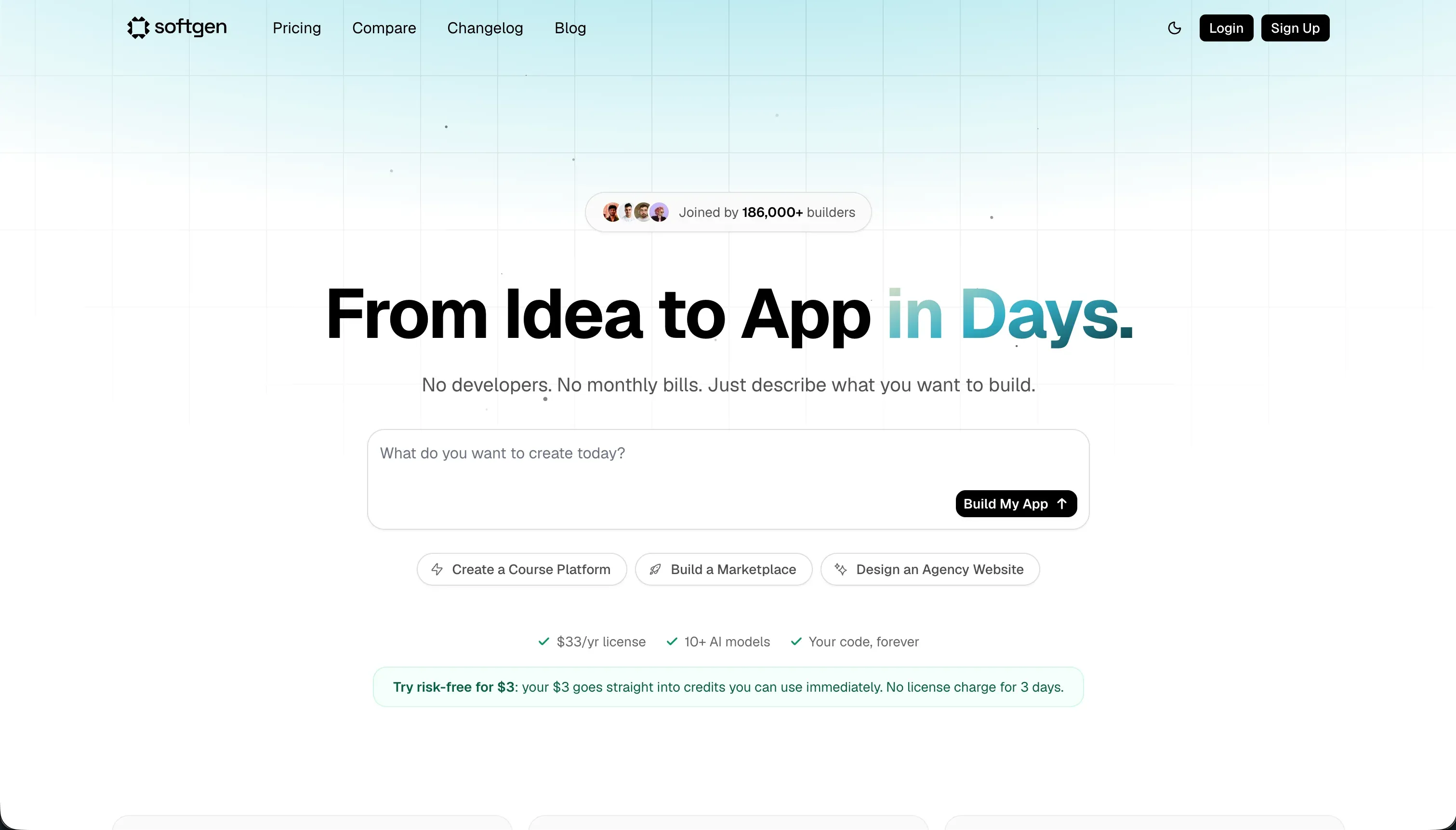 Softgen product snapshot
Instead of starting with a blank design canvas, you chat with Cascade to outline database columns, user sign-in views, and third-party integrations (like Stripe payments). Once your blueprint is complete, the AI compiles the code and deploys it to a staging domain.
What types of applications can you build with Softgen?
Softgen is optimized for simple database-driven web utilities:
- Interactive SaaS MVPs: Scaffold basic billing directories, payment links, and signup screens.
- Basic Web Directories: Replicate filterable grids, search inputs, and details pages.
- CRUD Database Tools: Create simple tables to input, store, and edit user logs.
However, because Softgen lacks visual customization tools, building enterprise-level administrative systems with complex access rights or custom branding requires coding.
Where Softgen genuinely shines
Softgen’s biggest advantage is its pricing model. Rather than charging high monthly subscriptions, it features a flat $33/year membership fee for access and hosting, and you buy pay-as-you-go credit packs for AI modifications. This is very cost-effective for developers who only edit their apps occasionally.
Its Cascade AI agent is a great planning helper, guiding users to structure their database schemas and layouts logically prior to compiling. It also supports exporting generated code, preventing platform lock-in.
The engineering overhead & setup complexity
While initial app generation is fast, visual iteration introduces significant prompting overhead:
- No Visual Drag-and-Drop Editor: Every visual change-such as aligning a button, adjusting margin padding, or changing visual grids-requires writing a new chat prompt. This can be slower and less precise than using a visual designer.
- Template Design Constraints: The AI compiles code within strict structural assumptions. If your desired design deviates from these modules, you will hit a visual ceiling.
- Manual Code Refactoring: If your application requires complex custom data relationships or multi-role permission paths, you must export the React files and write the custom code yourself.
The pricing gotchas & token/credit model
Softgen’s credit model requires careful token management:
- Credit Consumption on Edits: AI updates consume pay-as-you-go credits. If you get stuck in a visual loop trying to correct layout offsets or text alignment, you will burn through your credits quickly.
- Low Initial Allocations: The $33/year plan covers platform hosting but does not bundle large credit pools, forcing builders to purchase top-up packages during development.
- Debugging Costs: As with most conversational code generators, you spend credits asking the AI to diagnose and repair compiling errors introduced during edits.
Public Sentiment & Community Consensus
Discussions across SourceForge and analyst reviews highlight key trade-offs:
- Saves Prototyping Budget: Indie hackers appreciate the low base pricing, making it a great option for launching simple validation MVPs.
- Fails on Complex Customization: Reviews note that compared to Bubble, Softgen falls short in providing visual styling control.
- Maintainability Concerns: Tech analysts warn that relying purely on prompt-generated code can create technical debt that complicates future scaling.
For business teams looking to build secure B2B portals, client hubs, or internal databases, relying on chat-prompt iteration creates heavy maintenance overhead. If you’re building tools for business operations - think client portals, CRMs, internal tools, or partner networks - Softr is a much more practical fit. Softr’s AI Co-Builder generates complete apps from a prompt (database, pages, permissions, and navigation in one go), and you can refine everything in a visual editor without writing another prompt. It stores data in Softr Databases natively and connects to 17 external sources if you need them. Built-in user groups, role permissions, and auth are included from day one, so ops teams and founders ship production-ready software rather than fragile demos.
Verdict: Who is it actually for?
Best for: Indie hackers, solo founders, and creators looking to quickly build and test simple MVPs and SaaS web layouts under an affordable annual pricing model.
Not for: Business operations teams or agencies building stable client portals, corporate CRM dashboards, or systems requiring precise visual layout control.