

VibeCode and Softgen represent two prominent approaches to prompt-driven app building, but they target completely different screen formats. VibeCode is a native mobile-first generator designed to scaffold applications directly for smart phone deployment, while Softgen is a web-centric helper that relies on conversational chat to generate standard SaaS dashboards and databases.
Technical founders, product designers, and solo builders are often caught between these platforms depending on whether their target audience lives on a desktop browser or an app store. Deciding between them introduces a classic tradeoff around device format, visual customization limits, and the ongoing expense of prompt credit loops when debugging software.
Meet the Contenders
What is VibeCode?
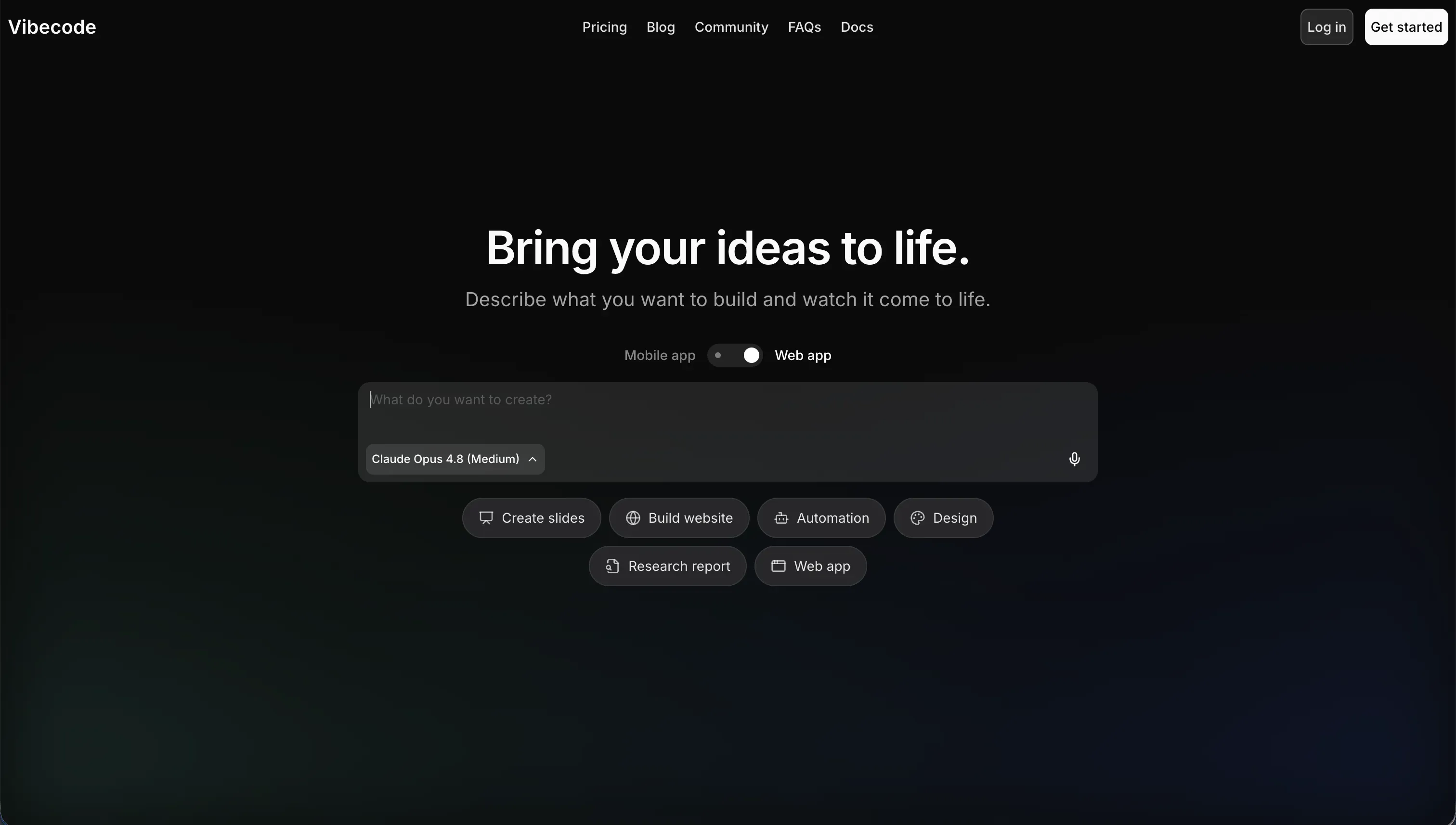
VibeCode is an AI-powered, mobile-first application builder designed to let creators build, test, and publish native mobile applications using natural language. It attempts to bypass the high steep learning curves of mobile development frameworks like React Native or Swift by allowing the user to dictate features in plain English.
In practice, the platform provisions a bundled backend database, handles user authentication, and coordinates cloud storage out of the box in its VibeCode Cloud. Paying subscribers on the $50 or $200 tiers can deploy their apps directly to the official Apple App Store and Google Play Store, while utilizing developer-centric features like full code exports and raw SSH connection directly to external code editors like VS Code or Cursor.
The system is genuinely built for developers who want to quickly build and test functional mobile MVPs, as well as non-technical creators aiming to launch simple utilities or personal mobile tools. However, users frequently hit a complexity wall where the AI hallucinates logic or loses context of the wider codebase when trying to integrate custom data pipelines or native mobile hardware triggers.
| Spec | Details |
|---|---|
| Primary Stack | Native iOS and Android framework with VibeCode Cloud database |
| Interface | Natural language builder chat and smartphone simulator window |
| Primary Deployment Target | Apple App Store and Google Play Store |
| Key Advantage | Mobile-first native scaffolding with terminal and SSH code access on Pro tiers |
What is Softgen?
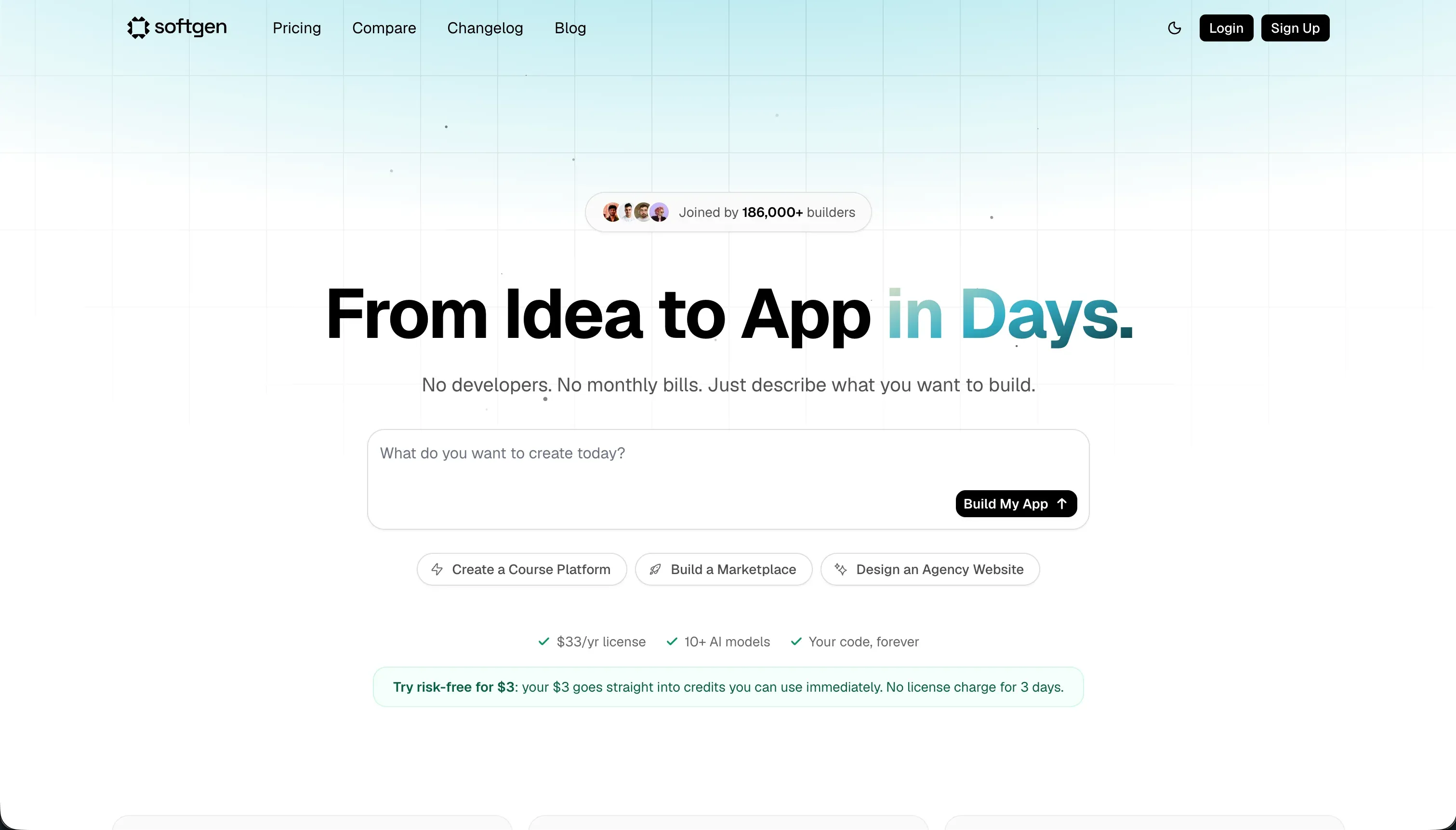
Softgen is a conversational AI application builder focused on desktop web layouts, portfolios, and database directories. It centers its user experience entirely around an interactive conversational chat interface that designs, configures, and deploys pages without visual drag-and-drop canvases.
The builder works through the Cascade AI Agent, which helps structure the relational database schema, setup user registration, and even integrate Stripe payments via raw text guidance. Users tweak alignments, font styling, and visual copy by responding directly to the chat agent, which pushes updates immediately to Softgen’s cloud hosting with custom domain options.
Softgen is built for indie creators, marketers, and SaaS builders who want to test basic functional interfaces without commit-heavy monthly plans. However, its visual rigidity irritates users who expect precise layout tools, often forcing them into repeating long prompt iterations that consume pay-as-you-go credits for minor styling corrections.
| Spec | Details |
|---|---|
| Primary Stack | React and Tailwind CSS frontend with relational backend db schema |
| Interface | Conversational workspace assistant (Cascade AI Agent) |
| Primary Deployment Target | Hosted browser applications and custom web domains |
| Key Advantage | Ultra-low annual fee paired with full code ownership and export rights |
The Core Difference
The main difference between these two systems resides in their target display platform and deployment pathways.
- VibeCode runs as a native-mobile deployment machine, targeting smart device apps with local smartphone components and App Store validation paths.
- Softgen focuses on desktop-first SaaS layouts, templates, and database tables hosted on standard browser URLs.
Head-to-Head Comparison
We evaluated both platforms across four core categories.
1. Developer Experience & Iteration Speed
The builder interface provides an interactive smartphone simulator on the side of a prompt terminal, making mobile UX styling highly responsive to text directions. You can write features like custom API integrations and preview them immediately under simulated mobile operating conditions.
However, once you write more complex logic, the loop breaks down quickly. The AI struggles to maintain code structure, leading to compile errors that developers must fix manually. This can turn simple adjustments into long troubleshooting sessions.
Designing occurs in a broader conversational window via its Cascade AI Agent, which walks the user through the process of architecting database tables and page workflows. Visual elements are modified entirely through text prompts, which can take multiple attempts to align simple structural columns or navigation bars.
The lack of visual drag-and-drop panels makes adjusting basic padding feel slow and counter-intuitive. You are constantly trapped in chatbot prompts just to fix a layout element that shouldn’t take more than a mouse click.
Edge: VibeCode, because the parallel mobile simulator and immediate preview speed up mobile iterations more successfully than Softgen’s desktop prompt-only setup.
2. Code Ownership & Exit Paths
Access to raw files and code export is treated as a premium feature locked behind the $50-per-month Pro tier. This lock-in can feel highly frustrating on lower tiers if you just want to run local backups or build tests without running up AI credits.
Once unlocked, however, it is highly useful because developers can bypass the AI entirely via direct SSH connection to tools like Cursor or VS Code. This creates a solid transition from prototype to real mobile engineering.
This platform handles code ownership much more cleanly on any tier post-generation. Developers can export their full React source code if they choose to leave, preventing absolute vendor lock-in.
This is exceptional given the entry price point of its annual subscription. It makes the platform a reliable playground to quickly generate structured templates and and scale them inside your own repository.
Edge: Softgen, as it offers easy code export on any tier rather than locking it behind expensive monthly plan requirements.
3. Database & Backend Capabilities
It provisions a managed mobile backend (Content Cloud) that takes care of basic authentication, security, and user-record linking. Connecting third-party APIs like maps or custom database engines also happens quickly through simple text setups.
The limitation remains storage caps and the fact that managing complex relational structures on native devices is highly fragile through chat commands.
The tool generates relational schemas that support basic CRUD, user sign-ups, and Stripe checkout logic out of the box. The database is pre-configured with structural tables, making it relatively functional for SaaS applications and directories.
But like VibeCode, it lacks advanced, fine-grained access permissions, which makes handling sensitive or multi-tenant corporate resources risky.
Edge: Softgen, due to its reliable relational data mapping and clean payment integrations for desktop platforms.
4. Pricing Comparison & Credit Economics
VibeCode functions on a traditional subscription model where your monthly plan tier includes a specific dollar value of raw LLM API credits with no markup. For instance, the Pro plan costs $50 per month and supplies $55 in raw credit.
While this transparent model keeps costs clear, active debugging loops or codebase modifications can drain your monthly allowance surprisingly fast, forcing you to upgrade plans.
Softgen utilizes a $33 annual membership that acts as a low-cost baseline to host active apps and access the design panel. Instead of monthly plans, builders must buy standalone pay-as-you-go credit packages to fund the conversational AI agent during updates and generations.
Although this keeps hosting incredibly cheap if your application is stagnant, making recursive structural updates, debugging bad files, or rebuilding features can trigger unexpected financial spikes.
Edge: Softgen, as the $33/year hosting fee ensures your published app stays online with minimal overhead compared to monthly subscription plans.
5. Learning Curve & Technical Guardrails
Creators must think of mobile states, device dimensions, and apple store rules, which introduces a complex engineering mindset even when using natural language. Because VibeCode is generating native files, there are real guardrails against layout misalignment, but the lack of error warnings can leave beginners stranded.
The tool’s learning curve is steep because understanding how native components communicate requires developer familiarity.
The setup process is approachable because the Cascade AI Agent prompts the builder with structured questions to design the database and page schemas before writing custom layouts. This guided scaffolding limits early design mistakes.
Still, the complete visual rigidity of the UI means that fixing small alignment errors requires trial-and-error phrase manipulation, which is frustrating.
Edge: Softgen, because its conversational helper structures the planning process, avoiding early system architecture roadblocks.

Pricing Comparison
VibeCode:
- Free - $0 per month with $2.50 included AI credits and access to premium models.
- Plus - $20 per month with $20 AI credits and 1 active deployment.
- Pro - $50 per month with $55 AI credits, 3 active deployments, code export, and SSH access.
- Max - $200 per month with $220 AI credits and 5 active deployments.
Softgen:
- Annual Membership - $33 per year for platform access, hosting rights, and custom domain support.
- AI Usage Credits - Pay-as-you-go packages purchased on demand to fund AI generation and ongoing application updates.
Use Case Fit: When to use which?
When to choose VibeCode
- You are building a native smartphone utility or simple mobile app that must live on the Apple App Store or Google Play Store.
- You want direct terminal connection via SSH so external editors like Cursor can edit the generated files.
- You want to prototype mobile-first swipe UI concepts and test them instantly in a phone-sized emulator panel.
When to choose Softgen
- You want to deploy desktop software directories or basic SaaS landing pages with a minimal recurring financial commitment.
- You require full React code export capabilities on a budget to migrate to your own hosting infrastructure later.
- You prefer a structured chat assistant that guides the creation of relational backend data schemas before writing visual templates.
When neither VibeCode nor Softgen is the right fit
For internal tools and client portals
For team apps, internal databases, client dashboards, or inventory systems, relying purely on conversational code generators like VibeCode or Softgen is a recipe for maintenance fatigue. Because every single visual change, layout adjustment, or role permission update has to pass through fragile prompt iterations, these apps quickly suffer from technical debt or server regression bugs. If a developer is not manually reviewing the output, a simple query can halt operations without a clear recovery path.
This is exactly where an AI-powered visual platform like Softr outclasses generated-code ecosystems. Softr combines a secure visual drag-and-drop block builder with high-performance Softr Databases to construct production-ready business software, client portals, and work trackers. By building core functions like user groups, granular access permissions, and automated workflow logic onto a reliable, SOC 2 compliant architecture, you can invite actual clients and partners to securely manage records. If you need bespoke features, you can prompt custom React components directly within the visual interface using the secure Vibe Coding block without risking the rest of the application.
For native mobile development at scale
While VibeCode gets native mobile layouts running quickly, its scale is heavily restricted by the limits of a prompt-based context window. If your application grows to require complex offline syncing, custom device integrations, or complex multi-step screen flows, chatbot scaffolding will break. The context window limitations mean that major changes frequently break older parts of the app, resulting in a frustrating cycle of credit consumption.
To build professional, production-grade applications for iOS and Android, FlutterFlow or Adalo provide much better alternatives. FlutterFlow integrates raw visual controls with Dart code export, giving developers structural access to native hardware features and extensive database systems without forcing them to write layouts from scratch. It is a far more robust path to publishing on official stores than trying to debug raw AI code manually in a simulated environment.

Verdict
Choose VibeCode and accept that you will be locked into a monthly subscription ecosystem where complex development requires the $50-per-month Pro tier to export files or hook directly into Cursor. It is best suited for visual prototyping of basic native iOS and Android apps, assuming your team can safely handle mobile compilation rules and API setup.
Choose Softgen if you plan to launch a basic relational directory, SaaS landing page, or desktop database with minimal baseline overhead. It is a cost-effective way to get a simple React layout online for $33 per year, but you must accept the visual rigidity of a tool that forces you to align simple paddings entirely through conversational prompt loops.
For teams building structural business operations like student portals, CRM dashboards, or internal work trackers, both platforms construct fragile systems that invite massive day-two coding debt. High-growth organizations are better served by using Softr, which handles the critical heavy lifting, including security, authentication, and user permissions, in a stable visual interface, allowing anyone to modify screens manually without risking code regressions or running out of AI credits.

Summary Comparison Table
| Criterion | VibeCode | Softgen |
|---|---|---|
| Build Paradigm | Conversational Mobile Scaffolding | Conversational Web Layouts |
| Primary Target | Native iOS & Android Apps | Browser-Based Web Apps |
| Editing Interface | Prompt Chat & Smartphone simulator | Conversational Chat Agent |
| Code Export | Paid Plans ($50 per month plus) | Enabled on any plan |
| Pricing Model | Monthly Subscription | Annual Membership + Pay-As-You-Go |
| Database | VibeCode Cloud Backend | Relational Tables & Schema |