

VibeCode and Base44 both tap into the promise of vibe coding - letting you describe what you want in plain English while AI builds the underlying software. However, they target fundamentally different form factors. VibeCode generates native mobile applications optimized for smartphones and deployable to major app stores, whereas Base44 scaffolds responsive full-stack web applications with managed hosting and PostgreSQL databases.
Teams evaluating these two platforms are usually developer-adjacent builders, non-technical founders, or product operators trying to avoid a slow development cycle. What is at stake is not just the speed of the first prototype, but what happens on day two when you need to handle database boundaries, manage unpredictable credit costs, and prevent destructive bug regression loops.
Meet the Contenders
What is VibeCode?
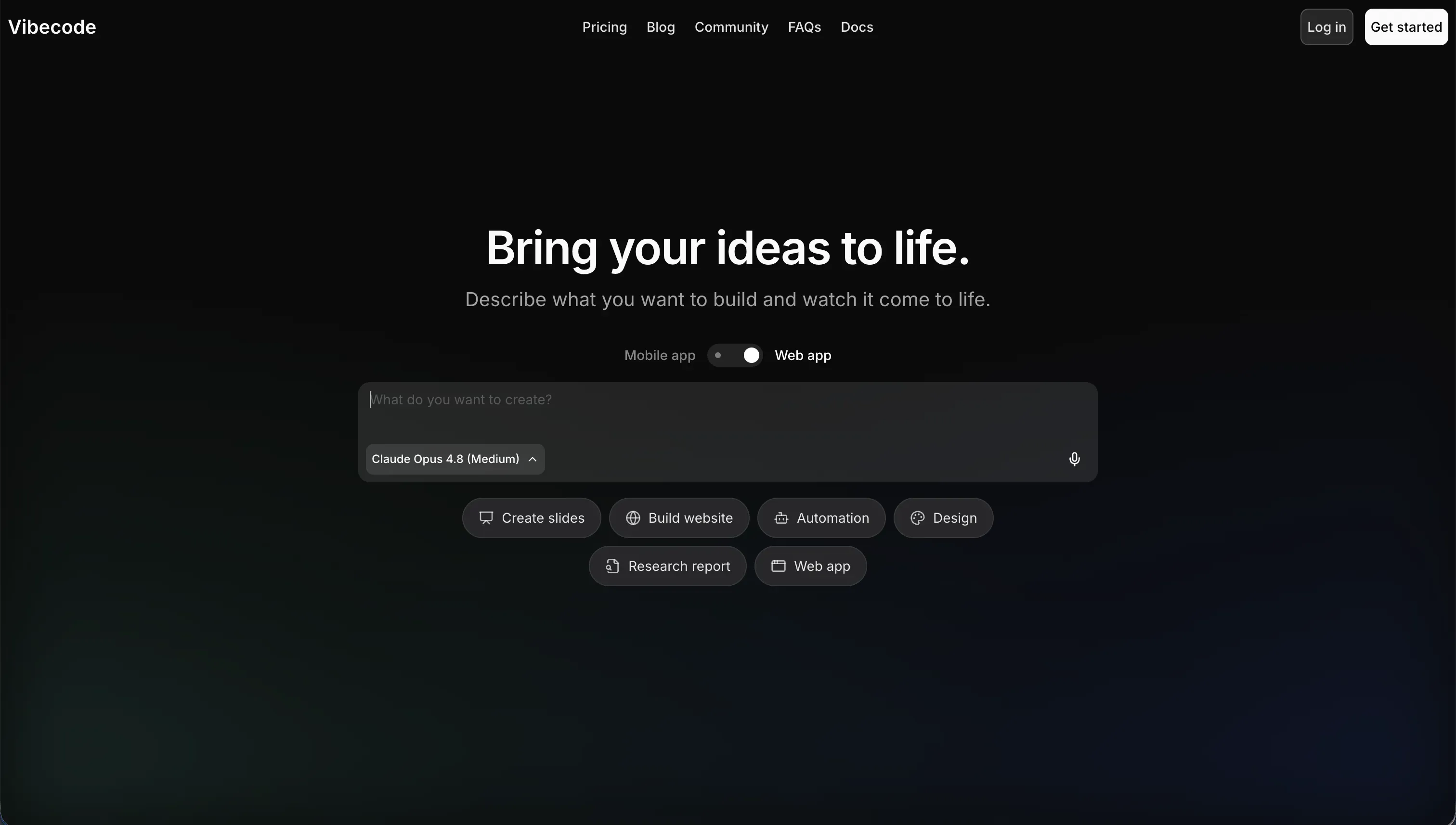
VibeCode is an AI-powered, mobile-first app builder designed to let users create, test, and publish native mobile applications using conversational prompts. The platform, located at vibecodeapp.com, completely bypasses local development client configurations, allowing makers to run an interactive design simulator through natural language queries.
In practice, VibeCode provisions a visual mobile emulator canvas on the left of its workspace and an AI director interface on the right. It automatically creates schema tables, sets up user authentication assets, and provides built-in API integrations to connect services like weather feeds or map layers. On higher paid tiers like the USD 50 per month Pro plan, creators get a major developer escape hatch: full code download and direct SSH access to integrate with local IDEs like VS Code or Cursor.
This platform is built primarily for mobile app prototypers and non-technical mobile creators wanting to publish basic native utilities or simple smartphone MVPs without navigating React Native, Swift, or Kotlin. However, users building deep operational tools or heavy database backends find that the AI often hits a complexity wall, introducing hallucinated logical routes and breaking state management in larger, multi-screen directories.
| Spec | Details |
|---|---|
| Primary Stack | AI-generated mobile code with VibeCode Cloud database and authentication |
| Interface | Generative prompt chat with interactive mobile canvas preview |
| Primary Deployment Target | Native iOS App Store and Google Play Store on paid tiers |
| Key Advantage | Direct SSH access on Pro/Max tiers to pull and modify source code locally |
What is Base44?
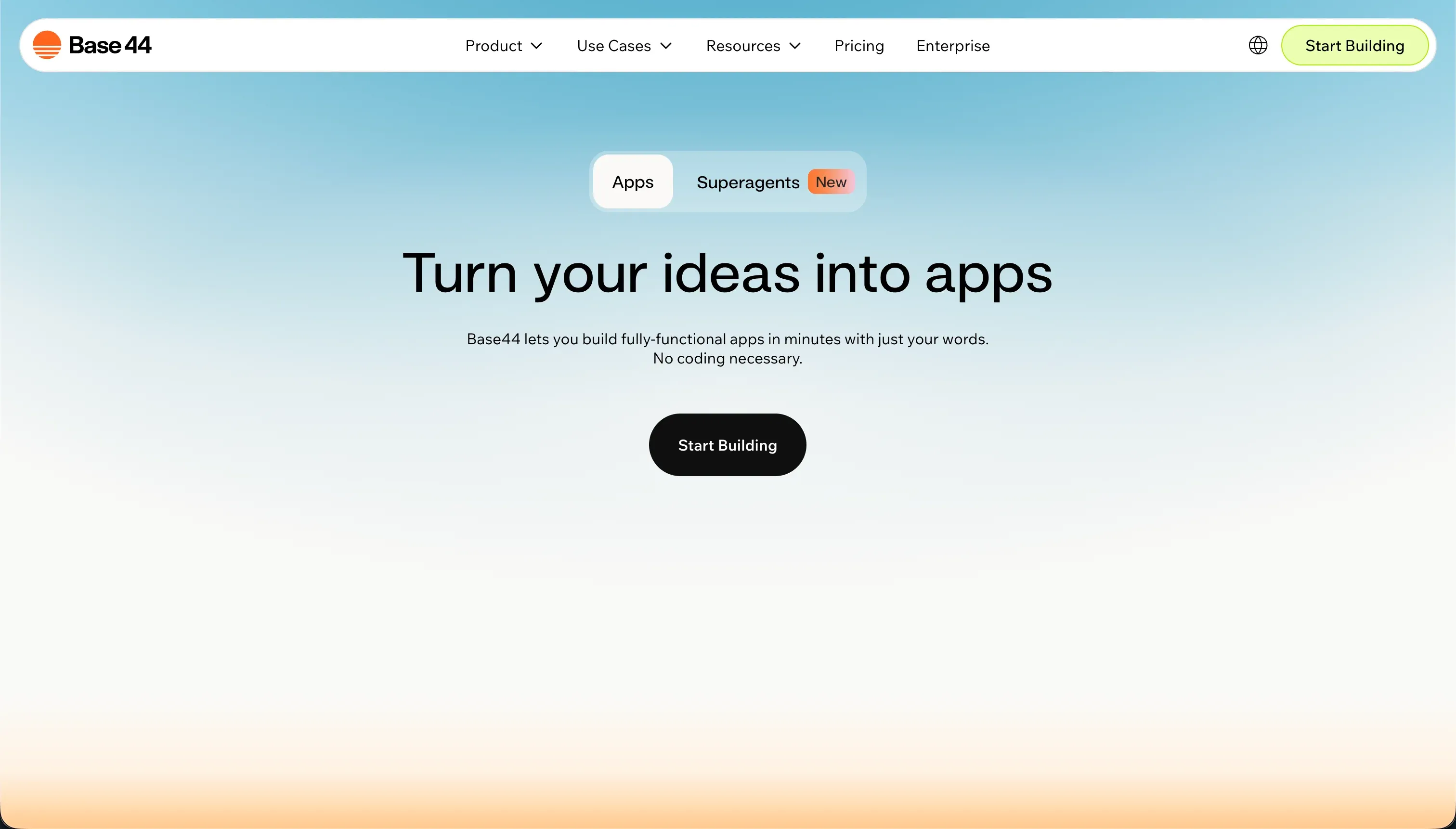
Base44 is an AI-powered all-in-one builder designed to construct full-stack web applications from raw conversational prompts. Operating as an integrated hosting environment, it generates responsive browser interfaces, writes custom business logic, and provisions a managed SQL database without requiring manual server deployment.
In practice, you enter your software requirements inside the Conversational Builder Chat to scaffold core pages, data entries, and authorization endpoints. Once generated, you can use the visual click-to-tweak editor to make surface-level changes to elements and themes, or boot up Discuss Mode to explore app architecture without consuming your monthly message credits. Higher plans also support syncing your generated frontend directly to GitHub.
It is built for non-technical founders and operations coaches looking to scaffold desktop-friendly mockups or simple transactional web tools. Despite the clean initial setup, users often express frustration with Base44’s rigid credit mechanics, destructive editing updates that break existing production flows, and severe platform limits on processing complex file types like PDFs.
| Spec | Details |
|---|---|
| Primary Stack | AI-generated React frontend with managed PostgreSQL database |
| Interface | Prompt-based chat with click-to-tweak visual layout controls |
| Primary Deployment Target | Hosted on Base44 cloud with partial GitHub export for frontends |
| Key Advantage | All-in-one web deployment including databases and basic transactional logic |

The Core Difference
The core difference between VibeCode and Base44 lies in their target architecture and downstream exit strategy.
- VibeCode targets native mobile developers drafting app store utility binaries and offers clean developer escape hatches like raw SSH editor syncing.
- Base44 targets web-first operations looking for rapid full-stack scaffolding, but locks database backends entirely within its own managed infrastructure.
Head-to-Head Comparison
We evaluated both platforms across four core categories.
1. Developer Experience & Iteration Speed
VibeCode is designed around a mobile simulator preview that reflects native component layouts as you prompt. Building out screens, lists, or buttons is fast because the client automatically links UI requests with a basic local database and auth without requiring external service tokens.
However, visual and structural consistency degrades as logic grows. Because the client is entirely mobile-first, modifying complex data schemas on smaller smartphone preview viewports can be tedious. If the AI loses alignment on state variables across multiple mobile page states, resolving the layout requires starting with fresh components or hoping the prompt agent doesn’t introduce circular logic loops.
Base44 offers an all-in-one chat canvas alongside a web preview pane that makes dashboard creation painless. You can refine layout spacing using single-word style prompts or test different database queries in Discuss Mode before executing edits, saving valuable message credits.
The major issue is the risk of editing regressions. Multiple user reviews on Reddit complain that Base44’s AI fixes one bug only to break ten working features, leading to looped prompts that drain message credits. Unlike standard software environments where you can roll back precise commits, Base44 developers often find their applications completely unusable after trying to execute successive layout iterations.
Edge: VibeCode, because it structures its changes without the aggressive regression loops frequently reported by Base44 web builders.
2. Code Quality & Portability
VibeCode shines for teams who worry about platform lock-in. Starting at the USD 50 per month Pro tier, the app offers full source-code export and developer-friendly SSH exit paths, meaning you can easily connect the workspace to external editors like Cursor or VS Studio.
This capability completely changes the day-two risk calculation. If VibeCode’s AI agent hits an execution limit on complex state logic, a developer can run a code pull, refactor the dirty screens locally, and submit updates manually without feeling trapped in a restricted web container.
Base44 allows users on the Builder plan to sync frontend code directly to GitHub repositories, which tracks styling changes. This partial exportability is helpful if a developer needs to tweak Tailwind utility styles or modify layout scripts later.
However, the backend remains permanently locked. Base44’s managed database, PostgreSQL schema, and backend logic are trapped inside its hosting environment, meaning you cannot perform a clean full-stack migration. Coupled with high subscription fees to authorize continuous exports, the exit strategy remains a major point of friction.
Edge: VibeCode, which provides raw source-code access and direct SSH links instead of trapping the backend engine.
3. Database & Backend Capabilities
VibeCode automatically wires up a lightweight, relational database and user management system inside the VibeCode Cloud. It supports standard API integrations out of the box, letting you parse external feeds or connect generic endpoints via pre-configured API blocks.
The bottleneck is scalability. The built-in database handles typical mobile MVPs and simple user directories, but it lacks visual database editors for administrative queries, manual schema layout, or granular row-level permissions. If your native app needs to process thousands of customer objects across strict permissions, managing the data layer via raw prompts gets messy.
Base44 leverages a managed PostgreSQL database that handles web queries, relational architecture, and custom storage models right from your chat prompt. Generating tables, seeding mock data, and hooking up standard auth inputs requires no initial database setup.
Unfortunately, administrative backend control is completely locked away. Creators have no visual database dashboard to tweak permissions, enforce granular team viewing boundaries, or scale table indexes. If you attempt to build a strict, multi-tenant portal where various user cohorts access different modules, you must rely on conversational prompts that often write incomplete permission filters.
Edge: Base44, because PostgreSQL is structurally more robust than VibeCode’s minimal mobile data blocks, despite the lack of visual database editors.
4. Hosting & Deployment Options
VibeCode is designed specifically to compile native IPA and APK packages for deployment to the Apple App Store and Google Play Store. It uses its cloud compiler to automate code compilation, simplifying the traditional developer portal publishing steps on paid plans.
The downside is the friction inherent to mobile app store constraints. Bypassing Apple or Google review cycles is impossible, meaning every quick prompt update can face rejection, review delays, and app store deployment overhead. For fast-changing operational software, this delay is a major bottleneck compared to web-accessible channels.
Base44 executes instant deployment to its own hosted cloud containers, serving your full-stack app on custom live subdomains. Web previews reload instantly, making it simple to send fresh operational updates to clients or testers with zero store compilation steps.
However, builder stability has been a recurring concern. G2 and Reddit developer reports indicate that Base44’s server infrastructure can go down unexpectedly, causing live hosted applications to break in production. If your team relies on stable uptime to run real-world activities, this infrastructure instability poses a major risk.
Edge: Base44 for deployment speed, though its server downtime reports make both platforms risky for mission-critical operations.
5. AI Quality & Reliability
VibeCode passes raw, un-marked-up API credits directly to popular LLM backends like Anthropic and OpenAI. This transparent credit-based calculation ensures you are paying fair prices for generative actions, keeping long-term prototyping costs directly aligned with token updates.
While the model transparently charges for prompts, the native-mobile code interpreter handles UI state changes reliably only of simple screens. When you prompt a complicated state transition - such as passing values between high-latency hardware sensors and remote database API logs - the AI is prone to code hallucinations and dependency errors.
Base44 handles all API integrations via LiteLLM connectors, establishing a unified route to execute background conversational steps. It lets users select from premium models to draft text blocks or validate structural forms.
The primary flaw is the high frequency of destructive AI updates. Product evaluations and user posts confirm that the AI frequently fails to recognize existing context, writing buggy updates that delete critical logic and force users into circular credit-draining recovery loops. For non-technical teams, these loops mean paying Base44 subscription fees just to restore functional layouts.
Edge: VibeCode, because raw credit translation and block-level updates are far less destructive than Base44’s full-stack regression loops.

Pricing Comparison
VibeCode:
- Free: USD 0 per month. Includes USD 2.50 of credits, access to premium AI models, and standard prompt-based building.
- Plus: USD 20 per month. Includes USD 20 of AI credits, basic features, and 1 active deployment.
- Pro: USD 50 per month. Includes USD 55 of AI credits, Pro features, 3 active deployments, complete code export, and developer SSH access.
- Max: USD 200 per month. Includes USD 220 of AI credits, 5 active deployments, and full developer options.
Base44:
- Free: USD 0 per month. Provides 25 monthly message credits (maximum 5 per day) and 100 integration credits to test basic database and auth integrations.
- Starter: USD 20 per month (or USD 16 per month billed annually). Includes 100 message credits, 2,000 integration credits, unlimited apps, and in-app code edits.
- Builder: USD 50 per month (or USD 40 per month billed annually). Unlocks 250 message credits, 10,000 integration credits, custom domain hosting, backend functions, and partial GitHub code export.
- Pro: USD 100 per month (or USD 80 per month billed annually). Provides 500 message credits, 20,000 integration credits, and premium AI model selection tools.
- Elite: USD 200 per month (or USD 160 per month billed annually). Maxes out at 1,200 message credits and 50,000 integration credits for high-volume apps.
Use Case Fit: When to use which?
When to choose VibeCode
- Choose VibeCode when you specifically need to scaffold native mobile applications for iOS and Google Play rather than desktop web portals.
- Choose VibeCode when developer-friendly exit options like direct SSH code sync and raw React Native exports are essential for your software.
- Choose VibeCode when you want raw, un-marked-up AI LLM usage billed transparently using simple API tokens rather than opaque platform pricing schemes.
When to choose Base44
- Choose Base44 when you need to build desktop-friendly full-stack web applications that launch instantly in a hosted cloud container without any database setup.
- Choose Base44 when you want to use conversational builder tokens to rapidly apply complex design layouts like glassmorphism to your prototype.
- Choose Base44 when syncing frontend styling edits directly with GitHub repositories is enough to satisfy your platform exit requirements.
When neither VibeCode nor Base44 is the right fit
For business applications, client portals, and secure internal systems
If you are trying to build operational business software - such as client portals, department CRMs, team project trackers, or partner tracking boards - both VibeCode and Base44 present massive operational risks. VibeCode forces your employees to download app binaries from App Stores, while Base44 locks your raw relational database inside its cloud containers and drains your monthly subscription fees with destructive AI regression loops. Business data needs a highly secure, visually maintainable platform rather than conversational code scaffolding that breaks on the next update.
This is where Softr offers the perfect zero-maintenance alternative. It combines a secure, visual visual editor with a native relational database (Softr Databases) that features robust Model Context Protocol (MCP) support to connect external tools like Cursor. Rather than guessing permissions inside a builder chat, Softr lets you visually design secure user groups, page visibility limits, and custom action buttons. If someone on your team can edit an Excel spreadsheet, they can manage and expand your Softr application without prompting AI or writing code.
For professional developer environments and complex visual development
When your application requires high-performance visual coding workflows, complex computational branches, or completely custom responsive desktop layouts, prompt-first tools will restrict your speed. VibeCode and Base44 both try to solve complexity by asking you to write better prompts, which shifts the burden of software architecture back to your shoulders. This often results in unmaintainable source files and fragile logic trees that hinder professional teams.
If you are a developer looking for a true visual programming experience, Bubble is highly recommended for web logic, while FlutterFlow is the standard for producing production-ready native mobile designs. For developers who want absolute control over their local environment, coding helpers like Cursor or hosted cloud workspaces like Replit provide actual developer shells, custom dependencies, and raw server hosting without forcing you into restrictive platform containers.

Verdict
Pick VibeCode if your target is native mobile, and you want to quickly test interactive mockups on iOS or Android screens. By selecting its Pro plan, you obtain a real developer escape hatch through SSH sync and clean React Native code exports, mitigating the risk of structural vendor lock-in.
Pick Base44 if you are seeking a fast web-first generator to scaffold responsive full-stack screens with pre-configured auth and PostgreSQL tables. You accept the reality of an isolated backend database, conversational limits when using LiteLLM connections, and unpredictable pricing driven by its dual credit platform.
However, if you are building actual business software to run internal team tracking or manage external clients, both platforms will leave you with fragile technical debt. For client portals, partner directories, and team CRMs, Softr represents the more mature path - providing stable, visual permission rules, native Softr Databases, compliance structures, and a hybrid AI model that remains fully editable by your non-technical operations teams.

Summary Comparison Table
| Criterion | VibeCode | Base44 |
|---|---|---|
| Form Factor | Native Mobile (iOS & Android) | Full-Stack Web |
| Exit Strategy | Full code download and SSH database sync on Pro | Frontend GitHub sync only; backend database is locked |
| Database Layer | Lightweight API integration & local tables | Managed PostgreSQL with conversational updates |
| Builder Experience | Conversational prompt compiler | Conversational builder chat + visual tweaks |
| Pricing Metrics | Raw LLM credit transfers with no markup | Dual credit model (Message & Integration tokens) |
| Day Two Risk | App store rejections and complexity scaling degradation | Bug regressions, server instability, and PDF limits |