

VibeCode vs Bubble: this matchup represents a massive tradeoff between conversational AI mobile engines and proprietary visual compilers. VibeCode belongs to the category of conversational, mobile-first AI draft generators, while Bubble represents traditional, full-stack visual programming suites. The former uses raw AI prompts to draft native mobile layouts optimized for smartphones, while the latter uses manual visual tools and workflow triggers to build deep desktop database systems.
Usually, founders, non-technical creators, and design agencies are deciding between these platforms as they attempt to balance building speed against downstream logic requirements. What is really at stake is the long-term cost of development workspace maintenance, code ownership flexibility, database scaling limits, and whether a builder prefers typing plain English prompt loops or mastering database variables. Choosing the wrong fit means risking either unmanageable code debt or being permanently locked into a single hosting ecosystem.
Meet the Contenders
What is VibeCode?
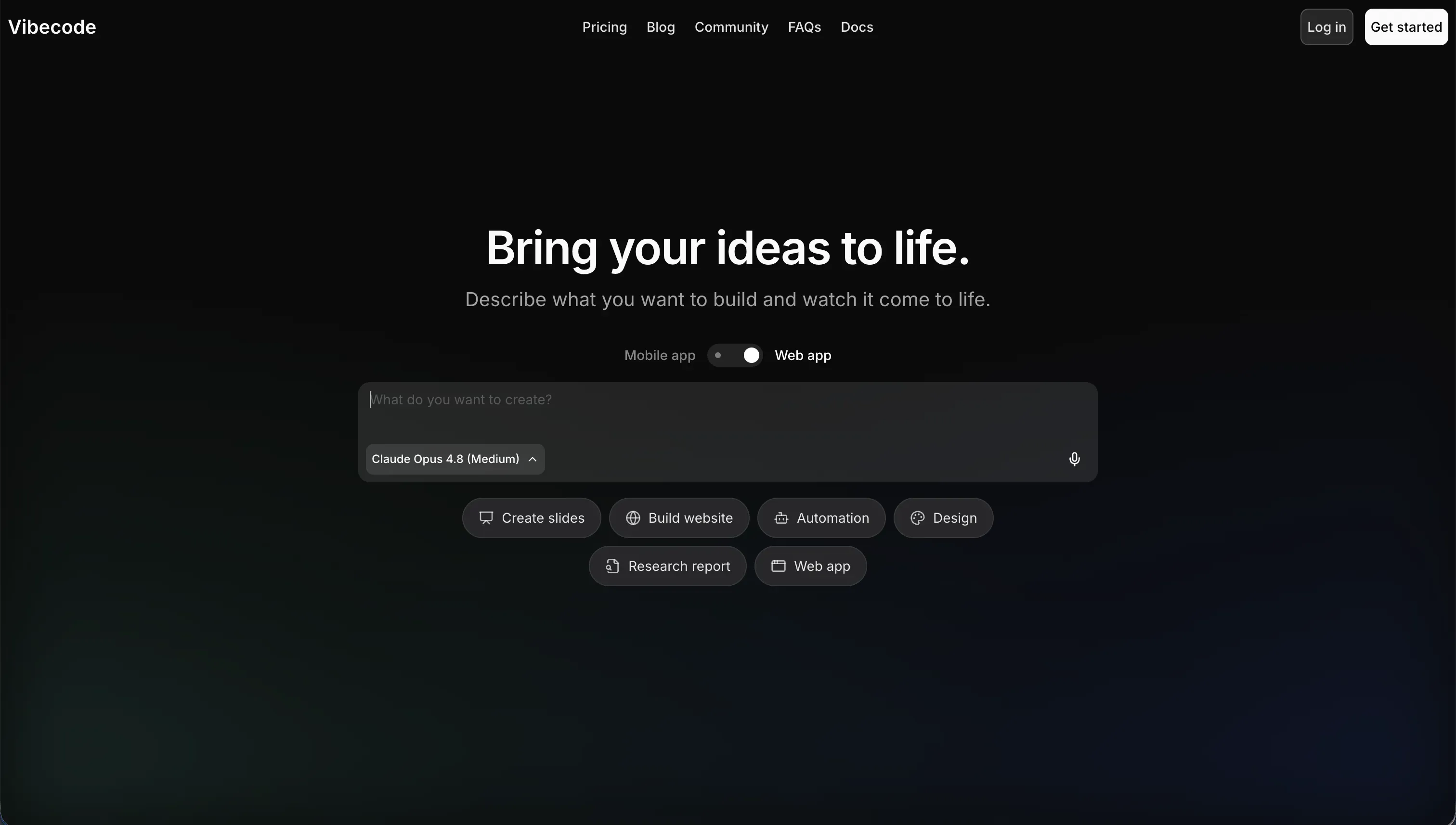
First launched as a mobile-first generative tool, VibeCode is an AI-powered software compiler designed to let users create, test, and publish native mobile applications using conversational natural language. Built for both non-technical creators and developers looking to produce prompt-driven MVPs, it operates under the ‘vibe coding’ philosophy where the user acts as a director describing actions in plain English.
In practice, describing your desired elements in chat prompts the VibeCode AI engine to generate the underlying frontend layouts and provision storage systems on VibeCode Cloud automatically. Paid plans unlock valuable visual adjustments alongside advanced options like direct SSH access, which allows developers to connect external visual IDEs like Cursor directly to the generated mobile codebase to clean up styling and custom scripts.
It is genuinely built for makers, app prototypers, and non-technical mobile creators who want to deploy lightweight utilities or personal applications to iOS and Android markets quickly. However, creators are frequently frustrated by context window drift in large projects, as subsequent prompt updates can trigger bugs in previously stable components, leaving builders trapped in credit-consuming debug loops.
| Spec | Details |
|---|---|
| Primary Stack | AI-generated mobile code bundled on VibeCode Cloud database infrastructure |
| Interface | Conversational natural-language builder with visual adjustments on higher plans |
| Primary Deployment Target | Native iOS and Android packages published directly to app stores |
| Key Advantage | Fast native mobile scaffolding using ordinary English instructions with partial code export |
What is Bubble?
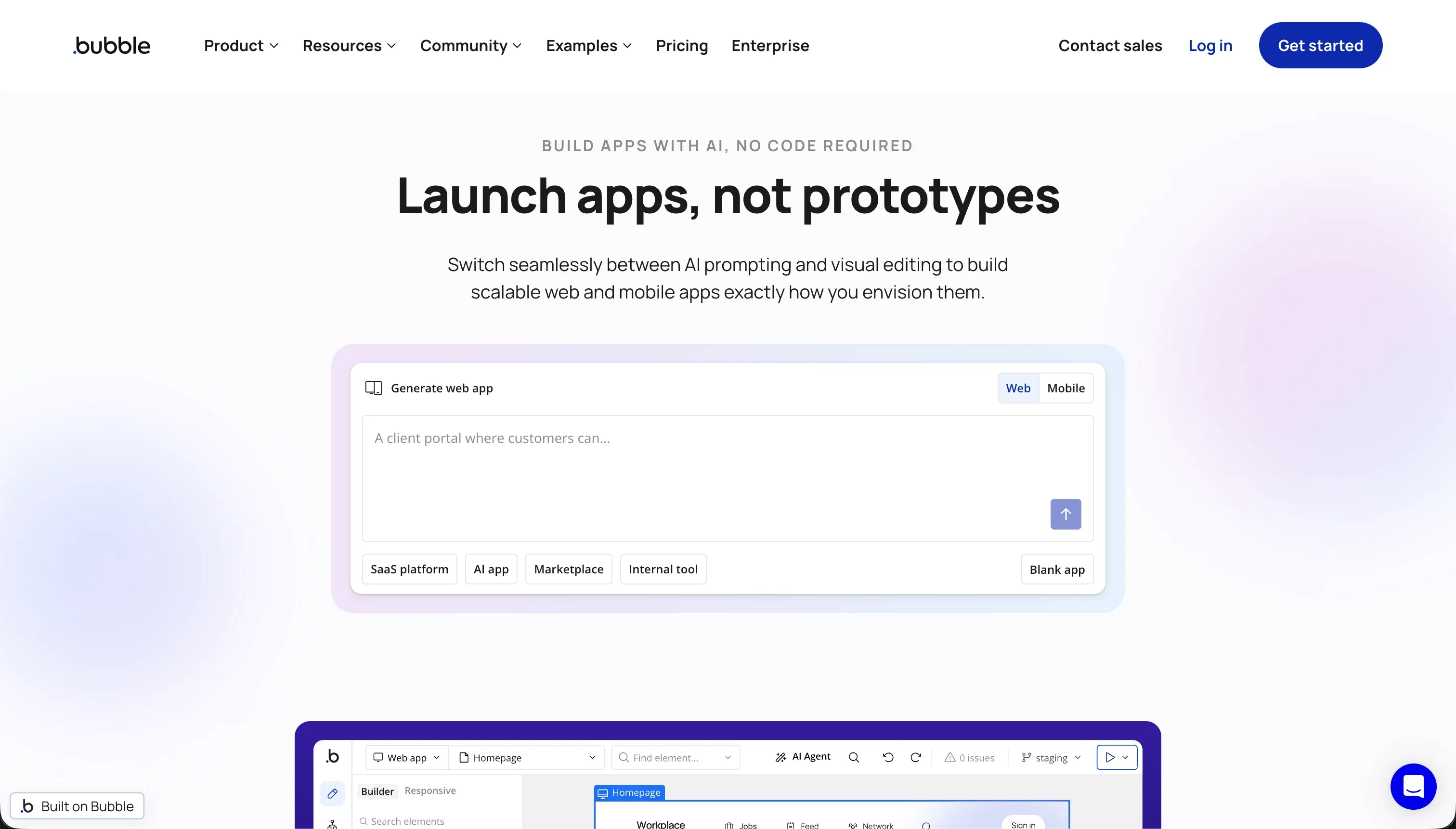
Established as an early giant of visual development, Bubble is a complete visual programming engine designed to build and host full-stack desktop and web applications without writing manual syntax. It trades conversational AI generation for a highly structured visual space where every database parameter, responsive margin, and server-side workflow is explicitly configured by the builder.
In practice, builders configure custom data models, link relational profiles, and program logical progressions using a visual workflow builder. From connecting external payment processors via its global API Connector to browsing over 8,000 plugins in its community marketplace, Bubble allows creators to assemble deep B2B logic and custom multi-tenant saas systems without technical coding background.
It is genuinely built for SaaS founders, visual designers, and enterprise operations teams who need to launch robust, database-rich web platforms that scale beyond basic templates. However, builders frequently complain of steep initial learning curves, proprietary walled-garden constraints, a volatile Workload Unit pricing model, and notorious browser editor RAM bottlenecks.
| Spec | Details |
|---|---|
| Primary Stack | Proprietary visual full-stack editor with a managed SQL relational database |
| Interface | Pixel-level visual drag-and-drop workspace with structured logic builders |
| Primary Deployment Target | Hosted web applications with responsive CSS and public beta mobile options |
| Key Advantage | Deep server-side logic controls with an array of over 8,000 marketplace integrations |
The Core Difference
The primary dividing line between these two platforms represents a choice between hands-free AI code generation and manual visual assembly.
- VibeCode runs on a prompt-based paradigm that converts natural language requests into custom native mobile code, prioritizing generation speed.
- Bubble utilizes a visual drag-and-drop workflow canvas that requires builders to explicitly define relations, logical rules, and responsive coordinates.
Head-to-Head Comparison
We evaluated both platforms across four core categories.
1. Developer Experience & Iteration Speed
VibeCode is designed to bypass layout manual configurations entirely, creating responsive screens, user auth portals, and mock parameters from simple English guidelines in under ten minutes. The onboarding path includes $2.50 in starting AI credits to allow immediate development, making it highly competitive for greenfield product runs.
However, as applications expand into hundreds of fields, the model hits visual and logic walls. Prompt queries often regress, meaning a text instructions patch designed to modify a login form can accidentally detach databases or scramble custom buttons, forcing creators to expend additional credits repeating instructions.
Bubble operates entirely via visual configuration panels, removing prompt dependencies for editing tasks. Dragging coordinates onto a responsive grid provides explicit visual control, and constructing complex backend workflows sequentially ensures that changes do not randomly warp your database rows or visual designs.
Yet, the user interface remains notorious for browser memory leaks and slow execution speeds. Reddit threads document high-end development rigs lagging severely, with Bubble tab layouts frequently consuming over 5GB of active RAM, turning massive product revisions into sluggish manual cycles.
Edge: VibeCode for immediate mobile visual draft speed, but Bubble is far more reliable for predictable, manual visual alterations.
2. Code Portability & Platform Lock-In
VibeCode presents an attractive export model for technical makers on its Pro ($50/month) and Max ($200/month) subscription tiers. Paid builders can download clean React Native source trees and establish direct SSH configurations with Cursor or Visual Studio Code, giving them a real exit path from their visual hosting setup.
However, these features are blocked on Free and Plus packages. If your business is subscribed to base plans, you are locked into the hosted engine, and since the underlying VibeCode Cloud database remains stuck on their servers, backend migrations require manual script operations.
Bubble enforces a complete proprietary lock-in in the no-code ecosystem. All application functions, sequential visual coordinates, and custom backend rules compile via Bubble’s server runtime. There is no code export feature - you cannot access nor download standard Javascript, PHP, or HTML code files.
If you decide to migrate away from Bubble due to performance bottlenecks or platform adjustments, your only technical choice is to rebuild the application from the ground up on standard code or alternative structures, as only the raw tabular database records can be exported via CSV.
Edge: VibeCode, which provides raw native directory downloads on its paid tiers to avoid complete vendor lock-in.
3. Database & Backend Capabilities
VibeCode automations automatically generate standard datastores on VibeCode Cloud, removing typical database registration friction. This serves basic requirements like logging registration coordinates, saving user inputs, and pulling simple key-value datasets for native card modules smoothly.
However, it lacks granular backend controls. Because structural updates flow primarily through prompts, creating highly specific nested relational tables, aggregate sum variables, and tight row-level data roles is fragile and vulnerable to hallucinated schema configurations.
Bubble functions as a highly programmable logic database container. It allows visual designers to construct deep relational layers, map data variables, and program server-side schedulers to clean up tables automatically or route bulk actions without manual prompt inputs.
It also supports visual data boundary fields. Builders can visually establish detailed database privacy boundaries, ensuring that specific user accounts only query records they explicitly own, avoiding the security leaks typical of prompt-generated architectures.
Edge: Bubble, because its visual data modeler provides robust, scalable tables and explicit security visual rules.
4. Hosting & Deployment Options
VibeCode targets native mobile compilation specifically. Once your layout is generated using prompts, VibeCode compiles iOS and Android native configurations, enabling developers on paid plans to publish mobile files directly to Apple App Store and Google Play marketplaces.
This mobile specialization makes it highly optimized for smartphone ratios and native gestures. However, desktop browsers are neglected; trying to scale a VibeCode layout for a large widescreen monitor results in a stretched mobile wrapper.
Bubble operates as an all-in-one visual hosting engine for desktop and portable web browsers. Applications load in Single Page Application (SPA) mode with custom domain routing, and creators can scale custom hosting memory on dedicated capacities when enterprise visual traffic peaks.
However, Bubble’s native mobile engine remains a maturing wrapper ecosystem in public beta. Review sites frequently document that wrapped Bubble systems run slowly on smartphones, lacking the performance of dedicated mobile frameworks.
Edge: VibeCode for native app store packaging, whereas Bubble is far superior for hosting responsive desktop dashboards.
5. AI Quality & Reliability
VibeCode builds directly from Anthropic and OpenAI integrations without markup, passing high-grade visual models and logic scaffolding. The LLM connection is standard across all tiers, and natural language prompts allow absolute beginners to shape simple application outlines immediately.
However, conversational AI dependency introduces generation variance. Changes requested late in the design cycle can accidentally override stable functional blocks, and running repeated debugging loops to fix syntax deviations will rapidly drain your monthly token budget.
Bubble approaches generative AI as an auxiliary plugin connection rather than herding users into prompt-based builders. You assemble responsive panels, map fields, and establish workflows using drag-and-drop visuals, guaranteeing consistency once elements deploy.
This manual architecture avoids generative decay. Your layouts, navigation paths, and security values remain exactly how you visually draw them, meaning you never lose code progress due to model context limits, though visual testing takes longer.
Edge: Bubble, as its visual engine ensures visual consistency and structural logic without generative decay.

Pricing Comparison
VibeCode:
- Free - $0/mo with $2.50 included AI credits and premium model access.
- Plus - $20/mo with $20 included credits and 1 active deployment.
- Pro - $50/mo with $55 included credits, 3 active deployments, code export, and direct SSH access.
- Max - $200/mo with $220 included credits and 5 active deployments.
Bubble:
- Free - $0 with 50,000 Workload Units (WU) per month and a limit of 200 records.
- Starter - $69/mo (billed monthly) with 175,000 monthly Workload Units.
- Growth - $249/mo (billed monthly) with 250,000 monthly Workload Units.
- Team - $649/mo (billed monthly) with 500,000 monthly Workload Units.
Use Case Fit: When to use which?
When to choose VibeCode
- Choose VibeCode when your primary objective is to prototype and launch lightweight native mobile utilities or games directly to iOS and Android app stores.
- Choose VibeCode when you want high-speed software scaffolding and require clean React Native source code export options on Pro tiers.
- Choose VibeCode when you prefer building through conversational English chat interfaces rather than configuring margins and relational variables manually.
When to choose Bubble
- Choose Bubble when you are building a database-rich desktop web application or SaaS platform that requires highly customizable relational models.
- Choose Bubble when you demand strict, server-side data privacy controls to secure sensitive user records across multi-tenant networks.
- Choose Bubble when you want to avoid prompt decay, codebase context loss, and the volatility of continuous conversational iteration.
When neither VibeCode nor Bubble is the right fit
For secure internal tools and client portals
When you need to construct a robust business workflow, a department CRM, or an interactive client portal, neither conversational mobile drafts nor steep visual suites are optimal. VibeCode’s prompt loops generate too much code fragility for transactional business actions, while Bubble introduces extreme developer overhead and the continuous anxiety of unpredictable Workload Unit cost spikes.
Instead, Softr offers the logical solution by delivering secure business software over native Softr Databases first, followed by key integrations to backends like Airtable or HubSpot. By locking in core patterns like authentication, visual user permission groups, and responsive web pages directly within visual blocks, Softr isolates custom code generation to specific UI blocks, meaning business operators can deploy live, European-hosted, and SOC-2-compliant client zones within afternoon hours.
For high-performance native mobile frameworks
If you are planning to deploy a mobile utility that requires full access to device hardware, complex offline performance capabilities, or native components, both VibeCode and Bubble present design gaps. VibeCode’s conversational engine hits logic walls as requirements expand, while Bubble remains a desktop-first browser compiler with slow mobile wrapper options.
For native mobile software, transitioning to FlutterFlow or utilizing Adalo provides a superior developer ecosystem. FlutterFlow is highly optimized for compiling native Dart packages, giving developers full drag-and-drop visual editors over device APIs and integration trees with zero prompt limits.

Verdict
Pick VibeCode if you are building an experimental consumer app or a lightweight mobile tool, and you value rapid conversational prototyping with the option to export raw React Native files on higher tiers. The tradeoff you accept is confronting prompt context drift, potential mobile review adjustments, and backend database restrictions on lower plans.
Pick Bubble if you are planning to deploy a complex browser web application with hundreds of concurrent users, granular security rules, and detailed relational database paths. The tradeoff you accept is absolute platform lock-in with zero code export options, a demanding visual layout interface, and the constant financial threat of volatile Workload Unit pricing.
The day-two reality of software building is that both generated prompt codes and proprietary visual visual frameworks introduce high maintenance debt as platforms scale. For teams constructing internal portals, workflow CRMs, or client spaces, choosing Softr delivers the perfect operational alternative. By using native Softr Databases first and setting permissions visually with drag-and-drop visual blocks, Softr bypasses generative code errors and walled-garden constraints entirely, allowing teams to deliver secure, European-hosted business apps without technical overhead.
Summary Comparison Table
| Criterion | VibeCode | Bubble |
|---|---|---|
| Best for | Native mobile MVPs and conversational prototyping | Relational web databases and deep SaaS logic |
| Build paradigm | Conversational prompt generation | Visual programming and manual configuration |
| Database model | AI-managed VibeCode Cloud storage | Managed SQL database with explicit privacy controls |
| Code export | Available on Pro ($50/mo) and Max ($200/mo) tiers | Absolute zero code export (proprietary lock-in) |
| Pricing metric | Predictable credit meters linked to LLM use | Workload Units (WU) prone to billing spikes |
| Target screens | Mobile devices (iOS & Android native layouts) | Desktop and responsive web browsers |