

Lovable and Softgen both sit in the AI app builder category, but they solve the problem from slightly different angles. Lovable is closer to AI scaffolding for a React, Node.js, and Supabase stack, while Softgen is a lighter conversational builder aimed at generating web apps through chat. Both promise fast app creation, hosted deployment, and less manual setup than building from scratch.
The people comparing them are usually indie hackers, technical founders, or small product teams trying to get something live before they commit real engineering time. What is actually at stake is not just first-day speed, but how much credit burn, lock-in, and cleanup work appears once the first draft is done. Lovable looks more serious when code ownership matters. Softgen looks cheaper when you only want occasional generation and a fast hosted prototype.
Meet the Contenders
What is Lovable?
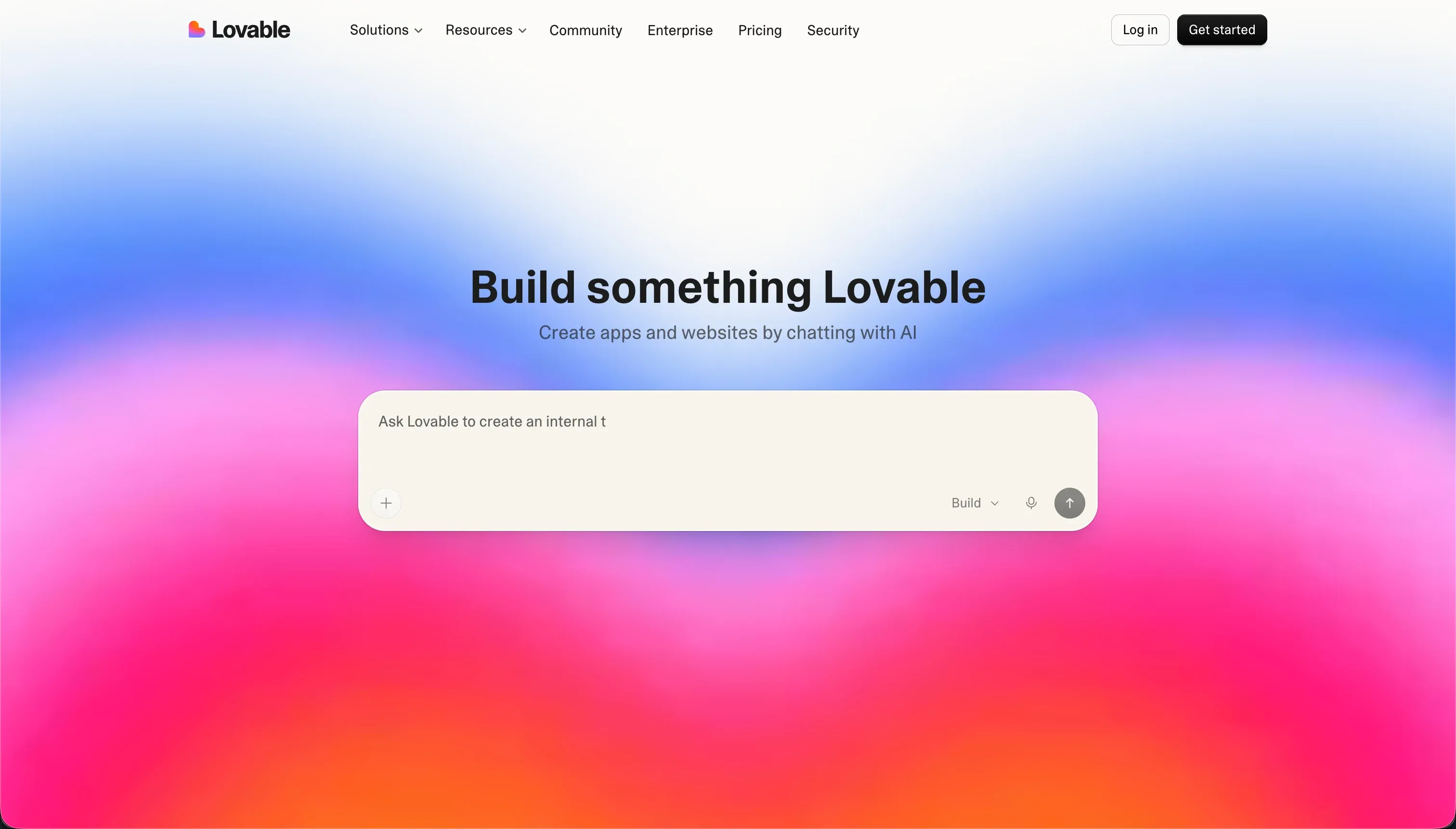
Lovable is an AI-powered full-stack application builder that turns natural language prompts into React frontends, Node.js backends, and Supabase databases. It belongs to the current wave of prompt-first app generators that try to collapse frontend, backend, auth, and deployment into one conversational workflow.
In practice, you describe the app, let Lovable scaffold the stack, and then keep iterating through chat. Its concrete strengths include GitHub sync, Figma import, one-click deployment via Lovable Cloud, built-in Supabase integration for PostgreSQL and auth, and pre-publish security scans that check generated code and Supabase RLS policies.
It is genuinely built for founders and builders who want to get a SaaS MVP or prototype online fast and who may eventually hand the code to developers. It becomes frustrating for non-technical teams once the app needs reliable permissions, stable edit loops, or careful backend control, because user feedback repeatedly points to regression loops, rising credit burn, and messy day-two maintenance.
| Spec | Details |
|---|---|
| Primary Stack | AI-generated React frontend, Node.js backend, and Supabase database |
| Interface | Prompt-first conversational builder with iterative code and layout edits |
| Primary Deployment Target | Lovable Cloud hosted web apps with custom domains on paid plans |
| Key Advantage | Fast full-stack scaffolding with GitHub sync and strong developer portability |
What is Softgen?
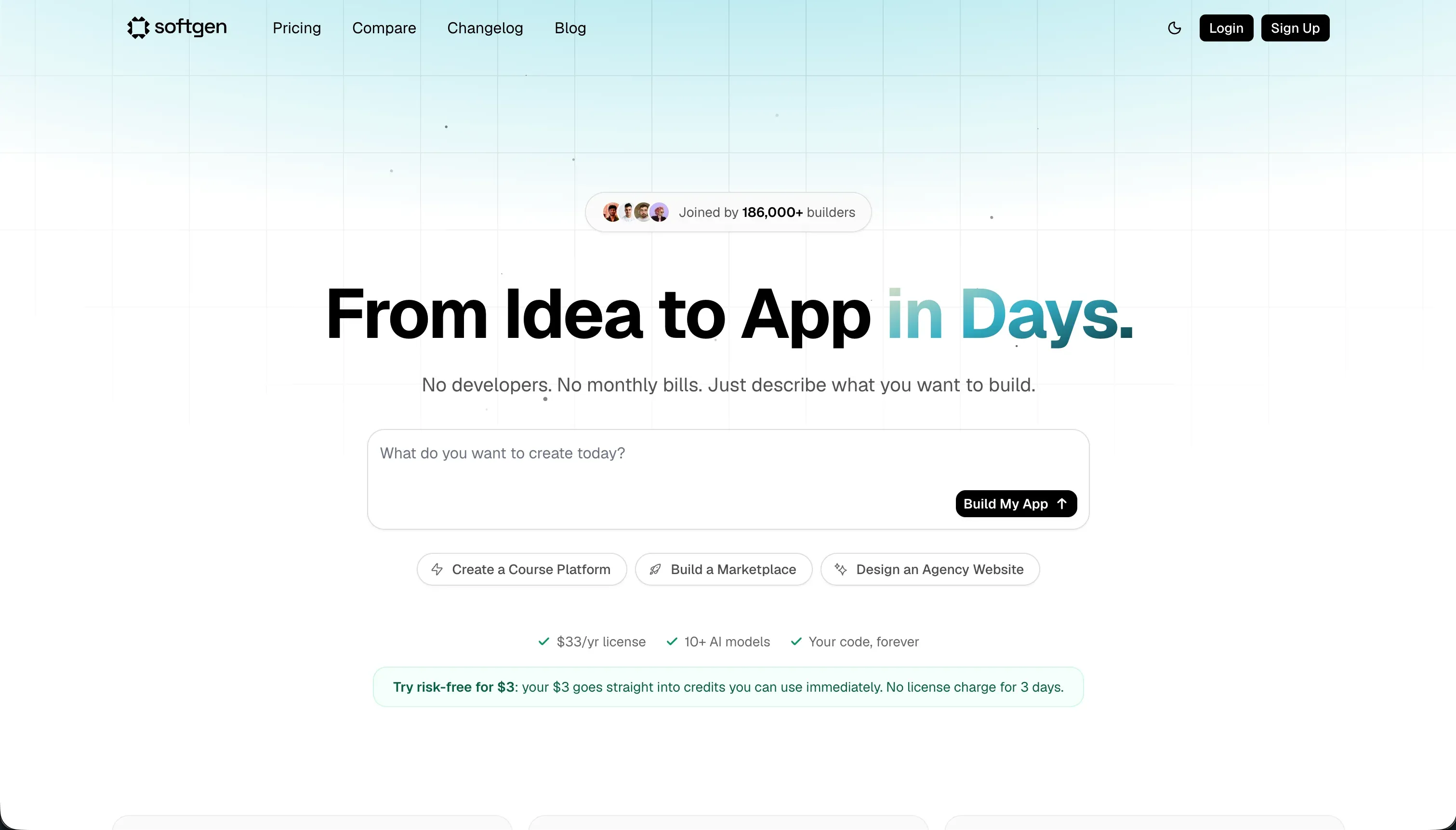
Softgen is a conversational AI application builder that generates web apps and layout structures through a chat-based assistant. It is positioned more as an accessible MVP and launch tool than a full visual platform with deep manual controls.
In practice, Softgen uses its Cascade AI Agent to help outline the app, generate interface structure, create relational database schemas, add user authentication, and support integrations like Stripe. It also includes one-click deployment, custom domain support, interactive visual tweaking through prompts, and code export if you eventually want to leave the platform.
It is genuinely built for creators and indie hackers who want a low base cost and a simple way to test a product idea without signing up for another expensive monthly plan. It becomes frustrating for users who want pixel-level control or repeated visual tweaks, because reviews and analyst summaries describe a customization ceiling, template rigidity, and pay-as-you-go credit burn during prompt loops.
| Spec | Details |
|---|---|
| Primary Stack | Conversational AI-generated web app with database, auth, and hosted deployment |
| Interface | Chat-based builder centered on the Cascade AI Agent |
| Primary Deployment Target | Softgen-hosted web apps with custom domain support |
| Key Advantage | Very low base access cost with pay-as-you-go AI usage |
The Core Difference
The biggest gap here is not raw speed. It is how much structure and portability you get after the first prompt.
- Lovable runs as a more developer-oriented AI scaffolder that pushes you toward a real React and Supabase codebase, with stronger export and GitHub paths but higher maintenance risk.
- Softgen runs as a lighter chat-first app generator with a lower base cost and simpler workflow, but it gives you less customization headroom and fewer signs of deep production readiness.
Head-to-Head Comparison
We evaluated both platforms across four core categories.
1. Developer Experience & Iteration Speed
Lovable is strong in the first build cycle because it can generate a React frontend, Node.js backend, and Supabase setup from a plain-language prompt. Features like context connectors for Linear, Notion, Jira, Confluence, and Miro also help it feel more like a serious AI scaffolding tool than a toy website generator.
The problem is iteration after the shiny first pass. Lovable users repeatedly complain about regression loops, prompts that claim to fix bugs without actually fixing them, and credit burn during repeated debug sessions, with some Reddit reports saying prompts now consume roughly 3 to 4 credits instead of older lower rates.
Softgen is simpler and lighter to start with because its workflow is basically chat, generate, tweak, deploy. The Cascade AI Agent gives users a structured planning flow, and the low $33 annual membership makes the product easy to try without the psychological weight of another $20 to $50 monthly SaaS bill.
But iteration speed slows down when visual details matter. Softgen does not have a drag-and-drop editor, so every meaningful change pushes you back into chat, and multiple reviews note that layout refinement can turn into repetitive prompting loops that burn paid credits without landing exactly where you wanted.
Edge: Softgen for lightweight first-pass simplicity, because its workflow is cheaper and less intimidating if you only need a basic app draft.
2. Code Quality & Portability
Lovable has the clearer code ownership story. It generates readable React and TypeScript, supports GitHub sync, and is explicitly positioned so developers can continue work locally in environments like VS Code or Cursor.
That does not make portability perfect. User reports still question how cleanly the exported code scales, and some builders say the generated code is good enough for fast design work but not something they would want to port directly without cleanup. Still, compared with most prompt-first builders, Lovable is at least trying to leave you with a recognizable codebase.
Softgen does offer code export, which matters because it means you are not fully trapped in a proprietary runtime forever. For indie hackers, that is a meaningful checkbox, especially given the platform’s low base cost and emphasis on quick hosting.
The weaker part is confidence in what you are exporting. The available research says customization beyond the initial AI output sometimes requires manual coding, and analyst summaries frame Softgen as fast to deploy but behind richer builders on flexibility. That suggests the exit path exists, but the exported result may still need real developer cleanup.
Edge: Lovable, because GitHub sync and a more explicit React and TypeScript code path make it the stronger portability play.
3. Database & Backend Capabilities
Lovable’s backend story is more concrete on paper. It has built-in Supabase integration, managed PostgreSQL, instant email and social auth, and can generate backend logic alongside the UI, which gives technical founders a familiar full-stack base to work from.
The catch is that Supabase convenience does not remove Supabase complexity. Lovable’s own weak spots include manual RLS setup, custom triggers, and schema security overhead, plus user complaints about broken database relationships and backend lock-in, including reports that backend migration behavior has been hard to control.
Softgen can generate relational database schemas, authentication, and some standard integrations like Stripe, which is enough for MVPs, directories, and basic SaaS flows. That makes it more capable than a pure landing-page generator and gives non-developers a backend starting point without much setup.
What it does not seem to offer is the same level of backend seriousness or ecosystem maturity around database control. The research points more to template-driven generation and a customization ceiling than to strong backend administration, so for anything beyond a fairly standard app schema, you should expect to hit limits faster.
Edge: Lovable, because Supabase gives it a more credible backend foundation even if that foundation still asks you to think like a developer.
4. Hosting & Deployment Options
Lovable keeps deployment easy. You can push to production through Lovable Cloud, use staging URLs, and add custom domains on paid plans, which is exactly the convenience most MVP builders want when they are trying to ship something this week instead of next month.
The reliability concern is the part that muddies the picture. Community complaints mention preview-to-production discrepancies and broader skepticism that text-to-full-stack output is truly production-ready, so the hosted path is fast but not always reassuring for apps that need to stay stable after launch.
Softgen also wins points for keeping deployment simple. One-click deployment and custom domain support are enough for most makers launching an early SaaS, directory, or client-facing prototype without hiring DevOps help.
The difference is that Softgen feels more modest about what it is trying to host. It gives you a basic path to get a project live, but there is less evidence of deep hosting infrastructure, enterprise controls, or a mature production posture. It feels adequate for launch-day convenience, not like a platform you pick because hosting is its killer differentiator.
Edge: Lovable, because both remove deployment friction, but Lovable has the more developed cloud workflow and staging story.
5. AI Quality & Reliability
Lovable’s AI is ambitious. It can scaffold full-stack apps, make multi-file code changes through conversation, import Figma designs into functional components, and run pre-publish security scans, which is a lot more than basic copy generation or wireframe assistance.
But it also has the harsher documented downside. User complaints describe failure in regression, vague prompt failures, repeated bug-fix loops, and credits disappearing while the agent insists a problem has been fixed. That is the classic risk of relying on AI as the main control surface for both creation and repair.
Softgen’s AI feels narrower and more controlled. The Cascade AI Agent is built around helping you architect, generate, and tweak a standard web app, which can actually be a strength if you want less sprawl and fewer knobs to manage.
The downside is that narrower does not mean more precise. Reviews still flag prompt loops, rigidity in predefined layout modules, and weaker flexibility compared with tools like Bubble, so the AI may feel calmer than Lovable’s but also less capable once you leave the happy path.
Edge: Softgen, because it asks less of its AI and therefore exposes you to fewer spectacular failure modes, even if its ceiling is lower.
6. Learning Curve & Onboarding
Lovable is beginner-friendly in the first hour because the model is obvious: type what you want, get a stack. Its free tier with 5 daily credits, up to 50 per month, also makes it easy to experiment before committing money.
The harder truth is that Lovable’s real learning curve shows up later. Once you hit Supabase rules, prompt specificity, responsive fixes, and bug regressions, the product starts demanding developer judgment. That is why many users describe it as great for the first 70 percent and much rougher for the final 30 percent.
Softgen has the gentler onboarding curve for non-technical makers because its pricing is simple at first glance and the chat workflow stays narrow. Paying $33 per year for access also lowers the fear of making the wrong tool choice, especially for solo builders testing one idea.
Its limitation is that the easy onboarding can conceal a low customization ceiling. Once you need more than the default layout assumptions, Softgen forces you back into prompt-based tweaking without a richer manual editor to fall back on, which can make the simple beginning feel less flexible over time.
Edge: Softgen, because it is easier to approach for casual builders who want a cheap, chat-led start without immediately touching a heavier full-stack mental model.

Pricing Comparison
Lovable:
- Free - $0 with 5 daily credits, up to 50 per month, plus public projects and GitHub sync.
- Pro - starts at 25€/mo with 100 monthly credits, private projects, custom domains, 3 editors, and credit rollover.
- Business - starts at 50€/mo with 100 monthly credits, advanced design templates, SSO integration, data training opt-out, and custom user limits.
- Enterprise - custom pricing with custom messaging limits, dedicated support, audit logs, and custom integrations.
- Pro scaling examples - 200 credits for 50€, 400 for 100€, 800 for 200€, 1,200 for 294€, 2,000 for 480€, and 10,000 for 2,250€.
- Business scaling examples - 200 credits for 100€, 400 for 200€, 800 for 400€, and 10,000 for 4,300€.
Softgen:
- Annual Membership - $33/year for platform access and hosting rights.
- AI Usage Credits - pay-as-you-go credit packages fund generation and updates, with no monthly subscription listed in the research.
Use Case Fit: When to use which?
When to choose Lovable
- Choose Lovable when you want a fast SaaS MVP with a recognizable React and Supabase stack behind it.
- Choose Lovable when GitHub sync and partial code ownership matter more than predictable iteration costs.
- Choose Lovable when you have enough technical skill to audit prompts, clean up exported code, and handle backend security details.
When to choose Softgen
- Choose Softgen when you want the cheapest low-commitment way to generate and host a simple web app.
- Choose Softgen when your project fits standard app patterns like MVPs, directories, or lightweight SaaS layouts.
- Choose Softgen when you care more about quick idea testing than maximum flexibility, backend depth, or long-term maintainability.
When neither Lovable nor Softgen is the right fit
For internal tools and client portals
This is the use case where both Lovable and Softgen start showing the same structural weakness: too much depends on prompts. Internal tools, CRMs, partner dashboards, and client portals usually need stable auth, role-based visibility, row-level restrictions, and safe editing after launch. That is exactly where Softr is the stronger fit, because it starts with Softr Databases, built-in auth, visual user groups, row-level permissions, workflows, and hosting in one system.
The bigger difference is day-two maintainability. With Softr, AI is the fast path, not the only path, so a business team can co-build with AI and then keep editing visually without reopening credit-burning prompt loops. If your app is going to be used by real employees, clients, vendors, or partners, that is a much safer operating model than trusting generated code and chat-based fixes.
For native mobile apps
Neither Lovable nor Softgen is the right pick if the brief includes real iOS or Android distribution. They are both fundamentally web app builders, so while you can make mobile-friendly experiences, that is not the same thing as shipping app-store-ready native binaries.
If native mobile is the requirement, start with FlutterFlow or possibly Adalo depending on how much control you need. FlutterFlow is the more serious choice for app-store publishing and mobile-first product design, while Adalo is easier if you want a simpler no-code route and can accept its own ceiling.
For professional developer environments
If you actually want a real coding environment with terminal access, file-level control, direct debugging, and architecture choices that are not filtered through a productized AI builder, both tools will feel constraining. Lovable gives you more code than Softgen, but it is still a managed AI scaffolding workflow. Softgen is even further from a full developer environment.
That is where Cursor or Replit make more sense. Cursor is better if you already work in a local development setup and want serious AI assistance inside a proper IDE, while Replit is better if you want an in-browser developer environment with actual files, runtimes, and deployment workflows rather than a chat-first app generator.
Verdict
Pick Lovable if your main goal is to generate a serious-looking SaaS MVP fast and keep a clearer path into GitHub, React, and Supabase. The tradeoff is that you are accepting more backend overhead, more reported regression pain, and a pricing model where debugging can quietly turn into a credit problem.
Pick Softgen if you want the cheapest way to spin up and host a simple app concept with minimal commitment. The tradeoff is that you are accepting a lower customization ceiling, less evidence of production depth, and a workflow that still falls back to prompt loops whenever the generated result is not quite right.
The day-two reality is that both tools are still mostly asking you to manage software through AI conversation. That can work for prototypes, but it ages badly for operational apps with real users and real permissions. For internal tools, CRMs, and client portals, Softr is the better long-term answer because it gives you AI speed on top of stable no-code infrastructure instead of replacing the whole editing model with prompts.

Summary Comparison Table
| Criterion | Lovable | Softgen |
|---|---|---|
| Best for | Fast SaaS MVPs with a developer handoff path | Cheap MVPs and lightweight app experiments |
| Build paradigm | Full-stack AI scaffolding for React, Node.js, and Supabase | Conversational app generation through a chat assistant |
| Database | Supabase PostgreSQL with auth and RLS setup | AI-generated relational schema with lighter backend depth |
| Pricing model | Monthly subscription plus credit tiers | $33 yearly access plus pay-as-you-go credits |
| Code export | Stronger, with GitHub sync and readable React and TypeScript | Available, but less confidence around depth and cleanup quality |
| Maintenance burden | High once prompt loops and backend issues appear | Moderate for simple apps, but rises fast with customization needs |
| Visual control | Limited fine-tuning without code or more prompts | Constrained by template modules and chat-only edits |