What is Zite?
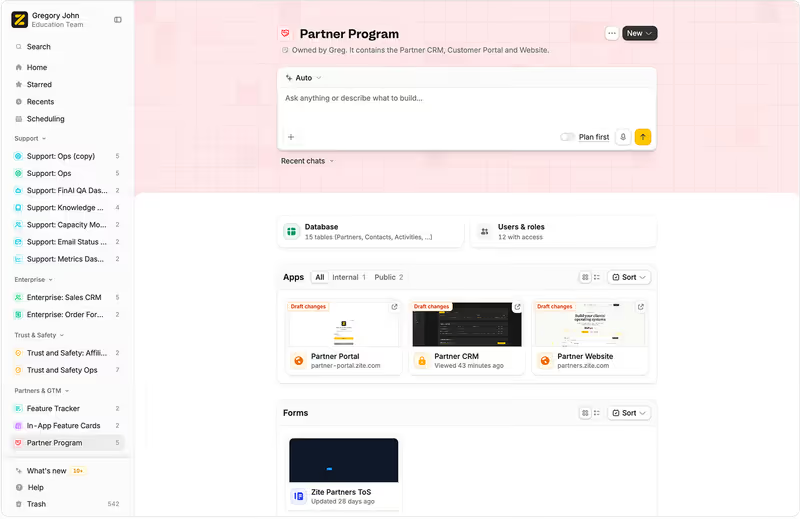
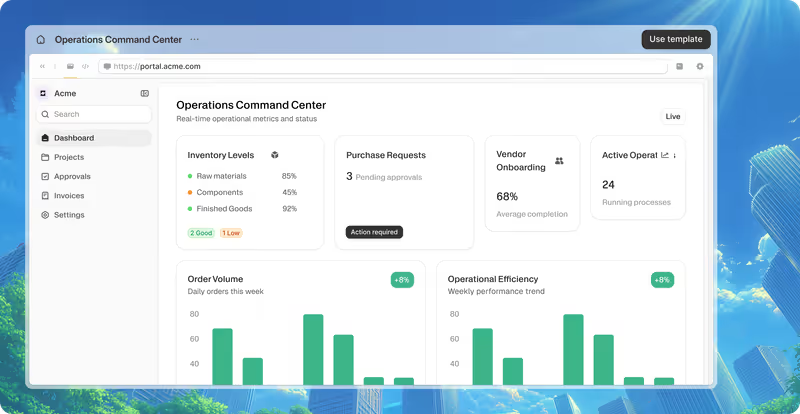
Zite, developed by the team behind the Fillout form builder, is an AI-first no-code application creator designed to construct web portals, databases, and internal workflows. By entering text prompts, users can generate styled frontends, configure relational SQL database schemas, and establish multi-step automation scripts in a single dashboard.
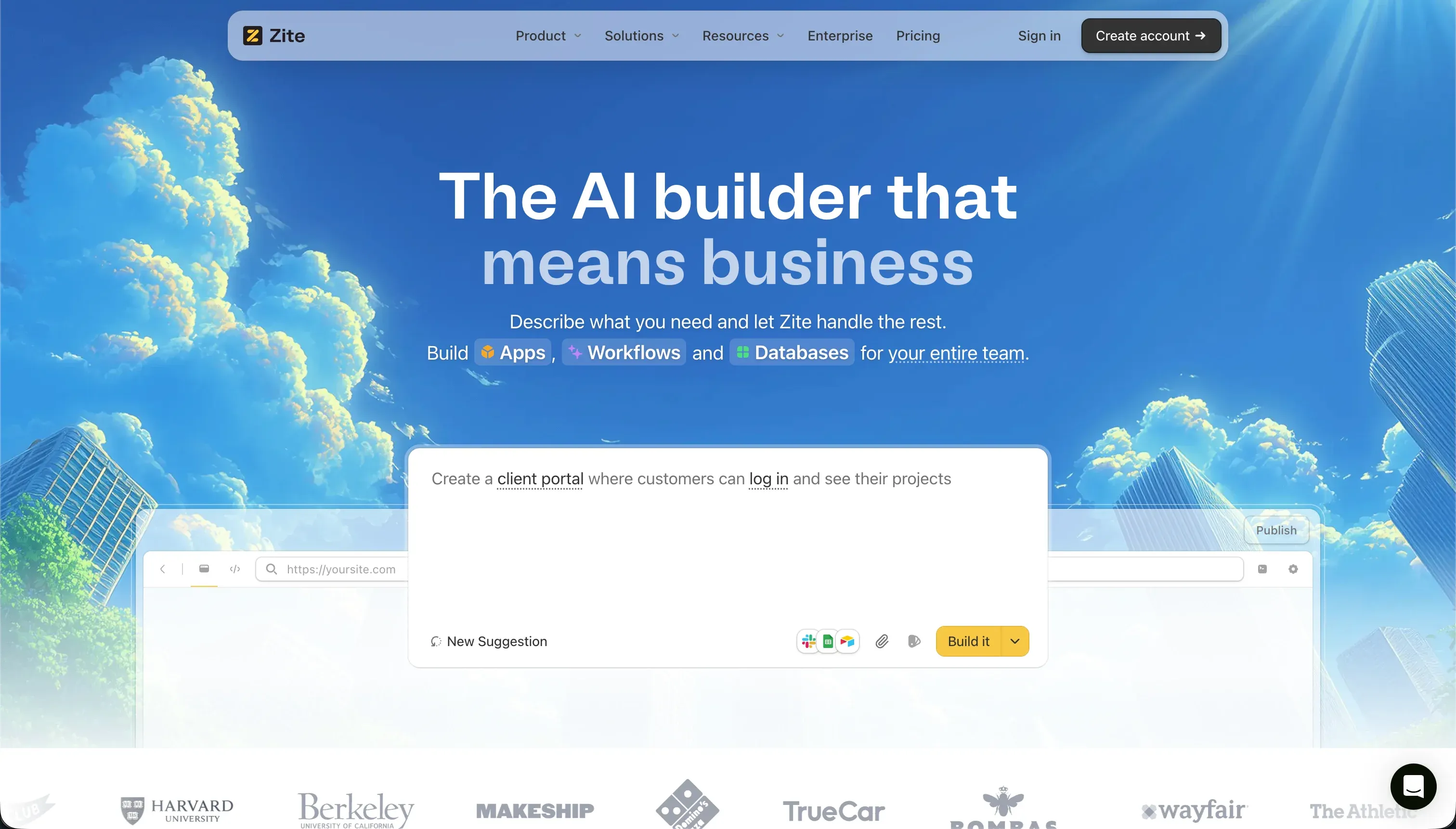 Zite product snapshot
The platform combines conversational generation with a spreadsheet-like database interface. It stands out in the B2B space by offering unlimited active users on all plans, bypassing typical per-seat licensing fees.
What types of applications can you build with Zite?
Zite targets business workflow applications, such as:
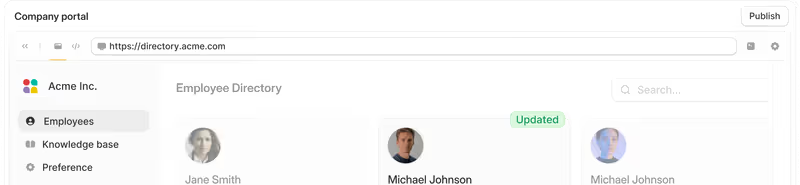
- Interactive Client Portals: Build onboarding tracks, file collection points, and payment routes.
- Internal CRM Dashboards: Create tables to track leads, schedule tasks, and assign roles.
- Complex Multi-Step Forms: Design multi-language surveys, quote calculators, and application steps.
However, because the layout engine is built on rigid component assumptions, creating highly customized designs or complex mobile app store apps is difficult.
Where Zite genuinely shines
Zite’s main benefit is its “Plan Mode.” Before the AI executes code edits, it provides a markdown outline of the changes, which helps builders catch obvious mistakes before the app is rebuilt around the wrong idea.
Its connection to Fillout gives it solid form capabilities, including validations and multi-language support. The unlimited user seat model is also genuinely useful for teams that want to share a tool broadly without paying per user.
That said, the sweet spot is narrower than the marketing suggests. Zite is strongest for small personal projects, event sites, calculators, and lightweight internal tools where the app stays close to a simple template and does not need deep customization.

The engineering overhead & setup complexity
While Zite is visually oriented, running it in production exposes layout and data limits:
- Visual rigidity: You are restricted to Zite’s generated designs. If you need custom styling grids or precise padding offsets, the conversational editor can struggle, forcing you into prompting loops.
- Database Functionality Gaps: The built-in SQL database is simple to edit, but lacks advanced features like formula columns, database views, and complex roll-ups.
- Vendor Database Lock-in: Because it is a proprietary SaaS platform with no code export, you are locked into Zite’s environment. Leaving requires rebuilding your app logic elsewhere.
- Corporate default style: Some users find the generated writing and design to lean corporate, which can be a mismatch for agencies or brand-heavy projects.
- Workflow bloat: Zite turns almost every action into a workflow behind the scenes, so generating a simple CRM from a couple of prompts can create dozens of separate workflows. The workspace gets cluttered fast and larger apps become hard to navigate and maintain.
The pricing gotchas & token/credit model
Zite’s pricing scales based on data volume and credit packs:
- Rapid Credit Depletion: Iterating on design systems consumes credits quickly. Multiple paid subscribers have reported exhausting their entire monthly credit pool in a single day of active visual editing.
- No rollover support: Chat mode and Plan Mode prompts consume credits from your pool, and unused credits do not roll over to the next month.
- Workflow runs are the hidden meter: Zite advertises “unlimited users” and lists generous workflow quotas (5,000/mo on Pro), but standard CRUD actions - including every database read when a page loads or reloads - count as workflow executions. A few active users browsing dashboards or directories can burn through the Pro quota in days, and there are no clear self-serve add-ons once you hit the cap, so you are pushed into a custom Enterprise plan.
- Undisclosed Business-plan gates: Customizing the login screen and setting recurring schedule triggers both require the Business plan ($55/month billed annually), and neither limit is flagged on the pricing page, so Pro subscribers only discover it after they try.
- Credit Scaling Tiers: While the Pro plan starts at $19/month, scaling credits to 19,200 monthly credits increases the plan price to $3,769/month, which represents a high cost for growing teams.
- Credit burn can blur the real price: The base subscription looks affordable, but active use can make the true monthly cost feel much higher than the sticker price.
Public Sentiment & Community Consensus
Discussions across no-code forums and Reddit reveal the following:
- Praise for Unlimited Users: Businesses value the ability to share apps with large teams without facing per-user seat bills.
- Friction with Chat Limits: Users express frustration when debugging loops exhaust their monthly credits quickly.
- Validation Gaps: Builders warn that while Zite is excellent for validating an MVP, the database is not mature enough to support complex enterprise-level operations.
- Best as a narrow builder: Community feedback suggests Zite is easiest to like when the project is small, bounded, and not expected to evolve into a deeply customized business system.
For teams looking to build secure client portals, CRM dashboards, or partner networks, managing custom AI prompts can be high-overhead. If you need an app that holds up in production, Softr is usually the more practical route. Softr’s AI Co-Builder generates complete apps from a prompt - database, pages, permissions, and navigation included - and the result is production-ready software with built-in auth and user groups, not generated code you’ll need to debug later. It comes with its own native database and also connects to 17+ external sources if you’re already working with Airtable, Google Sheets, or other tools. Every AI action can also be done manually, so you’re never blocked by credit limits.
Zite is better read as a fast idea-to-app tool than a forever platform. That makes it a decent fit for a personal project or a narrow use case, but the limits around customization, export, and iteration cost show up fast once the app needs to behave like real business software.

Verdict: Who is it actually for?
Best for: SMB owners, solopreneurs, and operations teams who want to rapidly build simple internal portals and databases and can accept a managed, credit-based platform.
Not for: Teams building highly custom B2B portals with precise design requirements, or builders who want full code ownership, predictable usage costs, and an easy migration path later.