

Base44 and Zite sit in the same broad category of AI app builders, but they come from different instincts. Base44 feels closer to AI scaffolding for web apps with a managed stack behind the scenes, while Zite leans more toward AI-first no-code software with a built-in database and workflow layer. Both promise fast app creation from prompts, both hide a lot of infrastructure, and both can get expensive once iteration starts. The real choice is not just speed, but what kind of maintenance burden you are signing up for.
The people actually deciding between these two are usually founders, ops teams, and product-minded builders who want software without spinning up a full engineering project. What is at stake is pretty simple: how much you will spend in credits, how trapped you will be if the app matters later, and how painful edits become after the first impressive demo. If you are only testing an idea, either can look good on day one. If you need a system you will still trust in six months, the differences get sharper fast.
Meet the Contenders
What is Base44?
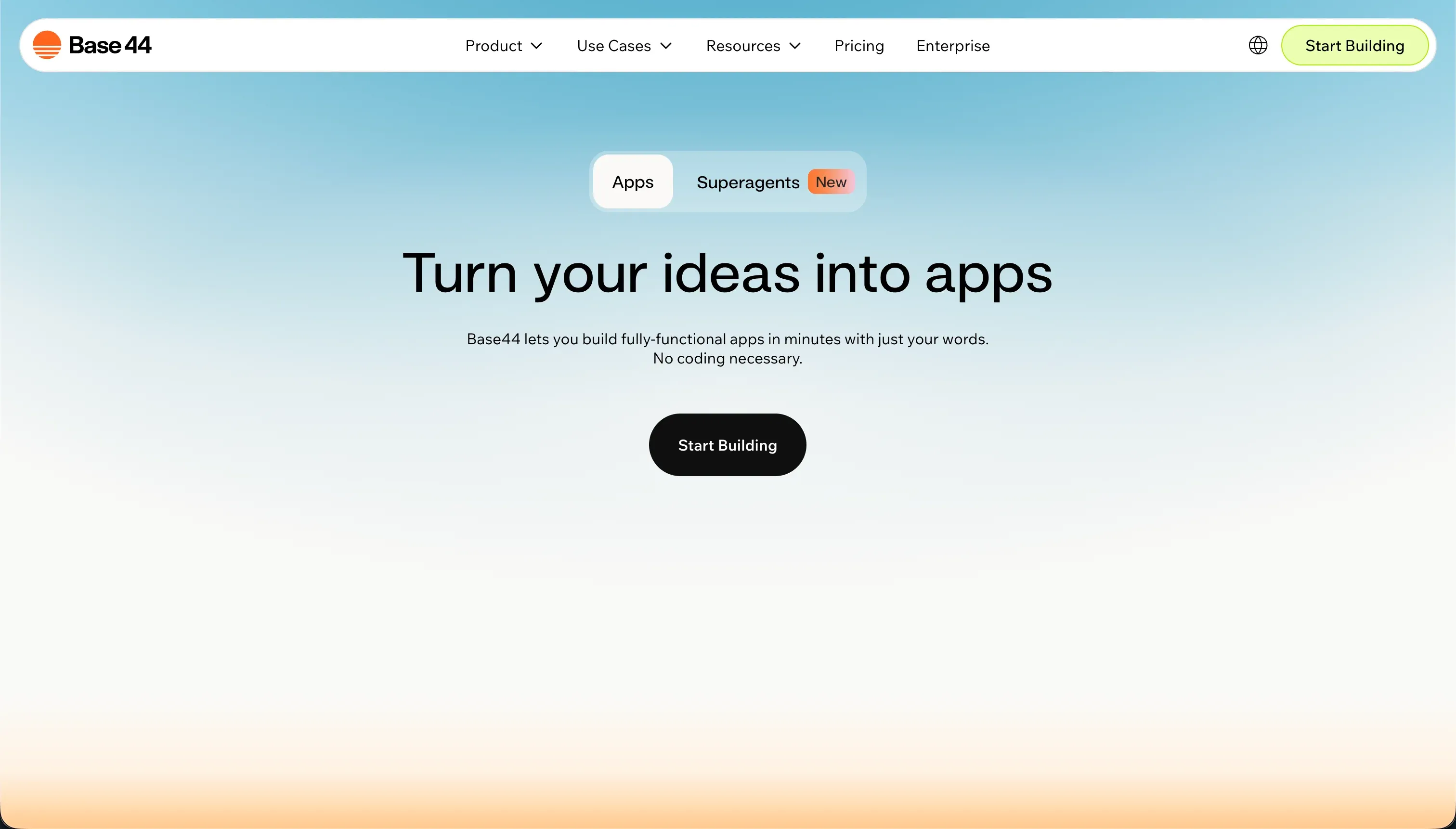
Base44 is an AI-powered all-in-one builder that generates full-stack web applications from conversational prompts. The pitch is straightforward: describe the app in plain English and let Base44 assemble the UI, database, auth, and hosting without making you touch setup work.
In practice, it combines AI-powered full-stack generation with a visual post-generation editor, Discuss Mode for planning without consuming message credits, and GitHub integration for frontend export on higher plans. It provisions a managed PostgreSQL database, ships built-in authentication, and deploys directly on Base44 cloud, but the backend stays hosted and controlled inside Base44’s own infrastructure.
It is genuinely built for people who want quick web app scaffolds and are willing to let the platform make most of the structural decisions. It gets frustrating for builders who need stable iteration, custom-branded auth flows, deeper backend control, or predictable costs once debugging starts, because user reports repeatedly mention regression loops, downtime, and credits disappearing while fixes create new bugs.
| Spec | Details |
|---|---|
| Primary Stack | Managed PostgreSQL, hosted backend, web app frontend with GitHub export for the frontend |
| Interface | Conversational AI builder, Discuss Mode, and click-to-tweak visual editor |
| Primary Deployment Target | Base44 cloud hosting, with GitHub sync on Builder and above |
| Key Advantage | Very fast full-stack scaffolding with almost zero initial setup |
What is Zite?

Zite is an AI-first no-code application builder, formerly Fillout, that turns natural-language prompts into business apps, portals, databases, and workflows. It sits closer to the no-code end of the spectrum than Base44, even though the creation flow is still heavily prompt-led.
In practice, Zite combines prompt-to-app generation with Plan Mode, selective AI editing in chat, a built-in SQL-style database, visual workflows, and mature form functionality inherited from Fillout. It also stands out for unlimited users on all plans, which is unusual at its price point, but credit usage still governs how much active building and refinement you can do each month.
It is genuinely built for SMB teams, ops users, and solo builders who want a lighter-weight path to internal tools or portals without thinking like frontend developers. It starts to frustrate builders who care about code ownership, advanced database depth, or highly custom layouts, because there is no GitHub sync, no code export, and several users describe the output as rigid, corporate-looking, and not fully ready for larger-scale apps.
| Spec | Details |
|---|---|
| Primary Stack | Built-in SQL-style Zite Database, workflows, and hosted no-code app layer |
| Interface | Prompt-to-app builder with Plan Mode, chat editing, and visual workflow tools |
| Primary Deployment Target | Hosted Zite apps with staging environments and custom domains on paid plans |
| Key Advantage | Unlimited users plus strong forms DNA from Fillout |
The Core Difference
The biggest difference is not feature count. It is the type of lock-in you are accepting: Base44 leans toward AI-generated app scaffolding with partial code escape hatches, while Zite leans toward an AI-first no-code system with fewer developer handoff options.
- Base44 runs like a conversational full-stack generator that can hand you frontend code, but keeps the backend, database, and most real control inside its own managed environment.
- Zite runs like a prompt-first no-code app builder with a friendlier business-software surface, but it keeps you inside its own platform because there is no GitHub sync or code export path.

Head-to-Head Comparison
We evaluated both platforms across four core categories.
1. Developer Experience & Iteration Speed
Base44 is very good at the first 30 minutes. You can describe an app in plain English, get UI, auth, database, and hosting provisioned quickly, then use the visual post-generation editor to tweak layout, text, spacing, and colors without opening a full codebase.
The problem is what happens after the first scaffold. Multiple user reports describe regression loops where fixes create new bugs, weekly builder instability, and hundreds of credits burned trying to recover a working state. That makes iteration feel fast at first and strangely expensive later, especially when message credits top out at 100 on Starter, 250 on Builder, and 500 on Pro.
Zite feels steadier for non-technical iteration because it includes Plan Mode, which lets you review a markdown plan before the AI executes changes. That is a meaningful guardrail when compared with raw prompt-and-pray editing, and its no-code orientation is usually easier for ops users than a more app-scaffolding-centric product.
But Zite still lives inside prompting loops more than its marketing suggests. Chat, planning, and refinement all pull from the same credit pool, and Reddit feedback repeatedly says credits disappear quickly during active building. So while the editing experience is more controlled than Base44’s, it is still not truly cheap or frictionless once the app grows.
Edge: Zite, because Plan Mode gives builders more control over changes before they execute and reduces some of the chaotic iteration Base44 users complain about.
2. Code Quality & Portability
Base44 has a real advantage here compared with many AI-first builders because it offers GitHub integration and frontend code export on the Builder plan and above. If you are a founder who wants to get a React frontend out of the platform later, that is at least a partial exit path.
The catch is that it is only a partial one. Product Hunt and community feedback consistently note that the database and backend stay trapped in Base44’s closed infrastructure, so you are not getting full-stack portability. That means you can own part of the app, but not the whole thing that actually makes the product work.
Zite is weaker on portability. There is no GitHub sync path and no code export, which means handoff to a developer later is more like rebuilding than migrating. For teams that care about long-term ownership, that is a serious structural downside, not a minor missing feature.
The flip side is that some buyers may not care. If your goal is to stay fully inside a hosted no-code platform and move fast on a narrow internal app, code export might be irrelevant. But if the app becomes revenue-critical, Zite gives you less leverage than Base44 when it is time to leave.
Edge: Base44, because partial frontend export is still materially better than Zite’s no-export, no-GitHub position.
3. Database & Backend Capabilities
Base44 includes a managed PostgreSQL database and bundled backend functions, which sounds attractive because it removes setup. For simple CRUD apps, that can be enough, and having auth, database, file storage, and email in one environment is genuinely convenient.
Still, the control story is weak. Backend logic is hosted and managed by Base44, cannot be directly exported, and user feedback suggests the platform is not especially comfortable for SaaS-ready patterns like workspace isolation or more advanced multi-user architecture. You get convenience, but not much confidence once data structure complexity rises.
Zite’s built-in database is more accessible for non-technical teams because it behaves like a spreadsheet-backed SQL layer with linked records, bulk operations, undo history, and REST API or webhook support. For straightforward business apps, that is often a more understandable mental model than asking an AI to keep reshaping backend logic correctly.
That said, Zite’s database is not deep by no-code standards. The research specifically flags missing advanced formula fields, complex rollups, and native SQL custom views, so it can run out of headroom faster than teams expect. It is easier to grasp than Base44’s backend, but not obviously stronger for complex relational work.
Edge: Zite, because its database model is clearer and more directly usable for non-technical builders, even if it still has important depth limitations.
4. Hosting & Deployment Options
Base44 wins points for simplicity: apps deploy directly on Base44 cloud and live previews are immediate. For quick stakeholder reviews or MVP demos, not having to configure deployment at all is a real productivity gain.
But reliability concerns muddy that advantage. Reddit users describe server and builder downtime happening almost weekly, plus cases where production apps became unstable after updates. Easy hosting is only a strength if the host feels dependable, and Base44’s public sentiment on that front is rough.
Zite also removes hosting friction by bundling the app, database, and staging environments into one platform. That makes it attractive for teams that want a managed path and do not want to stitch together external infra just to launch an internal workflow app.
The difference is that Zite’s weakness here is less about public outage complaints and more about ceiling. It works well for lightweight portals, calculators, and narrower builds, but user commentary suggests it is not fully there for scaling yet. So hosting is easy, but not necessarily future-proof.
Edge: Zite, because both are hosted and easy to launch, but Base44’s documented instability makes its convenience feel riskier.
5. AI Quality & Reliability
Base44’s AI can be impressively productive when the task fits its happy path. Discuss Mode is useful for brainstorming architecture or user flows without consuming message credits, and the initial generation often looks polished enough to create the illusion that most of the work is done.
The reliability record is the problem. Community feedback is blunt: false positives, destructive edits, and fixes that create 10 new issues are recurring themes. When the AI is wrong, you are not just losing time, you are burning message credits and sometimes destabilizing a working app.
Zite appears more disciplined in how it frames AI changes because Plan Mode lets you inspect proposed edits before execution. That alone makes its AI feel less reckless than Base44’s, and the product inherits a more structured business-tool temperament from Fillout rather than trying to cosplay as a full autonomous dev team.
Still, Zite is not free from AI fatigue. Planning, chat, and refinement all consume credits, and users report that active iteration drains those credits quickly. The result is more controlled AI, not dramatically cheaper AI, and certainly not AI you can lean on forever without watching the meter.
Edge: Zite, because its planning guardrails make the AI feel safer than Base44’s more error-prone edit loop.
6. Learning Curve & Onboarding
Base44 is approachable in the sense that you can start with almost no setup knowledge. The all-in-one environment, template library, and prompt-led generation lower the barrier for founders who do not want to think about databases, auth flows, or hosting on day one.
But that easy start can be misleading. Once the generated app misbehaves, you still need to reason about product structure, workflows, and debugging, except now you are doing it through a conversational layer that may or may not cooperate. So the learning curve is low at entry and steep later.
Zite is usually easier to learn for a true no-code audience. The spreadsheet-like database, familiar form-builder roots, and more explicit workflow and planning tools make it feel less like you are negotiating with a black box and more like you are configuring an app.
It still has a ceiling, though. Layout customization can be rigid, database depth is limited, and the more you push past stock patterns the more you get pulled back into prompting and credit consumption. Easier onboarding does not remove the need to understand how the product wants apps to be built.
Edge: Zite, because its no-code framing and Plan Mode make onboarding less deceptive for non-technical builders than Base44’s fast-but-chaotic learning curve.

Pricing Comparison
Base44:
- Free - $0 with 25 message credits per month, capped at 5 per day, plus 100 integration credits.
- Starter - $16/mo annually or $20/mo monthly with 100 message credits and 2,000 integration credits.
- Builder - $40/mo annually or $50/mo monthly with 250 message credits and 10,000 integration credits.
- Pro - $80/mo annually or $100/mo monthly with 500 message credits and 20,000 integration credits.
- Elite - $160/mo annually or $200/mo monthly with 1,200 message credits and 50,000 integration credits.
Zite:
- Free - $0 with 50 monthly credits, 5,000 DB records, 1,000 workflows per month, unlimited users, and unlimited apps.
- Pro - $15/mo annually or $19/mo monthly with 100 credits, with higher credit tiers from $39/mo for 200 credits up to $3,769/mo for 19,200 credits.
- Business - $55/mo annually or $69/mo monthly with 200 credits, with higher credit tiers from $119/mo for 800 credits up to $3,799/mo for 19,200 credits.
- Team / Enterprise - custom pricing with higher usage caps, priority support, and advanced security.
Use Case Fit: When to use which?
When to choose Base44
- Choose Base44 when you want the fastest possible full-stack web scaffold and value frontend GitHub export more than backend control.
- Choose Base44 when you are validating an MVP or internal concept quickly and can tolerate a rougher editing experience.
- Choose Base44 when your team is comfortable accepting proprietary backend lock-in in exchange for zero setup.
When to choose Zite
- Choose Zite when you want a more no-code-oriented builder with unlimited users and stronger form capabilities out of the box.
- Choose Zite when your app fits a narrower internal portal, workflow, or lightweight business app pattern and you want easier onboarding.
- Choose Zite when reviewing AI plans before execution matters more to you than partial code portability.
When neither Base44 nor Zite is the right fit
For internal tools and client portals
If the thing you are actually building is operational software for a team, a client portal, a vendor dashboard, or a custom CRM, neither Base44 nor Zite is the clean answer. They both lean heavily on prompt-driven iteration, which means the maintenance burden keeps coming back the moment permissions, workflows, and user-specific visibility get messy.
That is where Softr is the more pragmatic choice. Softr’s AI Co-Builder can generate the app, but it is not AI-only: you can switch to visual editing for pages, blocks, permissions, and workflows without re-prompting. More importantly, it gives you built-in auth, granular user groups, row-level data restrictions, and a native database in Softr Databases first, with 17 external data sources after that, which is exactly what business apps need on day two.
For native mobile apps
Neither Base44 nor Zite is the right pick if your real requirement is publishing native apps to the Apple App Store or Google Play Store. Both are fundamentally web-focused builders, and neither is positioned as a serious native mobile pipeline.
If app store distribution is central, look at FlutterFlow or even Adalo depending on how much flexibility you need. FlutterFlow is the stronger option for teams that want native mobile depth and a more mobile-first development model, while Adalo fits simpler app concepts with less engineering ambition.
For professional developer environments
If you are a real developer team and what you actually want is AI assistance inside a proper coding environment, both Base44 and Zite can feel too closed. One gives you only partial export and managed backend lock-in, and the other gives you no code export at all.
That is the point where Cursor or Replit make more sense. Cursor is better if you want AI embedded in a serious local-code workflow, while Replit is stronger if you want a browser-based developer environment with more direct control than either of these prompt-first app builders.

Verdict
Pick Base44 if your priority is generating a web app quickly and keeping at least some route to frontend ownership through GitHub. The tradeoff is that you are accepting a shakier day-two story: dual credits, backend lock-in, user-reported regression loops, and a platform reputation that is much better at scaffolding than at calm maintenance.
Pick Zite if you want the more approachable product for no-code business software, especially if unlimited users and mature form-building matter. The tradeoff is that you are giving up even more portability, and you are still living inside an AI credit economy where planning, chat, and refinement all consume budget as the app evolves.
The broader problem is that neither tool really solves the maintenance reality of business apps once permissions, data rules, and external users become central. That is where Softr tends to age better for internal tools and client portals: build with AI for speed, then maintain visually without re-prompting, on top of stable infrastructure instead of constantly renegotiating with generated app logic.
Summary Comparison Table
| Criterion | Base44 | Zite |
|---|---|---|
| Best for | Fast web MVP scaffolding with partial frontend export | Lightweight no-code business apps with unlimited users |
| Build paradigm | Conversational full-stack AI builder | Prompt-first no-code builder with planning layer |
| Pricing model | Monthly plan plus message and integration credits | Monthly plan plus AI credits and top-up scaling tiers |
| Code export | Frontend export via GitHub on Builder and above | No code export or GitHub sync |
| Database approach | Managed PostgreSQL inside Base44 | Built-in SQL-style Zite Database |
| Reliability risk | Higher, based on repeated user reports of regressions and outages | Moderate, with more concern about scaling and rigidity than outages |
| Maintenance burden | High once prompt fixes start looping | Medium to high as credits and platform limits accumulate |