

Comparing Mocha and Zite is almost redundant now. Both were AI-first app builders that shared the same basic architecture - conversational generation, built-in database, credit-based metering, zero-configuration hosting. They were competing directly for the same users: founders and small teams who wanted to skip engineering but still build functional software.
One is shutting down. Mocha announced its closure on May 15, 2026, with the platform going offline on August 1, 2026. The team cited high user acquisition costs, expensive AI token unit economics, and capital demands. If you have anything on Mocha, export it now.
Zite remains live - but it’s worth being clear-eyed about where Zite lands after the hype, because the credit-burn complaints that plagued Mocha apply to Zite as well.
Meet the Contenders
What is Mocha?
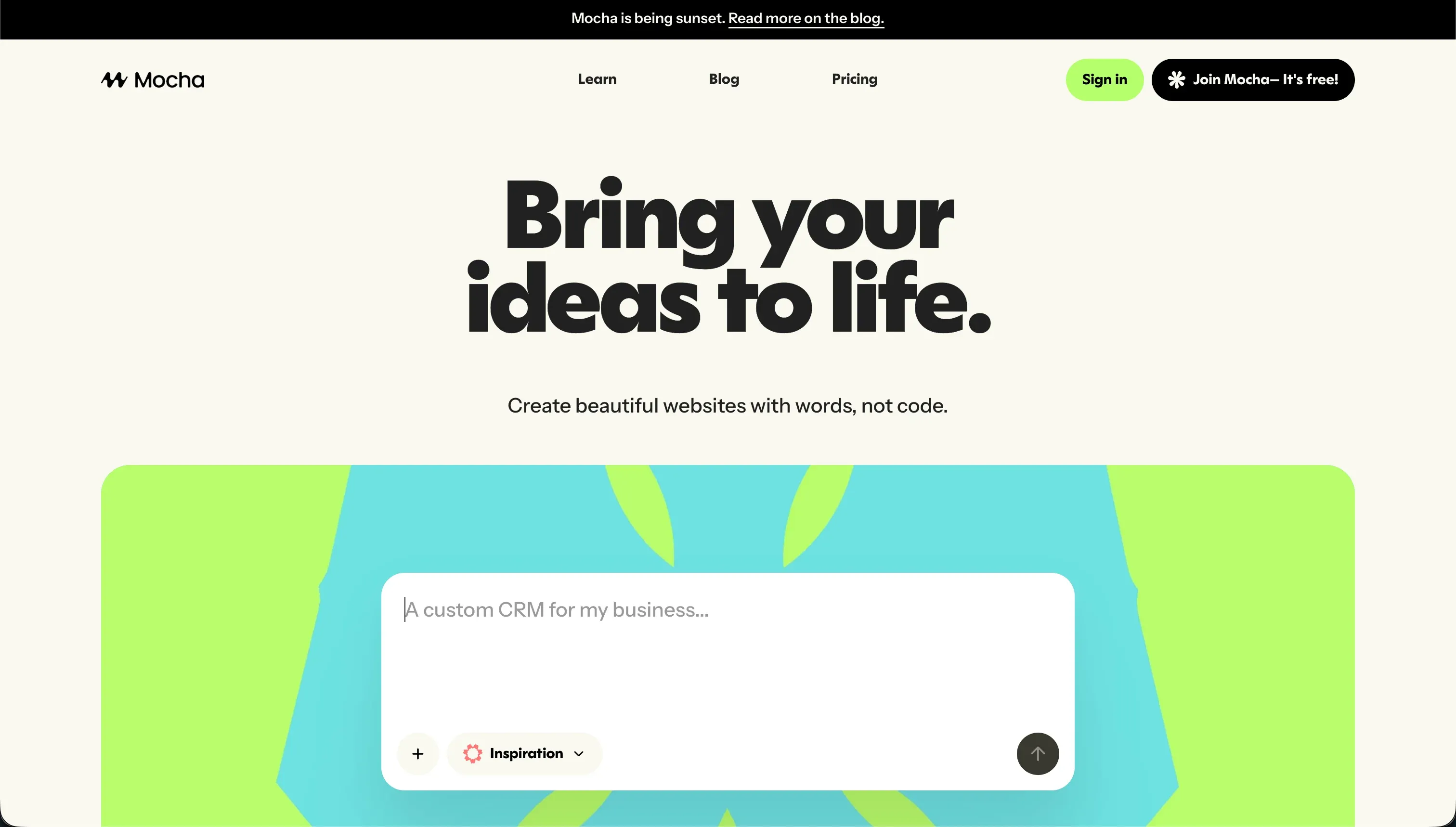
Mocha (formerly Srcbook) was an AI-powered web app builder that converted plain-text descriptions into deployable applications. Each app included a pre-configured SQLite database, Google Sign-in authentication, and managed hosting - all without any setup. You described the app, and Mocha built it.
The platform supported full code export, custom domains on paid plans, and automated bug resolution where the AI detected and attempted to fix compilation errors. It was aimed at startup founders testing product ideas quickly.
| Spec | Details |
|---|---|
| Primary Stack | React, SQLite, built-in auth |
| Interface | Natural language chat + visual preview |
| Primary Deployment Target | Mocha-managed hosting |
| Key Advantage | Complete zero-configuration app stack |
Note: Mocha is shutting down on August 1, 2026. Export all projects and data before that date.
What is Zite?

Zite (formerly Fillout) is an AI-first no-code app builder that generates web applications, internal portals, and databases from plain-language prompts. It includes a built-in SQL database, visual workflow automation, user role management, and unlimited users on all plans. Its Plan Mode lets you review proposed changes before the AI executes them - a feature designed to reduce wasted credits during debugging.
Zite inherited its form-building roots from Fillout, giving it solid multi-step form and data validation capabilities.
| Spec | Details |
|---|---|
| Primary Stack | Built-in SQL database + visual builder |
| Interface | AI chat (Plan Mode + Chat Mode) + visual editor |
| Primary Deployment Target | Zite-managed hosting with custom domains |
| Key Advantage | Unlimited users on all plans + Plan Mode guardrails |
The Core Difference
Mocha and Zite used very similar approaches. Both relied on conversational AI to generate and modify apps. Both included a managed database and hosting in the package. Both charged for usage via credits.
The meaningful differences were in what happened after the initial generation.
Mocha had no guardrails. If the AI built something wrong or you needed a change, you prompted again - and the AI could enter debug loops that burned credits without productive output. There was no way to review proposed changes before they ran.
Zite added Plan Mode: the AI shows you a markdown plan of what it intends to do before executing. You can edit that plan, reject parts of it, or confirm. This significantly reduces wasted credits on unwanted changes and gives you more control over the iteration loop.
Zite also has a more capable database - a relational SQL system with linked records and REST API support, compared to Mocha’s SQLite. And Zite’s unlimited user model means you’re not paying per seat as your app grows.
The result: Zite was the more mature version of the same product category. Mocha ran out of runway before it could get there.

Head-to-Head Comparison
1. Developer Experience & Iteration Speed
Both tools offered fast initial generation - working apps in minutes from a description. The iteration experience diverged after that.
Mocha’s AI iteration was straightforward but risky. Prompting changes could trigger regression loops where the AI burned through credits while cycling through fixes that didn’t resolve the root issue. Users reported debugging sessions consuming hundreds of credits in an afternoon. There was no preview step before changes ran.
Zite’s Plan Mode addresses this directly. Before the AI modifies your app, it presents a structured markdown plan of proposed changes. You review it, adjust it, or reject parts you don’t want. This makes iteration more deliberate and reduces surprise credit consumption. In Chat Mode, you can target specific components for changes without triggering full app regeneration.
The tradeoff is that Zite’s Plan Mode adds friction to quick changes. If you know exactly what you want, reviewing a plan before every edit feels slow. For complex edits where you’re not certain the AI understands the intent, it’s worth the overhead.
2. Code Quality & Portability
Mocha supported full code export at any time - React and backend source code that you could run anywhere. The AI-generated code was functional but might not be consistent across a large project.
Zite’s portability is less clear-cut. The platform doesn’t advertise clean code export in the way Mocha did. Your data is accessible via REST API and webhooks, which means programmatic access exists. But the application structure itself is tied to Zite’s platform. Migration to another tool means rebuilding.
Reddit community feedback is direct on this: “I’d double-check how your data is stored, backed up, and what happens if they change pricing or shut down.” Given that Mocha - a similar product - just announced a shutdown with two months’ notice, that’s not an abstract concern.
3. Database & Backend Capabilities
Mocha’s built-in SQLite database was pre-configured and required zero setup. SQLite is not designed for concurrent multi-user production workloads - it handles single-user or very low-traffic apps but starts showing limitations with multiple simultaneous writes.
Zite’s built-in SQL database is more capable. It supports linked records, bulk operations, undo/redo history, REST API access, and webhook triggers. It’s designed to look and feel like a spreadsheet but behave like a relational database. The functionality gap between Mocha’s SQLite and Zite’s SQL backend is meaningful for anything beyond a simple prototype.
The limitation Zite reviewers flag is depth: no advanced formula fields, limited rollups, and no native SQL custom views. Teams that need complex data operations will hit a ceiling.
4. Hosting & Deployment Options
Mocha handled hosting on its managed infrastructure with custom domains on paid plans. That infrastructure is going offline August 1, 2026.
Zite hosts on its own managed infrastructure with custom domain support starting on the Pro plan ($19/month). Staging environments are available on Business tier ($69/month). No self-hosting option currently exists, which means Zite users share the same vendor dependency risk that Mocha’s shutdown just made concrete.
Pricing Comparison
Both platforms used credit-based pricing with the same fundamental problem: credits burn fast during active development.
Mocha (now irrelevant for new projects):
- Free: 120 credits/month
- Bronze: $20/month (1,500 credits)
- Silver: $50/month (4,500 credits)
- Gold: $200/month (25,000 credits)
Zite (billed monthly):
- Free: $0 (50 credits/month, 5,000 DB records)
- Pro: $19/month (100 credits, 100,000 records, 1 custom domain)
- Business: $69/month (200 credits, 250,000 records, unlimited domains)
Zite’s base plan credits are tight. The Pro plan’s 100 credits/month disappears in a single active development session if the AI needs multiple iterations to get something right. Credit top-ups are available and plans scale, but the scaling tiers are steep - Pro scales to $3,769/month at 19,200 credits. That’s not a typo.
Real user feedback confirms the concern: “I paid for the Pro version, and all my credits got used up in a day.” Another user notes: “I love love love Zite but I hate how the chat/plan feature eats into your daily limit.” The credit model creates unpredictable costs during active building phases.
On the positive side: Zite offers unlimited users on all plans, including the free tier. If you’re building for a large team or external audience, you’re not paying per seat as the user base grows - that’s a genuine advantage over seat-based tools.
Use Case Fit: When to use which?
When to choose Mocha
Don’t. The platform is closing August 1, 2026.
When to choose Zite
- You need to ship a basic internal tool or SaaS prototype quickly and can tolerate prompt-driven iteration.
- Unlimited users on all plans is important to you - you need to onboard a large team without seat fees.
- You’re building something simple enough that the credit limits on Pro or Business won’t become a problem.
- You want Plan Mode’s review guardrails to reduce wasted credits during debugging.
- You understand the vendor lock-in risk and have an exit plan if needed.
When neither Mocha nor Zite is the right fit
For native mobile apps
Neither platform builds native mobile apps. Both generate responsive web apps for browser use. FlutterFlow is the dedicated choice for native iOS and Android apps that need app store distribution - it compiles Flutter code to native binaries and has a visual builder that non-developers can use effectively.
For internal tools and client portals
Zite works for simple internal tools, but scaling complaints are real. Complex permissions, multi-tenant data access, and advanced workflows push against Zite’s current capabilities.
For business apps that need to handle real organizational workflows - client portals, CRMs, vendor dashboards, team intranets - Softr is purpose-built for that use case. Key advantages over Zite: click-to-configure user groups with row-level data restrictions (no prompting required), SOC 2 Type II security certification, flat-rate pricing without credit burn risk, and a visual editor for ongoing maintenance that doesn’t consume AI credits. Over 7,000 organizations including Netflix, Google, and Stripe use Softr for production business apps. MIT replaced a $100K custom-coded app with a Softr portal built by one person.
For professional developer environments
Both Mocha and Zite are aimed at non-technical builders. If you’re a developer who wants AI assistance alongside a real code environment, you’ll outgrow both quickly. Cursor provides AI-assisted coding inside VS Code with deep repository context. Replit offers cloud development environments with full virtual machines and Replit Agent for complex backend projects.

Verdict
- Avoid Mocha - it’s shutting down August 1, 2026.
- Zite is the surviving option in this category, but go in clear-eyed: credit burn is real, layout customization is rigid, and scaling gaps exist for more complex business apps. It’s a solid choice for quick MVPs and simple internal tools within its current limitations.
For anything that needs to scale - in users, complexity, or maintenance longevity - Softr is the more durable choice.
Summary Comparison Table
| Feature | Mocha | Zite |
|---|---|---|
| Build Paradigm | AI Code Generation (shutting down) | AI Generation + Visual Editor |
| Output Type | React / SQLite codebase | Proprietary app (no code export) |
| Database | Built-in SQLite | Built-in SQL (linked records, REST API) |
| Visual Permissions | AI-prompted rules | User groups + role-based access |
| Pricing Metric | Subscription + Credits | Subscription + Credits (unlimited users) |
| Maintenance Burden | Developer needed post-export | AI prompting required for changes |
| Code Export | Yes (full export) | No |