

Lovable and Zite both promise the same dream: describe an app in plain English and get something usable without setting up a traditional stack. But they come from different directions, with Lovable acting more like AI code generation on top of React, Node.js, and Supabase, while Zite is closer to an AI-first no-code builder with its own SQL database and workflow layer.
The people comparing them are usually founders, operators, and product teams trying to avoid a long custom build while still keeping some future flexibility. What they are really deciding is whether they want cleaner code ownership with more engineering overhead, or a more guided app platform with less exit optionality. The stakes are not just first-day speed, but whether the app becomes expensive to maintain once prompts, permissions, workflows, and user growth show up.
Meet the Contenders
What is Lovable?
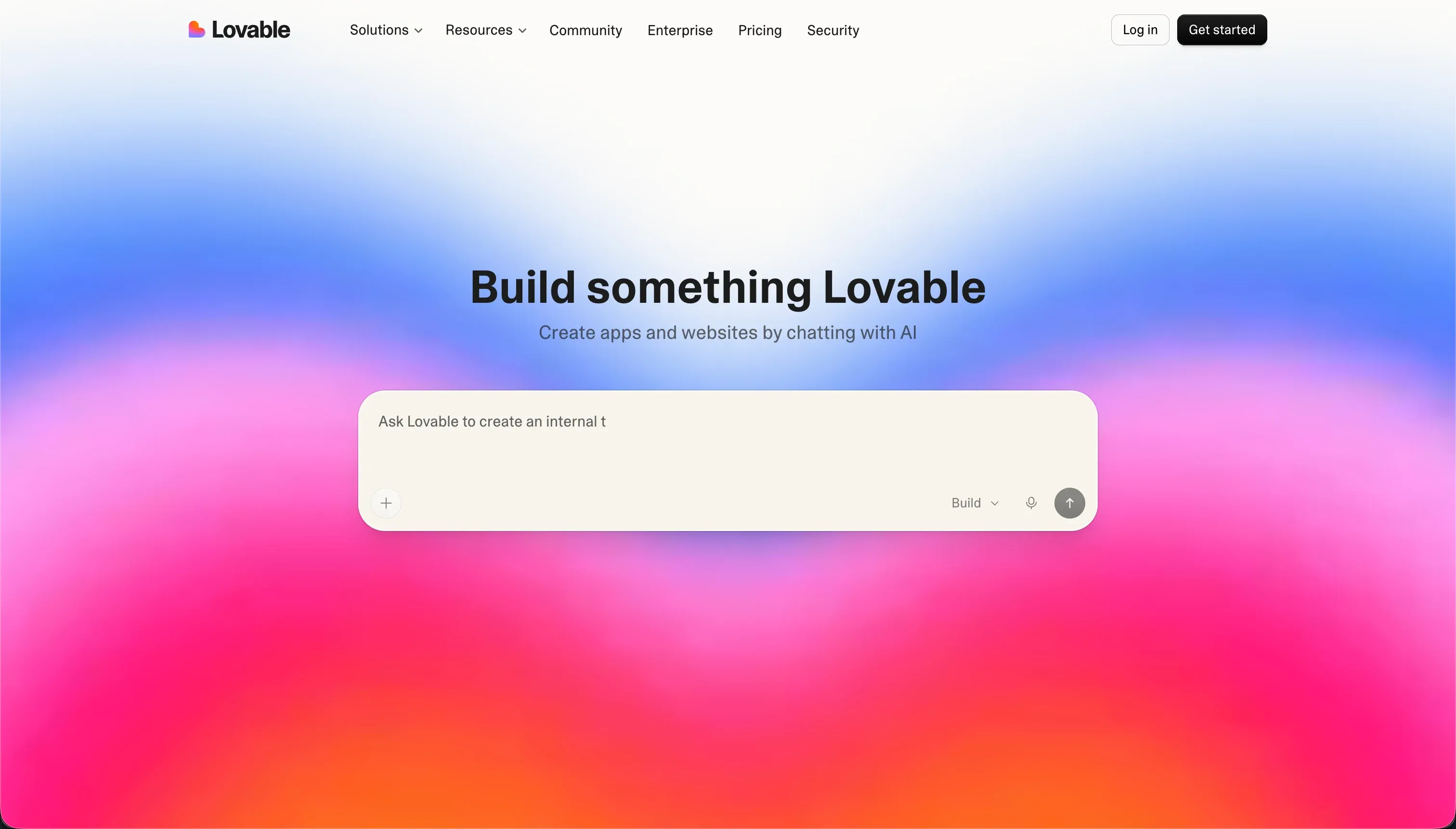
Lovable is an AI-powered full-stack app builder that turns prompts into React frontends, Node.js backends, and Supabase databases. It sits in the AI scaffolding camp rather than the classic no-code camp, which means its main promise is generating a real-ish web app stack fast, not giving you a deeply structured visual admin layer.
In practice, you prompt Lovable to generate the app, then keep iterating through conversation while it edits multiple files for you. Its concrete strengths are GitHub sync, Figma import, one-click deployment through Lovable Cloud, pre-publish security scans, and built-in Supabase integration for PostgreSQL plus auth. That is a compelling setup when you want to get from idea to React code quickly without assembling the stack by hand.
Lovable is genuinely built for fast-moving founders, makers, and developers who like the idea of AI writing most of the first version and who may want to take the code further in tools like Cursor. The people who get frustrated are non-technical builders who expected AI to remove engineering thinking entirely, because the moment security rules, regression bugs, or backend changes show up, Lovable starts demanding more developer judgment than its landing-page promise suggests.
| Spec | Details |
|---|---|
| Primary Stack | AI-generated React frontend, Node.js backend, and Supabase database |
| Interface | Conversational prompt builder with iterative multi-file code edits |
| Primary Deployment Target | Lovable Cloud hosting with staging URLs and custom domains on paid plans |
| Key Advantage | Fast full-stack scaffolding with GitHub sync and developer-friendly code output |
What is Zite?
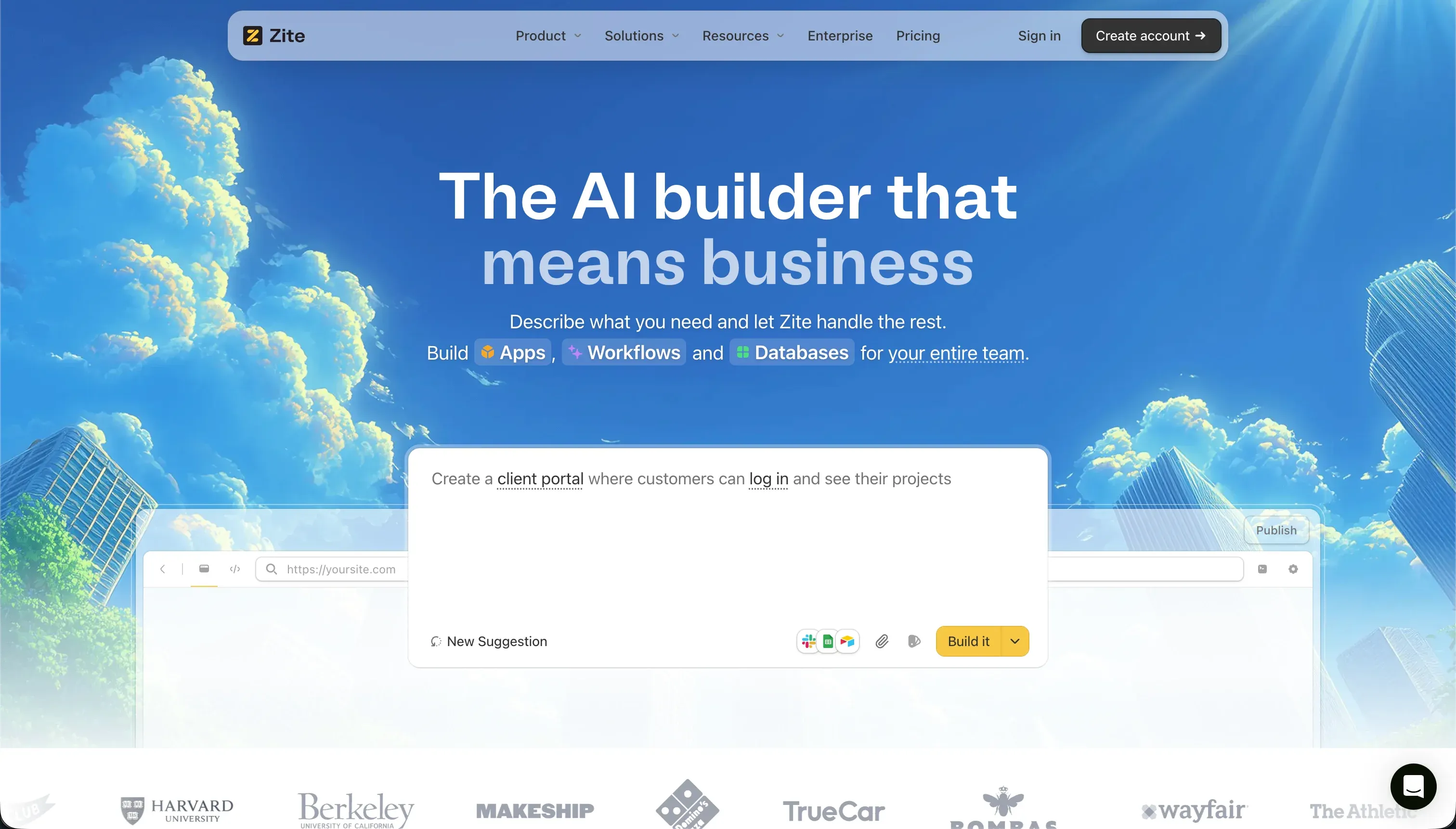
Zite is an AI-first no-code application builder, formerly Fillout, that combines prompt-driven app generation with a built-in SQL database, workflows, and strong form tooling. It is less about exporting a codebase and more about giving teams a contained environment to build internal tools, lightweight portals, and database-backed apps quickly.
In practice, Zite lets you generate interfaces, relational data structures, and workflows from a prompt, then refine them through Chat Mode or its Plan Mode before execution. Its concrete features include the Zite Database, workflow automation, Fillout-powered forms, unlimited users even on free and paid plans, and AI plan review to reduce wasted iterations. That makes it feel more operationally bundled than Lovable, even if it is still heavily dependent on credits during active building.
Zite is genuinely built for small businesses, ops teams, and solo builders who want to stay inside one no-code environment and avoid setting up Supabase or a frontend stack. The people most likely to bounce off it are technical teams who care about GitHub sync, code export, or long-term migration options, because Zite’s portability story is much weaker and its layout flexibility still seems narrower than its AI-first positioning suggests.
| Spec | Details |
|---|---|
| Primary Stack | Built-in SQL database, no-code interface layer, workflows, and hosted app infrastructure |
| Interface | Prompt-to-app builder with Chat Mode, Plan Mode, and visual editing |
| Primary Deployment Target | Hosted web apps with staging environments and custom domains on paid plans |
| Key Advantage | All-in-one no-code workflow with unlimited users and strong built-in forms |
The Core Difference
The biggest gap is not raw speed. It is whether you want AI to generate a codebase you may hand off later, or an AI-first no-code system that keeps more of the app inside a managed platform.
- Lovable runs on AI code generation for a React and Supabase stack, so its upside is developer handoff and its downside is higher day-two engineering overhead.
- Zite runs on an AI-first no-code model with a native SQL database and workflows, so its upside is a more contained builder experience and its downside is tighter platform lock-in.

Head-to-Head Comparison
We evaluated both platforms across four core categories.
1. Developer Experience & Iteration Speed
Lovable is extremely strong in the first session. You can prompt a full-stack app into existence, get React, Node.js, Supabase, auth, and deployment in one pass, then continue editing through chat. For a founder trying to get a SaaS shell online quickly, that immediacy is the whole appeal.
The problem is what happens after the initial wow moment. Lovable users repeatedly report regression loops where bug fixes burn through credits without actually resolving the issue, with some Reddit complaints saying prompts that used to cost around 1.2 credits now cost 3 to 4 credits. Once the app becomes more complex, the workflow starts feeling less like rapid iteration and more like paid debugging roulette.
Zite is also fast, but in a more constrained way. Its prompt-to-app flow can generate UI, relational data, and workflows together, and Plan Mode is a genuinely useful guardrail because it lets you inspect the AI’s intended changes before spending more credits on execution.
That said, Zite is still caught in the same core trap as many AI-first builders: chat, planning, and refinement all draw from the same pool. User feedback specifically calls out that credits disappear quickly during active iteration, and because design changes remain closely tied to generated layouts, the editing flow can still feel rigid once you want something outside the standard shape.
Edge: Zite, because Plan Mode gives it slightly better guardrails for iterative work even though both tools are still too dependent on prompt loops.
2. Code Quality & Portability
This is Lovable’s clearest advantage. It generates React and TypeScript-style output, supports GitHub sync, and is designed to let a developer continue work in a local environment or tools like Cursor. If your plan is ‘AI gets me 70 percent there, then engineers take over,’ Lovable at least respects that workflow.
The catch is that its portability story is not as clean as the marketing suggests. Community complaints mention messy exported code that still needs rebuilding, and some users describe Lovable as a ‘Hotel California’ for the database because backend migrations and infrastructure control can become murky. So yes, Lovable is more portable than Zite, but not nearly as frictionless as true ownership buyers hope.
Zite is much weaker here. There is no GitHub sync path, no real code export story, and no obvious handoff route for a development team that wants to take the product into its own stack later. For technical buyers, that is a serious limitation, not a footnote.
To be fair, Zite is not really trying to win on source-code ownership. It is trying to win by reducing setup friction through a built-in database, visual workflows, and a managed environment. That works if you are comfortable staying inside Zite, but if exit options matter, the platform looks much more proprietary than Lovable.
Edge: Lovable, because GitHub sync and generated React code are still a materially better exit path than Zite’s managed no-code lock-in.
3. Database & Backend Capabilities
Lovable’s backend story is really a Supabase story. That gives it a strong baseline on paper because PostgreSQL, auth, and real-time features are proven, and it is a big reason technical founders find the platform attractive for MVPs.
But Supabase convenience is not the same thing as backend simplicity. Lovable still leaves row-level security, schema quality, and more advanced database behavior exposed to prompt quality or manual Supabase configuration, and its own research notes point to struggles with complex business logic and broken relationships as apps scale. In other words, the underlying stack is solid, but the builder experience around it is not especially safe for non-developers.
Zite has a more integrated backend experience because the database is native to the platform. The Zite Database offers linked records, bulk operations, REST API and webhook support, and a spreadsheet-like editing model that feels easier for operations teams than reasoning about generated Supabase rules.
Still, Zite is not a complete backend powerhouse. Research points to missing advanced formula fields, limited rollups, and no native custom SQL views, which means the simplicity comes with a ceiling. It feels better bundled than Lovable, but it is also less technically deep than the underlying Supabase stack Lovable rides on.
Edge: Zite, because its native database is easier for the intended buyer to operate even if Lovable sits on a technically stronger underlying backend.
4. Hosting & Deployment Options
Lovable makes deployment feel easy. You get Lovable Cloud, instant staging URLs, custom domains on paid plans, and a simple path from prompt to live app without touching traditional hosting infrastructure. That is exactly the kind of convenience that wins demos and early prototypes.
The issue is confidence in production. User reports mention preview-to-production gaps and broader concerns that text-to-full-stack outputs are not reliably production-ready. When deployment is easy but the generated app still needs real inspection before launch, the convenience starts to feel more like prototype hosting than a trustworthy operational platform.
Zite also keeps hosting simple, but it is a more bundled product overall. Staging environments, built-in database hosting, and custom domains on paid plans give it a clean all-in-one path that fits the no-code buyer better than Lovable’s more developer-adjacent stack.
The limitation is not deployment setup so much as scale confidence. User commentary suggests Zite feels strong for MVPs, calculators, event sites, and lightweight portals, but ‘not fully there for scaling yet.’ So its hosting story is neat, but still more convincing for contained business apps than for ambitious software products.
Edge: Zite, because its all-in-one hosting model better matches its target user even if neither tool inspires huge confidence for complex production apps.
5. AI Quality & Reliability
Lovable is ambitious here. It can generate frontend, backend, schema, and integrations in one conversational workflow, and features like context connectors plus pre-publish security scans show it is trying to behave like a serious AI builder rather than a toy.
But the user complaints are hard to ignore. Reddit threads describe failed regressions, repeated bug-fix lies from the agent, and steep credit inflation where even diagnostic chats consume meaningful budget. When the AI is both your builder and your repair loop, unreliable fixes become very expensive very fast.
Zite’s AI is less flashy in the code-generation sense, but arguably more disciplined. Plan Mode is its best reliability feature because reviewing a markdown change plan before execution reduces blind trust and can prevent some wasted credit burn.
That said, Zite is still AI-first enough that the same economic problem remains. Chat and plan actions consume the same pool, model choice affects credit spend, and community feedback says active iteration can eat through credits quickly. It feels safer than Lovable, but not fundamentally free from the AI-loop tax.
Edge: Zite, because its planning layer creates a better reliability buffer than Lovable’s more chaotic prompt-and-patch workflow.
6. Learning Curve & Onboarding
Lovable is easy to understand in the abstract: type what you want, get an app, keep chatting. That is why it attracts both non-technical founders and developers who want a shortcut, and the free plan with 5 daily credits makes it easy to test without paying immediately.
The catch is that the learning curve does not disappear, it just arrives later. Once users hit Supabase RLS, custom triggers, layout quirks, or ambiguous bug states, Lovable starts demanding low-to-medium technical skill for prototyping and much higher skill for production hardening. Beginners often find that the product taught them prompting, not app architecture.
Zite is also approachable, and in some ways easier for operations-heavy teams because its mental model is more no-code than codegen. A spreadsheet-like SQL backend, forms heritage from Fillout, and a visual workflow layer all make it feel closer to business-tool building than software engineering.
Even so, the AI-first structure still creates hidden complexity. You need to manage credits, understand what Plan Mode is doing, and work within layout constraints that some users describe as rigid or overly corporate-looking. It is easier to stay productive in Zite than in Lovable if you are non-technical, but it is not as effortless as the prompt-first pitch implies.
Edge: Zite, because it asks less backend and security literacy from non-technical builders than Lovable does.

Pricing Comparison
Lovable:
- Free - $0 with 5 daily credits, up to 50 per month, and public projects
- Pro - starts at 25€/month with 100 monthly credits, private projects, custom domains, and 3 editors
- Business - starts at 50€/month with 100 monthly credits, SSO integration, advanced design templates, and data training opt-out
- Enterprise - custom pricing with custom messaging limits, audit logs, dedicated support, and custom integrations
Zite:
- Free - $0 with 50 credits, 5,000 database records, 1,000 workflows per month, unlimited users, and unlimited apps
- Pro - $15/month billed annually or $19/month billed monthly with 100 credits, 100,000 database records, 5,000 workflows per month, and 1 custom domain
- Business - $55/month billed annually or $69/month billed monthly with 200 credits, 250,000 database records, 50,000 workflows per month, and unlimited custom domains
- Team / Enterprise - custom pricing with higher usage caps, advanced security, and priority support
Use Case Fit: When to use which?
When to choose Lovable
- Choose Lovable when you want AI scaffolding for a React and Supabase app and you care about GitHub sync more than visual control.
- Choose Lovable when you expect developers to take over later and need a more code-oriented handoff path than Zite offers.
- Choose Lovable when the project is an MVP, startup prototype, or experimental product where some regression risk is acceptable.
When to choose Zite
- Choose Zite when you want a more contained no-code builder with built-in database, forms, and workflows instead of managing Supabase setup.
- Choose Zite when unlimited users matter and your app is an internal tool or lightweight portal for a broad audience.
- Choose Zite when you value AI planning guardrails and operational simplicity more than source-code ownership.
When neither Lovable nor Zite is the right fit
For internal tools and client portals
This is the question neither Lovable nor Zite answers especially well once the app has real users, real permissions, and real operational risk. Both are still too dependent on AI-first editing loops, which means changes, debugging, and permission logic can become fragile right when the tool is supposed to be settling down.
If you are building business software for employees, clients, vendors, or partners, Softr is the better fit. It starts with Softr Databases as the native option, then supports 17 external sources after that, and it gives you visual user groups, page rules, row-level restrictions, workflows, and hosting from day one. The important difference is that AI is the fast path, not the only path, so you can keep maintaining the app visually even if you stop spending AI credits.
For native mobile apps
Neither Lovable nor Zite is a real native mobile answer if you need app-store binaries, mobile-first interaction patterns, or platform-specific UI conventions. Both are fundamentally web-app builders, which is fine for browser-based tools but not the same thing as shipping a proper iOS or Android product.
If native mobile is the requirement, start with FlutterFlow and consider Adalo or Glide depending on how much complexity you need. FlutterFlow is the stronger choice when you care about actual app-store deployment and richer mobile flows, while Glide can work for simpler mobile-friendly business apps when speed matters more than deep native control.
For professional developer environments
Some teams should skip both tools because what they actually want is not AI app generation, but a real development environment with terminals, files, debugging, package control, and architecture they can inspect directly. Lovable gives you more code than Zite, but it still wraps too much of the experience in AI scaffolding, while Zite is clearly not meant for developer-first workflows.
In that case, look at Cursor or Replit. Cursor is the better fit if your team already works locally and wants AI inside a serious IDE, while Replit is better if you want a browser-based coding environment with less proprietary no-code framing than Zite and more direct control than Lovable’s prompt layer.

Verdict
Pick Lovable if your real goal is to get AI-generated React and Supabase scaffolding into a workflow that developers can keep shaping later. The tradeoff is that you are accepting more instability, more prompt dependence, and more exposure to messy regression loops and backend complexity than the polished first-run experience suggests.
Pick Zite if you want a more packaged no-code environment with a built-in SQL database, strong form DNA, unlimited users, and a gentler path for operations teams. The tradeoff is weaker portability, narrower layout freedom, and the same basic AI-credit tension that shows up whenever iteration gets heavy.
The day-two reality is that both tools still leave buyers managing too much of the maintenance burden through prompts. That is why teams building internal tools, CRMs, and client portals often age better on Softr, where AI can generate the app but visual controls, Softr Databases, permissions, and workflows remain maintainable without re-prompting the whole system every time something changes.
Summary Comparison Table
| Criterion | Lovable | Zite |
|---|---|---|
| Best for | Startup MVPs and AI-scaffolded web apps with developer handoff | Lightweight business apps, portals, and forms-led internal tools |
| Build paradigm | Conversational AI code generation | AI-first no-code builder with visual editing |
| Database | Supabase PostgreSQL integration | Built-in Zite SQL database |
| Permissions model | Supabase RLS and prompted backend rules | User groups and app permissions inside a managed platform |
| Pricing metric | Credit-based plans starting at 25€/month | Credit-based plans starting at $15 annually or $19 monthly |
| Code export | GitHub sync and stronger code handoff | No meaningful code export path |
| Maintenance burden | Higher, especially in regression and debug loops | Lower than Lovable, but still tied to AI credit usage |