

The shift toward natural language application construction has split the development landscape into distinct domains. While some platforms focus on deploying native binaries straight to smartphones, others prioritize visual web-portals and relational databases. Deciding between a mobile-first code generator and an integrated web builder determines how easily your project can transition from a prompt mock-up into a production environment.
For technical founders, startup operators, and independent builders, this choice has serious long-term consequences. Getting stuck on the wrong side of the mobile-to-web divide can quickly drain your AI credit budget, introduce fragile code debugging bugs, or trap your operational files inside proprietary boundaries with no clean exit path.
Meet the Contenders
What is VibeCode?
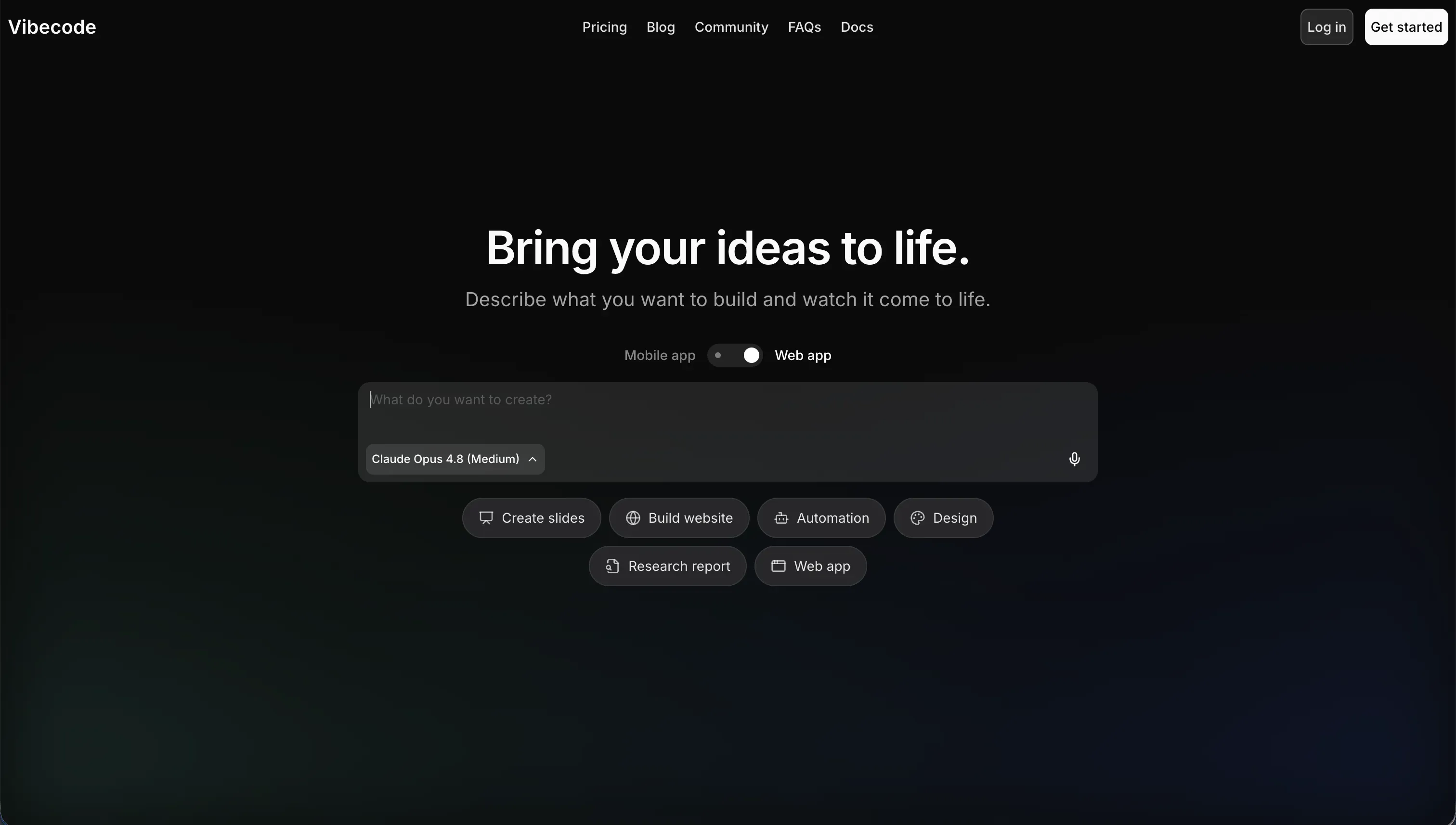
VibeCode is an AI-powered, mobile-first builder engineered to let users create, preview, and distribute native mobile applications using natural language. Designed to address the smartphone app assembly process, the developer commands the builder in plain English while the platform provisions the necessary backend interfaces automatically.
In practice, VibeCode builds true smartphone layouts optimized for iOS and Android deployment. On higher plans, it provisions a built-in database layer styled as VibeCode Cloud, establishes user authentication flows, and allows creators to link raw code outputs through direct SSH channels to external environments like Cursor or VS Code. This bypasses the typical hosting barriers of setting up separate database tables and managing manual deployment binaries.
This system is built for fast smartphone MVP prototypers and independent creators who want lightweight utilities without running Swift, Kotlin, or React Native manually. However, teams building complex, logic-heavy relational systems with multi-layered workflows find the platform frustrating, as long prompt sessions can lead the AI agent to drop overall code context or hallucinate state alignments.
| Spec | Details |
|---|---|
| Primary Stack | React Native, Kotlin, and Swift code scaffolding on VibeCode Cloud |
| Interface | Conversational natural-language builder with mobile layout emulator |
| Primary Deployment Target | Apple App Store and Google Play Store |
| Key Advantage | True native mobile app binary compiling directly from prompts |
What is Zite?
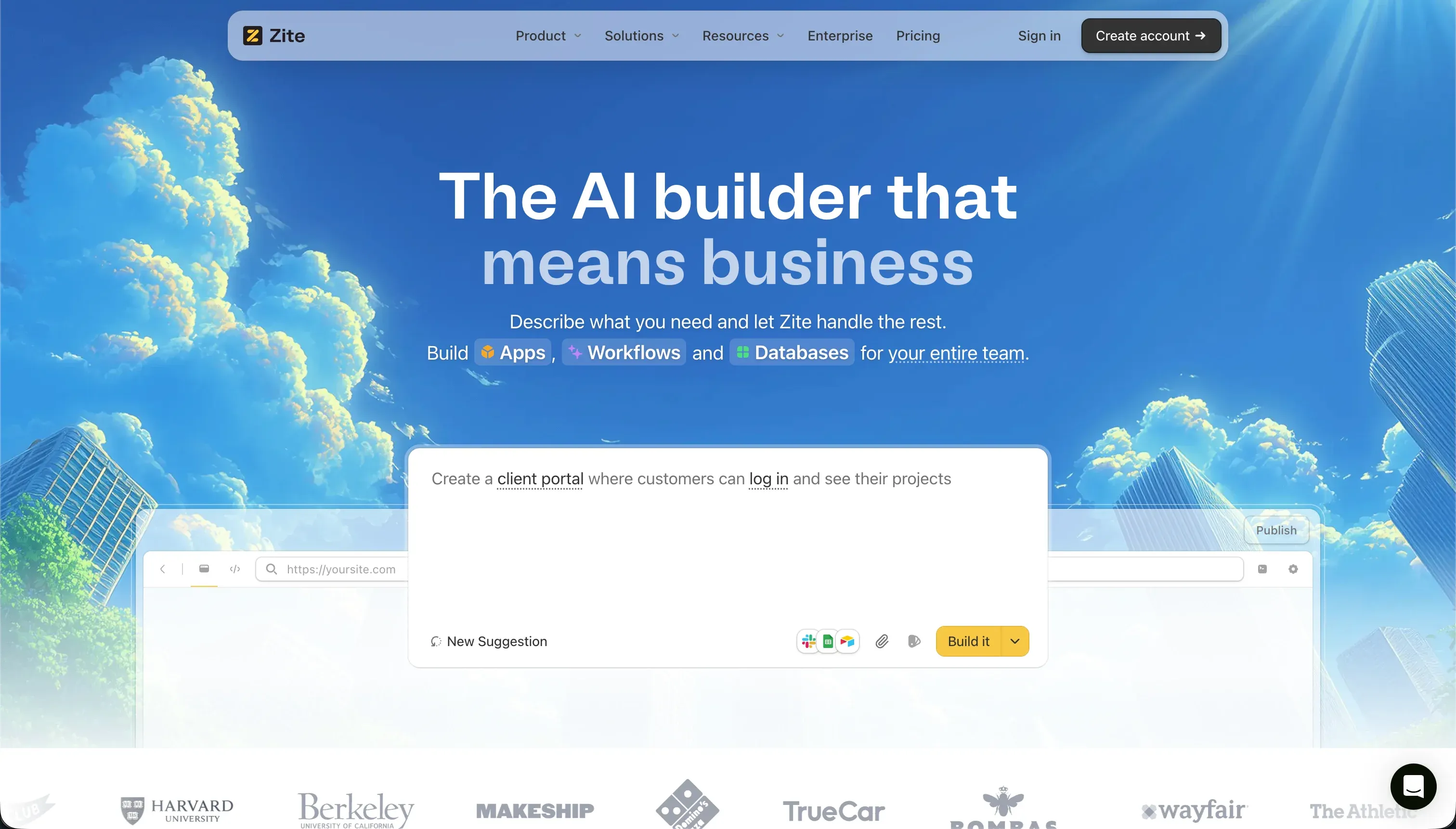
Zite, formerly known as Fillout, is an AI-first web application maker focused on building custom database tools, visual forms, and employee interfaces. It combines conversational prompts with structured visual editing pages to spin up web apps without requiring software configuration.
In practice, Zite features a spreadsheet-inspired SQL database layer designed for raw data entry and fast queries. Backed by its strong form builder origins, the platform enables builders to map visual fields, configure conditional logic tabs, and execute multi-step automations called Visual Workflows. It introduces a specialized Plan Mode that allows users to review markdown plan changes generated by the AI before executing them, helping to control credits.
This application is built for operations teams, small businesses, and managers who need internal databases or light client directories rapidly. However, professional product designers find Zite frustrating because the visual page outputs skew corporate and layout adjustments remain rigid when modifying generated interfaces beyond the AI’s default block groupings.
| Spec | Details |
|---|---|
| Primary Stack | Spreadsheet-inspired SQL base with visual form layouts and hosting |
| Interface | Prompt-to-build chat side-by-side with visual property panes |
| Primary Deployment Target | Managed Zite Cloud hosting with custom domain support |
| Key Advantage | Plan Mode change inspection and unlimited app users on all tiers |
The Core Difference
The core divergence centers on the output architecture and the target platform for which the apps are compiled.
- VibeCode runs on mobile-first native prompt code generation, delivering actual App Store binaries at the cost of potential code-drift and strict layout rules.
- Zite focuses on internal web portal structures connected to visual database records, prioritizing spreadsheet usability over custom mobile layouts.
Head-to-Head Comparison
We evaluated both platforms across four core categories.
1. Developer Experience & Iteration Speed
VibeCode provides a prompt-based editor coupled with an on-screen mobile simulator. This interface makes the first hour of mobile prototyping fast, allowing developers to generate basic forms or device views merely by describing them. The raw pricing translates directly into raw model API usage, giving creators predictable and markup-free cost-per-prompt parameters.
However, iterating past the initial prototype often introduces the dreaded vibe-coding context wall. Once the mobile app size expands, subsequent text prompts can trigger regressive code generations that break existing layout constraints or database maps. Dealing with smartphone-specific constraints like view safe-areas within prompt-only environments can drag out simple layout adjustments into long testing sessions.
Zite combines a chat interface with drag-and-drop structural panes. To combat the issue of rapid credit burn, Zite implements Plan Mode, which allows users to read a markdown preview of the planned layout and logic changes prior to spending AI resources. This structural check prevents unexpected styling bugs and saves active building cycles from repeating error correction loops.
Nonetheless, Zite suffers from UI stiffness. Modifying responsive layouts is heavily tied to the platform’s pre-rendered patterns. If the generated form or portal block does not fit your precise business grid, forcing custom styling requires continuous text-chat iterations, which can eat up credits quickly despite the Plan Mode checks.
Edge: Zite, as its Plan Mode and visual property adjustments make secondary iterations far safer than VibeCode’s prompt loops.
2. Code Portability & Exit Options
VibeCode stands out for its structural openness on paid tiers. Starting at the Pro plan ($50/mo), developers can download the complete generated source code of their application to move to independent systems. This tier also provides SSH connections directly into editors like Cursor, meaning professional teams can maintain and edit the mobile app code locally without platform lock-in.
This setup provides a reliable safety net if the AI eventually hits an absolute complexity limit. However, this code export is limited to higher plans, meaning free and base-tier users remain locked into VibeCode’s cloud environments. Furthermore, only the frontend structures are exportable, leaving the underlying database systems behind.
Zite does not offer any code export capabilities or direct connections to visual IDE tools. This creates absolute platform lock-in, where your business database logic, workflows, and frontend forms remain entirely hosted on Zite’s proprietary infrastructure.
While your data tables can be accessed via external webhooks and REST APIs, you cannot save a backup copy of your visual layout source files or sync them to GitHub. If Zite experiences service issues or shifts its pricing tiers, developers have no technical choice but to rebuild the entire system on another platform.
Edge: VibeCode, because visual SSH access and native source files provide actual code exit options on paid tiers.
3. Database & Backend Capabilities
VibeCode provisions custom databases in the background automatically, freeing creators from mapping variables or connecting external services manually. For lightweight mobile utilities or personal tracking projects, this managed backend removes standard API setup overhead entirely.
Unfortunately, as database structural complexity scales, the lack of a visual management console hurts. Developers must rely on chat instructions to restructure databases or establish relation rules. This makes complex data audits or relational debugging incredibly difficult to handle without risking structural crashes.
Zite utilizes a spreadsheet-like SQL backend designed directly for business operations. Inheriting Fillout’s powerful form handling DNA, it enables instant visual relation links, bulk record updates, and undo/redo change logs. Data fields can be organized easily without writing database queries.
Its main limitation is the absence of advanced data features like deep multi-table rollups or native SQL custom views. The storage rules are optimized for fast form submissions and basic record lookups rather than complex multi-layered data modeling.
Edge: Zite, because its visual spreadsheet-style tables are much easier to inspect, structure, and manipulate.
4. Hosting & Deployment Options
VibeCode delivers direct compiling and distribution channels to the Apple App Store and Google Play Store on its paid tiers. If you need standard smartphone apps, bypassing manual build-chain compilers and certificates is a valuable timesaver.
But native mobile publishing is bound to strict app review rules. If your prototype contains an invisible prompt hallucination or performance lag, it may face swift rejection during Apple’s review process. Mobile store updates also require compilation delays, preventing instantaneous live fixes.
Zite focuses entirely on web-hosted applications deployed directly to custom domains. While it completely lacks native mobile binary compiler capabilities, its web apps render responsively on mobile browsers, and changes publish instantly without waiting for mobile store approvals.
This is highly ideal for rapid internal business tools and portals where users do not want to download actual mobile apps. The Pro plan ($19/mo) and Business plan ($69/mo) provide custom domain mappings and staging portals natively, making web distribution hassle-free.
Edge: VibeCode for public native consumer apps, but Zite wins for rapid, instant-access business web portals.
5. AI Quality & Reliability
VibeCode utilizes pure model APIs without hidden pricing premiums, meaning your $20 Pro credit translates directly to raw processing power from models like Anthropic’s Claude. For structured mobile designs, this ensures excellent UI execution when the layout matches the model’s standard framework.
However, complex state management easily breaks VibeCode’s generation accuracy. Users have documented structural regressions where a simple backend change breaks unrelated menu paths, creating code loops that require developer editing to resolve.
Zite implements several AI models (Zite Mini, Zite Pro, Zite Max) to separate styling commands from functional database updates. Combined with Plan Mode, this division improves overall building safety and reduces structural failures because the system isolates styling edits from data storage logic.
Nevertheless, active chat loops can still struggle with complex visual commands, producing generic, corporate-looking interfaces. If you want high-fidelity design deviations, you may find yourself locked in prompting iterations that burn credits faster than expected.
Edge: Zite, as dividing prompt tasks between models and checking edits in Plan Mode results in far higher app stability.

Pricing Comparison
VibeCode:
- Free: $0/mo ($2.50 included credits, access to premium AI models, prompt-based building)
- Plus: $20/mo ($20 included credits, 1 active deployment)
- Pro: $50/mo ($55 included credits, 3 active deployments, code export, SSH access)
- Max: $200/mo ($220 included credits, 5 active deployments)
Zite:
- Free: $0/mo (50 base credits, 5,000 DB records, 1,000 workflows/mo, unlimited users)
- Pro: $19/mo monthly or $15/mo annually (100 base credits, 100,000 DB records, 5,000 workflows/mo, 1 custom domain)
- Business: $69/mo monthly or $55/mo annually (200 base credits, 250,000 DB records, 50,000 workflows/mo, advanced models, custom domains)
Note: those “unlimited users” come with a workflow-run meter. Standard CRUD operations, including every database read when a page loads or reloads, count against the monthly workflow runs (5,000 on Pro), so a few active users can exhaust the quota in days, with no clear self-serve add-ons before a custom Enterprise plan.
Use Case Fit: When to use which?
When to choose VibeCode
- Choose VibeCode when your primary product must be distributed directly via the Apple App Store or Google Play Store.
- Choose VibeCode when you want code ownership and need to export raw native React code to link with SSH editors like Cursor.
- Choose VibeCode when building basic native mobile utilities, simple single-player games, or clean smartphone mock-ups.
When to choose Zite
- Choose Zite when you are building visual, form-driven internal portals that do not require native app store distribution.
- Choose Zite when hosting costs must scale cleanly to support large teams without adding per-seat license fees.
- Choose Zite when you need to inspect AI plans in markdown before code compilation to manage credit consumption.
When neither VibeCode nor Zite is the right fit
For robust business apps, client portals, and secure operational databases
If you are attempting to build an active business portal, partner directory, client dashboard, or backend database app, both raw prompt code compilation and rigid template generators pose major operational risks. That is where Softr offers the ideal middle-ground. Softr provides a secure, fully visual drag-and-drop builder anchored on proven B2B infrastructure with out-of-the-box user authentication and precise European hosting.
Instead of exposing your team to prompt regression failures or unpredictable credit billing during visual edits, Softr treats AI strictly as an accelerator. You can generate your entire initial application - including Softr Databases visually on day one - and then switch seamlessly to manual visual editing without writing code or spending AI credits to make standard styling updates. This hybrid setup ensures your core business security, page rules, and granular row permissions stay intact, offering stable business scaling with none of the risk of unmaintained code debt.
For high-fidelity web apps and advanced programming workflows
For web applications that require deeply custom browser flows, nested logic modules, or precise front-end layout styling, Zite’s layout rigidity and VibeCode’s smartphone focus fall short. In these scenarios, Bubble or WeWeb are far more structured options.
Bubble offers full visual programming to map complex logic databases and custom state actions, while WeWeb allows teams to assemble responsive react views on top of existing headless databases, preventing technical limitations as scale demands grow.

Verdict
Pick VibeCode if your startup specifically demands native smartphone distribution and you require clean React or native mobile files. By utilizing VibeCode, you accept that logic adjustments past the prototype stage will require continuous prompt testing and that base plans limit your storage and export options, but you gain a compilation path to real native mobile app stores.
Pick Zite if your operational workflow stays close to standard web portals, spreadsheets, and database-driven form surveys. You of course accept full platform lock-in with zero code export or GitHub syncing, but you receive a stable visual interface builder with staging fields, markdown Plan Mode controls, and an unlimited user count for internal operations.
For real business software, operational apps, and client portals where code debt and prompt regressions must be avoided, neither tool is a resilient solution. Standard databases, login setups, granular permissions, and mobile-friendly layouts belong on a secure no-code platform like Softr. By anchoring your portal on Softr Databases with direct visual drag-and-drop editing, your operational systems grow smoothly alongside your business without any risk of AI-hallucinated breakdowns.

Summary Comparison Table
| Criterion | VibeCode | Zite |
|---|---|---|
| Primary Target | Native iOS & Android Mobile Apps | Web Apps & Internal Portals |
| Database | VibeCode Cloud (Prompt Managed) | Spreadsheet-Style SQL Backend |
| Pricing Metric | Raw AI Credits (No Markup) | Scaling Base Credits + DB Limits |
| Code Export | Yes (React / SSH on Pro+) | No (Full Platform Lock-In) |
| App Store Sync | Direct Store Publishing Tiers | No Mobile Store Publishing |
| User Fee Model | Credit-Based (Usage Focused) | Unlimited Users on all plans |