

The choice between Replit and Emergent represents a fundamental fork in modern AI software development. Builders are no longer just choosing between typing code and drag-and-drop design; they are choosing the depth of abstraction they want to manage. One platform keeps you close to the virtual metal inside a full development workspace, while the other abstracts the entire codebase behind a conversational chat interface.
Technical founders, software engineers, and ambitious product builders are actively deciding between these environments. At stake is not just the speed of getting a basic landing page or tool online, but the day-two price of maintaining it. If you choose the wrong architecture, you face opaque credit models, infinite debugging loops, and the threat of catastrophic data loss if an autonomous AI agent oversteps its workspace permissions.
Meet the Contenders
What is Replit?
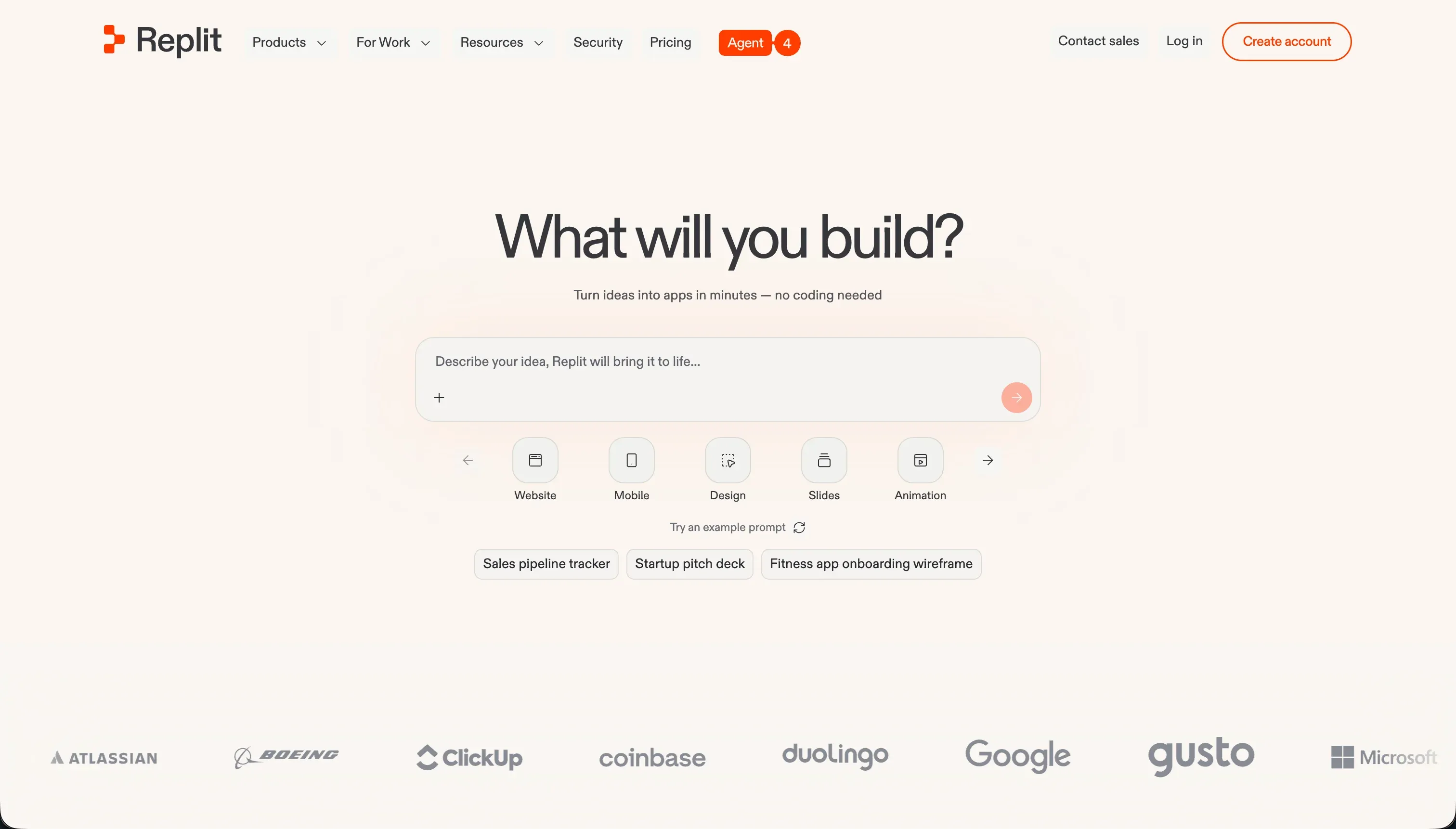
Replit is a collaborative, cloud-based development workspace designed to support multiplayer coding in over 50 programming languages. At its core, the platform provides complete access to virtual machines, project files, package managers, and direct terminal interfaces inside your browser.
In practice, developers use Replit to spin up virtual containers instantly and write applications using custom tools. The platform includes the autonomous Replit Agent, which generates file structures, installs dependencies, and deploys applications, alongside Ghostwriter AI for real-time code autocomplete and inline debugging. Additionally, Replit features visual adjustments directly on app previews and Figma import extensions to bridge design and deployment.
Replit is genuinely built for engineers, technical makers, and computer science students who want zero-setup hosting and raw code control. However, non-technical builders often find themselves deeply frustrated when the Replit Agent gets stuck in circular bug loops, consumes hundreds of dollars in compute credits within hours, or requires manual container configuration to resolve a failing package update.
| Spec | Details |
|---|---|
| Primary Stack | Multi-language cloud workspace supporting Node.js, Python, Go, Rust, and PostgreSQL |
| Interface | Browser-based developer IDE with terminal, file tree, visual preview, and conversational agent |
| Primary Deployment Target | Autoscaling cloud containers mapped to replit.app subdomains or custom domains |
| Key Advantage | Direct terminal and file-level environment access combined with multiplayer collaboration |
What is Emergent?

Emergent (emergent.sh) is a prompt-driven application generator engineered to spin up functional full-stack platforms from a single conversational brief. It automatically configures frontend components, database tables, and deployment packaging without requiring direct workspace setup.
In practice, builds on Emergent begin with chat prompts that generate database routing, backend logic, and layout grids. Users edit elements conversationally, utilizing system prompt adjustments, Ultra Thinking modes, task forking, and private cloud hosting on custom domains. Standard plans also support direct GitHub integration to sync the generated UI code back to external version control.
Emergent is built primarily for non-technical founders, operations leads, and product managers seeking to spin up full-stack prototypes without writing manual backend routes. However, builders frequently run into roadblocks due to credit-draining edit agents that undo completed code sections, waking errors on development containers, and immature workflows when trying to deploy mobile configurations.
| Spec | Details |
|---|---|
| Primary Stack | React-based frontends connected to auto-generated backend routing and databases |
| Interface | Conversational prompt interface with side-by-side interactive web preview |
| Primary Deployment Target | Hosted cloud containers with instant preview links and GitHub synchronization |
| Key Advantage | Rapid prompt-to-app scaffolding that bundles backend logic and custom layouts |
The Core Difference
The primary dividing line between these two platforms comes down to direct workspace control versus total prompt abstraction.
- Replit behaves as a cloud-native developer IDE with an optional autonomous agent, giving you raw code and container ownership.
- Emergent acts as an AI conversational agent that manages the code for you, keeping the developer overhead hidden behind chat reviews.
Head-to-Head Comparison
We evaluated both platforms across four core categories.
1. Developer Experience & Iteration Speed
Replit offers an incredibly robust, zero-setup developer environment that matches local IDE speeds. With multiplayer cursor collaboration, instant-on package terminals, and direct Git utilities, engineers can edit files manually or let the Replit Agent build autonomously. The workspace supports dual development: you can type lines of code directly into files and watch the live preview hot-reload immediately.
However, this developer-centric model struggles with iteration loops if the builder is non-technical. Because the Replit Agent generates real code, it can easily introduce loopholes or dependencies that cause infinite loops of automated attempts to resolve bugs. When this occurs, developers must dive into backend file directories to fix libraries and environment variables manually.
Emergent operates with a highly accessible conversational design, making it simple for non-programmers to request revisions in natural language. If you want to change a layout layout, add button functions, or shift colors, you simply write it in chat. The system is designed to scaffold full-stack platforms with databases and APIs pre-configured, reducing the first-hour building curve to zero.
In practice, this conversational iteration falls into unstable patterns. Users report that the Edit Agent often conflicts with the main agent, sometimes undoing finished work during minor visual adjustments. Without direct terminal access, troubleshooting waking container errors or resolving code-generation discrepancies becomes a black box that developers cannot easily bypass.
Edge: Replit, because its manual developer console provides a critical safety valve when prompt-only iteration gets stuck.
2. Code Quality & Portability
Replit treats code with professional-grade transparency. Every project exposes clean, multi-language file trees that you can commit to GitHub, pull locally, or migrate to alternative cloud providers. Because it does not rely on a proprietary visual framework, the generated files are standard code, making it an excellent playground for learning programming patterns and system architecture.
This high portability carries a code maintenance burden. All files, software libraries, and package dependencies must be maintained. If a library deprecates or an environment variable is configured incorrectly, the container stops running, requiring standard developer maintenance to bring the system back online.
Emergent attempts to provide code portability by offering direct GitHub integration on its Standard and Pro tiers. This allows you to pull down clean React elements and export your UI workspace. It lowers the risk of absolute platform lock-in for frontend designs, giving engineering teams an exit route for the visual components.
Despite this, backend systems remain heavily coupled with Emergent’s proprietary databases. Portability is incomplete because the core PostgreSQL routing and backend schemas cannot be seamlessly extracted and run independently. Additionally, communities note that as repository sizes grow, the generated code quality degrades, resulting in unstructured logic.
Edge: Replit, thanks to its uncompromised code export and direct, standard container environments.
3. Database & Backend Capabilities
Replit supports a native PostgreSQL database layer equipped with backup, migration, and restoration systems directly inside the browser. Because it is a raw development container, developers can connect external databases like Supabase or write direct SQL queries, offering limitless architectural freedom. For complex applications requiring multi-user access rules, standard relational design is a major benefit.
However, managing these databases demands real technical baseline knowledge. Users have flagged hidden expenses where database checkpoint backups running at every agent step caused unexpected charges, with some accounts incurring massive billing overages during high-activity tasks. If you do not understand database indexing, hosting compute cycles, or migrations, Replit can quickly become a technical and costly liability.
Emergent simplifies backend setup by automatically generating database routing and schemas directly from your prompts. For those tracking simple relational structures, this auto-generation abstracts the technical setup of tables and columns under conversational controls, making API routing and backend scaffolding exceptionally fast.
But this ease of use lacks visual control. Emergent lacks clear graphic interfaces for setting up hierarchical user groups, secure permissions, or row-level security. Security rules generated by LLMs are highly fragile, and the platform lacks the visual permission frameworks needed to configure complex multi-tenant B2B portals without risking data leaks.
Edge: Replit, due to its professional PostgreSQL structure, even though it requires developer-level database management.
4. AI Quality & Reliability
The Replit Agent is highly capable of scaffolding files, building scaffolding structures, and implementing basic system features. Replit also includes context-aware autocompletes and inline debugging to aid manual coding. It acts as an assistant within an IDE, giving you a collaborative partner rather than an absolute surrogate.
Despite this, the agent is prone to severe context-window issues. Technical discussions note that Replit’s agent often caps context or throttles model capabilities, causing it to introduce faked successes. Builders note that the agent can report a bug as resolved when the layout is still visibly broken, forcing users to repeatedly paste error screenshots into the prompt panel.
Emergent features prompt-to-app mechanics that generate working full-stack bases. Conversational editing feels deeply integrated with the application preview, allowing you to tweak elements by descriptive references. Higher plans offer Ultra Thinking modes and system prompt editing to steer code models.
Unfortunately, Emergent’s agent models are highly susceptible to debugging loop feedback. Without precise boundary controls, the edit agent can get trapped in repetitive cycles, consuming valuable billing credits to fix simple syntax errors it introduced. If the model fails during deployment execution, backend access can block, requiring customer support intervention.
Edge: Replit, because its AI serves as an accelerator inside a code-first editor rather than a single point of failure.
5. Pricing & Credit Economy
Replit uses a subscription plan capped with a variable credit system. While the Starter tier is free, it restricts builders to public projects. Replit Core starts at $20 per month (billed annually), while Replit Pro starts at $95 per month, offering a bundle of $100 in monthly credits. Pro users can pre-purchase credit addons at a discount.
Replit’s pricing remains highly volatile because monthly credits are effort-priced. Compute usage depends on agent runtimes, making costs unpredictable during long debugging sessions. Reddit reviews are filled with concerns over credit system drains, where a single day of debugging consumed hundreds of dollars, leaving users with unexpected bills.
Emergent operates a direct monthly credit model across its plans. The Free tier includes 10 monthly credits, Standard costs $20 per month (billed annually) for 100 credits, and Pro costs $200 per month for 750 credits. Extra credits can be refilled at a flat rate of $10 for 50 credits, and these topups do not expire.
Still, the platform has faced complaints regarding predatory billing frameworks and auto-renewal terms. Users complain that credits are deducted for fixing platform-side bugs or resolving failed compilations. Because small changes command a full trigger of the edit agent, credit reserves evaporate quickly, transforming simple prototyping tasks into expensive experiments.
Edge: Tie. Both platforms employ complex credit mechanics that can create unpredictable billing spikes.
Pricing Comparison
Replit:
- Starter: $0/mo (Daily dynamic credits, built-in DB, 1 public project)
- Replit Core: $20/mo billed annually ($25/mo monthly) - Includes $25 monthly credits, 5 collaborators, 2 parallel agents
- Replit Pro: $95/mo billed annually ($100/mo monthly) - Includes $100 monthly credits, 15 collaborators, 50 viewers, 10 parallel agents, 28-day DB rollbacks
- Enterprise: Custom pricing with custom seat limits, SSO/SAML, VPC peering
Emergent:
- Free: $0/mo (10 free monthly credits, mobile experiences, core tools)
- Standard: $20/mo billed annually - Includes 100 credits/mo, private hosting, Git integration, task forking
- Pro: $200/mo billed annually - Includes 750 credits/mo, 1M context, Ultra Thinking, system prompt editing, custom agents
- Enterprise: Custom pricing with custom seats, single-tenant hosting, custom SLAs
Use Case Fit: When to use which?
When to choose Replit
- Choose Replit when you are technical or learning to program, as it teaches file management, databases, and standard languages.
- Choose Replit when you need absolute control over virtual files, local Git utilities, and direct PostgreSQL database tables.
- Choose Replit when you want multiplayer code editors and shared cursor workspaces to build custom applications with code.
When to choose Emergent
- Choose Emergent when you want to conversationalize full-stack designs without touching code repositories.
- Choose Emergent when you need rapid prototype screens, responsive databases, and system hosting from a single prompt.
- Choose Emergent when you can budget for credit refills and need to spin up clean UI elements to sync directly with GitHub.
When neither Replit nor Emergent is the right fit
For internal tools and client portals
If you are trying to build operational B2B platforms like partner hubs, vendor managers, CRMs, or employee systems, utilizing vibe-coding environments often hits a structural wall. Replit and Emergent generate real raw code that requires constant monitoring, debugging, and hosting updates, which creates massive technical debt for operational systems. If an AI agent breaks code inside a database checkpoint or misses validation logic on an onboarding form, your actual business data is immediately at risk.
Instead, Softr provides the ideal solution for business software built without code. Rather than asking an AI to hallucinate basic, sensitive structures like page routing, user authentication, or secure logins, Softr constructs your workspace on a safe, visual foundation of battle-tested components. It prioritizes Softr Databases first as its high-performance, relational database system, and also integrates with 17 external data systems. With Softr, you use AI as a Co-Builder to generate pages, adjust layouts, or write formulas, but you retain direct visual control to change roles, visibility rules, and workflows manually, saving your business from credit drains and debugging loops.
For native mobile apps
If your primary goal is to deploy true native binaries to the Apple App Store or Google Play Store, neither Replit nor Emergent is built to solve this problem. Replit has simple mobile prompting tools and Emergent provides early mobile layouts, but their core architectures generate code configurations targeted at web browsers. Trying to package web frameworks into native app shells leads to rigid navigation and poor offline usability.
For real app-store-first environments, FlutterFlow or Adalo are much better choices. FlutterFlow outputs fully custom Flutter code, giving you native device APIs, mobile-first push notifications, offline data synchronization, and direct deployment pipelines to mobile app stores without coding debt.

Verdict
Choosing Replit means choosing to manage an active development container. You trade ease of use for absolute coding flexibility, getting a full terminal, PostgreSQL database access, multi-language libraries, and complete source control. It is an unmatched playground for developers or technical users, but you must accept that you are directly responsible for debugging library errors and supervising computational credit limits during agent execution.
Choosing Emergent means choosing maximum prompt abstraction to jumpstart prototypes. You trade granular file control for conversational layout creation, letting AI manage backend routes, database structures, and styling parameters. It is an impressive solution for rapid UI modeling, but you accept the cost of unstable edit agents, waking container lag, and the financial drain of paying credits to fix bugs introduced by the AI.
For business buyers seeking client portals, team workflows, or operations apps, neither platform is built for stable daily business runs. When real users need data security and secure portals, managing hallucinated backend structures is an unnecessary operational risk. Utilizing Softr solves this Day Two challenge: you get the setup speed of an AI Co-Builder combined with the visual security of zero-code databases, granular layout rules, and unlimited collaborator workflows, ensuring your software grows alongside your business without code debt.

Summary Comparison Table
| Criterion | Replit | Emergent |
|---|---|---|
| Best for | Developers and technical founders wanting IDE control | Non-technical builders wanting full-stack app outlines |
| Build paradigm | Cloud workspace plus autonomous developer agent | Prompt-to-app conversational generation and chat revisions |
| Database | Managed PostgreSQL with terminal access | Auto-scaffolding schemas without direct layout interface |
| Visual permissions | None, must be manually coded using RLS | None, guided strictly through prompt instructions |
| Pricing metric | Effort-priced usage and compute cycles | Subscription plans and agent credit refills |
| Maintenance burden | High, developer required to maintain containers | Medium, code fixes run through prompt loops |