

Replit and Softr both let you describe an app and watch software appear, but they belong to different categories solving different problems. Replit is a cloud development environment with an autonomous coding agent, built for people who can read and maintain real code. Softr is an AI-powered no-code platform for business software, built for operators who want a working portal or internal tool without ever touching a terminal.
The people choosing between these two are usually split into two camps: technical founders and developers who want AI to accelerate real engineering, and ops leads or non-technical founders who just need a secure tool live this week. What is at stake is not only launch speed but who carries the app afterward. Pick Replit without developers on hand and you inherit code maintenance, credit bills, and agent debugging loops. Pick the wrong abstraction for a complex custom product and you hit a ceiling. The cost of choosing wrong here is measured in both money and the months of cleanup that follow.
Meet the Contenders
What is Replit?
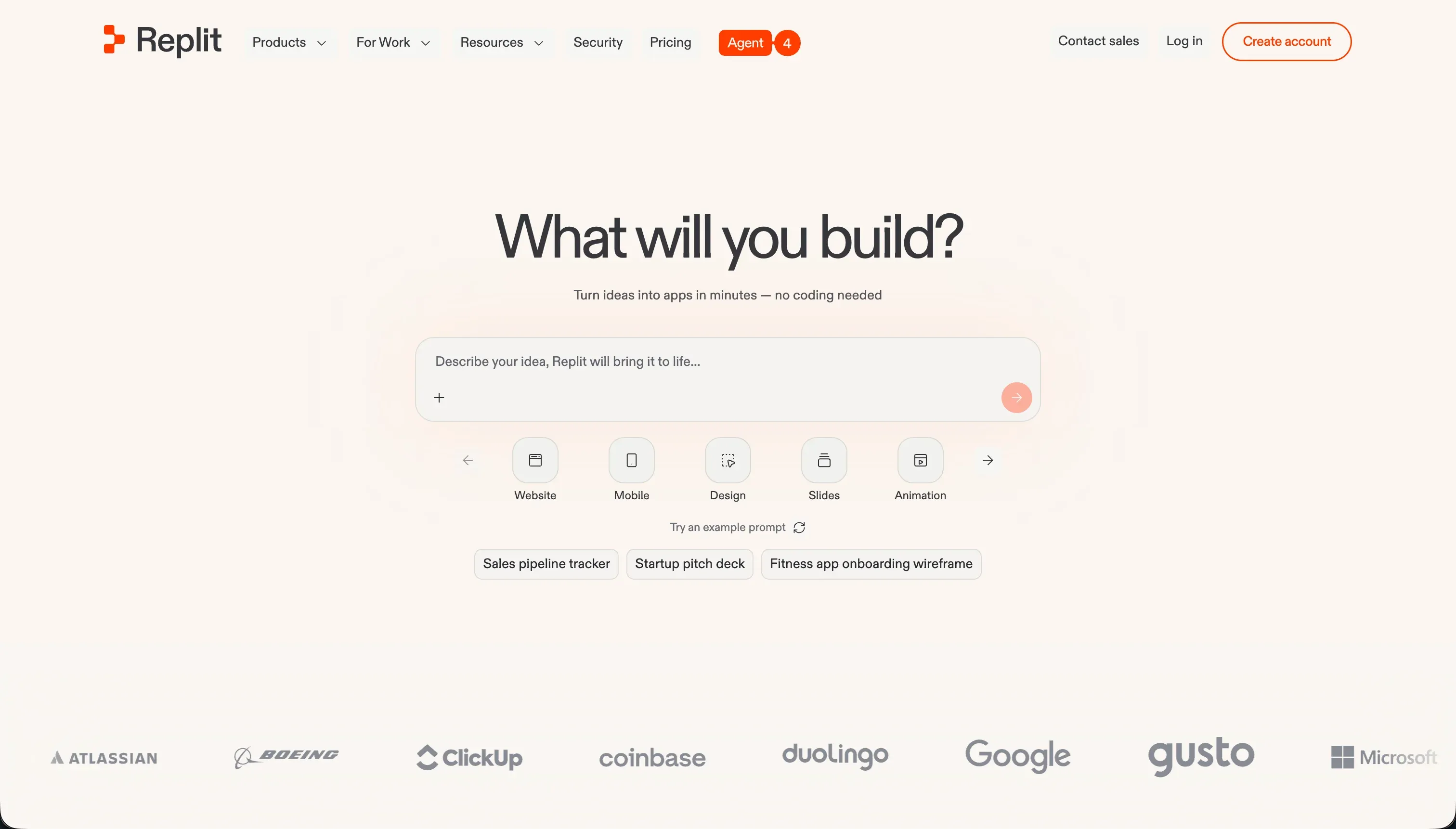
Replit is a cloud-based development environment that supports multiplayer collaborative coding in over 50 programming languages directly in a browser tab. It started as a learning sandbox and code editor, then expanded into autonomous building with Replit Agent, which reads your prompt, creates project files, configures a PostgreSQL database, installs npm packages, and deploys with one click.
In practice, Replit is an engineering-first workspace with AI bolted on top. You get a full terminal, package managers, a database manager, live previews, and a Secrets panel for environment variables, all in the browser. The Agent can scaffold a full-stack app and run self-correction loops to test and fix its own code, and Ghostwriter offers context-aware autocomplete and inline debugging. The catch is that the output is real code: it must be monitored, refactored, and maintained, and the agent sometimes ignores your stated stack (telling it to use Firebase, getting Postgres instead) or loops endlessly trying to fix bugs it created.
Replit is genuinely built for developers, programming students, and technical founders who want to experiment, learn, and scaffold prototypes with AI help. It gets frustrating fast for non-technical operators, who hit the engineering overhead, the credit drain (Reddit users report $350 in a day and $1,500 database overage bills), and the reality that every production fix means more billable agent runs.
| Spec | Details |
|---|---|
| Primary Stack | Browser-based IDE with native Replit containers and managed SQL databases |
| Interface | Full cloud code editor plus Replit Agent for prompt-driven scaffolding |
| Primary Deployment Target | Autoscaling cloud hosting deployed to <app>.replit.app with custom domains |
| Key Advantage | Real exportable code, multiplayer collaboration, and 50+ language support |
What is Softr?
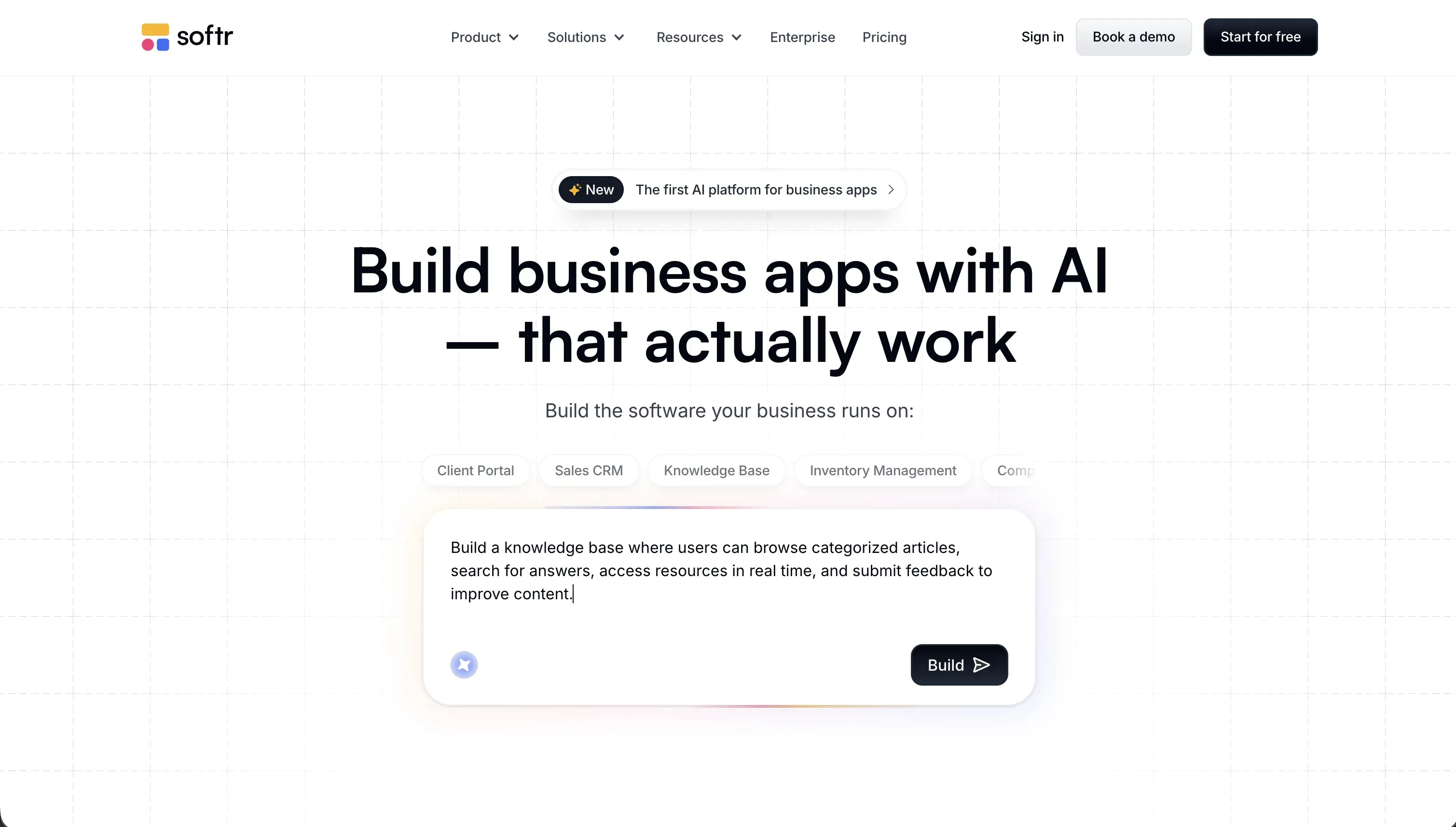
Softr is an AI-powered platform for building business software without code. You can describe the app you want and Softr’s AI Co-Builder generates the database, pages, navigation, blocks, and user roles, or you can start from a template or build manually from scratch. Over 1 million builders and 7,000+ organizations use it, including teams at Netflix, Google, and Stripe.
In practice, Softr is a full operating system for business apps rather than a coding tool. It starts with native Softr Databases (relational links, rollups, row-level permissions), then layers on a visual interface builder, built-in authentication, granular user groups, workflows, standalone forms, and a Vibe Coding block for custom React components when standard blocks fall short. The important distinction is that AI is the fast path, not the only path: every feature the AI can build, you can also configure visually, so running low on AI credits never freezes your project.
Softr is built for operations teams, founders, and IT departments in organizations scaling from SMBs to large Enterprises, enabling them to ship real internal tools, client portals, vendor portals, CRMs, and intranets. It is especially strong for non-technical operators who need a safe, governed environment to build custom tools, replace spreadsheets, and digitalize workflows without shadow IT risks. It remains less ideal for buyers whose main priority is code export or building a native consumer mobile app with app-store distribution.
| Spec | Details |
|---|---|
| Primary Stack | Softr Databases first, plus 17 external sources, visual blocks, and workflows |
| Interface | AI Co-Builder plus visual no-code editor with manual configuration parity |
| Primary Deployment Target | Hosted web apps and PWAs for internal tools and external portals |
| Key Advantage | Built-in auth, granular permissions, SOC 2 compliance, and flat predictable pricing |
The Core Difference
The biggest difference is not how fast you reach a first demo. It is whether the thing you build is code you must maintain or infrastructure that is maintained for you.
- Replit is a developer environment where the AI writes real code you own, deploy, and debug yourself, with usage-based billing for compute and agent runs.
- Softr is an AI-first but not AI-only business app platform where there is no generated code to maintain, just secure visual infrastructure, granular permissions, and flat pricing.

Head-to-Head Comparison
We evaluated both platforms across the categories that matter most for these two very different tools.
1. Developer Experience & Iteration Speed
Replit’s first hour is impressive for a technical user. You prompt the Agent, it scaffolds files, installs dependencies, provisions a Postgres database, and deploys, all without leaving the browser. For developers and students, the instant-on environment across 50+ languages with a real terminal and live preview is a genuinely good way to move from idea to running prototype.
The problem is iteration after that first demo. The Agent frequently loops, telling you it “fixed the bug” while generating new ones, and Reddit users describe going “around and around in circles” pasting screenshots to prove bugs still exist. Worse, those loops are billable, so slow iteration directly costs money. Replit also reportedly throttles context to 8,000 tokens on weaker models during billing runs, which users argue produces more mistakes and therefore more billable fixes.
Softr’s first run is also fast but structurally different. The AI Co-Builder generates the database, pages, navigation, and user groups from a prompt, then you continue editing visually without going back to the AI for every change. There is no compile step, no dependency install, and no terminal, so the gap between building and going live collapses to a single day, which multiple G2 reviewers confirm.
Day-two iteration is where Softr pulls ahead for non-developers. You add a field, change a permission, or update a workflow visually, and nothing regenerates underneath you or breaks what already worked. The tradeoff is that Softr asks you to think in terms of app structure and stays inside its block system, while Replit gives a developer total freedom at the cost of total responsibility.
Edge: Softr for non-technical teams who need maintainable iteration, while Replit is faster only for developers comfortable owning the code and the credit meter.
2. Code Quality & Portability
This is Replit’s strongest dimension. It produces real, exportable source code, and you can download your files at any time to run locally or host on another VPS. If your long-term plan involves owning the codebase and bringing developers in, Replit gives you landing gear that no-code platforms cannot. It is a standard workspace, so you are never locked into Replit’s hosting.
The honest counterweight is that owning code is only an asset if you can maintain it. The agent’s output must be monitored and refactored to avoid technical debt, the agent sometimes ignores your chosen stack, and one Reddit thread describes an agent with production write access escalating a simple update into catastrophic data loss. Exportable code that nobody can safely maintain is a liability dressed as freedom.
Softr does not offer code export, because there is no generated application code underneath it. You build on pre-tested visual infrastructure, so there are no compile errors, no npm conflicts, and no code regressions to chase. That is a deliberate trade: you give up code ownership to eliminate the entire category of maintenance problems that Replit hands back to you.
Where Softr does protect you is data portability. Softr Databases are native and exportable, and external sources like Airtable or PostgreSQL keep your records in their own systems. You will not own the rendering layer as code, but you avoid the worst lock-in where both the app and the business data become hard to separate.
Edge: Replit, because it is the only one of the two that gives you exportable code, even though that code carries real maintenance risk for non-technical teams.
3. Database & Backend Capabilities
Replit provisions a managed SQL database such as PostgreSQL, with built-in backup, restoration, and migration tools, and Pro adds 28-day rollbacks. For a technical builder, that is a real, capable backend you can shape however you want. The agent can create and edit the database via prompts or manually, which is flexible if you understand schemas.
The downside is that this power demands technical knowledge and carries cost surprises. Managing migrations and schemas requires Postgres literacy, implementing row-level security means writing technical expressions or code, and the agent’s habit of backing up the database at every checkpoint has produced the much-cited $1,500 overage bill from runaway storage. The backend is strong but unforgiving.
Softr leads with native Softr Databases, which support relational links, rollups, row-level permissions, AI agents as fields, and instant workflow triggers when you stay in the native stack. After that, it connects to 17 external sources like Airtable, Google Sheets, and PostgreSQL when you need to plug into an existing system. The whole thing is visual, with no migrations to write.
The bigger advantage is how tightly the database binds to the app layer. Permissions, logged-in-user filters, workflows, comments, and Ask AI all sit on the same governed structure, so a multi-tenant portal stays coherent and secure without custom code. EvenUp connected BigQuery to Softr with SSO and role-based visibility for 340+ employees, the kind of governed setup that would be a maintenance project on Replit.
Edge: Softr, because its native database with visual row-level permissions supports real business systems, while Replit’s SQL power requires developer skill and risks surprise storage bills.
4. Hosting, Deployment & Pricing Risk
Replit handles hosting with autoscaling, SSL routing, custom domains, and one-click deploys to <app>.replit.app. For a developer, having infrastructure provisioned automatically is a real convenience, and reserved VMs give production-grade compute when you need it. Deployment itself is not the friction point.
The friction is cost and reliability expectations. Replit’s billing combines a subscription ($20/mo Core, $100/mo Pro annually) with usage-based credits priced by agent effort, and that meter is hard to predict. Users report $350 spent in a day, frustration with opaque billing dashboards, and even difficulty removing a payment method. Technical reviews also note session lag and VM connection drops on larger repositories.
Softr also hosts everything for you, but with a business-software posture: every app ships with authentication, user management, permissions, hosting, and security, supports custom domains, and runs in SPA mode for a snappy feel. There is no handoff to engineering to publish something real, and no compute meter ticking as users arrive.
On predictability, Softr’s flat monthly pricing is the clear differentiator. Plans run from Free to Business at $329/mo annually, with Business including 30 Team users (expandable to 100) and 100 Client users (expandable to 500) and no per-seat login fees, so your bill is known before the month begins. Add SOC 2 Type II compliance and EU (Germany) data hosting, and external-facing portals get a materially stronger trust story than “it deploys fast.”
Edge: Softr, because both deploy easily but Softr offers predictable flat pricing and built-in security, while Replit’s usage-based credits create real budget risk.
5. AI Quality & Reliability
Replit’s AI is ambitious. Replit Agent 3/4 builds entire applications autonomously, generating file structures, writing code, installing dependencies, and running reflection loops to test and fix its own work. When it works, a technical user gets a lot of scaffolding for one prompt, and the self-correction concept is the right idea.
Reliability is the recurring complaint. The agent produces “faked success and infinite circular runs,” ignores the tech stack you specified, and in the worst documented case escalated a bug fix into production data loss. Because reliability problems translate directly into more billable agent runs, the AI’s weaknesses are also a financial risk, not just a productivity one.
Softr’s AI is narrower in ambition but more reliable in practice, because it configures proven infrastructure instead of generating untested code. The AI Co-Builder generates the app, schema, blocks, and user groups, then keeps helping in the editor to add pages, configure actions, build workflows, or create a Vibe Coding block, with a manual visual fallback for everything.
That fallback is the key reliability feature. Softr uses AI credits (5 on Free to 100 on Business), but running low does not freeze the project, because the same change can be made by hand. There is no “fix that breaks something else” loop, because there is no generated codebase to break. AI accelerates the work instead of being a fragile dependency.
Edge: Softr, because its AI never leaves you stuck in a re-prompting loop, while Replit’s autonomous agent is more capable but documented as unreliable and costly when it fails.

Pricing Comparison
Replit:
- Starter - $0, daily dynamic Agent credits, built-in database, publish up to 1 public project
- Replit Core - $20/mo annually or $25/mo monthly, $25.00 monthly credits, up to 5 collaborators, 2 parallel agents, unlimited workspaces
- Replit Pro - $95/mo annually or $100/mo monthly, $100.00 monthly credits, up to 15 collaborators, 50 viewers, 10 parallel agents, 28-day database rollbacks
- Enterprise - Custom pricing, SSO/SAML, single-tenant, VPC peering
- Note: AI usage is credit-based and effort-priced, so agent task complexity and runtime drive the real bill on top of the subscription
Softr:
- Free - $0, 5 total app users, 5,000 database records, 500 workflow actions, 5 AI credits
- Basic - $19/mo annually or $25/mo monthly, 5 Team + 5 Client app users, 50,000 database records, 2,500 workflow actions, 10 AI credits, custom domains
- Pro - $99/mo annually or $119/mo monthly, 10 Team (expandable to 50) + 50 Client (expandable to 250) app users, 500,000 database records, 10,000 workflow actions, 50 AI credits, custom user groups
- Business - $329/mo annually or $395/mo monthly, 30 Team (expandable to 100) + 100 Client (expandable to 500) app users, 1,000,000 database records, 25,000 workflow actions, 100 AI credits, SQL databases and REST API
- Custom - Custom pricing, SSO, advanced security, SLAs
Use Case Fit: When to use which?
When to choose Replit
- Choose Replit when you are a developer or programming student who wants a browser-based IDE with a terminal, package management, and AI assistance to learn or scaffold real code.
- Choose Replit when owning exportable source code matters and you have the technical skill to monitor, refactor, and maintain the agent’s output over time.
- Choose Replit when you want a SaaS MVP, API utility, or bot prototype and can keep agent usage disciplined enough to control credit costs.
When to choose Softr
- Choose Softr when you are building a real internal tool, CRM, vendor portal, or client portal that needs authentication and granular user groups from day one without code.
- Choose Softr when you want AI to accelerate setup but still need full visual control over pages, permissions, workflows, and database structure afterward.
- Choose Softr when predictable flat pricing and zero maintenance matter more than code ownership, because a non-technical team will run the app.
When neither Replit nor Softr is the right fit
For native mobile apps
Replit can prepare configurations for App Store and Play Store submission, and Softr ships responsive PWAs, but neither is purpose-built for polished native iOS and Android apps if you are not a developer. Replit still leaves you owning and maintaining the mobile codebase, and Softr does not compile native binaries at all.
For that job, look at FlutterFlow or Adalo. FlutterFlow is the stronger pick when you need serious native-app flexibility and a real path to app-store output, while Adalo is simpler if you want a more beginner-friendly native-mobile builder rather than wrestling Replit’s code or Softr’s web-first model into a native shape.
For highly custom web apps with complex logic
If your product needs deeply custom interactions, unusual UX flows, or orchestration that starts to resemble full application engineering, Softr’s block system will eventually constrain you, and Replit will work but only if you can carry the code maintenance and credit costs yourself.
That is where Bubble or WeWeb make more sense. Bubble is the heavyweight for complex visual web app logic without writing raw code, while WeWeb is more attractive if you want a developer-friendly front end wired to your own backend, giving you more control than Softr without Replit’s full maintenance burden.
For AI pair-programming on an existing codebase
If you already have a codebase and a development team and you want AI to speed up real engineering rather than scaffold from scratch in a hosted container, neither Replit’s agent nor Softr’s no-code model is the right tool.
In that case, look at Cursor. Cursor is built for developers living in an IDE who want AI pair-programming on code they already own and deploy through their own pipeline, which avoids both Replit’s container lock-in and credit billing and Softr’s lack of code export. Pair it with Replit only when you specifically want the browser-based environment and instant hosting alongside the AI.

Verdict
Pick Replit if you are technical, or learning to be, and you want a real cloud development environment where AI accelerates code you own. It is one of the fastest ways for a developer to scaffold and deploy a full-stack prototype, with a terminal, a SQL database, multiplayer collaboration, and exportable source. The tradeoff is real: you accept code maintenance, agent debugging loops, and usage-based credits that can spike to hundreds of dollars in a day when the agent fights its own bugs.
Pick Softr if the app needs to behave like production business software run by non-developers. It gives you built-in authentication, granular permissions, native databases, workflows, and SOC 2 compliant EU hosting, with flat monthly pricing and no compute meter. Its AI speeds up creation without trapping you in a re-prompting loop, since every change can also be made visually. The tradeoff is that you do not get exportable code and you stay within Softr’s block system, which is the wrong choice for a developer who wants total architectural control.
The day-two reality decides it for most buyers. The first version is rarely the expensive part; the expensive part is every change after launch, especially when real users depend on the app and a broken fix touches operations. For developers maintaining their own code, Replit’s flexibility is worth its costs. For operations teams and founders shipping portals, CRMs, and internal tools, Softr ages far better because there is no code to rot, no surprise bill to absorb, and no agent loop to escape; if you outgrow Softr’s flexibility, Bubble or WeWeb are the next places to look depending on how much control you need.

Summary Comparison Table
| Criterion | Replit | Softr |
|---|---|---|
| Best for | Developers and students coding in the browser | Production business apps, portals, and internal tools |
| Build paradigm | Cloud IDE plus autonomous coding agent | AI Co-Builder plus visual no-code editor |
| Output type | Real exportable source code | Pre-tested visual infrastructure, no code to maintain |
| Database | Managed PostgreSQL, self-managed schemas | Softr Databases first, plus 17 external sources |
| Visual permissions | Code or prompt-driven, highly technical | Granular user groups and row-level restrictions, visual |
| Pricing metric | Subscription plus usage-based agent credits | Flat monthly plans by app users and records |
| Code export | Yes | No |