

Softgen and Softr both describe themselves as platforms for building web applications without writing code - but the similarity largely ends there. Softgen is a chat-first AI builder that generates applications through a conversational interface, targeting indie hackers and early-stage founders who want something deployed quickly. Softr is an AI-powered business software platform used by over 1 million builders and thousands of organizations including Netflix, Google, and MIT, built specifically for the production business software that operational teams rely on daily. The comparison is worth making because both platforms attract non-technical builders, but the depth of what they deliver and the maturity of their infrastructure are fundamentally different.
Meet the Contenders
Understanding the design philosophy behind each platform - who built it, for whom, and with what constraints - is the prerequisite for evaluating either honestly.
What is Softgen?
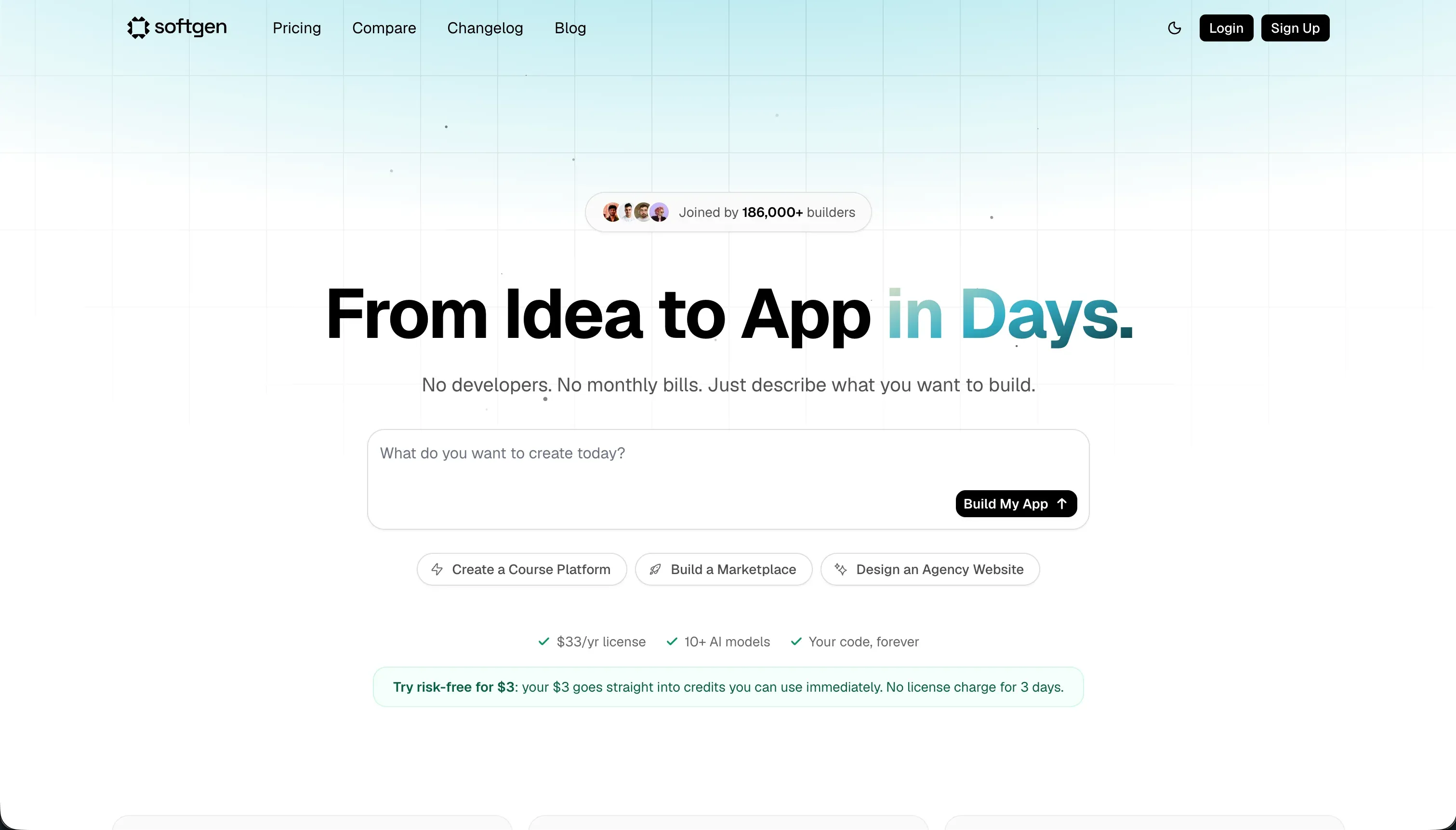
Softgen is a conversational AI application builder. Its Cascade AI agent guides users through outlining, architecting, and modifying application features in plain language. You describe what you want, the agent generates a full-stack web application - including a database schema, user authentication, and Stripe payment integration - and deploys it instantly to Softgen’s hosting environment. Post-generation, modifications happen through the chat interface or light visual tweaking. The platform targets creators and indie hackers looking to build and test MVPs and directories without an engineering background. The pricing model is unusual: a low annual membership fee ($33/year) plus separate pay-as-you-go AI usage credits.
| Spec | Details |
|---|---|
| Primary Stack | AI-generated frontend + database schema + hosted auth |
| Interface | Conversational Cascade AI agent + light visual tweaking |
| Primary Deployment Target | Softgen managed hosting with custom domain support |
| Key Advantage | Low annual base cost, structured planning conversation before building |
What is Softr?
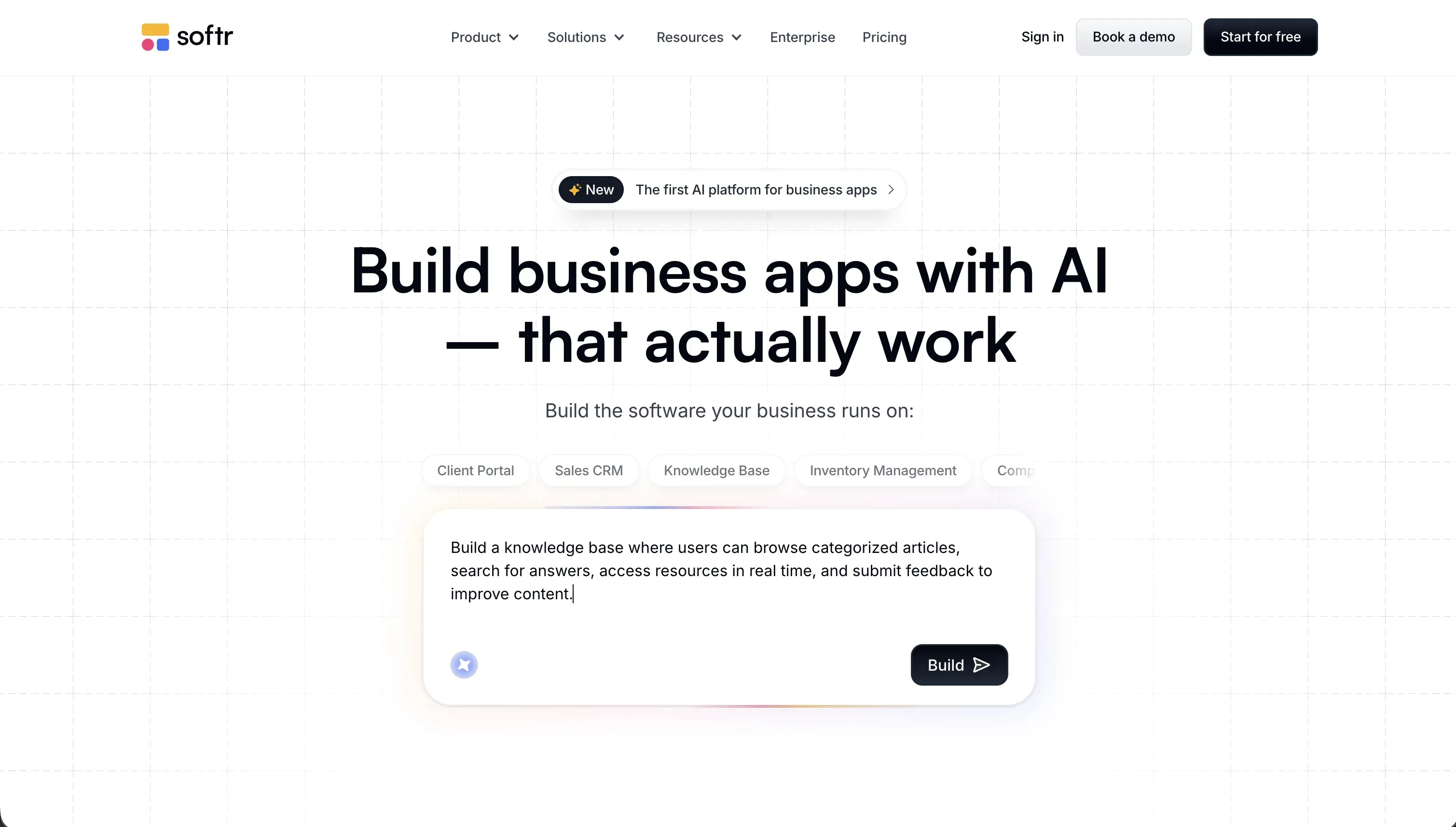
Softr is an AI-powered platform for building business software without code. Its AI Co-Builder generates complete applications from a text description - database tables, pages, navigation, user groups, and theme - in minutes. After generation, builders work in a visual drag-and-drop block editor where they can adjust layouts, configure permissions, connect data sources, and build workflow automations without going back to the AI. Softr’s native relational database (Softr Databases) is built for business operational data and serves as the default data layer for most applications; the platform also connects to 17 external data sources including Airtable, HubSpot, Google Sheets, and SQL databases. It provides granular user group permissions with row-level database security, and ships with SOC 2 Type II certification. Over 1 million builders and organizations including Netflix, Google, Stripe, UPS, and MIT use it to build client portals, internal tools, CRMs, intranets, and operational dashboards.
| Spec | Details |
|---|---|
| Primary Stack | Visual no-code blocks + AI Co-Builder + native Softr Databases |
| Interface | AI prompt for app generation + visual drag-and-drop block editor |
| Primary Deployment Target | Softr managed cloud (custom domains, PWA support) |
| Key Advantage | Visual editing + AI generation hybrid, with granular user permissions and SOC 2 compliance |
The Core Difference
The core difference between Softgen and Softr is the answer to a simple question: what happens on day two?
Softgen is optimized for day one. The structured AI conversation helps you quickly translate a business idea into a deployed web application. For the initial build, the experience is fast and accessible. The problem is that day two - adding a feature, changing a permission, adjusting a layout, onboarding a new user group - requires going back through the chat interface. There is no visual editor for layout changes, no click-to-configure permission panel, no data filter builder. Every change is mediated by an AI prompt, which means every change carries the risk of misinterpretation, regression, or unexpected credit consumption.
Softr is designed for sustained operation. Yes, the AI Co-Builder can generate an initial application faster than any manual configuration process. But after generation, the entire application is editable through a visual drag-and-drop interface. Adding a field to a table is a two-click operation. Changing a user group’s data visibility is a dropdown selection. Building a new page from an existing template takes minutes. Non-technical team members can maintain and evolve the application without any developer involvement - and without consuming AI credits for routine updates.
Put differently: Softgen optimizes for the first hour of building. Softr optimizes for the next two years of operating. For throwaway MVPs and demos, Softgen’s model is efficient. For any application that real users will depend on in a business context, Softr’s operational design philosophy is the more appropriate foundation.

Head-to-Head Comparison
1. Developer Experience & Iteration Speed
Softgen’s initial app generation is fast. The Cascade AI agent’s structured conversation - outlining the application’s features in a planning phase before building begins - is a thoughtful design choice that helps users clarify requirements before AI credits are consumed. For straightforward applications with clear, well-defined scope (a landing page, a simple form-driven tool, a basic directory), Softgen can produce something deployable quickly.
The iteration speed advantage evaporates when requirements are not perfectly clear from the start, which is the normal state for most real-world projects. Because Softgen has no visual editor for layout modifications, every visual refinement requires a chat prompt. One reviewer from SourceForge captured this accurately: “Customizing beyond the initial AI-generated output required some manual coding, which may not suit everyone’s needs.” For business operators who want to make precise visual adjustments - a different column width, a button repositioned, a specific form field styled differently - the chat-prompt loop is slower and less precise than a visual editor. SelectHub’s market analysis notes that Softgen “falls short in offering extensive customization and flexibility” when compared to platforms with dedicated visual editing layers.
Softr’s iteration loop is different in kind. The AI Co-Builder handles rapid initial generation, and then the visual editor takes over for refinements. A builder who wants to change a block’s data source, add a column to a table, or rearrange page sections does so directly in the interface - no prompting, no credit consumption, no risk of regression. For teams doing active product development with frequent changes, this cycle is significantly faster than re-prompting an AI for each adjustment. G2 reviewers consistently note that Softr’s visual editor makes updates “quick” and “straightforward” - one reviewer noted they could “change a layout, adjust visibility rules, or tweak styling in minutes.”
2. Code Quality & Portability
Softgen offers code export as a feature for users who want to take their generated codebase off the platform. For developers using Softgen as a scaffolding tool - generating an initial structure and then continuing development locally - this portability option is a genuine differentiator from fully closed builders. The generated code gives you a starting point for a custom development project.
The practical quality concern is the same one that affects all AI-generated codebases: the initial output is a starting point, not a finished product. SelectHub’s analysis notes a “potential trade-off between speed and long-term maintainability” in Softgen’s output. AI-generated application code tends to have inconsistent naming conventions, nested logic that could be refactored into reusable components, and styling implementations that work but are not optimal for long-term maintenance. If you export Softgen’s code expecting a production-ready codebase, plan for developer time to audit and clean it up before treating it as a foundation.
Softr operates on a different model: it’s a no-code platform, and its applications run on Softr’s visual infrastructure rather than on a generated codebase. The Vibe Coding block - Softr’s mechanism for creating custom UI elements - generates React components that can be inspected and modified. But the broader application structure (pages, blocks, workflows, permission rules) is configured visually rather than expressed in exported code. For the non-technical business operator who is Softr’s primary target, this is entirely appropriate - they don’t want to manage a codebase. For developers evaluating code portability specifically, Softgen’s export capability is the differentiator.
What Softr does provide in terms of data portability is more relevant for most business applications: full data export from Softr Databases, REST API access to your records, native connections to external data sources you already own (your Airtable base, your PostgreSQL database), and an MCP server that connects external AI tools directly to your Softr data. If you stop using Softr, your data travels with you.
3. Database & Backend Capabilities
Softgen generates a relational database schema and standard authentication flows as part of its initial application. For simple data models - a list of contacts with notes, a basic inventory with categories, a project tracker with statuses - this is functional and sufficient. Stripe payment integration is included in the feature set, which is useful for founders building monetized products.
The database and security limitations become apparent for complex business applications. Softgen’s access control system lacks field-level and button-level permission granularity. All users in a given role see the same data fields and the same interface elements. For applications where a manager needs to see financial data that a regular employee should not, or where a specific action button should only appear for authorized administrators, Softgen’s permission model cannot accommodate this. The platform also lacks documented SOC 2 or GDPR compliance certifications for the data it hosts.
Softr’s database infrastructure is purpose-built for business operational software. Softr Databases is the platform’s native relational database, designed specifically for the kind of structured, multi-tenant data that operational apps require. It supports linked records across tables, rollup fields for calculated aggregations, CSV import, Airtable base import, and a REST API with connectors for Zapier, Make, and n8n. It’s optimized for fast reads on filtered datasets with high record counts. The database also supports MCP integration, allowing Claude, Cursor, ChatGPT, and other external AI assistants to read, write, and modify data and schemas via natural language - a capability that enables teams to build sophisticated AI-powered workflows on top of their business data. For teams with existing data in other systems, Softr also connects to 17 external sources including Airtable, HubSpot, Google Sheets, and SQL databases.
Security in Softr operates at multiple layers simultaneously. Row-level database security rules govern which user groups can access which records. Page-level visibility rules determine which pages appear in each user’s navigation. Block-level visibility controls show or hide interface components based on user group membership or dynamic conditions. Button-level permission rules restrict specific actions to authorized roles. All of this configuration is visual and click-to-set - no code or SQL required. Softr is SOC 2 Type II certified and hosts all user data in Germany, making it compliant with GDPR requirements that regulated industries require.
4. Hosting & Deployment Options
Softgen’s hosting is included and handles deployment automatically after AI generation. One-click deploy to a live URL with custom domain support is straightforward and appropriate for the platform’s use case. For an indie builder who wants to show something to early users quickly, Softgen’s hosting removes any infrastructure friction. The pay-as-you-go nature of the credit model means you are not paying a monthly hosting fee when the application is not actively being developed.
The operational risk with Softgen’s hosting is less about the infrastructure itself and more about the dependency: all modifications to the application go through the AI chat interface and Softgen’s servers. If you want to make a change and the AI misinterprets the prompt, you consume credits and potentially introduce regressions without being able to directly edit the output. There is no direct file access, no staging environment, and no deployment pipeline you can inspect or control.
Softr’s hosting is managed on its cloud infrastructure, with custom domains on all paid plans, SSL provisioning, and PWA configuration for mobile home screen installation. Softr’s applications are deployed instantly when changes are published - there is no build pipeline to wait for. The SPA (Single Page Application) mode provides snappy, native-app-like navigation within the hosted application. Enterprise plans include SLAs for uptime and dedicated support for deployment issues.
Softr also supports connecting external data sources for teams that have existing data infrastructure. If your team’s records already live in Airtable, Google Sheets, or a PostgreSQL database, you can build a Softr portal that reads and writes directly to those systems alongside Softr’s own native database - no forced migration required. This is a deployment model that Softgen does not support.

Pricing Comparison
Softgen uses an annual membership plus pay-as-you-go credit model:
- Annual Membership: $33/year - covers platform access and hosting rights
- AI Usage Credits: Pay-as-you-go packages - fund AI generation, updates, and modifications
The low annual base cost is Softgen’s most attractive pricing aspect. For indie hackers testing an MVP idea, $33/year is a minimal commitment. The unpredictability comes from the credit layer: active development with frequent iterations consumes credits at rates that reviewers flag as potentially significant for complex or iterative projects. The absence of a published credit-per-action rate card makes it difficult to budget development costs in advance.
Softr uses flat tiered subscriptions with predictable costs:
| Plan | Annual Price | Monthly Price | App Users | DB Records | Workflow Actions | AI Credits |
|---|---|---|---|---|---|---|
| Free | $0/mo | $0/mo | 5 total | 5,000 | 500 | 5 |
| Basic | $19/mo | $25/mo | 5 Team + 5 Client | 50,000 | 2,500 | 10 |
| Pro | $99/mo | $119/mo | 10 (to 50) Team + 50 (to 250) Client | 500,000 | 10,000 | 50 |
| Business | $329/mo | $395/mo | 30 (to 100) Team + 100 (to 500) Client | 1,000,000 | 25,000 | 100 |
| Enterprise | Custom | Custom | Custom | Custom | Custom | Custom |
All plans include unlimited collaborators - no per-seat charges for your internal team building and managing the application. AI credits cover the AI Co-Builder, Vibe Coding block generation, and AI-powered user features like Ask AI and database enrichment. Critically, AI credits are not the only way to build - every AI action in Softr can also be done manually in the visual editor. Running low on credits never blocks you from making changes or maintaining your application.
Softr’s Pro plan ($99/month annually) is where most production business applications land. It supports 10 team app users (expandable to 50) plus 50 client app users (expandable to 250), external clients or team members who use the application, 500,000 database records, and adds custom user groups and advanced integrations. The Business plan ($329/month annually) scales to 30 team app users (expandable to 100) plus 100 client app users (expandable to 500) and 1,000,000 records, adding HubSpot, SQL databases, and REST API integrations.
Compared to Softgen’s base cost of $33/year, Softr’s paid tiers are higher. But the appropriate comparison is not base cost alone - it’s total cost of operation for a production business application. Softgen’s credit consumption during active development, the lack of visual editing (requiring more prompts per change than a direct visual editor would), and the eventual need to involve a developer for complex customizations all represent costs that don’t appear in the $33/year figure. Softr’s flat, predictable pricing covers a complete platform with professional-grade infrastructure, compliance certifications, and a maintenance model that non-technical teams can sustain independently.
Use Case Fit: When to use which?
When to choose Softgen
- You are an indie hacker or solo founder testing an MVP idea quickly with a minimal budget commitment.
- Your application is simple enough that the initial AI generation captures most of what you need, and you expect limited post-launch iteration.
- You want a structured planning conversation with an AI agent before committing to a build - Softgen’s Discuss Mode is genuinely useful for this.
- You intend to export the generated code and continue development in a local IDE, treating Softgen as a scaffolding tool rather than a long-term platform.
- You are building a demo or prototype to validate a concept before investing in a production-grade platform.
When to choose Softr
- You are building production business software that real users - clients, employees, partners - will rely on as part of their daily work.
- Your application needs granular user permissions where different roles see different data, pages, and interface elements.
- Your team includes non-technical operators who need to maintain and extend the application after launch without developer assistance.
- You need a fast, reliable database for your business data - Softr Databases is the default starting point, with options to connect existing data sources like Airtable, HubSpot, Google Sheets, or PostgreSQL if you already have data there.
- You require enterprise-grade security compliance (SOC 2 Type II, GDPR, data hosted in Europe).
- You want predictable monthly costs rather than variable credit consumption.
- You are building for external users (clients, partners, members) and need a white-labeled portal with custom domain and branding.
When neither Softgen nor Softr is the right fit
Both Softgen and Softr build web applications for non-technical users. But some project types fall outside what either platform delivers well.
For native mobile apps
Neither Softgen nor Softr produces native mobile binaries for App Store or Google Play distribution. Softgen generates browser-based web applications. Softr deploys managed web applications with PWA support for home screen installation, but PWA is not the same as a native app store submission.
For projects that specifically require App Store and Google Play distribution with native-grade performance, push notifications, offline capabilities, and native device API access, FlutterFlow is the appropriate tool. It is built on Flutter’s cross-platform widget engine and compiles to native Dart code for both iOS and Android. Applications built in FlutterFlow pass App Store review standards and perform like native applications. It requires more learning investment than either Softgen or Softr, but it delivers genuinely native mobile output.
For professional developer environments
Softgen’s chat-based editing is less precise than a dedicated coding environment, and its generated code may require cleanup before it meets production quality standards. Softr is a no-code platform that does not expose code except through the Vibe Coding block.
For experienced developers building complex, custom applications, AI-assisted coding environments like Cursor provide far more control. Cursor is a VS Code fork that indexes your local codebase and provides context-aware multi-file editing, making it appropriate for full-stack projects that require custom database schemas, API design, and business logic that goes beyond what visual platforms support. For cloud-based development with backend services and persistent environments, Replit provides virtual machine containers, collaborative coding, and Replit Agent for autonomous development tasks.
Verdict
Softgen and Softr are targeting different use cases, and the choice between them is clearer than most platform comparisons.
Choose Softgen if you are testing an idea quickly, have a simple application with limited post-launch iteration needs, and want a low-cost entry point. The $33/year base and pay-as-you-go credits make it a reasonable tool for an MVP or prototype. Accept that visual refinements require AI prompting rather than direct editing, that the permission model lacks enterprise depth, and that complex applications will likely require developer involvement to finish. Treat it as a scaffolding tool rather than a production platform, and it can be efficient for its intended narrow use case.
Choose Softr if you are building any application that real users will rely on - clients logging into a portal, employees using an internal tool, partners accessing a shared dashboard. Softr’s combination of AI-powered generation and visual editing gives non-technical teams both the speed of AI and the control of a visual builder. Its native Softr Databases handle business data reliably from day one, and the platform’s granular user permission system, SOC 2 Type II compliance, 17 external data integrations, and flat subscription pricing make it the appropriate foundation for operational business software. Over 1 million builders and enterprise organizations have validated this use case, and the platform’s “day two” operational model is specifically designed to keep that software maintainable and evolving without developer dependency.

Summary Comparison Table
| Feature | Softgen | Softr |
|---|---|---|
| Build Paradigm | Conversational AI generation (chat-first) | AI Co-Builder + visual drag-and-drop block editor |
| Output Type | Managed hosted web app (code export available) | Managed hosted no-code app (visual configuration) |
| Database | AI-generated schema, managed by Softgen | Native Softr Databases + 17 external data integrations |
| Visual Permissions | Basic roles, no field/button-level granularity | Granular user groups, row-level security, button-level controls |
| Pricing Metric | $33/year base + pay-as-you-go AI credits | Flat subscription tiers ($19-$329/month annually) |
| Maintenance Burden | Medium (chat-only edits; developer needed for complex changes) | Low (visual editor; non-technical teams can maintain) |
| Code Export | Yes (Builder plan $40/mo annually and above) | Vibe Coding blocks only; data export via API |