

Replit and WeWeb both help you ship web apps without starting from a blank repo, but they attack the problem from opposite ends. Replit is a cloud-based development environment with an autonomous agent that writes and deploys full-stack code from a prompt. WeWeb is a visual frontend builder that produces a Vue.js single-page app and leaves the backend entirely to external services you connect yourself.
The people choosing between these two are usually technical: a developer or technical founder deciding whether to let an AI agent scaffold the whole stack, or to keep a clean separation where they design the frontend visually and own the backend. What is at stake is real money and real maintenance. Pick Replit and you accept credit-based billing that can spike during debug loops; pick WeWeb and you accept a multi-tool stack and a learning curve measured in weeks. Either way, the first version is the easy part, and the cost shows up later.
Meet the Contenders
What is Replit?
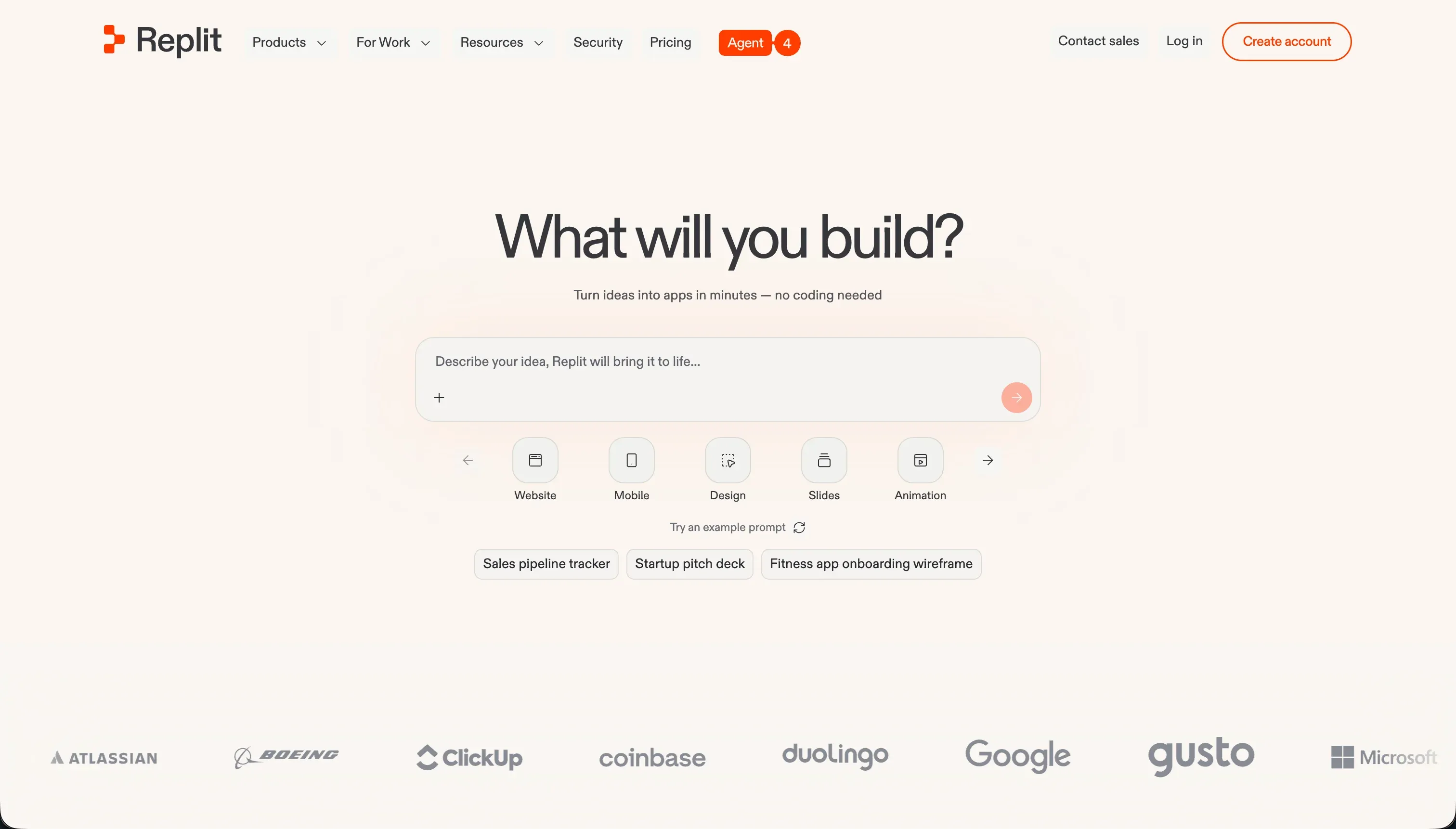
Replit is a cloud-based development environment that supports multiplayer collaborative coding in over 50 programming languages directly in a browser tab. It started as a learning sandbox and code editor, then moved into autonomous building with Replit Agent, which reads your spec, creates project files, configures a PostgreSQL database, installs npm packages, and deploys with one click.
In practice, Replit works like a real IDE with an AI sitting next to you. You get full terminals, package managers, a managed database layer with backup and migration tools, and instant deployment with autoscaling and custom domains. Replit Agent runs self-correction loops to test its own code and fix compilation errors, and Ghostwriter adds context-aware autocomplete and inline debugging. The tradeoff is that the output is real code you have to monitor, and the agent sometimes loops on bugs it created or ignores your chosen stack, for example writing Postgres when you asked for Firebase.
Replit is genuinely built for developers, programming students, and technical founders who want a zero-setup environment to experiment, learn, and scaffold prototypes with AI help. It gets frustrating for non-technical operators, because keeping an app running means managing migrations, environment secrets, and scaling, and because credit-based billing can drain hundreds of dollars in a day during agent debugging runs.
| Spec | Details |
|---|---|
| Primary Stack | Full-stack cloud IDE with managed PostgreSQL and 50+ supported languages |
| Interface | Browser code editor plus Replit Agent for prompt-driven scaffolding |
| Primary Deployment Target | Autoscaling hosted apps on <app>.replit.app with custom domains |
| Key Advantage | Agent builds and deploys real full-stack code, with downloadable source |
What is WeWeb?
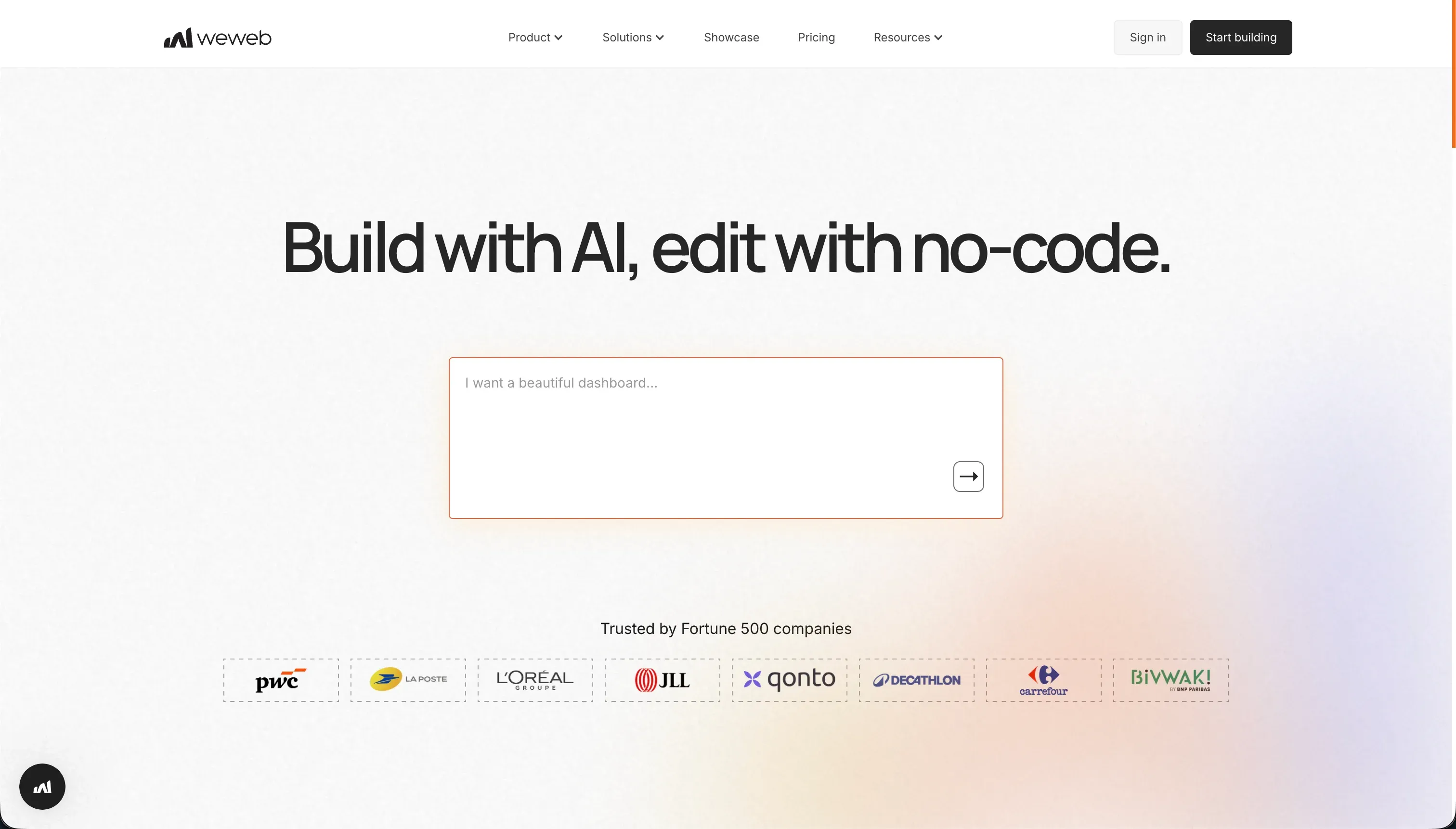
WeWeb is a visual frontend builder designed to construct web applications on top of a decoupled backend. Instead of bundling templates and a database into one closed ecosystem, WeWeb generates only the user interface, compiling your layout into a Vue.js single-page app, then talks to external databases through REST APIs.
In practice, WeWeb is the most visually precise builder short of Webflow. Its layout engine supports CSS flexbox, grids, and absolute positioning, and you configure variables, action triggers, and conditional data routing through a visual state manager. A built-in AI assistant writes JavaScript snippets and CSS classes for custom components, and the hybrid rendering engine keeps SPAs SEO-indexable. The catch is that WeWeb stores no data and handles no auth natively, so you build, pay for, and connect a separate backend like Xano, Supabase, or Airtable, plus a separate auth setup, which multiplies the points of failure.
WeWeb is built for frontend developers, UI designers, and agencies who want pixel-level CSS control and are comfortable running decoupled backends. It is a poor fit for non-technical operators or SMB founders who just want a client portal, because mapping API payloads, configuring token-based authentication, and managing multiple services takes weeks of study, and reviewers repeatedly flag slow, unresponsive customer support.
| Spec | Details |
|---|---|
| Primary Stack | Frontend-only builder compiling to Vue.js / Nuxt.js, connected to external backends |
| Interface | Visual CSS layout editor with visual state management and an in-editor AI assistant |
| Primary Deployment Target | Hosted SPA on a WeWeb domain, or exported Vue code self-hosted on Scale plans |
| Key Advantage | Pixel-level layout control and a clean code-export exit path on Scale |
The Core Difference
The biggest difference is not how each tool looks. It is how much of the stack the tool owns versus how much it hands back to you.
- Replit owns the whole stack: it generates and hosts real full-stack code, including backend and database, through an AI agent, in exchange for credit-based billing and code you must maintain.
- WeWeb owns only the frontend by design, giving you precise visual control over a Vue.js SPA while you supply, secure, and pay for the backend and authentication separately.

Head-to-Head Comparison
We evaluated both platforms across six categories that matter for these two tools.
1. Developer Experience & Iteration Speed
Replit is fast at the first hour. Prompt Replit Agent, and it scaffolds files, sets up a PostgreSQL database, installs dependencies, and deploys, so a functional skeleton appears quickly without local setup. The visual editor lets you tweak text, images, margins, and colors from the preview, and Figma import converts designs into front-end components. For getting from idea to running app, it is hard to beat.
The trouble is iteration after that first demo. Users report the agent going around in circles, announcing it “fixed the bug” while creating new ones, and even ignoring the stack you specified by building Postgres when you asked for Firebase. Because every agent run consumes credits, slow iteration is not just annoying, it is expensive, with documented reports of $350 in a single day from debugging churn.
WeWeb’s iteration is slower to start but more deterministic once you know it. There is no agent regenerating your app, so you build layouts with flexbox and grids and wire data through visual state management, which gives you precise, repeatable control. The cost is the ramp: configuring state variables, page permissions, and API JSON payloads is described by reviewers as taking weeks to learn.
Once you are fluent, WeWeb iteration is steady because nothing rewrites your work under you, but you pay for that control with manual setup of every binding. There is no autonomous scaffolding to lean on, so the speed depends entirely on how well you already know web development.
Edge: Replit, because the agent gets you to a working full-stack app dramatically faster, even though that speed comes with credit risk.
2. Code Quality & Portability
Replit produces real, exportable code. You can download your Python, Node, or HTML source at any time and host it elsewhere, so you are not locked into Replit’s environment. That is a genuine strength for a technical team that wants an escape hatch, and it covers the full stack including backend logic.
The quality caveat is that agent-generated code still needs review. The output must be monitored, refactored, and maintained to avoid technical debt, and the same agent that scaffolds quickly can also introduce catastrophic bugs. One widely shared report describes the agent escalating a routine update into production data loss. Exportable does not mean hands-off.
WeWeb also exports code, but only the frontend and only on the Scale plan at $249 per month. You get compiled Vue.js and Nuxt.js files you can host on Vercel or Netlify, which is clean and developer-friendly for the interface layer. Frontend developers rate WeWeb as one of the most visually flexible builders, and that flexibility carries into the exported code.
The limit is that WeWeb’s export is half the app. Your data and auth live in a separate backend, so portability of the frontend does not give you a portable whole-stack application. You are exporting a UI that still depends on services you manage outside WeWeb.
Edge: Replit, because it exports a complete full-stack codebase at any tier, while WeWeb exports only the frontend and gates it behind the $249 Scale plan.
3. Database & Backend Capabilities
Replit ships a managed database layer. It provisions and manages SQL databases such as PostgreSQL with built-in backup, restoration, and migration tools, and the agent can create and edit the schema from prompts. For a developer who wants backend and frontend in one place, that integration is the whole point.
The weakness is operational. Managing schemas and security still requires Postgres knowledge, and the automatic checkpoint backups have generated surprise charges, including a reported $1,500 database overage from frequent backups and migrations. The backend is capable, but it can bite you on both complexity and cost.
WeWeb has no native database or authentication at all. By design it is frontend-only, so you connect Xano, Supabase, or Airtable for data and a separate provider for auth. The upside of this decoupling is real flexibility: you can change the backend without touching the interface, which suits teams that already standardized on a backend.
The cost of that design is a multi-tool stack with more breaking points and more bills. The free tier limits you to 150 records through the connected source, and reviewers note that integrating something like a headless CMS can be painful. You get freedom, but you also get the full burden of running the backend yourself.
Edge: Replit, because it actually provides a managed database and backend in one environment, while WeWeb owns none of it and pushes that work onto separate services.
4. Hosting & Deployment Options
Replit handles hosting end to end. Apps deploy with autoscaling, custom domain routing, and live previews in one click to a replit.app address, with reserved virtual machines available for steadier workloads. For a developer who does not want to configure DevOps, that convenience is real.
The drawbacks show up under load and in production parity. Reviewers report session latency and virtual machine connection drops on larger repositories, and users describe deployment-to-editor mismatches where environment variables or database connectivity differ in production from what previews showed. The deploy button is easy; the production behavior is not always predictable.
WeWeb also hosts your SPA for you, and the hybrid rendering engine keeps it SEO-indexable, which is a plus for apps that need to be crawlable. Deployment to a WeWeb domain or a custom domain on paid plans is straightforward for the frontend.
WeWeb’s real flexibility is the export option: on Scale you can self-host the compiled Vue.js code on Vercel, Netlify, or your own servers, which gives you control Replit’s managed hosting does not. But again, that is only the frontend; your backend is hosted and scaled separately, so deployment is never a single coordinated action.
Edge: WeWeb, narrowly, because its SEO-friendly SPA output plus self-hosting on Scale gives more deployment control, while Replit’s managed hosting is easier but shows production drift and latency.
5. AI Quality & Reliability
Replit’s AI is foundational to the product. Replit Agent builds entire applications from natural language, runs reflection loops to test and self-correct, and Ghostwriter adds inline debugging and refactoring. When it works, it is the most capable AI in this matchup because it touches the whole stack.
Reliability is the open question. The same agent is documented looping on self-created bugs, faking success while errors persist, and ignoring the chosen tech stack. Users even allege the platform throttles context to 8,000 tokens during certain runs, which produces more mistakes and therefore more billable fixes. The AI is broad, but its failure modes are expensive.
WeWeb’s AI is deliberately narrow. The in-editor assistant generates JavaScript snippets and CSS classes for custom components, helping you build pieces faster, but it does not scaffold or maintain the whole app. It is a helper, not an autonomous builder.
That narrowness is also a kind of reliability. Because the AI is not regenerating your application or making backend decisions, it cannot loop you into a credit-draining debug spiral or rewrite working logic. You give up speed and breadth, but you keep predictable, human-controlled iteration.
Edge: Replit, because its agent does far more, but with a real reliability and billing risk that WeWeb’s limited assistant simply avoids.
6. Learning Curve & Onboarding
Replit is approachable on the surface if you can prompt and read code. The browser environment removes setup entirely, and the agent does the initial heavy lifting, so a technical user can be productive quickly. For programming students and developers, it doubles as a strong learning platform across most languages and frameworks.
The hidden curve is operational. The first prompt is easy, but understanding migrations, secrets, scaling, and the credit model is not, and the billing console is criticized for offering no clear breakdown of where credits went. Onboarding feels smooth until the first surprise bill or agent loop.
WeWeb is honest about being harder. Setting up layouts, conditional routing, token-based authentication, and API payloads requires solid web development understanding, and users say documentation has not always kept pace with updates, so you sometimes dig to figure out how things work. This is not a tool a non-developer picks up in an afternoon.
The flip side is that the learning maps to durable skills. Once you understand WeWeb’s visual state model, you have precise control that does not change under you. The onboarding is steep, but it is steep toward real frontend capability rather than toward managing an unpredictable agent.
Edge: Replit for technical users who want to start fast, though both are genuinely demanding and neither suits a true non-developer.

Pricing Comparison
Replit:
- Starter - $0/mo, daily dynamic Agent credits, built-in database, publish up to 1 public project
- Replit Core - $25/mo annually or $25 base, $25.00 monthly credits, invite up to 5 collaborators, 2 parallel agents, unlimited workspaces
- Replit Pro - $95/mo annually or $100/mo, $100.00 monthly credits, up to 15 collaborators, 50 viewers, 10 parallel agents, 28-day database rollbacks
- Enterprise - Custom pricing, SSO/SAML, advanced privacy, single-tenant, VPC peering
Note: AI usage is credit-based and effort-priced, so the bill depends on agent task complexity and runtime, not a flat fee per prompt. Users report large single-day spikes during debugging.
WeWeb:
- Free - $0, editor and visual builder access, up to 150 database records, weweb.io subdomain
- Starter - $39/mo annually or $59/mo, 1 published app, custom domain, 50,000 monthly page views, basic integrations
- Scale - $199/mo annually or $249/mo, 3 published apps, 250,000 monthly page views, staging environments, code export
- Enterprise - Custom pricing, self-hosting, unlimited page views, advanced SSO, SLAs
Note: WeWeb has no native database, so a backend service such as Xano or Supabase is a separate, additional cost on top of these plans.
Use Case Fit: When to use which?
When to choose Replit
- Choose Replit when you want an AI agent to scaffold a full-stack app, including database and backend, and you are technical enough to review and maintain the generated code.
- Choose Replit when multiplayer real-time collaboration matters, since shared cursors, voice chat, and team billing make it strong for pairing developers.
- Choose Replit when you value owning a complete, downloadable codebase and can tolerate credit-based billing that varies with agent runtime.
When to choose WeWeb
- Choose WeWeb when you already run a backend like Xano or Supabase and want a precise, visually controlled Vue.js frontend on top of it.
- Choose WeWeb when pixel-level CSS layout control and SEO-indexable SPA output matter more than having an AI build the whole app.
- Choose WeWeb when predictable plan-based pricing and an eventual frontend code export on the Scale plan outweigh the cost of managing a separate backend.
When neither Replit nor WeWeb is the right fit
For internal tools and client portals
If your real goal is a client portal, vendor portal, or internal CRM that a non-technical team can run and change safely, neither Replit nor WeWeb is the natural fit. Replit hands you a full-stack codebase to maintain, and WeWeb makes you wire a separate backend and token-based auth before a single user can log in. Both leave the unglamorous foundation, authentication, roles, and permissions, as work you do yourself.
For that job, look at Softr or Retool. Softr ships authentication, granular user groups, and row-level restrictions out of the box, with a native database first and 17 external sources like Airtable and Google Sheets if you need them, so an operations team can publish a portal in a day and change a permission without re-prompting or re-coding. Retool is the stronger pick for data-heavy internal dashboards where engineers want to assemble admin tools quickly over existing databases. Both remove the backend-and-auth wiring that Replit and WeWeb leave on your plate.
For native mobile apps
If you need to ship native iOS and Android binaries to the App Store and Google Play, both tools fall short. WeWeb only produces responsive web apps and PWAs, with no native packaging path, and reviewers even note its mobile performance trails its desktop experience. Replit can build mobile apps from prompts and help prepare store submission configurations, but you still manage that build and submission as a developer rather than getting a true app-store pipeline.
For native distribution, FlutterFlow is the stronger option when you want serious native-app flexibility and a real path to compiled app-store output, while Adalo is the simpler choice for a more beginner-friendly native-mobile builder. Both are built for the app stores in a way neither Replit nor WeWeb is.
For complex visual web apps without managing a backend
If you want deep application logic and a visual builder but do not want to assemble and secure a separate backend the way WeWeb requires, there is a middle ground neither tool occupies well. WeWeb gives you the frontend and nothing else, and Replit gives you code you own and must maintain.
Bubble is the heavyweight option here, pairing a visual builder with its own integrated database and workflow logic for genuinely complex web apps, so you are not stitching services together. For teams whose complexity is really about business operations rather than custom UX, Softr again fits, because its workflow engine, native database, and permissions cover operational logic without a decoupled stack.

Verdict
Pick Replit if you are technical and want an AI agent to build and deploy a full-stack app, database and backend included, from a prompt. It is the more complete builder in this matchup, it gives you a real, downloadable codebase, and its collaboration features are excellent for developer teams. The tradeoff is accepting credit-based billing that has produced documented single-day spikes, an agent that sometimes loops on its own bugs, and code you are responsible for maintaining.
Pick WeWeb if you already own a backend and want precise visual control over a Vue.js frontend with an SEO-friendly SPA output and a clean code-export path on the Scale plan. It is the better choice for frontend developers and agencies who value layout precision and predictable plan pricing. The tradeoff is a steeper learning curve, a multi-tool stack you must secure and pay for separately, and customer support that reviewers describe as slow and unresponsive.
The day-two reality decides most of these calls. The first version is rarely the expensive part; the expensive part is every change after launch, when a permission needs updating, a user group needs adding, or a bug touches production. Between these two, Replit ages better for developers who want to own full-stack code, while WeWeb ages better for frontend specialists with a backend already in hand. If the app is really business software that a non-technical team must run, Softr or Retool will age better than either, because the permissions and infrastructure are built in rather than wired by hand.

Summary Comparison Table
| Criterion | Replit | WeWeb |
|---|---|---|
| Best for | Developers wanting full-stack AI scaffolding | Frontend devs and agencies with their own backend |
| Build paradigm | Cloud IDE plus autonomous Replit Agent | Visual frontend builder, decoupled from backend |
| Output type | Full-stack real code, hosted on replit.app | Vue.js / Nuxt.js SPA |
| Database | Managed PostgreSQL built in | None native; connect Xano, Supabase, or Airtable |
| Pricing metric | Subscription plus dynamic credit billing | Plan-based by published apps and page views |
| Code export | Yes, full stack, any tier | Frontend only, on the $249 Scale plan |
| Maintenance burden | High; you maintain generated code | High; you maintain a multi-tool stack |