

Emergent and WeWeb solve the same headline problem, but they do it from opposite directions. Emergent is an AI scaffolding tool that tries to generate the whole app stack from prompts, while WeWeb is a visual frontend builder that expects you to bring your own backend. One is trying to remove setup by generating it, and the other is giving you more UI control by separating frontend from infrastructure.
The people actually choosing between these two are usually founders, product teams, agencies, or technical operators who want to ship a web app without a full custom build. What matters here is not just how fast you get a demo, but how much glue work, lock-in, and debugging show up later. If you pick wrong, you either end up paying for repeated AI fixes or manually wiring auth, APIs, and state across a decoupled stack.
Meet the Contenders
What is Emergent?
Emergent is an AI-powered app development platform built around prompt-to-application generation. Its pitch is simple: describe the product in natural language and let the platform generate the frontend, backend, database, and hosting for you.
In practice, it works like a conversational full-stack builder. You prompt the system, it scaffolds database routing, UI elements, and cloud deployment, then you keep revising through chat-based edits. Key capabilities include prompt-to-application scaffolding, conversational revisions, built-in cloud deployment, GitHub integration on paid plans, and a credit-based system where even small edits can consume your monthly pool.
It is genuinely built for people who want to skip setup and get to a working app quickly, especially non-technical founders or operators trying to prototype a workflow fast. The people who get frustrated are usually the ones who need stable iteration, predictable billing, or confidence that a fix will stay fixed, because user reports repeatedly mention undoing completed work, waking errors, and expensive debug loops.
| Spec | Details |
|---|---|
| Primary Stack | AI-generated full-stack web apps with managed backend, database, and hosting |
| Interface | Conversational prompt builder with AI-led revisions |
| Primary Deployment Target | Hosted web apps with built-in cloud deployment and preview links |
| Key Advantage | Very fast full-stack scaffolding from a single prompt |
What is WeWeb?
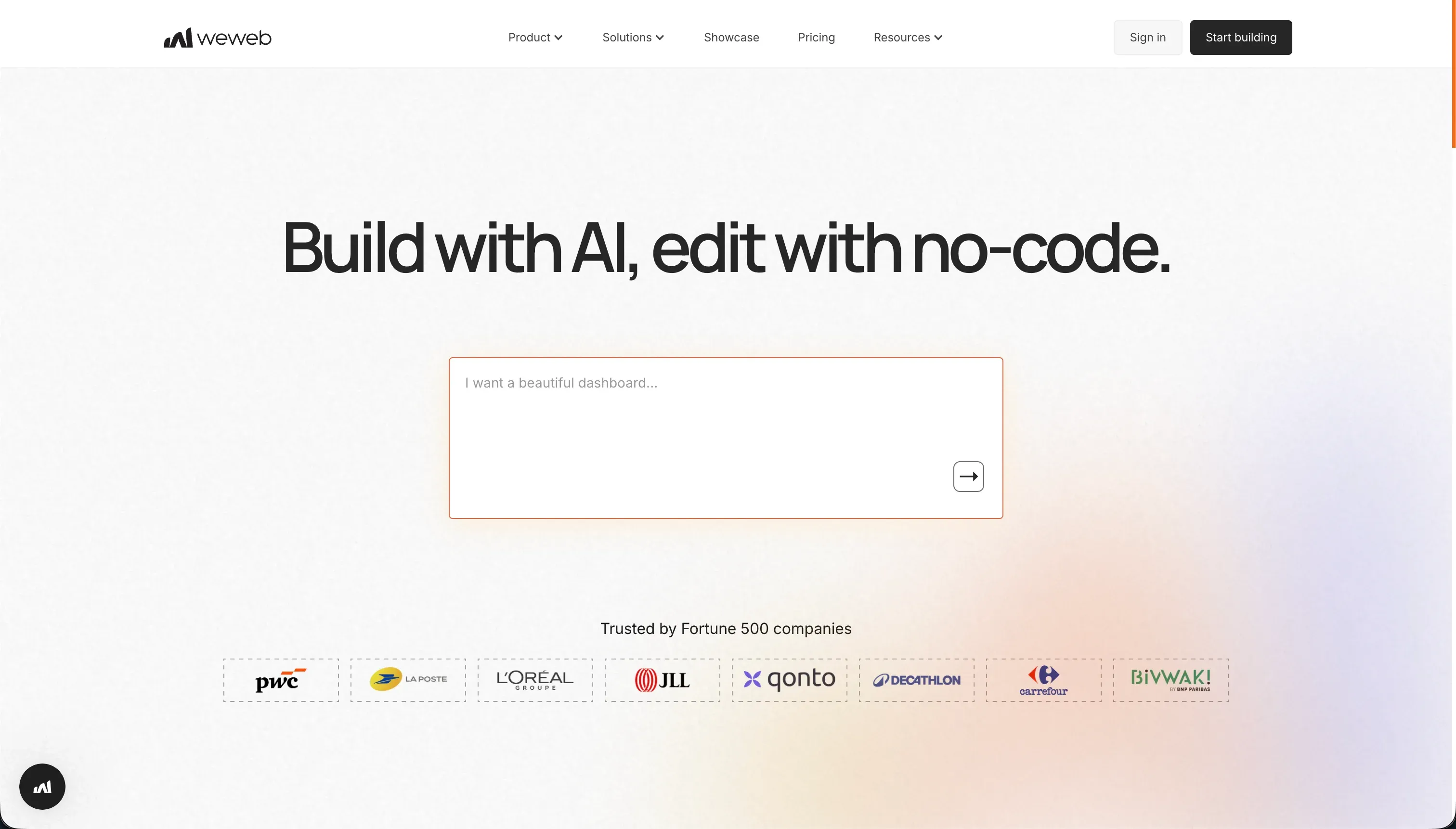
WeWeb is a visual frontend builder for web applications. Instead of generating the whole stack, it focuses on the interface layer and lets you connect that frontend to external databases or APIs such as Supabase, Xano, or Airtable.
In practice, WeWeb is closer to a frontend IDE than an AI app generator. You build layouts with flexbox, grid, and absolute positioning, manage variables and actions in a visual state system, and wire the app to external services for data and authentication. It also offers an in-editor AI assistant for JavaScript and CSS help, plus Vue.js or Nuxt.js code export on higher plans.
It is genuinely built for agencies, frontend-heavy product teams, and developers who want more visual control without hand-coding every screen. The people who get frustrated are business users expecting an all-in-one app builder, because WeWeb has no native database, requires backend setup, and asks you to understand auth flows, payloads, and web app architecture much earlier than simpler tools do.
| Spec | Details |
|---|---|
| Primary Stack | Visual frontend builder connected to external backends and APIs |
| Interface | Visual editor with layout controls, state management, and AI code helper |
| Primary Deployment Target | Web apps and SPAs, with code export on Scale and Enterprise |
| Key Advantage | Strong visual frontend control with a decoupled architecture |
The Core Difference
The biggest gap is not AI versus no AI. It is whether you want the platform to generate the stack for you or whether you want to architect the stack yourself and use the builder mainly for the frontend.
- Emergent runs on full-stack AI scaffolding, which makes first-pass generation fast but leaves iteration quality and cost tied to prompt loops and credits.
- WeWeb gives you a visual frontend system with more layout control and code portability, but pushes backend, auth, and data complexity back onto you.
Head-to-Head Comparison
We evaluated both platforms across four core categories.
1. Developer Experience & Iteration Speed
Emergent is extremely appealing in the first hour because it can generate a full-stack app from a single prompt. You get backend schema, database routing, UI, and hosting without first choosing a backend service, which is why it keeps showing up in conversations with tools like Bolt and Replit.
The problem is what iteration looks like after the initial wow moment. Community reports mention “Error Waking Up Agent” issues, edit loops that keep re-breaking previously finished work, and bug fixes that consume more credits even when the platform introduced the issue. That makes the daily workflow feel fast until it suddenly feels like paying to re-do the same ticket five times.
WeWeb is slower to start because there is more manual setup. You still need to model your backend elsewhere, connect APIs, configure auth, and understand how state, actions, and payloads move through the frontend. There is no single-prompt shortcut that gets you a usable full-stack app in minutes.
Once the architecture is in place, iteration can be calmer because you are working in a visual frontend environment instead of asking an AI to rewrite unknown parts of the stack. The tradeoff is that this calmer iteration is earned through more upfront complexity, and users regularly mention documentation gaps and the need to dig deeper when tutorials have not caught up to product changes.
Edge: WeWeb, because it is slower to start but usually less chaotic to iterate than Emergent’s credit-burning AI repair loop.
2. Code Quality & Portability
Emergent gives you some portability through GitHub integration on the Standard plan and above, which starts at $20/month billed annually. That is better than pure black-box builders, and it matters if a developer may eventually want to inspect or continue work outside the platform.
But the real limitation is that Emergent’s value is tied to its managed generation workflow, not to a clean handoff of the whole system. Research points to platform-managed hosting and backend generation, and community complaints about larger repositories breaking down suggest the output is not consistently something teams want to own outright once complexity rises.
WeWeb has the cleaner code ownership story. On the Scale plan at $199/month annually or $249/month monthly, it allows code export as Vue.js or Nuxt.js, which is a more explicit exit path than many visual builders offer.
That said, portability is not free here either. If your app depends on a separate backend in Xano, Supabase, or Airtable, then exporting the frontend only solves part of the migration problem. You own more of the presentation layer, but you are still responsible for the complexity of the surrounding stack.
Edge: WeWeb, because explicit Vue.js and Nuxt.js export is a stronger portability story than Emergent’s AI-managed full-stack environment.
3. Database & Backend Capabilities
Emergent has the easier story at setup time because it generates backend schema, database routing, and hosting as part of the same prompt flow. For builders who do not want to pick a separate backend product, that bundled approach feels refreshingly direct.
The weakness is trust and control. Reviews and forum comments repeatedly raise concerns about preview-versus-production mismatches, scale problems on larger repositories, and blocked backend access during deployment issues. So yes, Emergent gives you a backend faster, but the backend is still largely something the AI and platform are doing to you rather than a system you confidently control.
WeWeb has no native database, which is both its strength and its tax. You can connect to external services like Supabase, Xano, or Airtable, and that gives technical teams more freedom to shape the backend exactly the way they want.
For non-technical teams, that same freedom becomes setup debt. You have to pay for and configure the backend separately, handle token-based auth, and manage API payloads yourself. WeWeb is not weak because its backend is bad, it is weak because it does not actually have one.
Edge: Emergent for convenience, because it at least ships a backend story out of the box while WeWeb makes you assemble one.
4. Hosting & Deployment Options
Emergent includes built-in cloud deployment and public preview links, so getting something live is part of the default workflow. That is a real advantage if your priority is showing stakeholders a working web app without thinking about infrastructure.
The catch is reliability confidence. User complaints mention latency, unresponsive containers, backend access problems, and production not matching preview for more complex logic. Included hosting is great until the hosted environment itself becomes the variable you do not trust.
WeWeb’s deployment model is more conventional for a frontend platform. Starter at $39/month annually or $59/month monthly gives one published app and a custom domain, while Scale adds staging environments and code export. That is a more transparent hosting story for teams already comfortable with modern web tooling.
But the convenience is partial because publishing a WeWeb frontend does not remove the need to run and secure your backend elsewhere. If the external backend or auth provider is poorly configured, the frontend deployment being smooth does not save you. WeWeb hosts the shell well, but not the whole product reality.
Edge: WeWeb, because its deployment story is more predictable even if it does not solve the backend side for you.
5. AI Quality & Reliability
Emergent’s entire pitch depends on AI doing the heavy lifting. It can scaffold the application, revise workflows conversationally, and handle broad full-stack generation in a way that feels much closer to Lovable or Base44 than to traditional no-code builders.
That also means AI failures are not a side issue, they are the main operational risk. The research is unusually blunt here: users describe repeated rework, credit deductions for fixing platform-caused bugs, and cases where the same defect had to be fixed over and over. When AI is the primary control surface, unreliable AI is not an inconvenience, it is your entire maintenance model breaking down.
WeWeb has an AI assistant, but AI is not the product’s spine. The assistant helps generate JavaScript snippets and CSS classes for custom components, which can be useful for speeding up specific frontend tasks without making the whole app dependent on prompt output.
That makes WeWeb’s AI story less impressive in demos but safer in day-two reality. If the AI helper gives you mediocre code, you can ignore it and continue building visually. The downside is that WeWeb does not get the same dramatic prompt-to-app acceleration that makes Emergent look magical at first glance.
Edge: WeWeb, because its AI is optional assistance rather than the fragile core of the whole product.
6. Learning Curve & Onboarding
Emergent is easier to grasp immediately. The free plan gives 10 monthly credits, and the mental model is simple: describe the app, let the platform generate it, then keep editing through conversation. For a first-time builder, that feels accessible in a way visually dense products often do not.
The problem is that the apparent simplicity hides deferred complexity. Once the app starts misbehaving, you need to reason about bugs, revisions, and credit economics without much structural transparency. That is why beginners can feel successful quickly and then get trapped in an expensive debugging loop later.
WeWeb has the steeper learning curve up front. Even the official positioning assumes comfort with concepts like flexbox, conditional actions, token-based auth, external APIs, and state management, which is why it tends to resonate more with agencies and frontend-savvy teams than with total beginners.
The upside is that the complexity is at least honest. You are learning how your frontend actually works instead of relying on a prompt to hide architecture decisions. Still, if you just want to build something this week and you do not speak web app already, WeWeb can feel like getting dropped into the middle of a frontend course.
Edge: Emergent for first-hour approachability, because WeWeb asks for real frontend understanding much earlier.

Pricing Comparison
Emergent:
- Free - $0 with 10 free monthly credits and core platform features.
- Standard - $20/month billed annually with 100 credits/month, private project hosting, GitHub integration, task forking, and paid credit top-ups.
- Pro - $200/month billed annually with 750 credits/month, 1M context window, Ultra Thinking, system prompt editing, custom AI agents, and high-performance computing.
- Enterprise - Custom pricing with custom seat limits, SSO/SAML, advanced privacy, single-tenant deployment, and custom SLAs.
- Extra credits - $10 for 50 credits, or sometimes $8 for 50 credits under overage structures or promotions.
WeWeb:
- Free - $0 with editor access, visual builder, up to 150 database records, and a weweb.io subdomain.
- Starter - $39/month billed annually or $59/month monthly for 1 published app, custom domain, 50,000 monthly page views, and basic integrations.
- Scale - $199/month billed annually or $249/month monthly for 3 published apps, 250,000 monthly page views, staging environments, and code export.
- Enterprise - Custom pricing with self-hosting, unlimited page views, advanced SSO, and SLAs.
Use Case Fit: When to use which?
When to choose Emergent
- Choose Emergent when you want a full-stack web app scaffolded from prompts as quickly as possible and you do not want to assemble backend, database, and hosting manually.
- Choose Emergent when your project is still exploratory and the speed of AI generation matters more than long-term control over architecture or predictable editing costs.
- Choose Emergent when you can tolerate a credit-based workflow and have enough technical resilience to recover from regressions, failed edits, or preview-versus-production surprises.
When to choose WeWeb
- Choose WeWeb when you care more about frontend control, visual layout precision, and a cleaner separation between interface and backend.
- Choose WeWeb when your team is comfortable wiring external services like Supabase, Xano, or Airtable and wants to avoid relying on AI for every structural change.
- Choose WeWeb when code export matters and you want the option to take the Vue.js or Nuxt.js frontend further outside the platform on higher plans.
When neither Emergent nor WeWeb is the right fit
For internal tools and client portals
Neither Emergent nor WeWeb is the clean answer for business apps that need stable permissions, easy maintenance, and non-technical ownership. Emergent creates too much day-two risk because edits and bug fixes stay tied to AI credits, while WeWeb expects you to stitch together frontend, backend, auth, and workflows across multiple tools before the app feels production-ready.
That is where Softr is the better fit. Softr starts with Softr Databases as the native option, then layers interface builder, workflows, authentication, user groups, row-level permissions, and hosting into one platform. Its AI Co-Builder is the fast path, but not the only path, so teams can generate the app quickly and then maintain it visually without reopening a prompt loop every time a client portal or internal CRM needs a small change.
For native mobile apps
Neither of these tools is the right answer if your real target is the Apple App Store or Google Play. Emergent says it can build web and mobile experiences, but the research specifically flags mobile workflows as less mature than its web product. WeWeb has responsive output and PWA strengths, but that is still a web-first approach rather than true native mobile distribution.
If native mobile is the brief, start with FlutterFlow or look at Adalo and Glide depending on how much complexity you need. FlutterFlow is the stronger option when app-store deployment and mobile-first UX are requirements, while Glide and Adalo are easier picks for simpler mobile products.
For professional developer environments
If your team actually wants a real coding environment with files, terminals, debugging, package control, and architecture you can shape directly, both tools feel compromised in different ways. Emergent hides too much behind AI scaffolding and can trap you in expensive revision loops, while WeWeb gives frontend control but still is not a full developer environment.
That is where Cursor or Replit make more sense. Cursor is the better fit if you already work locally and want AI help inside a serious IDE, while Replit is stronger if you want an in-browser coding environment that still behaves like a real developer workspace instead of a specialized app builder.

Verdict
Pick Emergent if your top priority is getting a full-stack app scaffolded fast from plain English. The tradeoff is that you are accepting a credit-based workflow, weaker predictability once debugging starts, and a lot more risk that day-two maintenance turns into paid AI rework instead of straightforward iteration.
Pick WeWeb if you want stronger frontend control, a more explicit code export path, and less dependence on AI as the main editing mechanism. The tradeoff is that you are accepting a steeper learning curve, no native backend, and the need to wire together external auth, data, and automation services before the app really feels complete.
That is the real dividing line here: Emergent wins the demo, while WeWeb wins the architecture argument. But neither is ideal for the operator who just wants a secure, maintainable internal tool or client portal without code debt or stack assembly. For that kind of business software, Softr usually ages better because it starts with Softr Databases, permissions, workflows, and hosting already built in, while still letting AI speed up the setup instead of becoming a permanent dependency.

Summary Comparison Table
| Criterion | Emergent | WeWeb |
|---|---|---|
| Best for | Fast AI-generated prototypes and full-stack scaffolds | Frontend-heavy web apps with external backends |
| Build paradigm | Conversational full-stack AI scaffolding | Visual frontend builder with decoupled architecture |
| Database | Managed backend and database generated by the platform | No native database, connect your own backend |
| Visual permissions | Not a core strength in research | Possible through custom setup, but not native business-app logic |
| Pricing metric | Monthly credits plus paid top-ups | Subscription tiers plus backend costs outside WeWeb |
| Maintenance burden | High if AI edits regress or consume credits | High upfront setup, lower AI-related drift later |
| Code export | GitHub integration, limited full-stack portability | Vue.js and Nuxt.js export on Scale and Enterprise |