

Lovable and WeWeb approach the challenge of modern web application building from completely opposite ends of the technical spectrum. Lovable relies on generative artificial intelligence to scaffold entire React and TypeScript codebases from text instructions, while WeWeb provides an explicit visual layout engine modeled after professional web layouts and decoupled database states. The decision comes down to choosing between conversational automation and explicit visual engineering.
Technical founders, operations managers, and specialized agencies are the ones typically caught trying to choose between these two approaches. What is really at stake is the structural friction of ‘Day Two’ maintenance: the long-term cost of scaling, the burden of debugging code or configuring API states, and the risk of absolute vendor lock-in as your users and backend requirements evolve.
Meet the Contenders
What is Lovable?
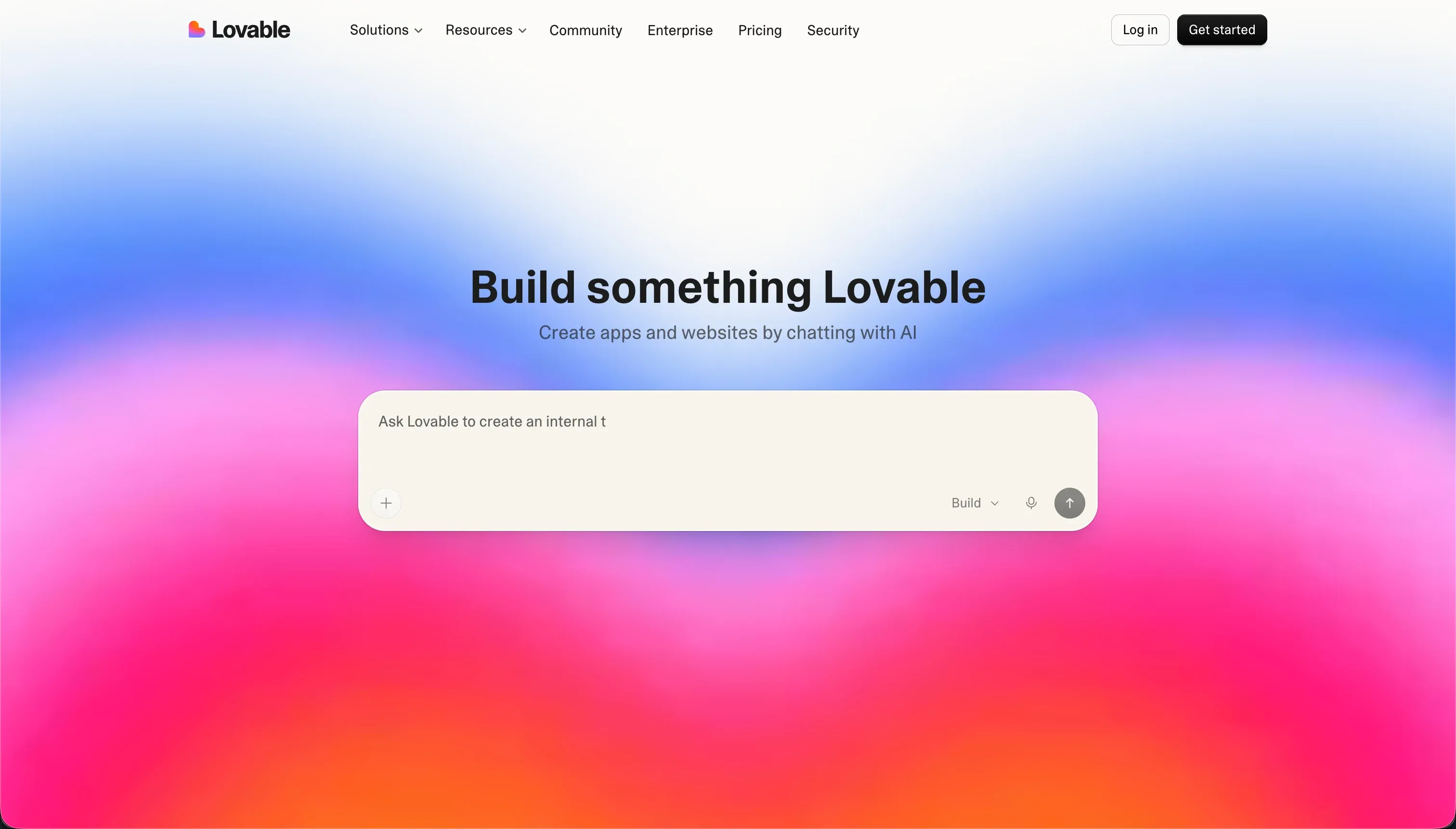
Lovable is an AI-powered full-stack application builder designed to convert natural language prompts into working React interfaces, Node.js backend logic, and Supabase database structures. By operating as a ‘vibe coding’ layer, it translates casual sentences into clean, multi-file code updates, skipping the traditional visual editor canvas almost entirely.
In practice, builders prompt the platform to generate features like user onboarding workflows, complex forms, or Stripe checkout views. It works directly with a managed Supabase database backend, handles one-click web deployments, and features a visual feedback loop where you click on UI errors to trigger automatic AI code repairs. For developers seeking to exit the platform, it provides GitHub integration to synchronize codebases locally to tools like VS Code or Cursor.
The platform is built specifically for rapid prototypers, solo founders, and makers who need to validate SaaS ideas within days without manually writing code or configuring infrastructure. However, users frequently hit a wall when attempting complex or custom business logic, where the AI can fall into expensive, credit-burning regression loops, introducing new bugs while attempting to patch old ones.
| Spec | Details |
|---|---|
| Primary Stack | React, TypeScript, Node.js, and Supabase |
| Interface | Conversational prompt input with visual point-and-click preview |
| Primary Deployment Target | Lovable Cloud with auto-generated staging URLs and GitHub sync |
| Key Advantage | Turnkey full-stack app generation from plain text instructions |
What is WeWeb?
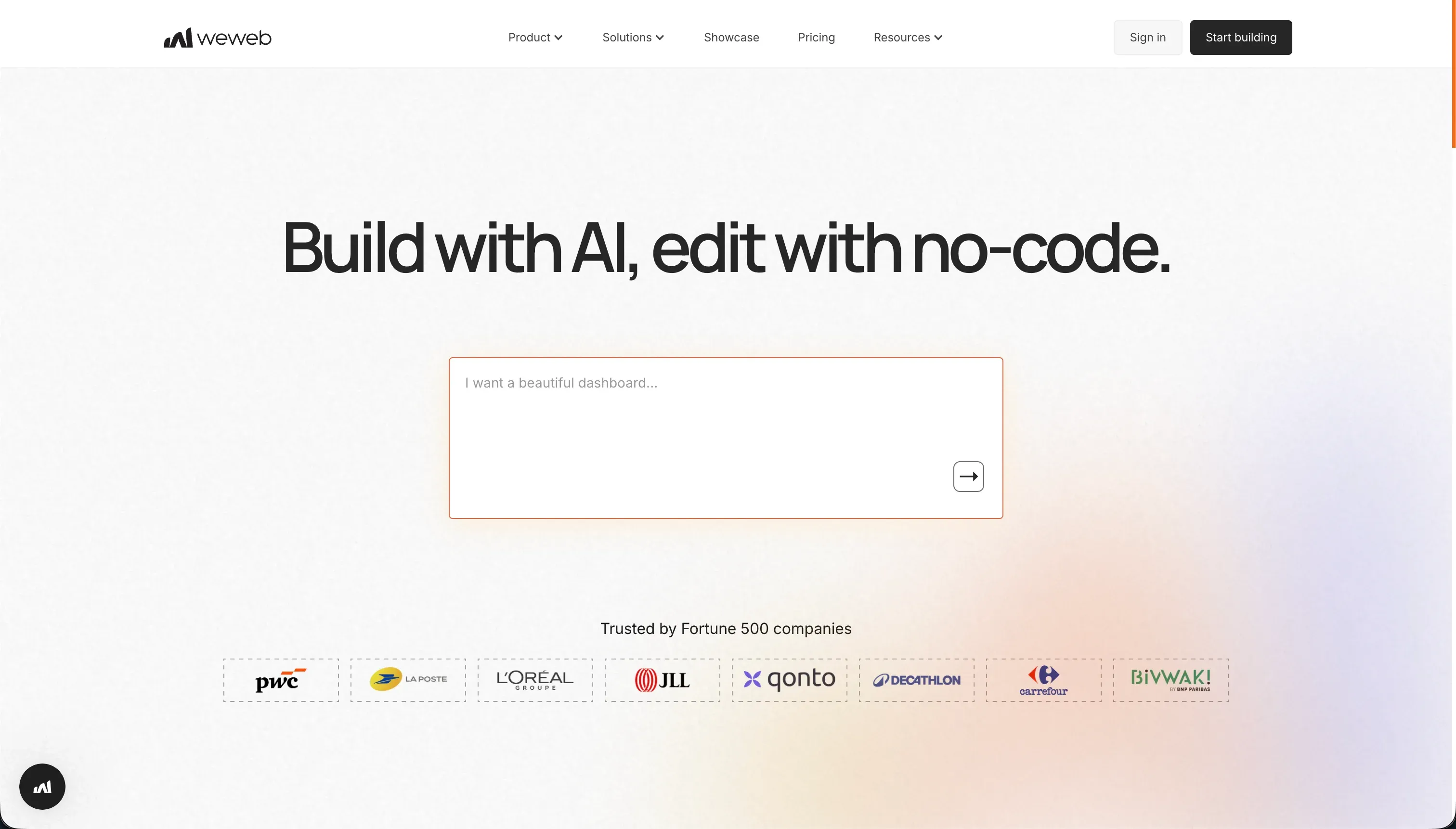
WeWeb is a visual frontend builder focused on creating highly responsive and performant single-page web applications. Operating on a strictly decoupled architecture, the platform separates frontend layout and execution logic entirely from your backend layer, meaning it does not house database tables or application logic within its own environment.
In practice, WeWeb provides a robust visual canvas featuring layout systems based on CSS flexbox, grids, and absolute coordinate positioning. Developers define global states, set conditional variables, and connect visual elements to external systems like Airtable, Supabase, Xano, or proprietary REST APIs. It compiles into visual assemblies that can be downloaded as standard Vue.js and Nuxt.js files on Scale and Enterprise plans.
It is built for agencies, product managers, and frontend design specialists who require pixel-perfect UI control and modular architecture for complex client projects. Beginners and non-technical business builders often find the tool exceedingly difficult to learn, struggling with the setup complexity of third-party API configurations, token-based user authentication, and data structures.
| Spec | Details |
|---|---|
| Primary Stack | Vue.js, Nuxt.js, and external API backends |
| Interface | Visual drag-and-drop builder with strict CSS and visual state controls |
| Primary Deployment Target | WeWeb hosted cloud or Vue.js code export on higher plans |
| Key Advantage | Decoupled architecture with complete visual control over layout and APIs |
The Core Difference
The core divide between these two tools is the way in which they require you to think: one is a conversational co-pilot that masks code complexity behind prompts, while the other is a strict visual interface for assembling frontends on top of structured APIs.
- Lovable operates as an AI-driven text-to-code generator that constructs a full-stack codebase in React and Supabase, relying on conversation to make updates.
- WeWeb acts as a technical visual designer that demands you manually construct layouts, variables, and API bindings without holding your hand on backend database setups.
Head-to-Head Comparison
We evaluated both platforms across four core categories.
1. Developer Experience & Iteration Speed
Lovable lets you prototype at breakneck speed. By simply typing functional requests like ‘build a client dashboard with dark mode and a graph,’ the platform edits multiple React and TypeScript files simultaneously, standing up a functioning page in seconds. This conversational flow eliminates the tedious layout and styling steps typical of manual editors, making it highly effective for early-stage feature drafting.
That speed breaks down during follow-up iterations. When resolving complex bugs, Lovable’s AI can fall into regression loops, introducing new bugs while falsely claiming the issue has been diagnosed and patched. Users on Reddit note that credit consumption has ballooned by up to ten times, with every simple update prompting 3 to 4 credits from Pro or Business plan allowances, leading to expensive loops just trying to revert bad AI choices.
WeWeb requires you to manually design every single button, container, and workflow action. There is no conversational magic to build layout pages instantly; instead, you build manually using visual CSS flexbox and grid layouts. This means the initial build process takes significantly longer, as you must configure visual variables, bind API requests, and handle front-end state routing yourself.
However, once the initial wiring is complete, WeWeb offers exceptional stability during iteration. The visual builder does not suddenly hallucinate or overwrite working logic as AI might, because every component is explicitly bound. If a component breaks, you can diagnose the visual state manager or the network dev logs directly, retaining tight, deterministic control over the app’s behavior.
Edge: WeWeb, because its explicit visual engine provides deterministic layout stability and prevents expensive AI credit-burning loops.
2. Database & Backend Capabilities
Lovable simplifies database setup by bootstrapping a managed Supabase database out of the box. The AI translates conversational schema requirements into structured PostgreSQL tables, default fields, and authentication states. It also tries to draft Supabase Row Level Security (RLS) rules to keep data secure, making full-stack setup approachable for builders who do not know backend architecture.
This convenience has a dangerous shadow side. User complaints on Reddit warn that Lovable has autonomously initiated migrations that pull customer databases from a private Supabase instance into Lovable Cloud without explicit warning. Managing complex relational queries, data pipelines, or critical PostgreSQL triggers still requires manual configuration directly within the Supabase console, exposing non-technical users to severe security vulnerabilities if prompt-generated RLS rules fail.
WeWeb enforces a decoupled frontend paradigm and does not offer any native, built-in database storage or backend logic. To publish a working application, you must connect the visual builder to an external backend layer such as Xano, Supabase, Airtable, or your REST APIs. This requires visual state manipulation to map auth tokens, handle JSON payloads, and manage CRUD actions manually.
The benefit of this approach is total structural freedom. By retaining your database inside a dedicated environment like Xano or standard PostgreSQL rather than a managed AI environment, you maintain high performance, scale limits, and database security. You do not have to worry about an AI agent altering your schema backend unexpectedly, keeping your data architecture clean.
Edge: WeWeb, because separating the backend layer ensures structural integrity and avoids dangerous AI-controlled database migrations.
3. Code Quality & Portability
Lovable stands out by generating standard React and TypeScript code instead of compiled visual blocks. For technical teams, having a clean GitHub sync means you have a real exit plan to pull the code and build on it. It also integrates Figma design token imports, allowing developers to scaffold standard React components directly from visual mockups.
However, this code export is often messy and can contain injected trackers. Developer feedback on Reddit indicates that up to 70% of the generated package payload can include custom tracking scripts and unoptimised node modules. Additionally, while the client React frontend is fully exportable, the backend remains dependencies-locked to Lovable Cloud and Supabase architectures, meaning it is not as easily portable as a standalone codebase.
WeWeb compiles high-performance single-page web applications that can be downloaded as visual Vue.js and Nuxt.js directories. This export capacity is unlocked on Scale plans ($249/mo monthly) and Enterprise tiers, letting agencies self-host layouts on their private servers. Since the front-end logic is decoupled, the visual elements export independently of your backend choices.
The quality of WeWeb’s visual architecture is exceptionally clean and complies with standard CSS paradigms. Unlike AI-generated layouts that might drop elements into unstructured visual containers, WeWeb enforces CSS flexbox alignment rules. The main limitation is that the visual project is not meant to be modified back-and-forth; exporting code is a one-way street, and continuing development locally breaks compatibility with WeWeb’s cloud editor.
Edge: WeWeb, because its exported Vue.js code directories follow standard visual paradigms without injecting opaque dependency tracking files.
4. AI Quality & Reliability
Lovable is built entirely around an AI-driven text-to-code core. Describe what you need, and its system updates layout code, styles elements, and manages multi-file dependencies. It acts as an autonomous developer, attempting preview and production safety audits automatically to verify dependency loops and protect your layouts from syntax errors.
The downside is that the developer becomes completely dependent on prompt quality. If you do not write precise prompts, the system tends to generate generic or structurally broken UI widgets. Because the compiler is an opaque black box, resolving deep-seated layout errors frequently requires technical builders to export the React code to local environments to clean up the code manually.
WeWeb features a localized AI Assistant embedded directly inside the visual canvas dashboard. This helper is focused and specialized: it does not generate full-stack applications from a prompt. Instead, it serves as an in-context coder that helps you write precise JavaScript loops, craft visual formula helpers, or formulate custom CSS classes for individual visual blocks.
This limited visual AI execution makes WeWeb much more stable. The core layout engine remains completely human-coded, ensuring that changes to layout elements do not randomly break adjacent layout elements. While it won’t write an app for you, this focused assistant speeds up formula tasks without presenting the regression bugs common in full-code generation.
Edge: WeWeb, because its visual assistant supports frontend scripting without risking destructive prompt-generated code cascades.
5. Learning Curve & Onboarding
Lovable has an incredibly flat learning curve in the first hour. An absolute beginner can type ‘make a web dashboard for landscaping projects’ and watch a full-stack, styled application appear on screen. The interface is intuitive, relying on conversational text commands and basic point-and-click edits to modify buttons or colors.
This initial simplicity is deceptively shallow. As soon as the application outgrows a basic prototype, builders must understand complex concepts like database schema rules, Supabase authentication setups, and TypeScript dependencies. If the AI introduces complex backend vulnerabilities or data regression breaks, a non-technical builder has no visual options to fix the errors and must learn code debugging to guide the AI out of loops.
WeWeb has a notoriously steep learning curve that demands a strong grasp of professional web layout standards. Builders must understand CSS models, conditional application routing, API headers, and visual state management variables. There is no simple prompt box to generate pages automatically, and onboarding typically requires weeks of studying WeWeb Academy tutorials to wire up basic features.
The long-term advantage is that you are learning standard visual coding principles. Once you master WeWeb’s parameters, you understand visual state states and API payloads, which translates directly to professional frontend engineering. You are not forced to become a ‘prompt engineer’ guessing text queries; instead, you build structural visual logic that behaves exactly as you design it.
Edge: WeWeb, because it forces you to build visual literacy instead of hiding complex logic inside conversational prompts.

Pricing Comparison
Lovable:
- Free: $0/mo. Daily cap of 5 credits (up to 50/mo), public visual projects, GitHub sync.
- Pro: Starts at 25€/mo ($25). 100 base monthly credits, private projects, custom domains, credit rollover. Scales up to 10,000 credits for 2,250€/mo.
- Business: Starts at 50€/mo ($50). 100 base monthly credits, advanced templates, SSO, data training opt-out. Scales up to 10,000 credits for 4,300€/mo.
- Enterprise: Custom pricing. Specialized credit volumes, audit logs, custom API integrations, and dedicated SLA support.
WeWeb:
- Free: $0/mo. Visual editor access, up to 150 database records, and preview on a weweb.io subdomain.
- Starter: $59/mo monthly ($39/mo billed annually). 1 published app, custom domain connection, and 50,000 monthly page views.
- Scale: $249/mo monthly ($199/mo billed annually). 3 published apps, 250,000 monthly page views, visual Nuxt.js/Vue.js code export, and staging build environments.
- Enterprise: Custom pricing. Self-hosting execution, unlimited page views, advanced SSO integration, and enterprise-grade SLAs.
Use Case Fit: When to use which?
When to choose Lovable
- You need to build a proof-of-concept or SaaS MVP in a few days and want a conversational AI tool to stand up a layout frontend and Supabase PostgreSQL backend in one go.
- Owning React and TypeScript source-code assemblies is a priority, and your team plans to eventually migrate the frontend output to local development workspaces.
- You are building for a small user volume where prompt-generated security rules and Supabase integrations do not require deep manual compliance audits.
When to choose WeWeb
- You are an agency or frontend designer requiring total control over visual elements using precise CSS flexbox, grids, and absolute sizing parameters.
- You want to host your project’s frontend decoupled from your databases, routing visual layouts dynamically to secure database systems like Xano or Airtable.
- Your project requires high visual stability where layout elements must keep working permanently without AI regression risks or credit-spending loops.
When neither Lovable nor WeWeb is the right fit
For business apps and customer portals
If your primary goal is to build secure operational software, such as client portals, team CRMs, partner directories, or internal dashboards, neither Lovable’s AI code loops nor WeWeb’s decoupled complexity are optimal. WeWeb forces you to design layouts manually and pay separate monthly bills for external databases, while Lovable exposes you to security risks as AI attempts to generate sensitive authentication and backend rules.
Instead, Softr offers the most reliable, zero-maintenance choice for business teams. It acts as an all-in-one ecosystem providing a native database, user authentication, and workflows integrated in one visual editor. Because it combines pre-built frontend blocks with a visual, secure permissions panel (without generating messy codebases), non-technical operators can deploy production-ready B2B tools in hours without risking broken code, database migrations, or security hacks.
For native mobile applications
Neither Lovable nor WeWeb can compile native mobile application binaries like IPA or APK files for distribution through the Apple App Store or Google Play Store. WeWeb can bundle layouts for web view, but this lacks native device integration, while Lovable remains focused entirely on responsive React web interfaces.
If your project requires mobile-first performance, background location tracking, or off-line data states, you should evaluate FlutterFlow or Adalo. FlutterFlow provides a visual engineering environment specifically for native mobile deployment with direct access to local device APIs, preventing you from wasting resources trying to stretch web builders onto mobile platforms.
Verdict
Choose Lovable if you need a rapid way to scaffold a full SaaS prototype or landing page from scratch without touching any layout components directly. The conversational prompt builder is exceptionally fast for generating the first version of an idea, and having a GitHub export path secures your frontend output. However, you must accept that downstream changes will consume expensive monthly credits, and managing database state or security rules will eventually land on your developers.
Choose WeWeb if you are a frontend professional or client-focused agency that demands pixel-perfect layout alignment and robust visual states decoupled from your data systems. It is by far the more stable platform for scaling visual layouts because changes do not rely on unpredictable AI loops. The tradeoff is a steep learning curve and the immediate requirement of configuring, securing, and paying for a separate backend engine like Xano.
If you are building operations systems like business portals, dashboards, or inventory tools, these code-heavy and API-complex architectures are often poor long-term matches. For these multi-user environments, Softr provides a safer, zero-debt path. By pairing a visual permissions system with native databases and workflows, it bypasses both the developer learning curve of WeWeb and the fragile, credit-burning regression loops of Lovable.

Summary Comparison Table
| Criterion | Lovable | WeWeb |
|---|---|---|
| Build Paradigm | Conversational AI scaffolding (React/TypeScript) | Decoupled visual design editor (Nuxt.js/Vue.js) |
| Primary Database | Managed PostgreSQL (Supabase) | None (Strictly external backend via API) |
| User Authentication | Conversational Supabase setup | Manual external API mapping |
| Pricing Metric | AI credit tokens and scaling tiers | App count and monthly traffic views |
| Code Export | React and TypeScript code synchronized via GitHub | Vue.js folder download (Scale plan and above) |
| Long-term Maintenance | High (Requires constant prompt revisions and credit consumption) | Medium (Explicit visual logic protects against regressions) |