

Same.dev and Emergent sit at opposite ends of the scope spectrum. Same.dev does one narrow thing - clone and scaffold frontend UIs. Emergent tries to do everything autonomously - generate a complete full-stack app with a single prompt and deploy it.
The ambition gap between them is significant. So is the risk gap. Same.dev is limited but predictable. Emergent is ambitious but has accumulated a troubling track record in the community around billing, debugging loops, and production instability. This comparison is partly about capability and partly about whether Emergent’s autonomous approach is trustworthy enough to build on.
Meet the Contenders
What is Same.dev?
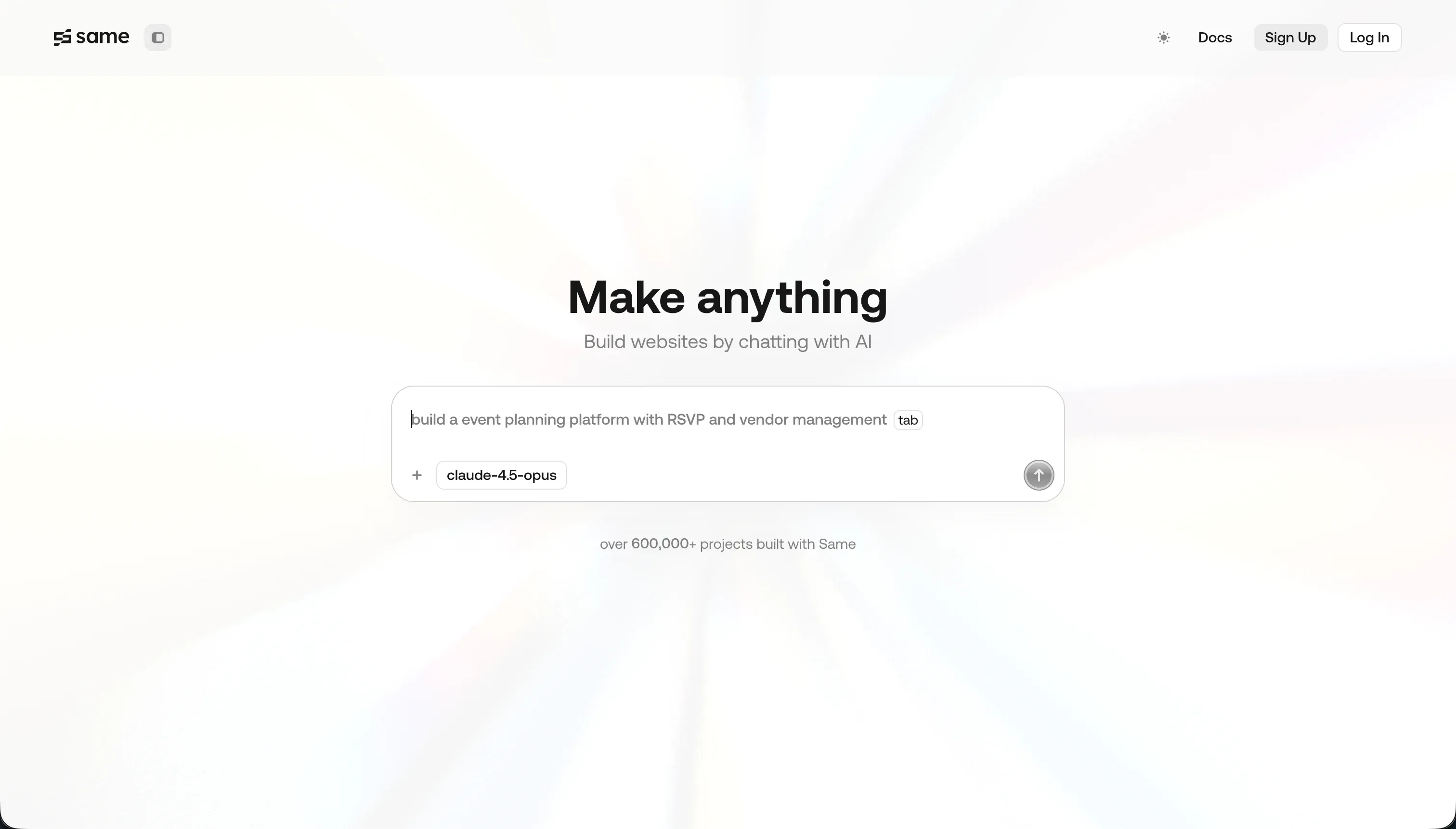
Same.dev (rebranded to Same.new) is a frontend scaffolding tool. Paste a website URL, and the AI agent replicates its visual layout - colors, typography, component structure - as a React and Tailwind CSS project. Modify through conversational prompts and download the code when you’re done. No backend, no hosting, no auth. It’s a design shortcut tool, not an app builder.
| Spec | Details |
|---|---|
| Primary Stack | React, Tailwind CSS |
| Interface | URL input + conversational prompt editor |
| Primary Deployment Target | Code export (no native hosting) |
| Key Advantage | Fast frontend layout scaffolding from existing website designs |
What is Emergent?
Emergent is an autonomous AI app builder. Describe your application in natural language, and Emergent’s AI agents generate a full-stack application - frontend, backend, database schema, and deployment configuration - in one pass. Conversational revisions let you continue refining through prompts. Built-in cloud deployment provides immediate preview URLs. It positions itself as the most hands-off approach to app creation: describe what you want, let the agents handle the rest.
| Spec | Details |
|---|---|
| Primary Stack | AI-generated full-stack (frontend + backend) |
| Interface | Conversational prompt + agent-driven build |
| Primary Deployment Target | Emergent Cloud (managed containers) |
| Key Advantage | Autonomous end-to-end generation from a single prompt |
The Core Difference
Same.dev is a scoped, predictable tool. It generates frontend scaffolding - fast, cheap, and limited to the UI layer. You know exactly what you’re getting.
Emergent is a bigger bet. Its autonomous agent model promises to handle the entire application lifecycle. But “autonomous” cuts both ways: when it works, it’s fast. When it doesn’t, it can get stuck in loops that undo completed work while billing you for each iteration. The community feedback around Emergent isn’t just complaints about the platform being difficult - it’s complaints about losing money to a system that charged for breaking things it had previously built.

Head-to-Head Comparison
1. Developer Experience & Iteration Speed
Same.dev is fast and frictionless for frontend work. The URL-to-clone pipeline delivers visual results quickly. The instability shows up on complex edits - users report destructive prompt regressions where reordering a section can wipe hundreds of lines of working code. The rebrand from same.dev to same.new also left some users unable to access paid projects during the transition, which is a poor signal for reliability.
Emergent’s initial generation experience is genuinely impressive. Describe an app concept, and the agent scaffolds a working skeleton quickly. The problem surfaces the moment something breaks. Because Emergent’s agent drives the entire build, fixing a bug means triggering the agent again - which consumes credits. Multiple community reports document the agent getting stuck in what one user called an “edit loop”: the agent addresses a bug, the same bug reappears, the agent charges credits to fix it again, repeat. One Reddit user spent nearly $10,000 AUD and described “nearly 100% of charges wasted on repeated work… same bugs fixed 5+ times, quality deliberately reduced.” Another documented paying for features multiple times as the agent kept undoing completed work.
There’s also the infrastructure reliability issue. Emergent’s deployment containers can experience “Error Waking Up Agent” messages, latency, or complete unresponsiveness. When that happens, you’re blocked from making progress until the platform recovers.
2. Code Quality & Portability
Same.dev exports clean, standard React and Tailwind CSS. Frontend developers can take the output and work with it directly in any toolchain. The code is frontend-only, but what’s there is portable and readable.
Emergent supports GitHub integration on Standard plans and above, which gives you access to the generated code. The quality of that code varies. Community feedback describes significant cleanup work required before generated code is developer-friendly. And the backend infrastructure - containerized deployment environments - is tied to Emergent’s platform. GitHub access helps with visibility, but the operational backend isn’t portable the way a clean codebase would be.
3. Database & Backend Capabilities
Same.dev has none. It’s a frontend tool. Any backend is your responsibility.
Emergent generates backend schema, database routing, and API configuration as part of its full-stack generation. For simple apps, this works. The limitation appears at scale and complexity. Community reports consistently describe the platform struggling once a codebase grows large - one developer called it “a money sink and terrible quality output” beyond basic complexity. Preview environments frequently diverge from production, meaning bugs visible in testing don’t always appear until you’re live - and vice versa.
4. Hosting & Deployment Options
Same.dev doesn’t host. It generates code for you to host elsewhere.
Emergent provides automatic cloud deployment with immediate preview URLs. The pipeline from generation to live URL is seamless, which is one of its genuine strengths. The concern is reliability: deployment containers can go unresponsive, and when they do, support response times have been reported as poor - one user documented 5 days with zero response to a support ticket about blocked backend access. For a production app, that’s an unacceptable level of availability uncertainty.
The billing transparency concerns compound this. Users have reported credit packages auto-renewing without clear notification, and credits being deducted for platform-triggered errors rather than user actions. One user noted: “Why does emergent.sh deduct credits for bug fixing - even when it’s clearly not the user’s fault?”

Pricing Comparison
Same.dev:
- Free: Limited tokens
- Pro: $10/month for 2 million tokens (additional tokens at $5 per million)
Emergent:
- Free: $0, 10 credits/month
- Standard: $20/month (billed annually) for 100 credits/month, private hosting, GitHub integration, task forking
- Pro: $200/month (billed annually) for 750 credits/month, 1M context window, Ultra Thinking, custom AI agents
- Enterprise: Custom, SSO/SAML, single-tenant, custom SLAs
Extra credit top-ups: $10 for 50 credits ($8 for 50 credits under some promotional structures). Unlike monthly subscription credits, top-up credits don’t expire.
The sticker price on Emergent’s Standard plan ($20/month) looks reasonable. The risk is what happens when the agent gets into a debugging loop - credits drain fast, and the platform has charged users for fixing errors it introduced. At $10 per 50 extra credits, a bad iteration cycle can cost $50-100 before you’ve added a single working feature. The $10,000 AUD story isn’t typical, but it’s not an outlier either.
Use Case Fit: When to use which?
When to choose Same.dev
- You need a frontend scaffold from an existing visual design, fast.
- You or a developer will build the backend separately.
- You want predictable, low-cost access to React/Tailwind CSS scaffolding.
When to choose Emergent
- You want a full-stack prototype generated from a prompt and are comfortable with the credit risk.
- You’re building something simple where the autonomous agent is unlikely to hit complex debugging loops.
- You’re willing to monitor credit usage closely and don’t need production-grade reliability or support SLAs.
The honest word of caution: given the community feedback, Emergent is best treated as an experimental prototyping tool rather than a platform for anything business-critical. The billing and support concerns are serious enough that committing real project work to it carries meaningful risk.
When neither Same.dev nor Emergent is the right fit
For native mobile apps
Neither platform offers reliable native mobile compilation. Same.dev generates web code only. Emergent’s mobile support is described as “unfinished” by community testers. For App Store and Google Play publishing, FlutterFlow is the dedicated tool - it compiles to native Flutter code with proper iOS and Android build pipelines.
For internal tools and client portals
Same.dev can’t do it. Emergent can attempt it, but the production reliability and billing concerns documented by the community make it a risky foundation for anything your team or clients depend on.
Softr is the appropriate tool for this use case. It provides built-in authentication, granular user group management, and data permissions through a visual editor - no credits burned on debugging loops, no surprise billing when users interact with the app, and no platform-triggered bugs charged back to you. The flat monthly pricing model means your cost doesn’t fluctuate with how often the AI makes mistakes. Organizations like Netflix, MIT, and Celonis use Softr in production for exactly these workflows.
For professional developer environments
For technical teams who want AI assistance without the managed platform constraints, Cursor gives you AI-powered code editing inside your own IDE. For a cloud development environment with more control, Replit provides full virtual machines and collaborative development. And if you want the autonomous agent approach with better community feedback, Lovable or Bolt are more established options in the full-stack generation space.
Verdict
- Choose Same.dev if you need a fast frontend scaffold and understand its backend limitations.
- Approach Emergent with caution: it has real capability for simple apps, but the billing practices and debugging loop reports from the community are serious enough to research thoroughly before committing any significant work or money.
Summary Comparison Table
| Feature | Same.dev | Emergent |
|---|---|---|
| Build Paradigm | Frontend UI cloning | Autonomous full-stack AI generation |
| Output Type | React / Tailwind CSS code | Hosted full-stack web app |
| Database | None | AI-generated (backend containers) |
| Visual Permissions | None | Basic (agent-configured) |
| Pricing Metric | Tokens (build-time only) | Credits (build + debugging loops) |
| Maintenance Burden | High (developer required for backend) | High (agent loops + credit risk) |
| Code Export | Yes (frontend, free) | Yes (GitHub sync, Standard plan) |