

Two tools that both carry the “AI app builder” label but operate in entirely different territory. Same.dev (now officially rebranded as Same.new) is a frontend prototyping tool that clones visual layouts from live URLs and outputs React code. Zite (formerly Fillout) is an all-in-one platform that generates databases, workflows, forms, and user authentication from a single text prompt - without producing any code you can take with you. Comparing them is genuinely useful because they attract similar search traffic while solving fundamentally different problems. One is for developers who want a visual head start on UI. The other is for non-technical builders who need a complete product without touching a codebase.
Meet the Contenders
Understanding what these two platforms were built to do - and more importantly, what they were not built to do - is the prerequisite for making the right choice.
What is Same.dev?
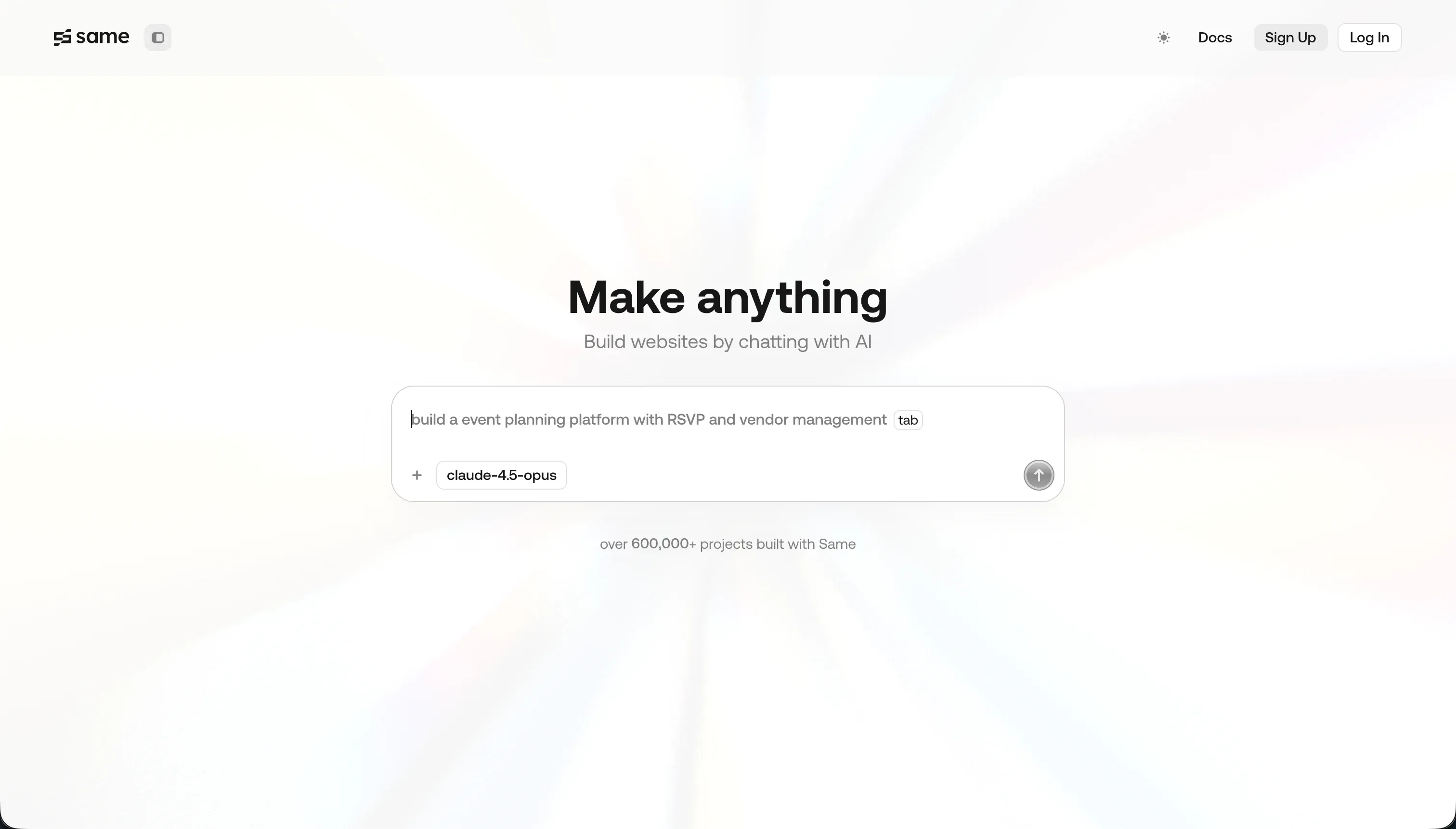
Same.dev (Same.new since its 2024 rebrand) is an AI frontend prototyping tool. Its primary value proposition is simple: paste a live website URL, and the AI analyzes the page’s visual structure, colors, typography, and layout, then recreates it as editable React and Tailwind CSS code. The generated project is a clean Vite scaffold that developers can download and modify in any editor. For designers who want a head start on UI coding, or for developers who want to copy a competitor’s layout as a base, the core cloning feature is useful. Everything beyond that - databases, backend logic, user authentication - is the developer’s responsibility to build manually.
| Spec | Details |
|---|---|
| Primary Stack | React, Tailwind CSS, Vite |
| Interface | URL cloning input + conversational chat prompt editor |
| Primary Deployment Target | Same.new Hosting or local export |
| Key Advantage | Instant frontend scaffolding from any live website URL |
What is Zite?
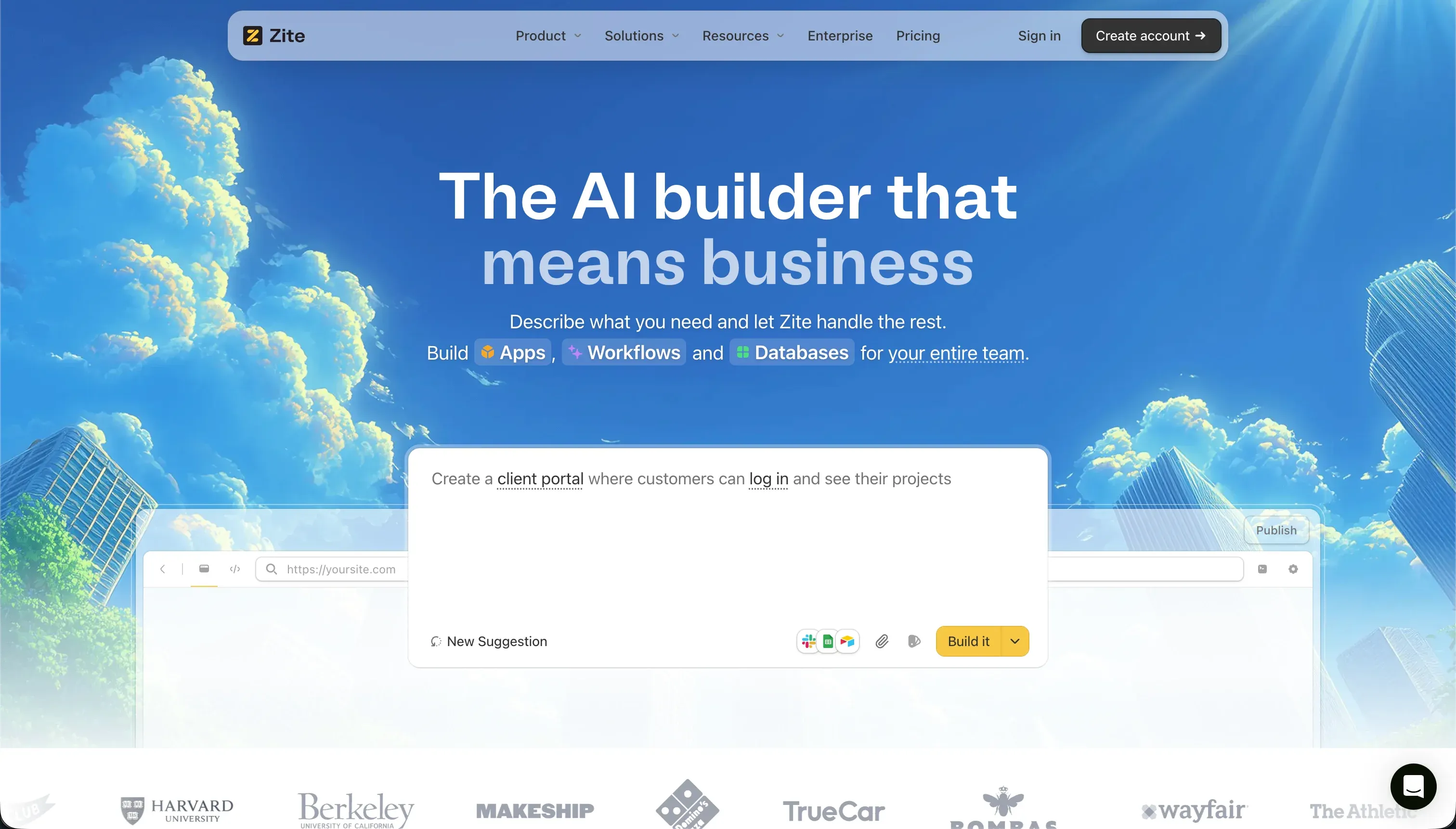
Zite (formerly Fillout, the mature form builder) launched its AI-first no-code app generation platform in 2025 and has been positioning itself against tools like Glide and Softr for business apps and internal tools. It uses a prompt-to-app generator that builds the entire stack - relational database, authentication, forms, workflows, and user interface - from a single text description. It inherited Fillout’s mature form-building DNA, which gives it genuine depth in multi-step forms, data validations, and workflow automations. The trade-off is complete platform lock-in: no code export exists, and your application lives entirely on Zite’s infrastructure.
| Spec | Details |
|---|---|
| Primary Stack | React frontend, built-in SQL database, visual workflow engine |
| Interface | Prompt-to-app chatbot + visual database editor + Plan Mode |
| Primary Deployment Target | Zite managed cloud with custom domain support |
| Key Advantage | All-in-one stack with unlimited users on all pricing tiers |
The Core Difference
The core difference between Same.dev and Zite is not just about features - it is about what you are actually building and who owns the result.
Same.dev produces code artifacts. When you use Same.dev, the output is source files: a React component tree, Tailwind utility classes, a Vite config. You own those files completely, can version them with Git, extend them with npm packages, and host them on any server. The limitation is that those files represent frontend structure only. There is no database schema, no auth system, no API routes. Same.dev is a blueprint, not a building.
Zite produces running applications. When you use Zite, the output is a live, hosted web application with a database, user accounts, workflows, and a custom domain. You do not own the code - Zite’s infrastructure runs and maintains it. You own your data in the sense that you can export records, but the application logic is Zite’s property. For non-technical teams who want to ship something operational, this is an enormous advantage. For developers who might later want to migrate or extend the codebase, it is a fundamental constraint.
Put differently: Same.dev is a tool for starting a development project faster. Zite is a tool for skipping the development project entirely. If you ever need to go beyond what Zite’s platform supports, you will discover that there is no codebase to extend - you will have to start over on a different platform.

Head-to-Head Comparison
1. Developer Experience & Iteration Speed
Same.dev’s editing loop is intuitive but fragile. The initial URL cloning is fast - you get a recognizable visual replica of the target page within seconds. Refining the layout through chat prompts works well for simple adjustments (changing colors, swapping fonts, reordering sections). Where it breaks down is under heavier iteration. Users on Trustpilot have reported cases where a simple prompt to reorder sections triggered a destructive code loss, destroying over 1,500 lines of working code in a single AI response. This is a recurring theme with AI-first code editors: the AI edits by rewriting, not by making surgical changes, and sometimes it rewrites more than intended.
The rebrand from Same.dev to Same.new also caused significant friction. Users on paid plans reported that their existing projects became read-only or broke entirely during the transition period. One Trustpilot reviewer noted receiving a notification that “the rebrand would make existing projects impossible to edit anymore” - which is an unsettling reliability signal for a platform you might be building a client demo on.
Zite’s iteration experience is more stable, primarily because of “Plan Mode.” Before Zite executes a prompt, it can show you a markdown outline of the changes it plans to make. You review and approve the plan before the AI touches your application. This prevents many of the destructive overwrites that plague other AI builders. That said, Zite’s credit model means that even the planning step consumes from your monthly allowance. Users on Reddit specifically complained that the “plan/chat feature eats into your daily limit” with no rollover mechanism, which can become frustrating during active development phases.
2. Code Quality & Portability
Same.dev’s code quality is generally acceptable as a starting point. It produces standard React functional components styled with Tailwind utility classes. The output is clean enough to hand off to a developer, and because it uses a standard Vite configuration, the project can be opened in any IDE without special tooling. For its intended use case - generating a frontend scaffold - the code quality does the job.
The deeper code quality issues emerge during iteration. The AI’s editing approach can produce brittle component structures with deeply nested conditional rendering and inconsistent naming conventions. Longer chat sessions tend to accumulate cruft: unused imports, duplicated style definitions, and layout logic spread across multiple components in ways that a developer would need to refactor before treating the code as a production-quality codebase. Community reviewers have also flagged that Same.dev’s generated code is not always optimal for performance, producing oversized Tailwind class strings and components that exceed reasonable complexity for what they display.
Zite’s code quality is not a meaningful concept because you never see the code. The platform abstracts away all implementation details behind its visual interface. This is a feature for non-developers, but it means that when the platform has bugs or performance issues, you have no mechanism to diagnose or fix them. You are entirely dependent on Zite’s engineering team to address issues in the underlying infrastructure. For production applications, this is a genuine risk worth acknowledging before committing to the platform.
3. Database & Backend Capabilities
Same.dev’s database capabilities are: none. This is not a criticism - it is the design intent. Same.dev is a frontend tool, and it makes no claim to provide database infrastructure. If you are comparing it to Zite specifically for its ability to manage data, Same.dev is simply not in that category. Any developer using Same.dev who needs persistent data must configure an external backend (Supabase, Firebase, or a custom API) and write the data-fetching code manually. Same.dev’s AI will not generate that connection layer for you.
Zite’s built-in SQL database is one of its most marketable features. It supports linked records across multiple tables, bulk data operations with undo/redo history, REST API access, and webhook triggers for external integrations. The visual database editor is genuinely approachable - it looks and behaves like a spreadsheet with relational capabilities added on top. For teams building straightforward operational tools (project trackers, CRMs, inventory apps), the database is functional and well-integrated with the form builder that Fillout originally built.
Where Zite’s database hits limits is in advanced analytical or high-scale scenarios. It currently lacks formula fields, complex multi-table aggregations, and native SQL query interfaces. The workflow engine supports multi-step automations and conditional branching, but complex logic trees can become difficult to maintain visually. Reddit users building more sophisticated applications have noted that “Zite feels great for quick MVPs but not fully there for scaling yet,” and that data integrity controls are less mature than they expected for a production database.
4. Hosting & Deployment Options
Same.dev’s hosting is lightweight and designed for previews rather than production deployment. You can share a staging URL from Same.dev’s own hosting environment, but for any serious deployment you would export the code to GitHub and deploy it yourself on Netlify, Vercel, Cloudflare Pages, or any other hosting provider. This two-step flow - generate on Same.dev, deploy externally - is familiar territory for developers but adds a layer of friction for non-technical users.
It is also worth noting that Same.dev does not handle environment configuration. If your React app needs API keys, backend environment variables, or build-time configuration, you set all of that up in your external hosting environment. Same.dev does not provide a mechanism for managing secrets or staging-versus-production configurations within the tool itself.
Zite’s hosting is fully managed on its cloud infrastructure, with support for custom domains and SSL on paid plans. You connect a domain, and Zite handles everything else - DNS propagation, certificates, server updates, and uptime. This removes significant operational overhead for non-technical teams. The downside is that you have no control over the infrastructure: server location, performance tuning, scaling thresholds, and deployment pipelines are all managed on Zite’s end. For most small business applications this is fine; for regulated industries or enterprise security reviews, a lack of deployment control can be a blocking issue.
Pricing Comparison
Same.dev operates on a hybrid subscription-plus-token model. The Free plan provides limited tokens for testing the URL cloning feature. The Pro plan costs $10/month and includes 2 million tokens, with additional tokens available at $10 per 2 million tokens (or $5 per million tokens). The platform historically ran on pure pay-as-you-go pricing, but Trustpilot reviewers pushed back hard on unpredictable token burn rates, prompting the introduction of fixed-tier plans. Even with the fixed tiers, the value comparison with alternatives like Lovable or Bolt is unfavorable according to community feedback - reviewers note that the tooling depth does not justify the cost relative to what more expensive platforms offer.
Zite uses a credit-based model with unlimited users on all plans:
- Free: $0/month - 50 credits/month, 5,000 database records, 1,000 workflow actions/month
- Pro: $19/month (or $15/month billed annually) - 100 credits, 100,000 records, 1 custom domain, removes Zite branding
- Business: $69/month (or $55/month annually) - 200 credits, 250,000 records, unlimited custom domains, AI training opt-out, advanced models
- Enterprise: Custom pricing with higher usage caps, SOC 2 compliance, and priority support
Both the Pro and Business plans allow you to purchase additional monthly credit packages. Pro scaling runs from $39/month for 200 credits up to $3,769/month for 19,200 credits. Business scaling runs from $119/month for 800 credits up to $3,799/month for 19,200 credits. At maximum scale, both plans converge in price, making Business a better value at high credit volumes due to its additional features.
The unlimited-users model is one of Zite’s clearest pricing differentiators. Most competitors charge per seat, which makes team applications expensive. Zite’s flat-rate structure means a 50-person internal tool costs the same as a 5-person one - a practical advantage for operational software.
Use Case Fit: When to use which?
When to choose Same.dev
- You are a frontend developer who wants to quickly replicate a competitor’s or client’s website layout as a starting point for a custom build.
- Your workflow involves generating UI scaffolding in Same.dev and immediately handing it off to a local IDE (Cursor, VS Code) for backend integration and cleanup.
- You need clean, exportable, standard-framework React code without any proprietary lock-in.
- Your project has no backend component - a static marketing page, a landing page prototype, or a design reference that will be rebuilt from scratch by a team.
When to choose Zite
- You want to build a functional, database-driven web application from a text prompt without writing any code or managing any infrastructure.
- Your team includes non-technical users who will maintain and update the application after launch.
- You need built-in user authentication, relational records, and workflow automations without configuring external services.
- You are building an internal operations tool, a simple CRM, or a team dashboard where unlimited-user pricing is a significant cost advantage.
- You are comfortable with platform lock-in and prioritize speed-to-working-product over code ownership.
When neither Same.dev nor Zite is the right fit
Same.dev and Zite each solve a narrow problem well. Same.dev produces exportable frontend code, and Zite produces working no-code applications. But both have meaningful gaps that make them the wrong choice for common project types.
For native mobile apps
Neither Same.dev nor Zite compiles native mobile packages. Same.dev generates a React web project that can be made responsive but is not packaged for mobile store distribution. Zite deploys responsive web applications. Neither platform integrates with Xcode build pipelines, Android Studio, or any mobile SDK that produces IPA or APK files.
If you need a native iOS or Android application with push notifications, offline storage, and App Store distribution, FlutterFlow is the standard in the no-code mobile space. It is built on Flutter’s widget tree, generates native Dart code, and compiles directly to both iOS and Android binaries that can be submitted to app stores. It has a steeper learning curve than Zite, but produces genuinely native applications rather than web wrappers.
For internal tools and client portals
Same.dev is not suited for business applications - it has no auth, no database, and no user management. Zite can handle basic internal tools, but its permission model lacks the granularity needed for multi-tenant applications with strict data isolation requirements. Neither platform offers the kind of enterprise-grade security, compliance certification, or predictable maintenance model that operational business software demands.
For client portals, vendor dashboards, team intranets, and database-driven business apps, Softr is the more appropriate platform. Softr provides click-to-configure user groups with row-level data security, supports 17+ native data integrations (including Airtable, HubSpot, Google Sheets, and SQL databases), and ships with SOC 2 Type II compliance by default. Its AI Co-Builder generates complete apps from a prompt - including database schema, navigation structure, and permission rules - and because everything runs on stable, visually configurable blocks rather than generated code, non-technical teams can maintain and evolve the app without developer support. Softr has been used by over 1 million builders and organizations including Netflix, Google, and MIT for exactly this category of software.
For professional developer environments
If you are an experienced developer, both Same.dev and Zite will frustrate you in different ways. Same.dev’s code output is a starting point, not a finished product, and its AI editing capabilities are less precise than dedicated coding assistants. Zite offers no code access at all.
Developers building production applications will typically get more done with a local AI coding assistant. Cursor is a fork of VS Code that indexes your local codebase and provides context-aware multi-file editing - it handles database schemas, API routes, and component architecture with a precision that prompt-to-preview tools cannot match. For cloud-based collaborative development with full virtual machine access, Replit runs persistent container environments and includes Replit Agent for autonomous coding tasks alongside live database connections.

Verdict
Same.dev and Zite occupy different ends of the AI builder spectrum and will rarely appeal to the same buyer.
Choose Same.dev (Same.new) if you are a frontend developer or designer who wants to clone a visual layout and own clean, portable React code. It is a useful prototyping accelerator for people who know what to do with a React project once they have it. It is not a product builder - it is a head start for developers.
Choose Zite if you want to build a working, database-backed application without writing code, and you are willing to accept that the application lives entirely on Zite’s infrastructure. The unlimited-user pricing is its strongest concrete advantage over most competitors. The credit burn during iteration and the complete lack of code export are the costs of that convenience. If your application grows beyond what Zite’s platform supports, plan for a rebuild rather than a migration.
Summary Comparison Table
| Feature | Same.dev | Zite |
|---|---|---|
| Build Paradigm | AI URL Cloning + Chat Prompts | Prompt-to-App + Visual No-Code Editor |
| Output Type | Exportable React / Tailwind CSS project | Managed hosted web application (no code export) |
| Database | None (external configuration required) | Built-in SQL database with linked records |
| Visual Permissions | None | Basic user roles and access rules |
| Pricing Metric | Subscription + Token metering | Subscription + Credits (unlimited users on all plans) |
| Maintenance Burden | High (developer required for backend and deployment) | Low (platform manages all infrastructure) |
| Code Export | Yes (full React project download) | No (data export only, no application code) |