

Zite and FlutterFlow are rarely considered direct competitors, and for good reason. They’re solving different problems for different platforms.
Zite is a web-first AI generator. You describe your app, get a working result, and iterate from there. It’s fast, accessible, and optimized for teams that want to move quickly without learning a development framework.
FlutterFlow is a visual IDE for mobile and web apps powered by Flutter. It’s the platform you choose when you need native iOS and Android binaries - real app store distribution, push notifications, and native performance. The price is a genuine learning curve and the need to configure an external database service.
The comparison only gets interesting when your target platform is ambiguous: web-only MVP, or cross-platform product that includes native mobile?
Meet the Contenders
What is Zite?

Zite (formerly Fillout) is an AI-first no-code application builder. It combines a conversational AI generator with a relational SQL database and visual workflow automation. Plan Mode lets you review proposed changes before the AI executes them, conserving credits during iteration. Unlimited users on all plans and a simple credit-based pricing model position it as a fast-entry option for small team tools and MVPs.
| Spec | Details |
|---|---|
| Primary Stack | AI-generated app on Zite infrastructure |
| Interface | Conversational AI chat + visual editing |
| Primary Deployment Target | Zite cloud (custom domain on Pro+) |
| Key Advantage | Fast prompt-to-app generation, unlimited users |
What is FlutterFlow?
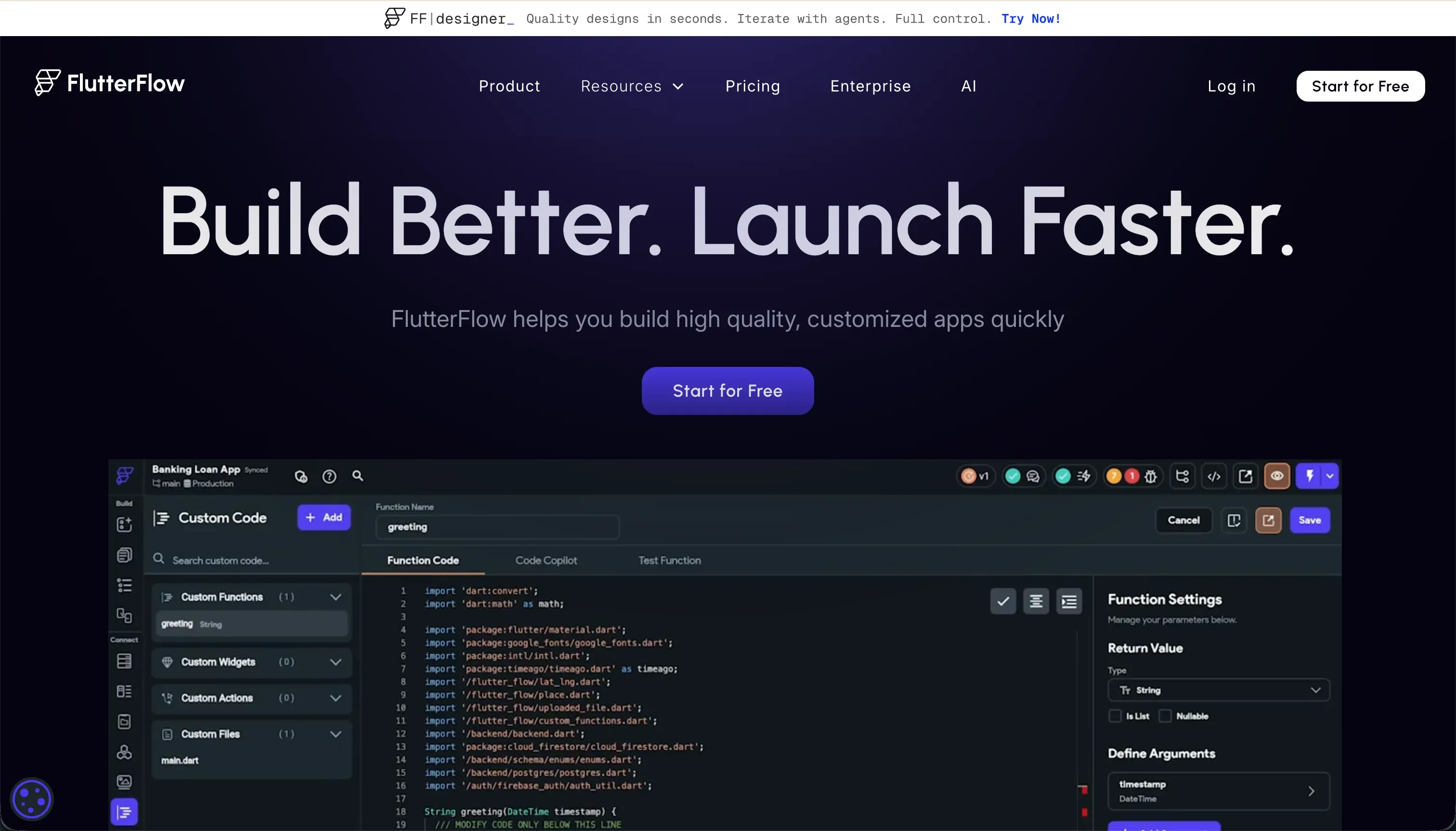
FlutterFlow is a visual builder built on Flutter’s widget tree architecture. It lets you design screens with drag-and-drop components, connect Firebase or Supabase as your database, add conditional logic and API integrations, and compile the result to native iOS and Android packages - or deploy to the web. Flutter’s cross-platform compilation is the platform’s primary differentiator.
| Spec | Details |
|---|---|
| Primary Stack | Flutter / Dart (code export available) |
| Interface | Visual widget tree builder + action editor |
| Primary Deployment Target | App Store, Google Play, or web hosting |
| Key Advantage | Native iOS and Android compilation from a visual editor |
The Core Difference
Zite and FlutterFlow diverge at the most fundamental level: platform target.
Zite builds web apps. You can view them on mobile via a browser or install them as PWAs, but they’re web applications. There’s no native compilation, no app store packaging, no Flutter widget tree.
FlutterFlow builds native mobile and web apps using Flutter. Its output compiles to real Dart code that runs as a native iOS app, a native Android app, and a web app. The visual editor is a representation of Flutter’s widget system, which means learning FlutterFlow means learning Flutter’s mental model.
If you need App Store or Google Play distribution, this comparison ends here: only FlutterFlow can do it. If you’re building web-only, then speed, credit model, and maintenance become the deciding factors.

Head-to-Head Comparison
1. Developer Experience & Iteration Speed
Zite’s AI chat interface makes the initial setup fast. You prompt, Zite builds, you review the plan and confirm. For simple apps - a task tracker, a client onboarding form, a lightweight CRM - you can have something working in under an hour. The iteration experience degrades as complexity grows: specific visual adjustments, non-standard layouts, and precise database query tweaks often require multiple prompts, each consuming credits.
FlutterFlow’s editor is slower to start but more precise once learned. You work directly with widget trees - placing containers, setting padding, configuring alignment - which gives you granular control over every visual element. Action editors let you configure navigation, state variables, and API calls visually. The learning curve is real: Capterra reviewers consistently note that there are “too many switches, menus and buried features” and that errors often produce no useful messages. Debugging FlutterFlow without developer experience is genuinely difficult.
2. Code Quality & Portability
FlutterFlow exports full Dart source code on Standard and Pro plans. It’s a complete Flutter project you can continue developing locally, push to a GitHub repository, or hand off to a mobile developer. This is a genuine ownership advantage for teams building long-term products.
Zite has no code export. The app’s structure, layouts, and logic are Zite-native. You can access your database externally via REST API, but the application itself isn’t portable. Community concerns about Zite’s (and Fillout’s) continued existence and pricing stability have been raised on Reddit - one user explicitly warned to “double-check how your data is stored, backed up, and what happens if they change pricing or shut down.”
3. Database & Backend Capabilities
Zite ships with a built-in SQL database that functions like a spreadsheet. Linked records, bulk operations, API access, and webhook triggers are supported. It’s simple enough for non-technical users to work with directly. What it lacks: advanced formula fields, complex rollups, and native SQL views for custom query logic.
FlutterFlow connects to Firebase (Realtime Database or Firestore) or Supabase as its primary database backends. These are powerful, scalable options, but setup requires configuring authentication rules, security policies, and API schemas in external services. If you don’t understand Firebase security rules or Supabase Row Level Security, you can accidentally expose data. Multiple reviewers note that FlutterFlow’s debugging experience when database connections fail is particularly unhelpful.
4. Hosting & Deployment Options
Zite hosts on its own cloud. Custom domains are available from the Pro plan onwards. The hosting model is simple - you publish an app and it’s live. No WU allocation, no server capacity planning.
FlutterFlow’s deployment story is its core strength for mobile. Pro plan users get codeless deployment directly to Google Play and Apple TestFlight/App Store. Web deployment requires a hosting destination (Firebase Hosting, Netlify, or similar). There’s no app store distribution on the Free or Standard plan - that feature is Pro-only ($50/mo annually).
Pricing Comparison
| Metric | Zite | FlutterFlow |
|---|---|---|
| Free Tier | 50 AI credits/mo, 5,000 DB records | Visual builder, Firebase integration, basic UI |
| Entry Paid Plan | $15/mo annually (100 credits) | $22/mo annually (Standard) |
| App Store Deployment | Not available | Pro plan ($50/mo annually) |
| Code Export | No | Pro plan ($50/mo annually) |
| Pricing Model | Per-credit consumption | Flat monthly per seat |
| Risk | Credit burn during development | Need Pro for mobile deployment |
For web-only projects, Zite’s $15/mo entry is appealing. For native mobile distribution, FlutterFlow’s Pro plan at $50/mo is the minimum - and you’re also paying for Firebase or Supabase separately.
Use Case Fit: When to use which?
When to choose Zite
- You’re building a web-only application and don’t need app store distribution.
- Speed to first working version is the priority.
- Your team isn’t comfortable with widget trees, state management, or mobile deployment configurations.
- You have a simple to mid-complexity use case: internal tool, lightweight portal, MVP prototype.
When to choose FlutterFlow
- Native iOS and Android app store distribution is a requirement.
- You or your team has mobile development familiarity or is willing to invest in learning Flutter concepts.
- Code export and Dart source ownership matter for your long-term project.
- You’re building a cross-platform product (mobile + web) from a single codebase.
When neither Zite nor FlutterFlow is the right fit
For native mobile apps
If native app store distribution is your primary requirement, FlutterFlow is the clear choice between these two - and is the right answer among most visual builders broadly. It’s worth noting: FlutterFlow’s mobile support is real and production-capable, but the web performance of FlutterFlow apps can be heavier than purpose-built web apps due to Flutter Web’s CanvasKit rendering approach.
For internal tools and client portals
Business teams building internal dashboards, client portals, CRMs, or operational tools will find both platforms have meaningful friction. Zite’s credit model turns ongoing app maintenance into a recurring billing event. FlutterFlow’s complexity makes it poorly suited for non-technical operators who need to make changes without developer support.
Softr is the alternative worth evaluating for this use case. It’s an AI-powered business app platform that generates complete operational apps from a description and maintains them through a visual editor - no credits consumed for changes, no developer required for updates. Built-in authentication, user group permissions, native database, and workflow automation are included. Flat monthly pricing scales by user count, not by build activity.
For professional developer environments
If you’re a developer who wants full code control alongside AI assistance, both Zite and FlutterFlow will feel constraining at different points. Cursor provides AI-powered multi-file code editing in a local IDE environment. For cloud-based development with backend scaling, Replit offers full virtual machines with an integrated AI agent.

Verdict
- Choose FlutterFlow if you need native iOS and Android app store distribution - it’s the only option here that compiles real mobile binaries.
- Choose Zite if you’re building web-only and want to move fast without learning Flutter’s widget system.
For non-technical business teams, the credit model and developer-level complexity of both platforms often mean neither is the right long-term choice for operational tools.
Summary Comparison Table
| Feature | Zite | FlutterFlow |
|---|---|---|
| Build Paradigm | AI prompt-to-app generation | Visual Flutter widget tree builder |
| Output Type | Zite-hosted web app (no export) | Flutter/Dart code (iOS, Android, Web) |
| Database | Built-in SQL (spreadsheet-style) | Firebase or Supabase (external) |
| Visual Permissions | Prompted workflow logic | External database security rules |
| Pricing Metric | Monthly AI credits | Flat monthly per tier |
| Maintenance Burden | Medium (credits for changes) | High (developer knowledge required) |
| Code Export | No | Yes (Standard+, full Dart) |