

Choosing between Softgen and Bubble is really a choice between two very different building philosophies. Softgen is an AI chat assistant that writes code for you - and lets you own it. Bubble is a visual programming environment where you design logic, workflows, and layouts yourself, inside a walled garden you can never fully leave. Both can produce real, functional web applications, but the trade-offs in cost structure, long-term maintainability, and exit options are significant enough that the wrong pick will hurt you later.
Meet the Contenders
Before comparing their features and pricing directly, it helps to understand what each platform actually is under the hood - because they’re fundamentally different tools despite often appearing in the same category.
What is Softgen?
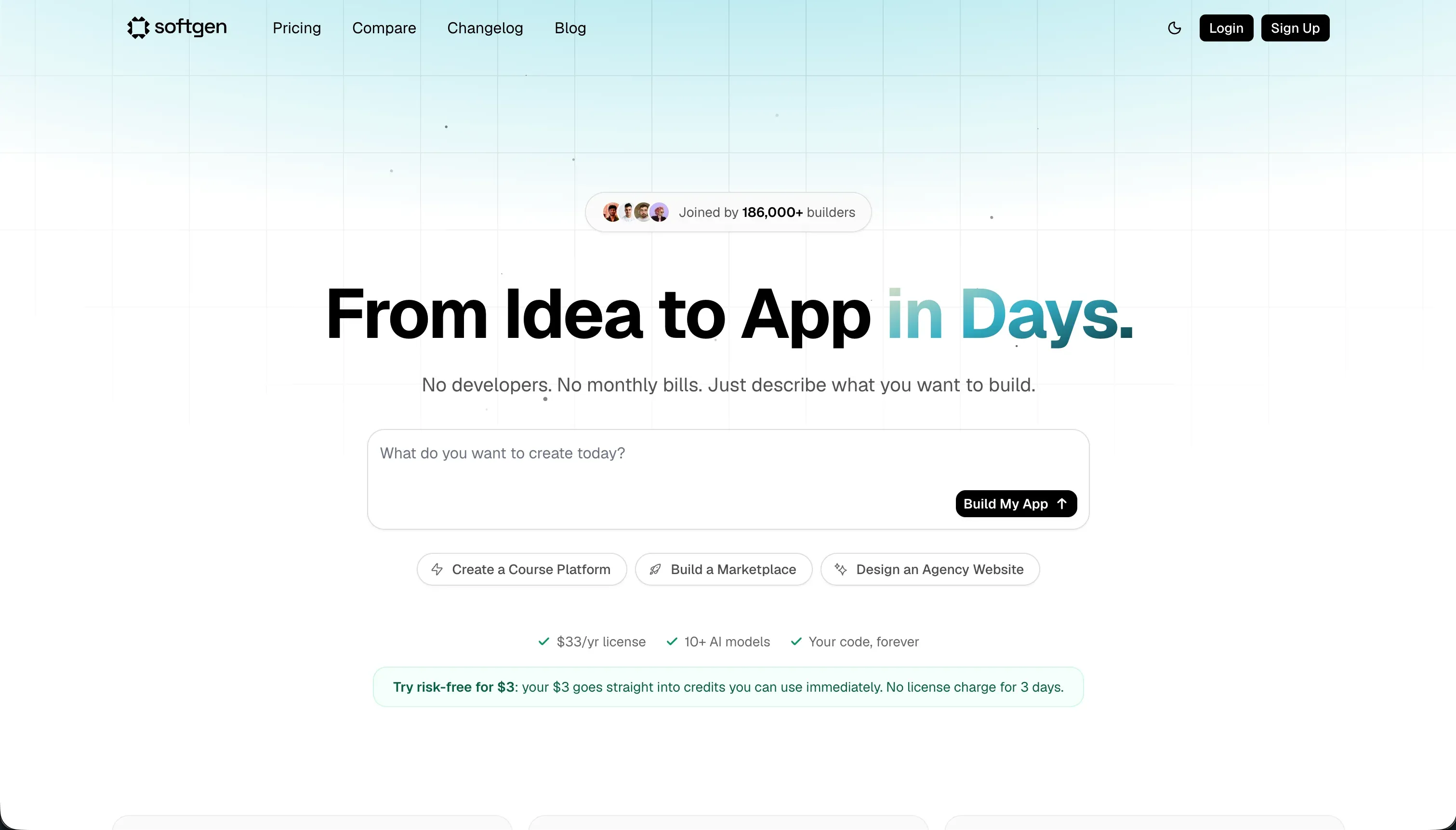
Softgen (softgen.ai) is a conversational AI application builder. Its core interface is the Cascade AI Agent, a structured chat workflow that collaborates with you to outline application requirements, generate database schemas, build authentication flows, and scaffold UI layouts in plain language. Rather than a drag-and-drop canvas, Softgen works through dialogue - you describe what you need, and the AI builds it. The platform handles one-click deployment to its hosting environment and allows code export for users who need to take their project off-platform.
| Spec | Details |
|---|---|
| Primary Stack | Web application (React-compatible frontend, SQLite-backed database) |
| Interface | Cascade AI Agent conversational chat |
| Primary Deployment Target | Softgen Cloud |
| Key Advantage | Low annual entry cost with full code export |
What is Bubble?
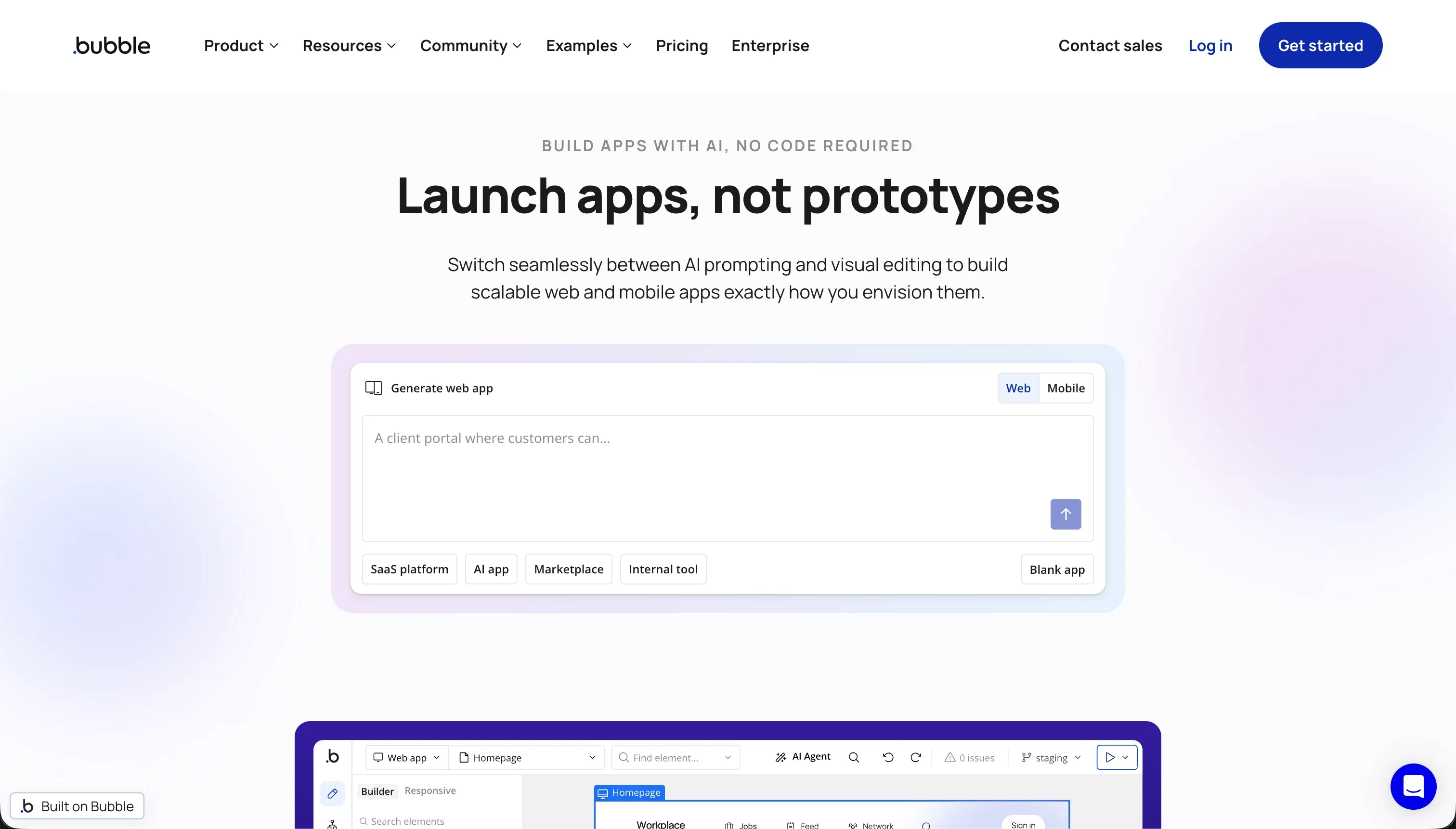
Bubble is a visual programming platform for building full-stack web applications without writing code. Unlike AI-driven generators, Bubble gives you a pixel-level drag-and-drop canvas where you manually position every element, design every database schema, and configure every workflow branch through a visual logic editor. It includes a managed relational database, server-side privacy rules, an API Connector for external integrations, and access to over 8,000 community-built plugins. Bubble hosts your application entirely on its own infrastructure - which is both a feature and a constraint.
| Spec | Details |
|---|---|
| Primary Stack | Bubble Visual Language (proprietary), Postgres-backed managed database |
| Interface | Pixel-level drag-and-drop canvas with visual workflow editor |
| Primary Deployment Target | Bubble Hosting (AWS-backed) |
| Key Advantage | Deep application logic controls and mature plugin ecosystem |
The Core Difference
The most important distinction between Softgen and Bubble is not a feature list - it’s about who controls the building process and what happens to the output.
In Softgen, the AI does the building. You describe your app, the AI generates the code, and you can take that code with you. The trade-off is that you’re relying on a conversational interface for every iteration. Fine-tuning a layout or fixing a bug means going back to the chat and hoping the AI understands your correction well enough not to break something else. When it doesn’t, and it will sometimes won’t, you need developer skills to clean up the output manually.
In Bubble, you do the building - visually. The platform gives you direct, manual control over every element, every database field, and every workflow branch. That control comes at the cost of a significant learning investment. Mastering Bubble’s responsive layout engine, relational database model, and workflow conditional logic takes weeks of dedicated study. And when you’re done, everything you’ve built lives exclusively inside Bubble’s cloud. You can export your data, but not your application. The product you spent months building is an asset you can never fully own.
Put plainly: Softgen is an AI code generator with an escape hatch. Bubble is a mature visual programming platform with no exit door.

Head-to-Head Comparison
We evaluated both platforms across four areas that matter most when choosing a tool for real projects.
1. Developer Experience & Iteration Speed
Softgen’s Cascade AI Agent offers a smooth starting experience. You describe your application concept - say, a subscription-based SaaS with user login, a dashboard, and Stripe payments - and the AI generates a structured outline before building. This planning step is useful for catching architectural gaps early. However, the real-world iteration experience is more mixed. Making precise layout adjustments through chat is slower than direct visual editing. You describe the change, the AI interprets it, rebuilds a section, and you evaluate the result. If the output is off, you describe it again. Users consistently report burning credits in loops on what should be simple visual tweaks - adjusting spacing, moving a button, changing a color - because the AI’s layout interpretation doesn’t always match the intent.
Bubble gives you direct manual control that eliminates this interpretation loop for visual edits. Want to move a button 10 pixels to the right? You just drag it. Want to change a font size? You click the element and adjust the property. The visual precision is genuinely excellent. The challenge is the editor’s complexity and performance. Building responsive layouts in Bubble requires understanding its non-standard flexible column system. The workflow editor, while powerful, has a steep conceptual curve. And on large projects, the Bubble editor is notorious for RAM leaks and lag - users with 32GB of RAM report the editor consuming 5GB or more per browser tab, causing the interface to freeze regularly during long sessions.
For raw speed of getting something visible on screen from nothing, Softgen wins. For iterating on a complex, multi-page application with precise visual control after the initial scaffold, Bubble’s direct manipulation model is faster - once you’ve paid the learning cost.
2. Code Quality & Portability
Softgen’s code export is its strongest differentiator. The generated output is standard application code that you own outright. There’s no proprietary runtime, no custom virtual machine, no special binary format. If Softgen raised its prices tomorrow, you could take your exported code and deploy it elsewhere. This is a real, meaningful advantage for anyone building a product with long-term commercial intent.
The practical limitations are real too. Softgen’s AI-generated code can develop what reviewers describe as “technical debt at scale” - a clean initial scaffold that becomes harder to maintain and extend as requirements grow beyond the original AI-generated structure. Users who attempt significant feature additions after the initial generation often find that the AI’s code doesn’t organize cleanly enough for manual extension without developer oversight. The SelectHub analysis noted a clear trade-off between the speed of Softgen’s initial generation and the long-term maintainability of the output.
Bubble’s code portability is, frankly, zero. This isn’t a minor limitation - it’s a fundamental architectural decision Bubble made deliberately. Your Bubble application is expressed in Bubble’s proprietary visual language, which can only run inside Bubble’s hosted runtime. The database schemas, workflow logic, and visual layout definitions have no equivalent in any standard framework. If you need to switch hosting providers, add a feature that Bubble can’t support, or simply stop paying Bubble’s monthly fees, your options are: stay, or rebuild from scratch. Multiple G2 reviewers and Reddit threads specifically name Bubble’s vendor lock-in as their biggest regret, particularly when pricing jumped or their app outgrew what Bubble could efficiently support.
3. Database & Backend Capabilities
Bubble’s database layer is its strongest technical asset. The managed relational database supports custom data types, record relationships, bulk operations, and a visual schema editor that non-developers can navigate after learning Bubble’s model. Crucially, the Privacy Rules system lets you define granular, server-side access controls: which user roles can see which records, which fields they can modify, and under what conditions. This is security enforced at the data query level, not just the UI level - a meaningful distinction for multi-tenant applications handling sensitive data.
That said, Bubble’s database has well-documented performance ceilings. Heavy read/write operations can cause query lag on shared hosting plans. Users have reported significant slowdowns when running complex searches across large record sets, and the standard SQL architecture isn’t designed for high-throughput real-time use cases. Bubble’s own forums and Reddit’s r/Bubbleio community contain numerous threads from developers hitting these walls and finding no affordable path forward short of Bubble’s dedicated hosting upgrades.
Softgen generates standard database schemas using AI, including basic authentication and CRUD operations. This is functional for simple applications, but the access control layer is basic compared to Bubble’s Privacy Rules. There’s no field-level visibility logic, no conditional row-level security, and no visual admin interface for managing data relationships. For any application handling more than basic user accounts and simple records, you’ll need to audit and likely extend the generated backend manually.
The plugin ecosystem gap is also significant. Bubble has over 8,000 community plugins covering payments (Stripe), maps, analytics, messaging, AI integrations, and nearly anything else you’d want to connect. Softgen includes basic integrations like Stripe payments, but its ecosystem is considerably smaller.
4. Hosting & Deployment Options
Softgen deploys applications instantly to its cloud environment with custom domain support included in the $33/year membership. The deployment process is straightforward: the AI builds, the platform hosts. If you outgrow Softgen’s hosting, you can export your code and deploy it to any standard hosting provider.
Bubble manages all hosting on its AWS-backed infrastructure. You get custom domains, SSL certificates, staging environments, and automatic scaling on higher-tier plans. The turnkey hosting is genuinely convenient - you never have to configure servers, manage SSL renewals, or set up deployment pipelines. The downside is that Bubble controls your infrastructure completely, and the cost of that infrastructure (billed through Workload Units) is opaque and difficult to forecast.
One specific Bubble risk worth naming: if your plan expires or payment fails, Bubble automatically downgrades your app to the free tier. If your app has more than 200 database records at that point - which most production apps will - it exceeds the free tier limits and displays a Bubble error screen to your users. Multiple Reddit threads document businesses losing live production traffic because of this automatic downgrade behavior.

Pricing Comparison
The two platforms have very different cost structures that suit different project types.
Softgen uses a split model:
- Annual Membership: $33/year - covers platform access and hosting rights for your applications.
- AI Credits: Pay-as-you-go packages to fund generation and iteration sessions.
The $33/year base is genuinely competitive for hosting rights alone. The variable cost is the AI credits, which can be unpredictable. Active development sessions involving multiple edits, debugging loops, and layout revisions will burn credits faster than occasional, deliberate use. Users report that the “unpredictable credit consumption” is their most frequent complaint, particularly during debugging or rebuilding sections.
Bubble uses subscription tiers with WU-based hosting:
- Free: $0 - 50,000 WUs/month, limited to 200 database records (extremely restrictive for real testing).
- Starter: $69/month - 175,000 WUs/month.
- Growth: $249/month - 250,000 WUs/month.
- Team: $649/month - 500,000 WUs/month.
The WU model is Bubble’s most significant pricing risk. Workload Units are consumed by every server-side operation: database searches, workflow steps, API calls, and scheduled jobs. Poorly optimized queries or workflows can exhaust monthly WU allocations rapidly, forcing unexpected plan upgrades. Developers on Reddit describe WU optimization as a necessary, time-consuming skill - essentially tuning your application’s server usage just to control your monthly bill.
For context, Bubble’s Growth tier at $249/month costs more annually than Softgen’s membership plus a meaningful credit budget. But Bubble also provides significantly more database capability, security controls, and a larger plugin ecosystem in return.
Use Case Fit: When to use which?
When to choose Softgen
- You want to scaffold a functional MVP from a text description in hours, not days.
- Long-term code portability matters and you want to avoid vendor lock-in from day one.
- Your project is relatively simple - a SaaS landing page, a basic CRUD app, an internal prototype.
- You have a developer available to clean up and extend the generated code if needed.
- You want a low initial financial commitment to test an idea before committing to an ongoing subscription.
When to choose Bubble
- You are building a complex, feature-rich web application with multi-step workflows, custom logic branches, and deep database relationships.
- You need production-grade privacy rules and database access controls without writing backend code.
- You want access to a mature ecosystem of plugins for payments, maps, authentication providers, and third-party integrations.
- You’re comfortable with vendor lock-in and plan to stay on Bubble’s platform long-term.
- You are willing to invest weeks learning Bubble’s visual programming system before building the application you actually need.
When neither Softgen nor Bubble is the right fit
Both Softgen and Bubble are built around specific, narrow use cases. When your project doesn’t fit their design assumptions, forcing it into either platform introduces unnecessary friction.
For native mobile apps
Bubble’s mobile support is still in public beta and is generally described as a web wrapper experience rather than a native application. Softgen’s generated code can be configured for mobile compilation, but the process requires developer skills and app store submission expertise. For serious, native mobile app development, FlutterFlow is the right tool. It provides a visual builder over Flutter’s widget engine that compiles directly to native Dart code for both iOS and Android - no wrappers, no web-to-native translations.
For internal tools and client portals
Managing generated code in Softgen is a liability when your business operations team needs to update the app regularly without developer help. Bubble’s Workload Unit billing at production scale can become expensive, and Bubble-specialized developers command high rates for ongoing maintenance. For business software like client portals, intranets, custom CRMs, or team dashboards, Softr is purpose-built for this job. Its AI Co-Builder scaffolds the full application in minutes, and then hands you a visual editor where non-technical team members can update layouts, add blocks, adjust permissions, and modify data connections without touching code or prompting an AI. SOC 2 Type II compliance and European data residency come standard.
For professional developer environments
Developers who need to write custom code, manage complex deployment pipelines, or work in proprietary languages and frameworks will find both Softgen and Bubble constraining for different reasons. Cursor is the more appropriate environment: a VS Code fork with codebase-wide indexing, multi-file AI agent editing, and full control over your local stack. Replit provides cloud-hosted collaborative development with full virtual machine access if you prefer a browser-based coding environment.

Verdict
These two tools solve genuinely different problems, which makes the choice more specific than a simple “better or worse” verdict.
Softgen is the right call when you need to validate an idea quickly, keep costs minimal, and don’t want to be tied permanently to a platform. The $33/year entry cost makes it easy to experiment. The code export means you can hand off the output to a developer later. The risk is that iterating through chat can be slow and credit-intensive, and the generated code may need significant cleanup before it’s production-ready.
Bubble is the right call when you’re building a complex application with multi-step logic, granular database access control, and a broad range of third-party integrations - and you’re committed to the platform long-term. The plugin ecosystem and Privacy Rules system are genuinely strong. The risk is vendor lock-in with no exit path, Workload Unit billing that can spike unpredictably, and an editor that has real performance issues at scale.
If code ownership and long-term cost predictability are your top priorities, Softgen’s escape hatch is worth more than Bubble’s deep feature set. If application complexity and database control matter more than portability, Bubble’s mature infrastructure justifies the lock-in.

Summary Comparison Table
| Feature | Softgen | Bubble |
|---|---|---|
| Build Paradigm | Chat-guided AI generation | Visual programming IDE |
| Output Type | Web application (exportable code) | Proprietary hosted web app |
| Database | AI-generated schemas (basic) | Managed relational DB with Privacy Rules |
| Visual Permissions | Basic user authentication | Advanced server-side Privacy Rules |
| Pricing Metric | Annual membership + pay-as-you-go AI credits | Monthly subscription + Workload Units |
| Maintenance Burden | High (developer needed for cleanup) | High (Bubble-specialist needed for optimization) |
| Code Export | Yes | No |