

Softgen and Zite both aim to let non-developers build functional web applications through AI-assisted interfaces, but they make very different architectural bets. Softgen prioritizes code portability and low base cost at the expense of editing precision and database depth. Zite prioritizes built-in data infrastructure and workflow automation at the expense of export flexibility and predictable credit costs. Understanding those trade-offs before you start building is significantly easier than switching platforms mid-project.
Meet the Contenders
Looking at where each platform came from helps explain the different capabilities they have today.
What is Softgen?
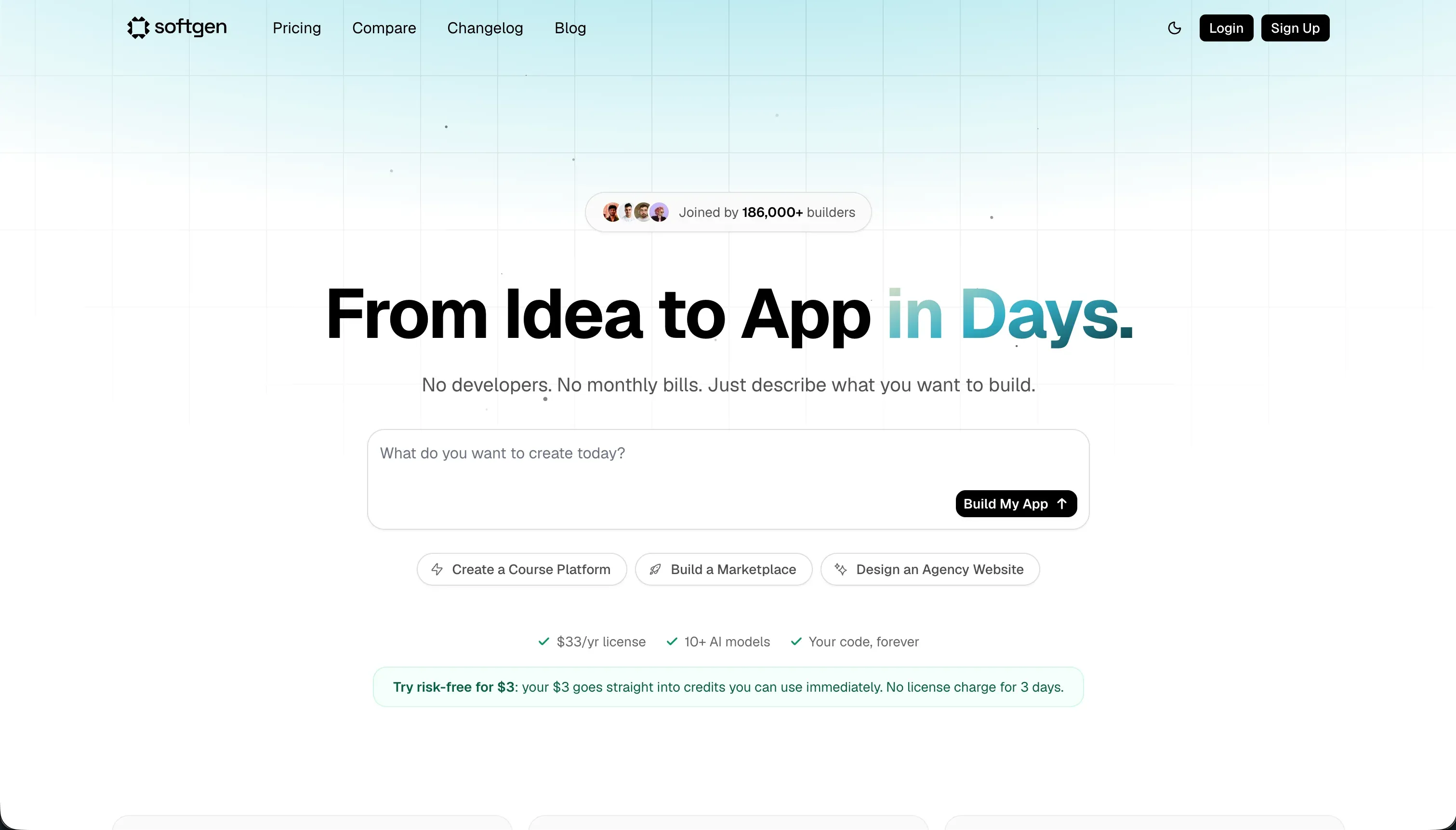
Softgen is a conversational AI application builder. Its Cascade AI Agent works with you through a chat interface to plan, architect, generate, and iterate on web applications - including user interfaces, database schemas, authentication flows, and basic integrations like Stripe payments. The entire build process runs through the AI chat, which means there is no drag-and-drop editor to fall back on when you want a precise visual adjustment. Softgen’s key positioning argument is its pricing model: a flat $33/year gives you platform access and hosting rights, making the base entry cost dramatically lower than monthly subscription competitors.
| Spec | Details |
|---|---|
| Primary Stack | Flutter (frontend), SQLite (database) |
| Interface | Conversational Cascade AI Agent (chat-based) |
| Primary Deployment Target | Softgen Cloud hosting |
| Key Advantage | $33/year base cost with code export included |
What is Zite?
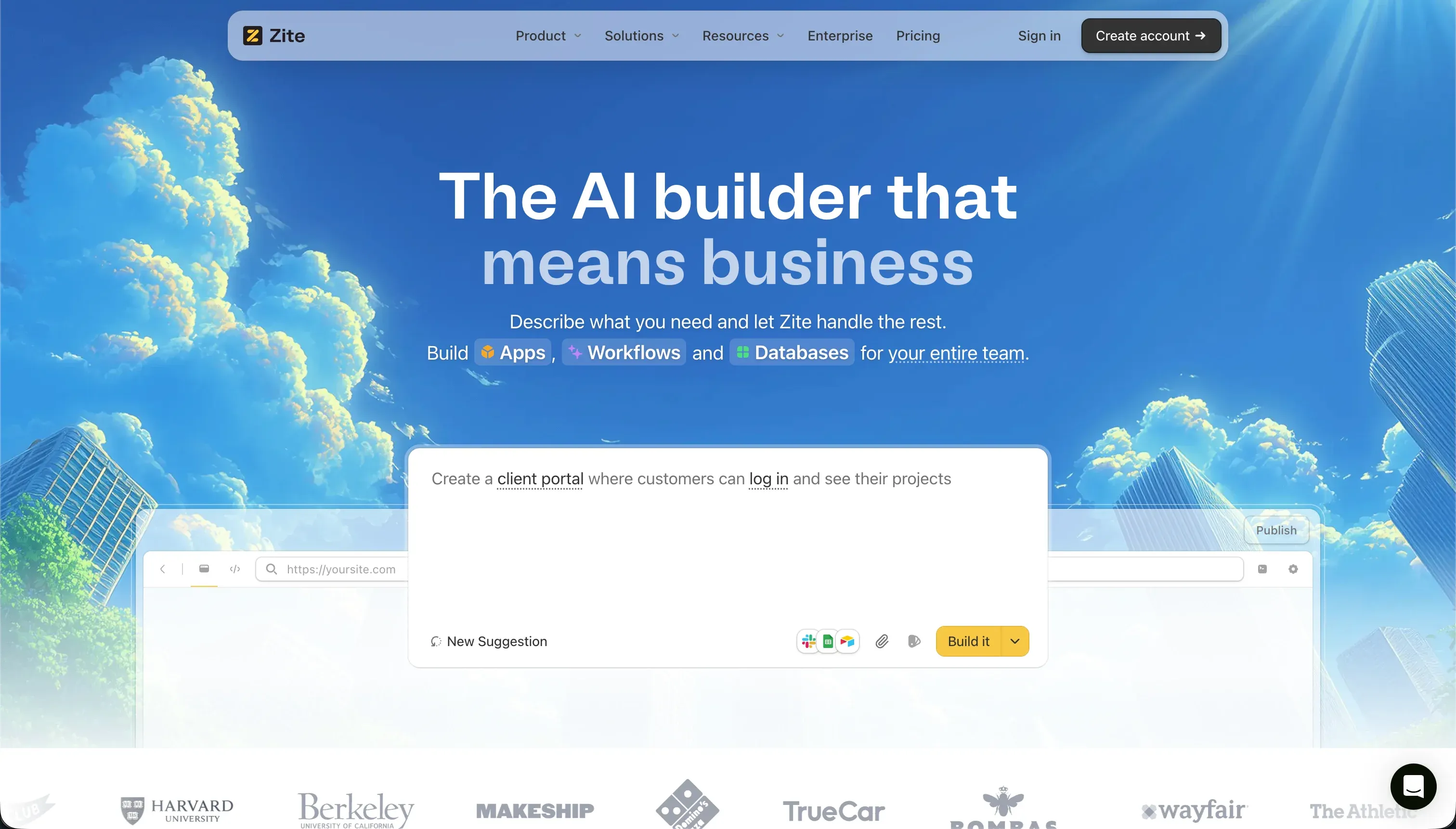
Zite is the rebrand of Fillout - a well-established form builder that has expanded into a full AI-first no-code application platform. Zite allows you to generate complete web applications from a text prompt, including the frontend interface, a relational SQL database, automated workflows, and form validation. The transition from Fillout gives Zite a mature form-building layer that is a real part of its appeal. Zite supports unlimited users on all plans, including the free tier - a practical pricing advantage for any team building collaborative tools.
| Spec | Details |
|---|---|
| Primary Stack | React frontend, built-in SQL Database |
| Interface | Prompt-to-app AI generator + visual database editor + Plan Mode |
| Primary Deployment Target | Zite managed cloud with custom domains |
| Key Advantage | Integrated SQL database with Fillout-powered forms and unlimited users |
The Core Difference
The fundamental trade-off between Softgen and Zite comes down to portability versus infrastructure.
Softgen gives you ownership of your application’s code. You can export what the AI generates and run it independently of Softgen’s platform. What you trade for that portability is a much thinner database layer, no workflow automation, and an editing experience that is entirely chat-driven. If the AI misunderstands what you want visually, your only path forward is to prompt it again - you cannot simply drag a block to the right position or adjust a spacing value in a property panel.
Zite gives you a complete operational stack out of the box: a SQL database, workflow automation, form validation, and a visual editor alongside the AI chat interface. What you trade for that infrastructure is complete vendor lock-in at the application logic level. Your database records are portable, but your pages, layouts, and workflow configurations are owned by Zite. The platform has also been known to rebrand - Fillout became Zite in 2026 - which community reviewers have flagged as a trust signal worth watching.
The choice comes down to whether code portability or database capability matters more for your specific use case. For a quick prototype you plan to hand off to a developer, Softgen’s export path makes sense. For a persistent operational database you want to run without technical help, Zite’s infrastructure is more capable - provided you are comfortable with the lock-in.

Head-to-Head Comparison
1. Developer Experience & Iteration Speed
Softgen’s initial generation speed is genuinely impressive. Describe a basic SaaS layout or a simple portal to the Cascade AI Agent, and you get a working app deployed to Softgen’s cloud in minutes. For early MVP validation - “does this basic concept work?” - the experience is smooth and fast. The experience deteriorates as soon as you start iterating beyond the initial scaffold. Because every change goes through the AI chat, tasks that would take seconds in a visual editor (move this button left, change this table’s column width, adjust this form field’s label) require prompt engineering and credit consumption. Reviewers consistently describe falling into “repetitive prompting loops” that consume credits without reliably achieving the intended visual result. The lack of a drag-and-drop fallback is the single biggest workflow friction point.
Zite handles iteration more gracefully. The “Plan Mode” feature deserves specific attention: before executing any AI-driven change, Zite generates a markdown outline of what it plans to build or modify and presents it for your review. You can approve, edit, or reject the plan before the AI touches your app. This prevents the kind of unintended layout overrides that cost users hours of recovery work in other AI builders. Beyond Plan Mode, Zite’s visual database editor - which looks and feels like a spreadsheet - is immediately accessible without prompting, allowing users to add records, edit fields, and manage data directly. This hybrid approach (AI for generation, visual tools for data management) significantly reduces the friction of day-to-day use after the initial build.
2. Code Quality & Portability
Softgen outputs exportable application code. The export path is the platform’s clearest differentiator against Zite and represents a genuine safety net for builders who are concerned about platform dependency. That said, community feedback suggests the exported code is not always production-ready out of the box. Reviews note that “customizing beyond the initial AI-generated output required some manual coding,” implying the generated codebase benefits from developer cleanup before it runs reliably in an independent environment. The platform is also explicitly described as best for simple MVPs, which implies the code complexity ceiling is lower than what a more mature no-code platform would handle.
Zite takes the opposite position: there is no code export. What you build in Zite stays in Zite. The application logic, page structure, forms, and workflow automations are proprietary to the platform. You can export your database records as a CSV or connect them to external systems via REST API and webhooks, but the front-end and business logic cannot be migrated. For teams evaluating long-term platform risk, this is the single biggest concern about Zite. The platform’s history as Fillout - a rebrand that happened in 2026 - already demonstrates that platform identity can shift quickly, and with no code export, there is no escape hatch if Zite’s direction changes in ways that do not suit your business.
3. Database & Backend Capabilities
Softgen’s database layer is thin. The AI generates basic SQLite schemas and login forms, but there are no visual database management tools, no workflow automation, no relational record linking, and no granular permission controls. For simple applications with a single data type and basic authentication, this is acceptable. For anything that involves complex data relationships, multi-user access patterns, or operational workflows, Softgen’s database is a ceiling rather than a foundation.
Zite’s database is one of the strongest in the no-code category. Built on SQL and presented as a spreadsheet-like interface, it supports linked records across multiple tables, bulk operations, undo/redo history, REST API access, and webhook integrations. The workflow automation layer adds multi-step business logic triggered by data changes or app actions - approval flows, notifications, field updates, conditional branching. This gives Zite the ability to handle genuine operational data without external tools like Zapier or Make. The stated limitations include a lack of advanced formula fields, complex rollup calculations, and custom SQL views - which matters for data-heavy analytical applications but is less relevant for standard operational databases. For most business use cases, Zite’s database is simply better than Softgen’s in every measurable dimension.
4. Hosting & Deployment Options
Both platforms handle hosting for you, which means neither requires a developer to configure a server, manage SSL certificates, or set up a deployment pipeline. For non-technical builders, this is a significant convenience.
Softgen deploys generated apps to its cloud environment immediately. Custom domain support is included, giving the app a professional URL. The hosting is managed by Softgen, which means your app’s availability depends on Softgen’s infrastructure. This is worth noting because the platform is relatively young and has a smaller infrastructure track record than established no-code platforms.
Zite’s hosting is more mature, supporting staging environments alongside production deployments and multiple custom domains on higher plans. Zite’s Pro plan includes one custom domain, and the Business plan offers unlimited custom domains. The staging environment support is a meaningful feature for teams that want to test changes before they go live - something Softgen does not appear to offer. Zite also supports scaling through its credit tier system, though the cost implications of scaling credits significantly can make it expensive for high-volume use cases.

Pricing Comparison
Softgen’s pricing model is deliberately unusual: a $33/year flat annual membership for platform access and hosting rights, plus pay-as-you-go credit packages for AI generation. On the surface, $33/year is an extraordinary price for an application platform. The catch is the credit layer. Active design iterations, debugging sessions, and feature additions all consume credits at a rate that reviewers describe as “unpredictable.” Understanding total monthly cost requires estimating your expected credit consumption, which is difficult to do before you start building. There is no published credit rate card in the research materials available, which makes direct cost comparison difficult.
Zite’s pricing is more transparent and subscription-based:
- Free: $0/month - 50 credits, 5,000 database records, 1,000 workflow runs/month, unlimited users, unlimited apps
- Pro: $15/month (billed annually) or $19/month - 100 credits, 100,000 records, 5,000 workflows/month, 1 custom domain, Zite branding removed
- Business: $55/month (billed annually) or $69/month - 200 credits, 250,000 records, 50,000 workflows/month, unlimited custom domains, AI training opt-out, advanced models
- Team/Enterprise: Custom pricing with higher caps, priority support, SOC 2 compliance
Both paid plans allow credit scaling at an additional cost: Pro can scale from 100 credits at $19/month all the way to 19,200 credits at $3,769/month. Business can scale similarly from 200 credits at $69/month to 19,200 credits at $3,799/month. The practical lesson is that Zite’s base plan prices are competitive, but any sustained high-volume building rapidly escalates costs through the credit scaling tiers.
The unlimited user model on all Zite plans is a genuine cost advantage for teams. Softgen’s per-credit consumption model means costs scale with AI activity, not with team size, which can be an advantage for a large team with infrequent edits or a disadvantage for a small team doing constant iteration.
Use Case Fit: When to use which?
When to choose Softgen
- You want to validate a concept quickly using AI-generated code and need the ability to export that code for further development.
- You are an indie hacker or solo creator building simple web apps with basic authentication and database schemas.
- You want to minimize recurring monthly costs and are comfortable working within a chat-only editing model.
- You plan to hand the generated codebase to a developer for production hardening after the initial AI scaffold.
When to choose Zite
- You want to build a database-driven application with multi-step workflows and form validation without writing code.
- You need unlimited users on a low-cost plan and do not need code portability.
- You value the Plan Mode safety net that shows you what the AI intends to change before it executes.
- You are building operational tools where Zite’s Fillout-inherited form capabilities and SQL database are a direct fit.
When neither Softgen nor Zite is the right fit
Both tools serve specific niches well, but there are common situations where neither is the right platform - and using the wrong tool for the wrong job creates more problems than it solves.
For native mobile apps (iOS & Android)
Neither Softgen nor Zite compiles native mobile packages. Softgen deploys to web. Zite builds responsive web applications. Neither produces iOS or Android binaries for app store distribution. If your use case requires native mobile delivery - with access to device hardware, offline storage, push notifications, and App Store distribution - FlutterFlow is the purpose-built tool. It provides a visual IDE over Flutter’s widget tree and codeless deployment pipelines for both Google Play and Apple TestFlight.
For internal tools and client portals
Teams building serious operational tools - with granular user permissions, multi-tenant data access, and ongoing maintenance by non-technical staff - will find both Softgen and Zite limiting in different ways. Softgen’s thin permission layer and chat-only editing are unsuitable for complex operational apps. Zite’s lock-in and basic access control limit how sophisticated a multi-role portal you can build. For this use case, Softr is the more purpose-built option. Softr provides click-to-configure user groups with conditional block, page, and button visibility; row-level database security; and a visual editor that business operators can use to update content and manage access without prompting an AI or touching code. The fact that every AI action in Softr can also be performed manually means that running low on AI credits never blocks you from maintaining your application.
For professional developer environments
Developers who want to write and extend real application code with AI assistance will quickly outgrow both Softgen and Zite. Both platforms are designed to hide the code from the user - which is appropriate for non-technical builders but frustrating for engineers who need to understand, extend, and debug the underlying implementation. Cursor is the appropriate tool for developers who want AI assistance inside their existing codebase. For cloud-based collaborative development with full virtual machine access, Replit offers an in-browser terminal environment with AI-assisted coding and backend scaling.

Verdict
Softgen and Zite serve overlapping audiences with fundamentally different approaches to application ownership.
If code export matters to you - because you want to hand off the code to a developer, because you are concerned about platform lock-in, or because you want the flexibility to self-host - Softgen is the only option of the two that gives you a genuine exit path. The credit model and chat-only editing are real limitations, but they are acceptable trade-offs for builders who treat AI generation as a scaffold for further development.
If you need a working, production-capable application that a non-technical team can maintain and operate - with real databases, workflow automation, and unlimited users - Zite is the stronger platform. The lack of code export is a significant long-term risk, but for teams that are committed to a no-code operational tool and prioritize capability over portability, Zite’s database and workflow layer is meaningfully more mature than Softgen’s.
Neither tool is ideal for complex, multi-role business portals with granular access control requirements.

Summary Comparison Table
| Feature | Softgen | Zite |
|---|---|---|
| Build Paradigm | Chat-guided AI Generator | Prompt-to-App + Visual No-Code |
| Output Type | Flutter web app (exportable) | Managed web application (no export) |
| Database | Basic SQLite (AI-generated) | Built-in SQL with linked records and workflows |
| Visual Permissions | Basic authentication only | Basic user roles and record access rules |
| Pricing Metric | $33/year + pay-as-you-go AI credits | Subscription tiers + credit-based scaling |
| Maintenance Burden | High (developer needed for code maintenance) | Low for basic apps (no code to manage) |
| Code Export | Yes (Flutter/Dart source files) | No (data export only) |