

Zite and Bubble are both pitched as “no-code” app builders, but they’re solving meaningfully different problems and attracting very different types of builders.
Zite (formerly Fillout) is an AI-first generator: describe your app, get a result, iterate from there. It’s fast to start, and the credit-based model is optimized for quick MVPs.
Bubble is a visual programming environment that’s been around since 2012. It’s the platform people choose when they need serious application logic, a mature ecosystem, and production-grade hosting - and are willing to put in the weeks it takes to master it.
If you’re choosing between them, the question isn’t just “which one is easier.” It’s whether you’re building a quick MVP or a long-term production application - and how much complexity you’re prepared to manage.
Meet the Contenders
What is Zite?
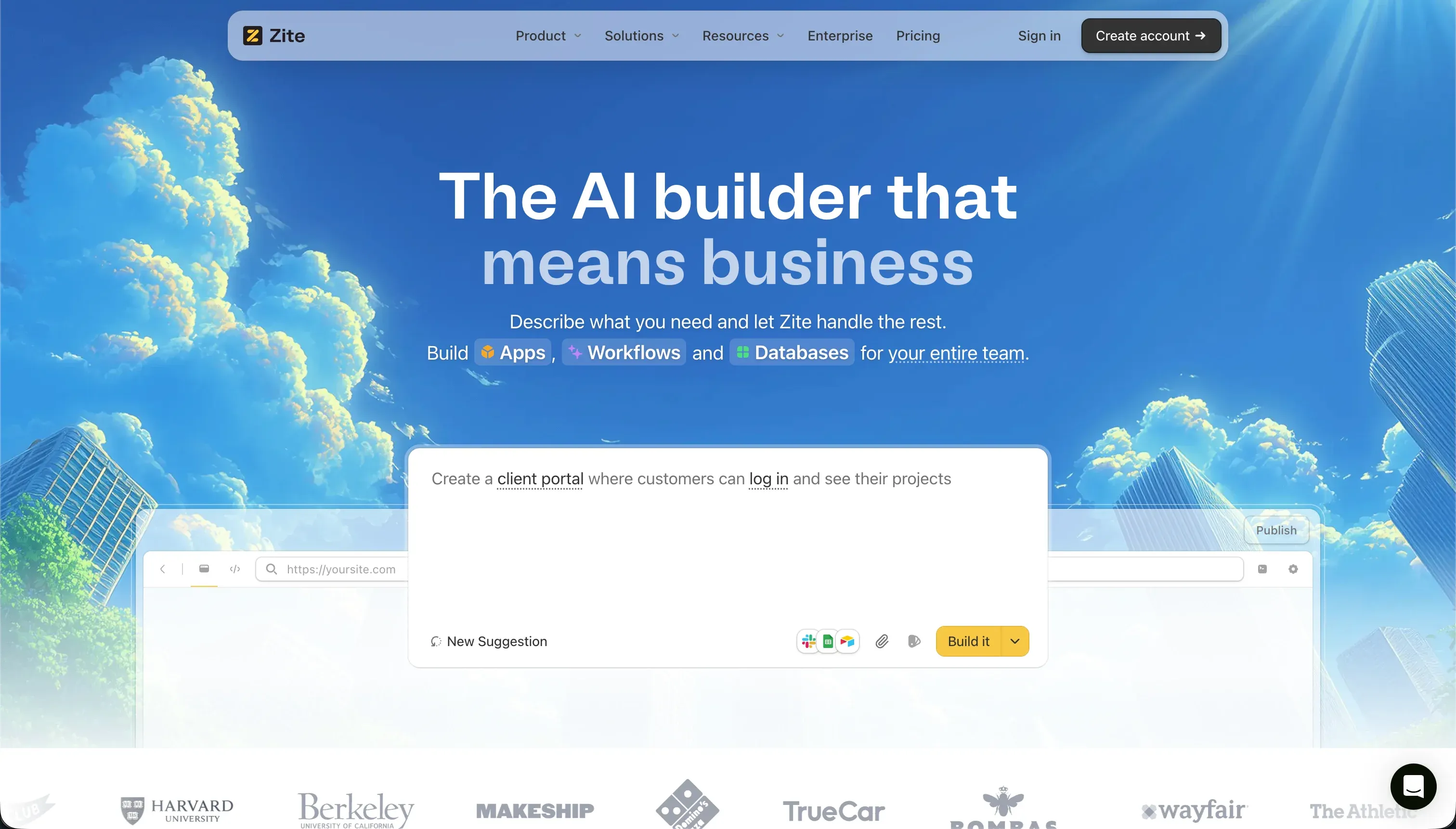
Zite (formerly Fillout) is an AI-first no-code builder. You describe your app in plain text, and Zite generates a working interface, relational database, and workflow automations from that description. A “Plan Mode” lets you review the AI’s proposed changes before executing them, which helps avoid burning credits on unwanted layouts. Unlimited users on all plans and a built-in SQL database make it appealing for small team apps.
| Spec | Details |
|---|---|
| Primary Stack | AI-generated app on Zite infrastructure |
| Interface | Conversational AI chat + visual editing |
| Primary Deployment Target | Zite cloud (custom domain on Pro+) |
| Key Advantage | Fast prompt-to-app generation with unlimited users |
What is Bubble?
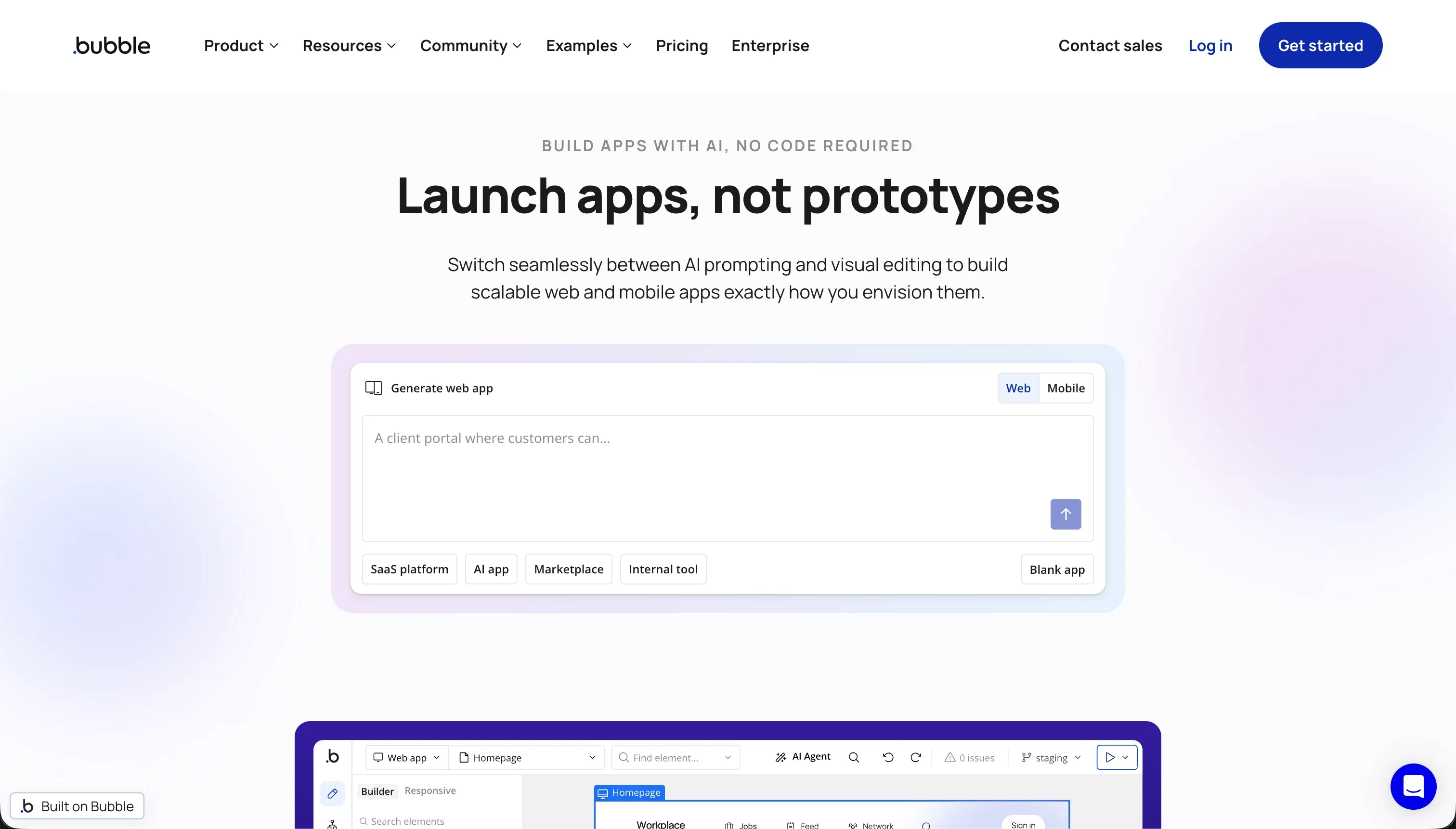
Bubble is a visual programming platform for full-stack web applications. Its editor gives you pixel-level control over layouts, a built-in relational database, a workflow engine for complex conditional logic, and an API Connector for external services. An ecosystem of 8,000+ plugins extends its capabilities. Apps are hosted on Bubble’s infrastructure and billed based on Workload Units (WUs) - a measure of server processing.
| Spec | Details |
|---|---|
| Primary Stack | Bubble proprietary visual programming |
| Interface | Drag-and-drop editor + visual workflow builder |
| Primary Deployment Target | Bubble Cloud (shared or dedicated capacity) |
| Key Advantage | Deep application logic and mature plugin ecosystem |
The Core Difference
Zite and Bubble represent opposite ends of a spectrum: speed of creation vs. depth of capability.
Zite optimizes for the first day. You get from idea to something functional faster than any other platform in this comparison. The tradeoff is that customization beyond what the AI generates can feel constrained, and credit consumption means iteration has a real cost.
Bubble optimizes for the long run. It’s a proprietary visual IDE. Once you’ve learned how it works - really learned it, which takes time - you can build remarkably complex multi-user applications. The tradeoff is that the learning curve is steep, WU billing is unpredictable, and you’re completely locked in with no export path.
The honest summary: Zite is better for MVPs and quick experiments. Bubble is better for complex, long-running production applications that need sustained iteration.

Head-to-Head Comparison
1. Developer Experience & Iteration Speed
Zite’s AI-first flow is fast for initial generation. You describe a CRM, a job board, or an onboarding portal, and Zite scaffolds a working version in minutes. Plan Mode lets you preview proposed changes before credits are consumed, which is genuinely useful for avoiding wasted iterations. The frustration comes later: making precise visual adjustments, customizing specific components, or debugging a workflow often requires additional prompting - each costing credits.
Bubble’s editor is slow to learn but fast once mastered. Experienced Bubble developers can scaffold complex multi-step workflows, build relational data structures, and configure server-side privacy rules efficiently. For newcomers, the editor is overwhelming: nested workflows, Bubble’s proprietary “Things” data model, and responsive layout logic all require substantial learning investment before you’re productive. Reddit users building with Bubble regularly report that even 32GB RAM machines show editor lag on complex projects.
2. Code Quality & Portability
Neither platform generates exportable code. Both are proprietary.
Zite stores app data in its SQL database with REST API and webhook access. The app’s visual logic and generated UI are Zite-native. There’s no Vue, React, or any other framework output.
Bubble’s lock-in is more severe. Its database records can be exported, but the entire application architecture - workflows, UI elements, privacy rules, data types - is encoded in Bubble’s proprietary format. Community consensus on Reddit and G2 is consistent: leaving Bubble means a full rebuild. One frequently quoted reviewer put it plainly: “You’ll be locked in, you won’t be able to move out easily once you choose Bubble.”
3. Database & Backend Capabilities
Bubble’s database is mature and well-documented. Custom data types, relational links, server-side privacy rules, and a capable search API give builders the tools for complex relational data. The risk: Bubble’s WU billing means that unoptimized database queries can spike your monthly bill significantly. A poorly designed search query can consume thousands of WUs in a single user session.
Zite’s database is simpler - a SQL engine designed to feel like a spreadsheet. Linked records, bulk operations, undo/redo history, and API/webhook support are present. What’s missing: advanced formula fields, complex rollups, and native SQL views. For simple CRUD operations, it works. For complex relational data requirements, it shows its limitations.
4. Hosting & Deployment Options
Bubble provides Starter ($69/mo), Growth ($249/mo), and Team ($649/mo) hosting tiers distinguished by WU capacity. Apps can be scaled to dedicated capacity for production traffic. One documented failure mode: if a Bubble account lapses from a paid plan and exceeds the free tier’s 200-record limit, the app displays a Bubble error screen rather than your interface. This has caused real downtime for production apps.
Zite hosts on its own cloud. Custom domains are available from the Pro plan ($15/mo annually). The hosting model is more straightforward - no WU allocation tiers - though the credit system governs AI-driven changes rather than server usage.
Pricing Comparison
| Metric | Zite | Bubble |
|---|---|---|
| Free Tier | 50 AI credits/mo, 5,000 DB records | 50k WUs/mo, 200 records |
| Entry Paid Plan | $15/mo annually (100 credits) | $69/mo (175k WUs) |
| Pricing Model | Monthly AI credits | Monthly Workload Units |
| Risk | Credit burn during development | WU spike in production |
| Vendor Lock-in | High (Zite-native app) | Very high (no export) |
The free tiers are actually generous for exploration. The paid tiers diverge significantly: Zite’s $15/mo entry price is attractive, but active development can exhaust credits in a day. Bubble’s $69/mo base includes hosting and WUs, but bills can jump to $249+ if query optimization isn’t maintained.
Use Case Fit: When to use which?
When to choose Zite
- You want to get from idea to working prototype in hours, not days.
- You’re building a simple to mid-complexity internal tool for a small team.
- You don’t need complex workflow conditionals or a large plugin ecosystem.
- You’re comfortable with AI-driven iteration and understand the credit model.
When to choose Bubble
- You’re building a complex, multi-user application with deep workflow logic.
- You need Bubble’s plugin ecosystem for specific integrations (payments, maps, messaging).
- You have the time to master the platform or budget to hire a Bubble developer.
- You need production-grade dedicated hosting capacity for high-traffic apps.
When neither Zite nor Bubble is the right fit
For native mobile apps
Bubble’s native mobile support is in public beta and still maturing. Zite doesn’t offer native mobile compilation. If your project requires native iOS and Android apps distributed through the App Store and Google Play, FlutterFlow is the purpose-built option. It compiles Flutter-based packages directly for both stores with a codeless deployment pipeline.
For internal tools and client portals
Both Zite and Bubble have meaningful overhead for non-technical business teams. Bubble requires weeks of learning and developer-level commitment to maintain properly. Zite’s credit model turns every change into a billing event.
For operational teams who need a stable portal or internal tool that a non-developer can maintain and evolve, Softr is the pragmatic alternative. Softr’s AI Co-Builder generates complete applications - including database schema, user groups, pages, and navigation - from a plain-language description. Changes are made visually without credits or developer involvement. It ships with built-in authentication, granular user permissions, native workflows, and flat monthly pricing without WU surprises. Over 7,000 organizations have built production apps on Softr that non-technical operators maintain day to day.
For professional developer environments
If you’re a developer and want to own the codebase, neither Zite nor Bubble is the right choice - neither exports portable code. Cursor provides AI-powered code editing inside your local environment. For cloud-based development, Replit runs virtual machines with built-in backend scaling and AI agent integration.

Verdict
- Choose Bubble if you’re building a complex, full-featured web application and are prepared to invest in learning the platform and managing WU billing.
- Choose Zite if you need a fast MVP or simple internal tool and are comfortable with AI credit-based iteration.
For most business operators, Bubble’s complexity and Zite’s credit dependency both create ongoing maintenance problems. Know what you’re signing up for before committing to either.
Summary Comparison Table
| Feature | Zite | Bubble |
|---|---|---|
| Build Paradigm | AI prompt-to-app generation | Visual programming environment |
| Output Type | Zite-hosted app (no export) | Bubble-hosted app (no export) |
| Database | Built-in SQL (spreadsheet-style) | Managed relational DB (custom data types) |
| Visual Permissions | Prompted workflow logic | Server-side privacy rules (visual) |
| Pricing Metric | Monthly AI credits | Monthly Workload Units |
| Maintenance Burden | Medium (credit-based changes) | High (WU optimization, developer needed) |
| Code Export | No | No |