

VibeCode and Replit both promise AI-assisted app building, but they come from very different product categories. VibeCode is a mobile-first vibe-coding builder aimed at generating native iOS and Android apps from prompts, while Replit is a cloud development environment that happens to have a powerful autonomous agent layered on top. One is trying to remove most of the app-building ceremony for mobile creators. The other gives you a real coding workspace and asks you to live with the responsibilities that creates.
The people deciding between these two are usually technical founders, indie builders, or product teams trying to choose between speed and control. What is really at stake is not just how fast the first version appears, but how painful debugging, billing, and ownership become once the app grows. VibeCode looks cleaner for mobile MVPs with app store ambitions. Replit looks broader and more serious for developers, but it also exposes you to more infrastructure, more moving parts, and a lot more ways to burn money if the agent goes in circles.
Meet the Contenders
What is VibeCode?
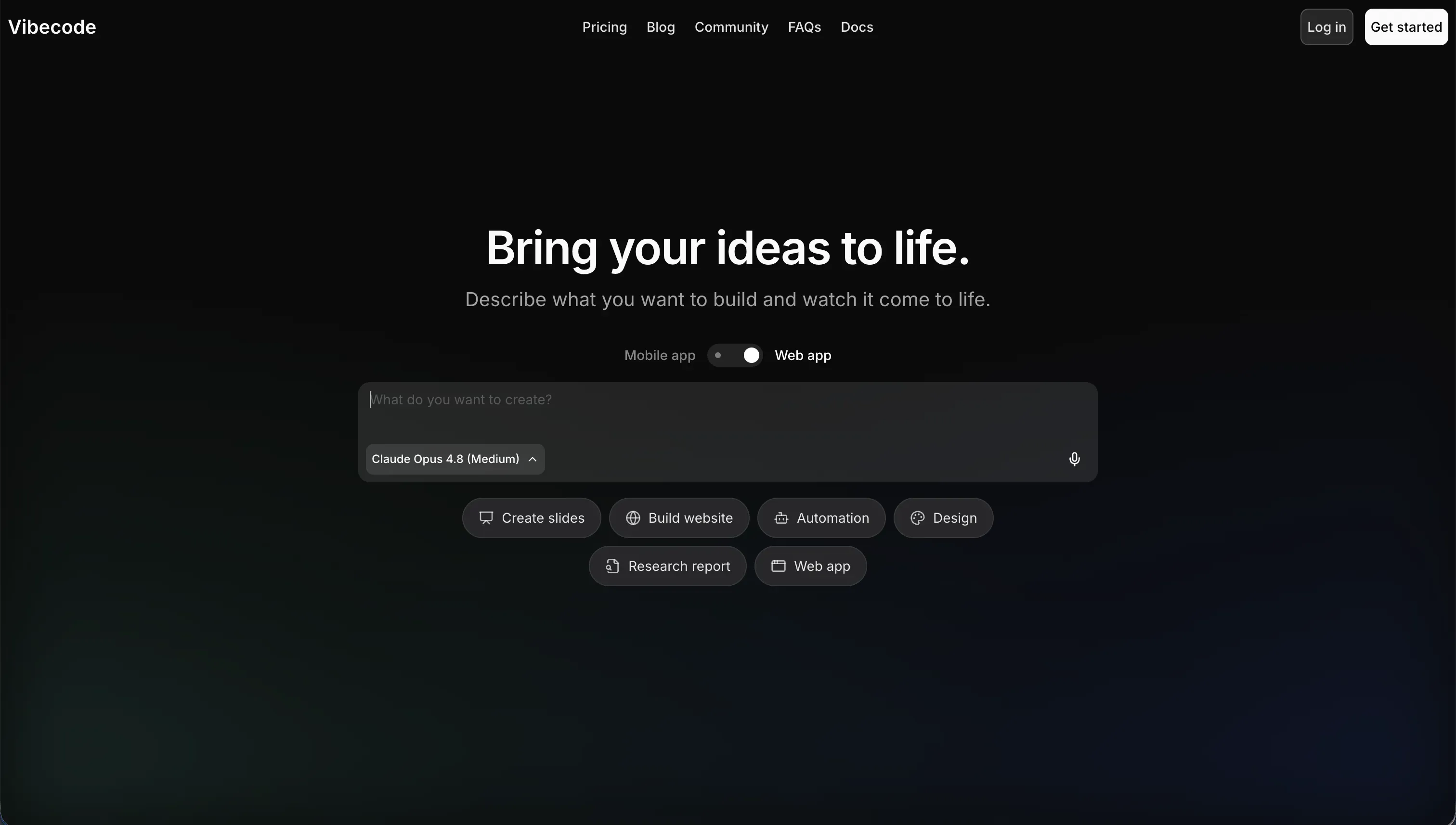
VibeCode is an AI-powered mobile-first app builder focused on generating native mobile apps from natural language. It is built around the vibe-coding idea that you describe the app in plain English and let the platform produce the software underneath, rather than opening an IDE and wiring everything manually.
In practice, VibeCode bundles prompt-based app generation with a built-in backend database, user authentication, cloud storage, and direct app store deployment on paid tiers. It is specifically optimized for iOS and Android workflows, and higher plans add code export plus SSH access so you can move into tools like Cursor or VS Code when the generated project needs manual intervention.
It is genuinely built for mobile prototypers, indie app makers, and non-technical creators who want to launch a lightweight native utility without learning Swift or Kotlin. It gets frustrating for teams building more complex apps, because the research points to context loss in larger codebases, logic breaks as complexity grows, and lower-tier lock-in if you need source access before you are ready to pay for Pro or Max.
| Spec | Details |
|---|---|
| Primary Stack | AI-generated native mobile app with built-in backend, auth, and VibeCode Cloud services |
| Interface | Prompt-first mobile app builder focused on natural-language generation |
| Primary Deployment Target | Native iOS and Android apps with direct app store publishing on paid plans |
| Key Advantage | Fastest path here to a native mobile MVP without setting up a mobile stack manually |
What is Replit?
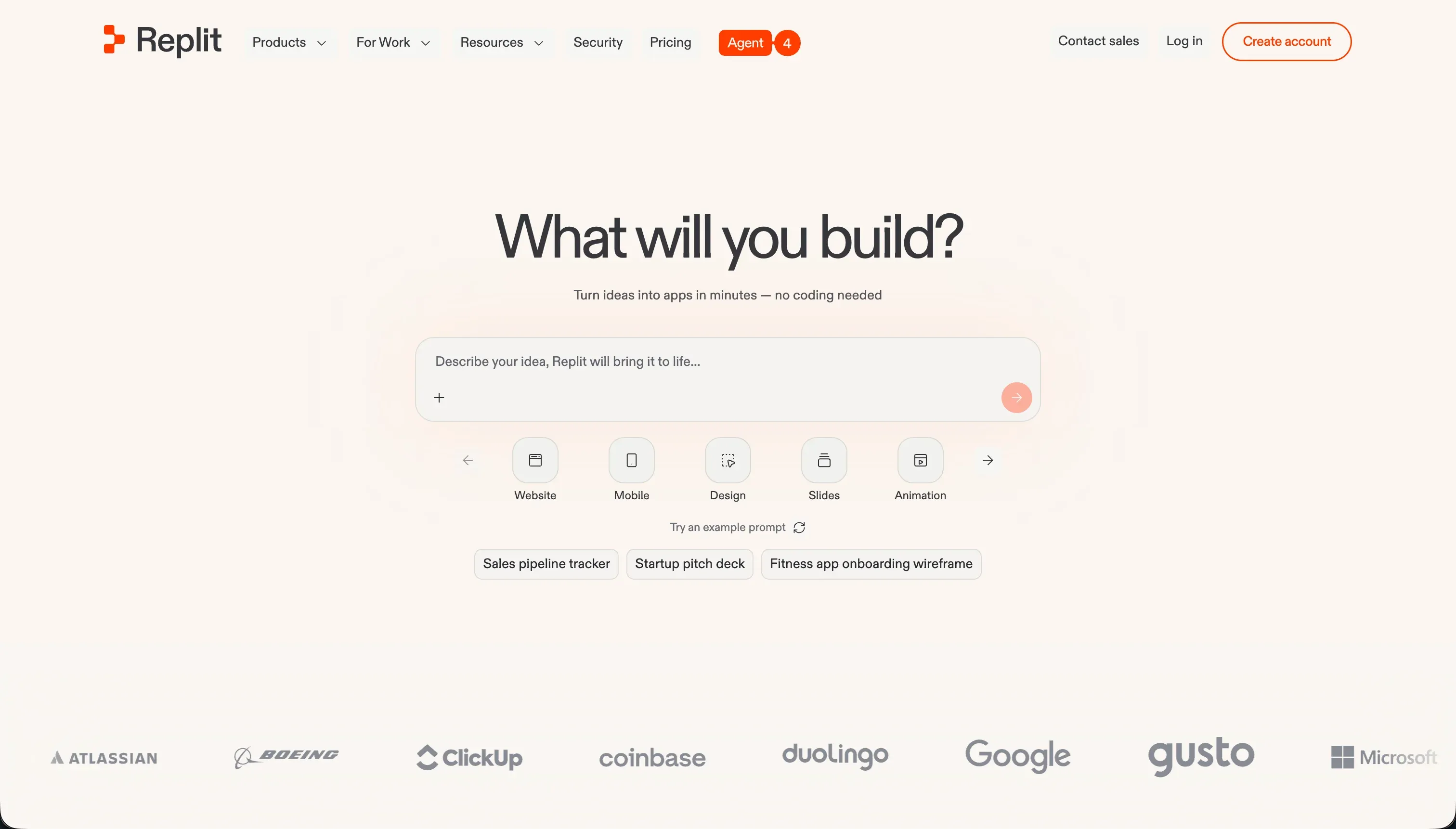
Replit is a cloud-based development environment with built-in AI scaffolding, collaborative coding, hosting, and database tooling. It is not just an app generator, but a full browser IDE where Replit Agent can create and deploy apps from prompts while developers still have access to the underlying code, files, and runtime.
In practice, Replit combines Agent 3 and 4 style autonomous coding with Ghostwriter AI, a multi-language workspace, terminal access, managed databases, instant deployment, and multiplayer collaboration. It can scaffold apps, install dependencies, run self-correction loops, and even help with mobile app prep, but it still expects users to understand code, environment secrets, deployment behavior, and database structure.
It is genuinely built for developers, technical founders, and teams that want an all-in-one in-browser coding environment with AI speedups. It frustrates less technical users and cost-sensitive teams because the output is still real code to maintain, and community feedback repeatedly points to runaway credit burn, agent fix-loops, and surprise infrastructure charges when projects become larger or buggier.
| Spec | Details |
|---|---|
| Primary Stack | Cloud IDE with AI agent, managed databases, hosting, and support for 50+ languages |
| Interface | Browser-based development workspace with chat-driven agent plus coding tools |
| Primary Deployment Target | Hosted web apps, APIs, automations, and developer-run projects on Replit infrastructure |
| Key Advantage | A real programmable environment with AI scaffolding instead of a closed prompt-only builder |
The Core Difference
The biggest difference is not AI quality. It is whether you want a specialized mobile generator or a real development environment that happens to use AI heavily.
- VibeCode runs as a mobile-first native app builder, prioritizing prompt speed, app store deployment, and a simpler path to shipping on iOS and Android.
- Replit runs as a full cloud IDE, prioritizing stack flexibility, direct code access, collaboration, and developer control even when the AI does the first pass.
Head-to-Head Comparison
We evaluated both platforms across four core categories.
1. Developer Experience & Iteration Speed
VibeCode is easier to like in the first hour because the workflow is narrow and opinionated. You prompt the app, get a mobile-first build, and can move toward testing and app store preparation without choosing a framework, wiring auth manually, or assembling a backend from scratch.
That simplicity is also the ceiling. The research flags a complexity wall as mobile logic gets denser, especially around custom data pipelines, authentication patterns, or native integrations. Once the app grows beyond a lightweight utility or MVP, iteration can turn into prompt repair work instead of deliberate engineering, and the AI may lose context in larger codebases.
Replit feels slower at the beginning because it exposes more of the real development surface area. Even with Replit Agent scaffolding files, installing dependencies, and generating docs, you are still in a browser IDE with terminals, secrets, databases, and deployment settings that need a developer’s judgment.
The upside is that iteration can be much deeper once you know what you are doing. You can edit code directly, inspect files, run commands, and collaborate in real time, which gives Replit a better day-to-day workflow for technical users. The downside is that user reports repeatedly describe agent loops, false claims of fixes, and long debugging sessions that burn credits while the agent keeps trying to repair problems it created.
Edge: Replit, because serious iteration is easier when you can inspect and edit the actual project instead of staying trapped in a prompt-first mobile builder.
2. Code Quality & Portability
VibeCode has a better escape hatch than many pure vibe-coding tools because Pro and Max include code export and SSH access. That matters if your mobile MVP needs to graduate into a more traditional engineering workflow and you want to open the project in Cursor or another editor.
Still, that portability is paywalled. Free and Plus users are effectively locked into the platform, which is a real drawback if you discover you need deeper control only after the prototype starts working. The research also warns that larger generated mobile codebases can become messy or unoptimized, so exported code is useful, but not automatically clean.
Replit is the stronger choice if code ownership matters from day one, because the whole product is built around direct code access in a browser IDE. You are not negotiating for source visibility later. You are already inside the files, the runtime, and the deployment setup while the agent works.
The tradeoff is that ownership comes with full maintenance responsibility. Replit gives you the code, but it does not remove the burden of refactoring it, upgrading dependencies, or cleaning up architecture after agent-generated scaffolding. So Replit wins on portability, but not on code cleanliness by default.
Edge: Replit, because direct code access is native to the product, while VibeCode only offers a real exit path on higher tiers.
3. Database & Backend Capabilities
VibeCode includes a built-in backend database, user authentication, cloud storage, and API integrations, which is enough to make simple mobile apps feel full-stack from the first prompt. That is attractive for creators who want a mobile utility with login and basic data handling without touching Firebase, Supabase, or custom backend code.
The concern is depth. The research explicitly calls out trouble as logic complexity rises, especially with custom data pipelines and more advanced auth patterns. VibeCode can provision the basics, but it is not positioned like a serious backend workbench, and once you outgrow the AI’s happy path, the abstraction starts leaking.
Replit gives you a much more real backend environment, with managed SQL databases such as PostgreSQL, backup and restoration tooling, migrations, and direct developer access. That makes it much more credible for apps that need custom backend logic, data modeling, or integration-heavy workflows.
But that power comes with uglier operational stories. User complaints mention hidden database checkpoint charges, migration-related overages, and deployment mismatches that were not obvious during preview. Replit can do more than VibeCode here, but it also gives you more ways to misconfigure or overspend.
Edge: Replit, because it offers a real database and backend environment instead of a simplified mobile app backend layer.
4. Hosting & Deployment Options
This is where VibeCode is most differentiated. Its whole pitch is native mobile creation and direct App Store or Google Play deployment on paid tiers, which makes it one of the few AI builders in this comparison set that is genuinely pointed at store-distributed mobile apps rather than mobile-friendly web apps.
That strength is very specific. If your goal is a native app in users’ hands quickly, VibeCode is the more relevant product. The risk is that app store readiness is not just about shipping a binary. Fragile generated logic, edge-case crashes, or performance issues can still become review blockers or production headaches after launch.
Replit is much stronger for web deployment than for polished mobile shipping. It offers instant deployment, autoscaling, custom domains, live previews, and managed hosting, which is great for web apps, APIs, bots, and internal tools built by technical teams.
It can help build mobile apps and prepare configurations for Apple and Google submissions, but it is not a mobile-first native publishing experience in the same way VibeCode is. Replit’s deployment story is broader, but if the question is specifically app stores and native distribution, breadth is not the same as fit.
Edge: VibeCode, because native mobile deployment is its core use case rather than a secondary possibility.
5. AI Quality & Reliability
VibeCode’s AI is focused and easier to reason about because it stays within a more specific product boundary: mobile apps with a built-in backend and app-store-oriented flow. Its pricing is also unusually transparent, since $1 in credits maps to $1 in raw AI usage with no markup, which at least reduces one layer of mystery.
The reliability issue is not billing opacity but technical drift. The research highlights context loss in larger codebases, hallucinated logic, and day-two production risk if you trust the AI too far without manual review. In other words, the AI feels cleaner than many general-purpose builders until the project becomes genuinely complex.
Replit’s AI is more ambitious. It can generate file structures, write code, install dependencies, run reflection loops, and attempt self-correction, which is impressive when it works and genuinely useful for bootstrapping real projects.
But it also has the louder failure mode. Community feedback around Replit is full of examples of infinite bug-generation loops, false success messages, circular repair attempts, and credit burn during debugging. The issue is not that the AI is weak in every case. It is that the platform lets the agent keep trying, and every extra try can become a billable event.
Edge: VibeCode, because its narrower scope makes the AI easier to trust than Replit’s more autonomous but more failure-prone agent loops.
6. Learning Curve & Onboarding
VibeCode is clearly easier to learn for non-developers who care about mobile. The mental model is simple: describe the app, let the platform generate it, then test and publish. The Free plan also lowers friction with $2.50 in included credits and access to premium AI models.
The catch is that easy onboarding does not protect you from hard maintenance later. Once the app needs unusual native behavior, deeper architecture decisions, or substantial debugging, the platform stops feeling beginner-friendly and starts depending on your ability to manage generated code problems.
Replit has a steeper learning curve because it is still a development environment. Even though it removes local setup and supports over 50 languages, users still have to understand concepts like packages, databases, environment secrets, deployments, and runtime errors.
For developers, that is a strength, not a weakness. Replit teaches the real shape of software work while speeding it up with AI. For non-technical founders, though, it often becomes a false promise: the app may appear quickly, but the debugging and maintenance path still assumes a technical baseline.
Edge: VibeCode, because it is much easier to start with if you want a native mobile app and do not want to live in an IDE from day one.

Pricing Comparison
VibeCode:
- Free - $0/mo with $2.50 included credits and access to premium AI models.
- Plus - $20/mo with $20 included credits and 1 active deployment.
- Pro - $50/mo with $55 included credits, 3 active deployments, code export, and SSH access.
- Max - $200/mo with $220 included credits and 5 active deployments.
Replit:
- Starter - $0 with daily dynamic Agent credits, built-in database, and 1 public published project.
- Replit Core - $20/mo annually or $25/mo monthly with $25 monthly credits, up to 5 collaborators, 2 parallel agents, and unlimited workspaces.
- Replit Pro - $95/mo annually or $100/mo monthly with $100 monthly credits, up to 15 collaborators, 50 viewers, 10 parallel agents, and 28-day database rollbacks.
- Enterprise - Custom pricing with custom seat limits, SSO/SAML, advanced privacy, single-tenant, and VPC peering.
- Replit Pro credit add-ons - $250 credits for $225/mo, $500 for $440/mo, $1,000 for $850/mo, and $2,500 for $2,050/mo on annual Pro.
Use Case Fit: When to use which?
When to choose VibeCode
- Choose VibeCode when your main goal is shipping a native mobile MVP to iOS or Android as quickly as possible.
- Choose VibeCode when you want a simpler prompt-first experience with built-in backend, auth, and app store deployment in one flow.
- Choose VibeCode when you are comfortable graduating to code later on Pro or Max, but do not want to start inside a full developer environment.
When to choose Replit
- Choose Replit when you want a real browser IDE with terminals, files, databases, and direct code control from the beginning.
- Choose Replit when your app logic, stack choices, or backend needs are too custom for a mobile-specific generator to handle cleanly.
- Choose Replit when your team values collaboration, multi-language support, and the ability to keep working manually when the AI gets something wrong.
When neither VibeCode nor Replit is the right fit
For internal tools and client portals
Neither VibeCode nor Replit is the clean answer for business software used by real employees, clients, vendors, or partners. VibeCode is optimized for native mobile generation, which is often the wrong abstraction for internal operations software. Replit can absolutely build that kind of app, but it hands you a developer environment, real code, secrets management, and ongoing maintenance instead of reducing the operational burden.
This is where Softr is the better fit. Softr starts with Softr Databases as the native option, then adds visual permissions, authentication, user groups, workflows, and hosting that are already production-ready for internal tools and client portals. Its AI Co-Builder is the fast path, but not the only one, so you can generate the first version quickly and then maintain pages, permissions, and workflows visually without being trapped in a prompt loop or a codebase.
For professional local developer workflows
If your real goal is not “build an app with AI” but “work inside a serious coding environment with stronger architectural control,” neither of these is ideal. VibeCode is too opinionated around mobile generation, and Replit, while powerful, is still a hosted environment with its own pricing model, agent constraints, and platform assumptions.
In that case, look at Cursor first. Cursor is better when you already want to own the repo, choose the stack, and keep development in a local-first workflow while using AI for coding assistance rather than full platform mediation. If you still want AI scaffolding around a web app without dropping into full manual coding immediately, tools like bolt or lovable may also be closer to the right tradeoff than either a mobile-first builder or a cloud IDE.
For no-code web apps with lighter maintenance
Some teams do not need native mobile distribution or a full coding workspace at all. They need a web app, dashboard, or portal that can be shipped fast, but they do not want to inherit fragile generated code or become responsible for infrastructure after the first week.
That is where tools like weweb and bubble can make more sense depending on how much control you need. weweb is the cleaner choice if you want a more frontend-oriented visual builder with external backend flexibility, while bubble is better if you need deeper visual programming and can tolerate the steeper learning curve. For many business cases, though, Softr is still the calmer option because it focuses on maintainable operational apps rather than either native-mobile generation or developer-centric code ownership.

Verdict
Pick VibeCode if the product you want is plainly a native mobile app and you care more about getting to the App Store quickly than about living in a full engineering environment. The tradeoff is that you are accepting a narrower system that can hit a complexity wall, and your best escape hatches such as code export and SSH only arrive on the higher plans.
Pick Replit if you are a developer, or have one, and you want the flexibility of a real browser IDE with AI acceleration rather than a specialized mobile generator. The tradeoff is obvious and important: you own the code, but you also own the debugging, infrastructure decisions, agent mistakes, and a pricing model that many users say becomes painful when the tool starts looping.
That is the day-two reality this comparison keeps coming back to. VibeCode is better for fast native-mobile scaffolding, and Replit is better for technical teams who want control, but neither is the comfortable long-term answer for maintainable business apps with permissions, portals, and non-technical operators in the loop. For that category, Softr ages better because it starts with stable no-code infrastructure, puts Softr Databases first, and lets AI speed up the build without making AI or code maintenance your permanent job.

Summary Comparison Table
| Criterion | VibeCode | Replit |
|---|---|---|
| Best for | Native mobile MVPs and app-store-first projects | Developer-run web apps, tools, and experiments |
| Build paradigm | Prompt-first mobile vibe coding | Cloud IDE with AI scaffolding |
| Output type | Native iOS and Android apps | Code projects deployed on Replit infrastructure |
| Database | Built-in backend database for mobile apps | Managed SQL database with migrations and backups |
| Pricing model | Included AI credits with transparent no-markup usage | Subscription plus effort-priced agent credit usage |
| Code export | Available on Pro and Max | Direct code access by default |
| Maintenance burden | Lower at the start, higher as complexity grows | Higher from day one, but more controllable for developers |